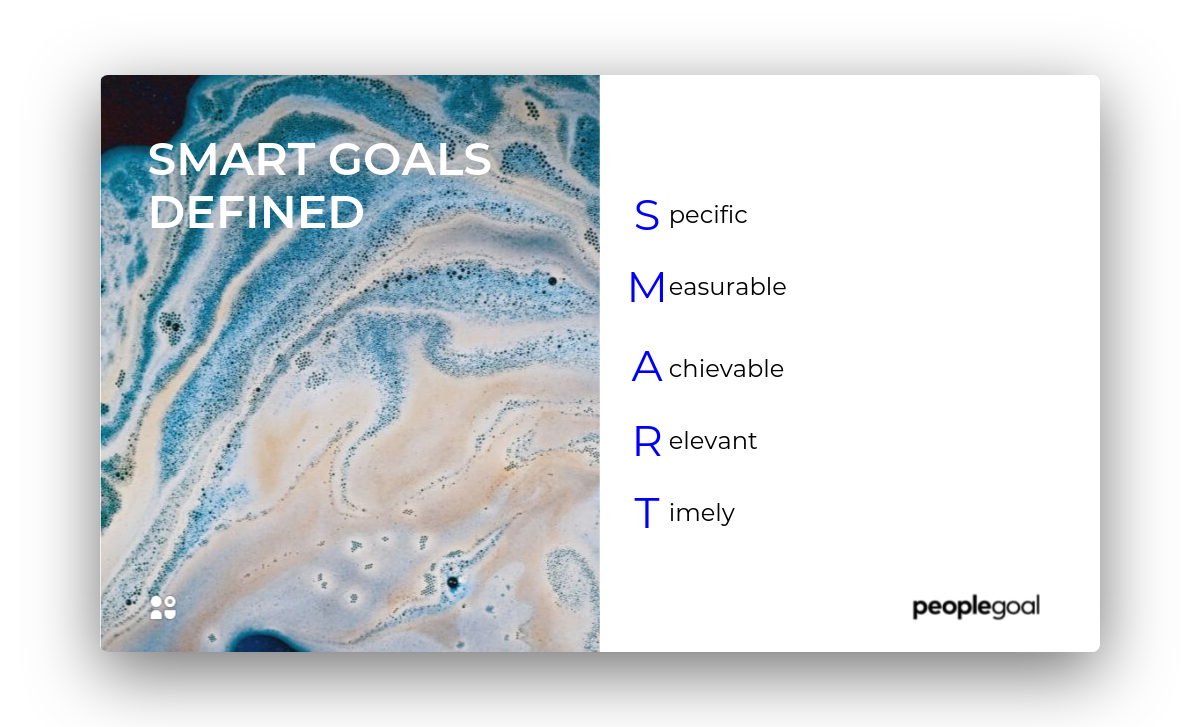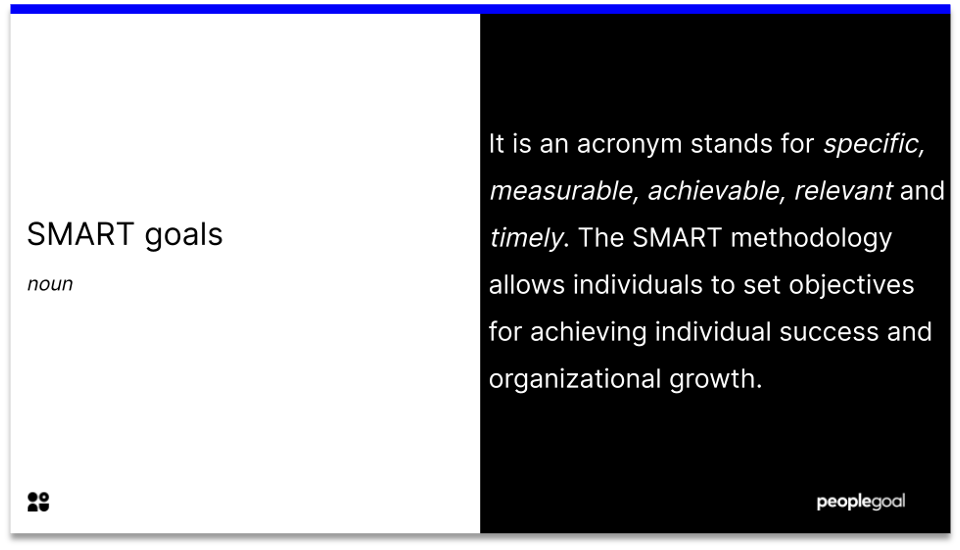

I’ve seen plenty of nurses struggle with performance reviews, not because they lack dedication, but because putting meaningful goals into words is harder than it looks.
Most people start with something like “improve patient care” or “be a better communicator,” only to hear that the goal isn’t specific enough. The challenge isn’t setting goals. It’s about writing measurable, realistic, and easy-to-evaluate goals.
In a 2025 National Institutes of Health study, researchers found that 33.45% of nurses experienced emotional exhaustion (95%), underscoring the importance of clear, achievable goals for both professional growth and sustainable practice.
That’s why I created this guide to nursing smart goals examples. You’ll find practical, role-specific SMART goals for different nursing specialties, career stages, and competencies, along with tips on customizing them for your next appraisal, clinical rotation, or professional development plan.
What Is a Nursing SMART Goal?
Here’s why writing your goals this way actually helps, not just on paper but on the floor:
- Gives your manager evidence: A measurable goal gives your appraisal something concrete to point to instead of a general impression.
- Keeps you accountable mid-shift: A vague intention gets forgotten by hour three. A specific target with a number attached doesn’t.
- Protects patient safety outcomes: Clinical SMART goals tie directly to fewer errors, faster response times, and better documentation.
- Builds your case for promotion or certification: Charge nurse roles, CCRN, and CEN applications all want proof of consistent, tracked growth.
- Works even when your shift doesn’t go as planned: A well-scoped goal (daily documentation time, one skill per week) survives chaotic days better than a broad career ambition does.
Vague vs SMART: See the Transformation
Before you look at the categorized examples below, it helps to see how a flat, generic goal gets rebuilt into something you can actually track. Every example of a SMART goal nursing managers approve without sending it back shares the same structure, so here are three transformations I see requested most often.
| Generic Intention | SMART Goal | Why It Works |
| “Improve patient care.” | Reduce average patient call bell response time to under 3 minutes for 90% of calls over the next 60 days, tracked through the unit’s call light system. | It swaps a feeling for a number the unit already tracks, so there’s no new system to build. |
| “Be a better communicator.” | Use the SBAR format for 100% of shift handoffs for the next 30 days and get monthly feedback from the charge nurse on clarity. | Communication becomes a checkable habit instead of a personality trait that can’t be measured. |
| “Grow in your career.” | Complete a CCRN certification study plan and sit for the exam within 6 months, studying 3 practice questions daily and one full practice test monthly. | A career ambition becomes a study schedule with a hard exam date attached. |
30+ Practical Nursing SMART Goal Examples
Here, I cover SMART goal examples across the most common nursing categories, including patient care, communication, documentation, specialty practice, career advancement, and self-care.
Patient Care and Clinical Safety Goals
These are the goals RNs use most often for annual reviews and competency checks, because they tie directly to the outcomes a unit already measures.
| Goal Focus | SMART Goal | Why It Works |
| Zero med errors | Complete every medication pass using barcode verification and the five rights checklist, with zero missed steps, for the next 90 days. | Names the exact safety mechanism to use instead of just promising to be careful. |
| Faster fall response | Complete hourly rounding checks on all high-fall-risk patients for the next 30 days and reduce fall incidents on the assignment by 25%. | Ties a daily action (rounding) to a measurable outcome (fewer falls) the unit already tracks. |
| Skin integrity audits | Perform a full skin assessment and document Braden Scale scores on 100% of at-risk patients every shift for the next 60 days. | It’s a task that can be checked off in real time, not an abstract commitment to “watch for pressure injuries.” |
| Pain reassessment window | Reassess and document patient pain scores within 30 minutes of administering PRN pain medication for every dose, for the next quarter. | Converts a policy requirement into a personal, tracked habit with a hard time window. |
Documentation and EHR Efficiency Goals
Documentation is the pain point I see mentioned most often in nurse forums, so I’ve kept these tied to specific, trackable time savings.
| Goal Focus | SMART Goal | Why It Works |
| Shift-end charting | Complete all EHR documentation before the end of each shift for 4 consecutive weeks, with zero carryover charting into the next shift. | Sets a hard cutoff, so there’s no ambiguity about what “on time” means. |
| EHR shortcut mastery | Learn and use 5 new EHR keyboard shortcuts or smart phrases within 2 weeks to cut average charting time per patient by 10 minutes. | Specific enough to complete in a single training session, with a measurable time payoff. |
| Real-time vitals entry | Enter vital signs into the EHR within 15 minutes of collection for 100% of patients over the next 30 days, instead of batching entries at the end of the shift. | Targets the exact habit (batching) that causes documentation backlogs and delayed alerts. |
Communication and Teamwork Goals
Soft skills are the hardest to make measurable. Here’s how I’ve seen nurses do it well.
| Goal Focus | SMART Goal | Why It Works |
| SBAR handoffs | Use the SBAR format for 100% of patient handoffs over the next 30 days and request monthly feedback from the charge nurse. | Turns a communication style into a checklist that’s either done or not done. |
| Interdisciplinary rounds | Actively contribute one patient-specific update during interdisciplinary rounds at least 4 times a week for the next month. | Sets a weekly minimum, so “participate more” becomes a countable target. |
| Family update calls | Make a proactive family update call for each long-stay patient at least once per shift for the next 3 weeks. | Replaces reactive communication with a scheduled habit families can rely on. |
Leadership Goals for Charge Nurses and Nurse Managers
These leadership smart goals in nursing examples are written for the secondary audience of this list, nurse managers and charge nurses, building goals for themselves or their team’s review cycle.
| Goal Focus | SMART Goal | Why It Works |
| Delegation confidence | Delegate at least one appropriate task per shift to a CNA or LPN over the next 30 days, tracked through the daily assignment sheet. | Targets a specific leadership skill gap (over-functioning) with a countable daily action. |
| Staff huddle consistency | Run a 5-minute start-of-shift huddle covering safety priorities and staffing gaps for 100% of shifts over the next 60 days. | Turns a leadership intention into a repeatable, timed ritual. |
| Conflict resolution follow-through | Document and follow up on 100% of staff conflict incidents within 48 hours for the next quarter, instead of letting them go unresolved. | Puts a deadline on a task managers often let slide. |
New Graduate Nurse Goals
New grads are usually working through what forums call “survival goals,” the specific skills that build shift-to-shift confidence.
| Goal Focus | SMART Goal | Why It Works |
| Preceptor independence | Complete the shift’s core tasks, medication passes, assessments, and charting, without preceptor intervention at least 3 times per week by week 8 of orientation. | Defines independence with a countable frequency instead of a vague feeling of readiness. |
| IV insertion reps | Successfully complete 10 supervised peripheral IV insertions over the next 6 weeks to build first-attempt success above 80%. | Names the exact skill and the exact number of reps needed to build competence. |
| Prioritization under load | Complete a written shift-prioritization plan for the full patient assignment before report for 20 consecutive shifts. | Builds the specific muscle new grads struggle with most, organizing a full patient load, through repetition. |
Specialty-Specific Nursing Goals
Generic goals fall flat in specialty units. Here’s one tailored example for each unit type nurses ask about most.
| Specialty | SMART Goal |
| ICU: rhythm recognition | Correctly identify 10 different cardiac rhythm strips per week for the next 8 weeks to improve telemetry response speed. |
| ER: triage speed | Complete initial triage assessments within 10 minutes of patient arrival for 90% of patients over the next 30 days. |
| Med-Surg: discharge teaching | Complete structured discharge teaching, using the teach-back method, for 100% of discharges over the next 60 days to reduce readmission risk. |
| Pediatrics: pain scale accuracy | Correctly apply age-appropriate pain scales (FLACC or Wong-Baker) for 100% of pediatric patients over the next 30 days. |
| Oncology: chemo safety checks | Complete double-verification checks on 100% of chemotherapy administrations for the next quarter with zero deviations. |
| Community Health: home visit follow-through | Complete follow-up calls within 48 hours for 100% of home health visits over the next 30 days to catch complications early. |
Professional Development and Certification Goals
These map directly to the career-ladder milestones nurses ask about most: CCRN, CEN, and ACLS.
| Goal Focus | SMART Goal | Why It Works |
| CCRN exam prep | Complete a CCRN review course and answer 20 practice questions daily for 4 months, sitting for the exam by the end of month 5. | Breaks a big certification goal into a daily habit with a fixed exam date. |
| ACLS recertification | Complete an ACLS recertification course and pass the skills evaluation at least 30 days before the current certification expires. | Builds in a buffer so a busy schedule doesn’t put the certification at risk. |
| Conference-to-practice loop | Attend one specialty conference or webinar this quarter and implement one new practice change on the unit within 30 days of attending. | Forces continuing education to translate into an actual practice change, not just a certificate. |
| Cross-training shadow shifts | Complete 3 shadow shifts in a different specialty unit over the next 6 months to explore a lateral career move. | Gives career exploration a countable, time-bound structure instead of staying a someday idea. |
Nursing Student SMART Goals
These nursing student smart goals examples fit clinical rotations and NCLEX prep specifically, not generic career language.
| Goal Focus | SMART Goal | Why It Works |
| Clinical rotation skill count | Perform 5 supervised bed baths, 5 vital sign rounds, and 3 medication passes during the 4-week clinical rotation. | Gives clinical instructors a specific checklist instead of a subjective impression of “trying hard.” |
| NCLEX question streak | Answer 50 NCLEX-style practice questions daily and maintain an accuracy rate above 70% for 8 weeks before the exam date. | Pairs volume with an accuracy threshold, so quantity doesn’t come at the cost of understanding. |
| Care plan confidence | Independently draft a full nursing care plan, using ADPIE, for one assigned patient per clinical day for the remainder of the semester. | Builds the exact skill (structured clinical reasoning) that students report struggling with most. |
Self-Care and Burnout Prevention Goals
Burnout prevention rarely makes it into formal reviews, but it belongs in every nurse’s personal goal list.
| Goal Focus | SMART Goal | Why It Works |
| Shift-end decompression | Take a 10-minute break away from the unit before starting the commute home, for 20 consecutive shifts. | Small enough to actually happen on a bad day, which is the whole point of a burnout-prevention goal. |
| Hydration and break compliance | Take the full meal break and drink at least 64 ounces of water per 12-hour shift for the next 30 days. | Targets the two basics nurses skip first under pressure, with numbers that can be tracked on a water bottle. |
| Financial stability buffer | Set aside one full shift’s pay into an emergency fund each month for the next 6 months to build a buffer for unpredictable scheduling. | Turns the financial stress that comes with shift work into a concrete, trackable savings habit. |
How Do You Align Nursing Performance Goals With Unit and Hospital Objectives?
Here’s something most nursing goal lists skip entirely: individual nurse goals don’t exist in isolation. If a nurse is chasing a SMART goal that has nothing to do with what the unit or the hospital is actually trying to achieve this year, that effort isn’t landing where it counts.
Cascading goals is the process of connecting hospital-level objectives all the way down to individual nurse goals. Here’s how it works in practice.
Step 1: Define Hospital-Level Objectives
Leadership sets 3 to 5 strategic priorities for the year, things like reducing falls, cutting readmission rates, or improving HCAHPS patient satisfaction scores.
Step 2: Translate Into Unit-Level Objectives
Each unit identifies how it contributes. The ICU’s rhythm-recognition and response-time goals connect to the hospital’s patient safety objective. The med-surg unit’s discharge-teaching goal connects to the hospital’s readmission-reduction target.
Step 3: Set Individual Nurse Goals That Roll Up
Each nurse’s goal is built to support their unit’s objective. An individual nurse’s medication-error-reduction goal connects to the unit’s safety metric, which connects to the hospital’s broader quality objective.
Step 4: Make Alignment Visible
This is where most units fail. Goals get set in huddles, written on individual forms, and never connected visually to anything bigger.
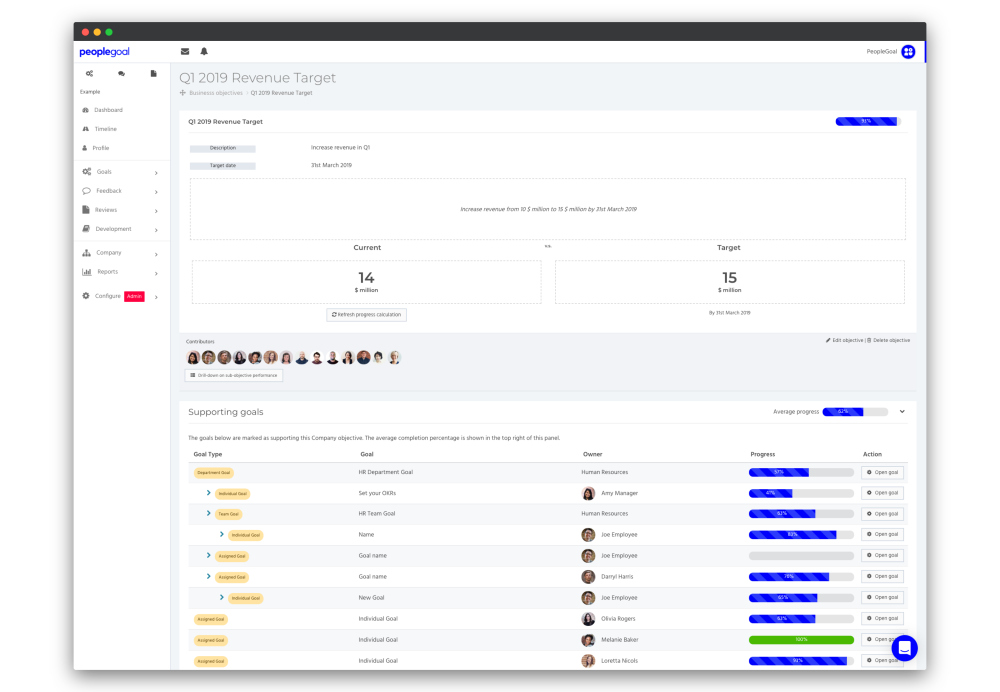
In PeopleGoal’s OKR software, a nurse manager can cascade goals from the hospital level down to the unit and individual nurse, with a live dashboard that shows every nurse exactly how their goal connects to the bigger picture. No more guessing, no more disconnected spreadsheets.
Step 5: Review and Update Quarterly
A goal that made sense during flu season may need a new target once patient volume shifts. Build in a structured quarterly review so unit and individual goals stay connected to what the hospital actually needs right now.
5 Common Mistakes to Avoid
I see the same five mistakes show up again and again when nurses and nurse managers write these goals, so here’s what to catch before you submit yours.
1. Skipping the Number
A goal without a percentage, count, or time window isn’t SMART yet, it’s just a nicer-sounding intention.
Fix:
- Attach a specific number, percentage, or count to the goal
- Set a hard deadline, even if it’s a rough one, instead of leaving it open-ended
2. Setting It Once and Forgetting It
A goal that isn’t revisited until appraisal day can’t be adjusted when unit priorities shift mid-quarter.
Fix:
- Schedule at least one mid-point check-in on the calendar when the goal is first set
- Note any changes to the goal in writing so the final review reflects the real timeline
3. Copying a Goal That Doesn’t Fit the Unit
A pediatric pain-scale goal doesn’t belong on an ICU nurse’s review.
Fix:
- Match the example to the actual specialty and patient population
- Swap out any metric that isn’t already tracked on the unit for one that is
4. Making It Too Ambitious for the Timeline
A new grad goal that assumes ICU-level independence in month one sets a nurse up to fail before they start.
Fix:
- Scale the target to the current stage, orientation week, first year, or tenured staff
- Extend the timeline rather than shrink the target if the two don’t fit together
5. Ignoring Soft Skills Because They’re Harder to Measure
Communication and delegation goals can be just as measurable as clinical ones once a frequency or a feedback loop is attached.
Fix:
- Attach a frequency (times per week or per shift) to any communication or leadership goal
- Add a feedback source, a charge nurse, preceptor, or peer, who confirms the behavior happened
Turn These Nursing SMART Goals Into Real Progress
Pick one goal from each category that matches where you actually are right now, not where you think you should be. A new grad goal and a charge nurse goal solve different problems, and trying to hit both at once is how goals end up abandoned by week three.
If you’re the one managing this across a whole unit or department, that’s where the tracking gets harder than the goal-writing. PeopleGoal cascades these goals from the hospital objective down to the individual nurse, and keeps every check-in, dashboard, and report in one place, so appraisal week stops being a scramble.
Ready to put these goals into practice? You can use a tool like PeopleGoal to track nursing SMART goals from creation to appraisal in one place.
Frequently Asked Questions
How many SMART goals should a nurse set per review cycle?
Most managers ask for 2 to 4 goals per cycle. That's enough to show growth across clinical, communication, and professional development areas without spreading focus so thin that none of them get real attention.
How often should nursing SMART goals be reviewed or updated?
Check in on progress at least monthly, even if the formal review is quarterly or annual. Clinical priorities shift fast, and a goal that made sense in January may need a new deadline by March.
Can nursing students use the same SMART goal format as working RNs?
Yes, the SMART structure stays the same. What changes is the source of the target. Students draw goals from clinical rotation objectives and NCLEX prep, while RNs draw theirs from unit metrics and appraisal criteria.
What's the difference between a nursing care plan goal and a professional SMART goal?
A care plan goal describes what the patient should achieve, like reduced pain or improved mobility. A professional SMART goal describes what the nurse will achieve in their own practice or career. They can be related but they're never the same goal.
Do nursing SMART goals need manager sign-off before starting to work toward them?
It's worth getting informal buy-in even if the unit doesn't require formal sign-off. A quick check confirms the goal is relevant to what the manager is actually evaluating and avoids putting effort into a goal that gets rewritten at review time anyway.
What should happen to a SMART goal that wasn't hit by the deadline?
Don't scrap it. Note what got in the way, whether it was staffing, scope, or timeline, and reset the goal with an adjusted number or date. An honestly revised goal reads better in a review than a quietly abandoned one.
Ready to 3x Your Teams' Performance?
Use the best performance management software to align goals, track progress, and boost employee engagement.