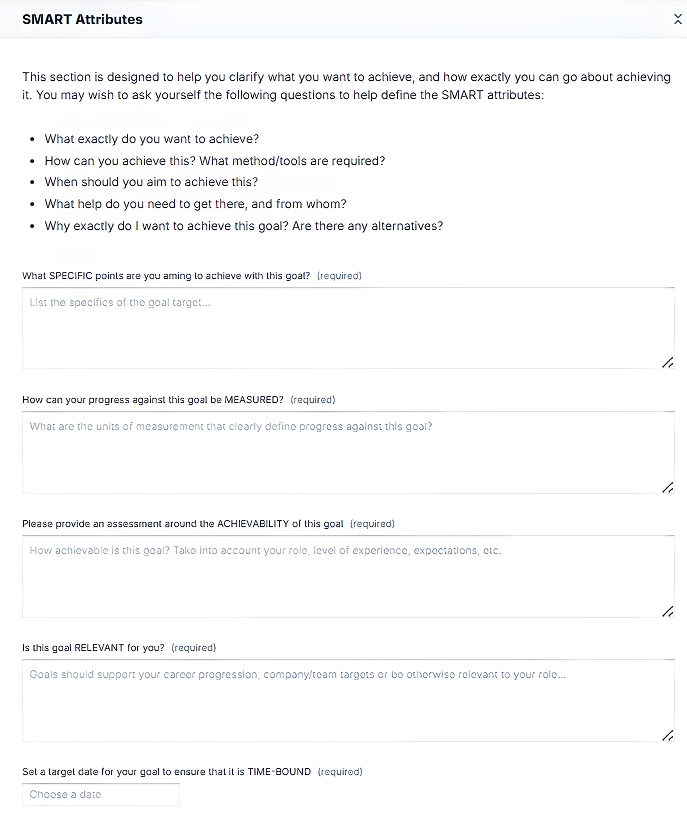

According to Gallup’s State of the Global Workplace report in 2026, only 2 in 10 employees strongly agree that their performance reviews motivate them to do outstanding work.
That tells us that most of us are investing time in a process that isn’t delivering results. The problem is not effort. It is the language we use.
I’ve noticed phrases like “meets expectations” or “great attitude” don’t really help employees improve. They don’t build trust or support decisions, such as promotions or PIPs.
That’s why I created this guide with 75+ performance review phrases focused on specific behaviors and real outcomes. The goal is simple. Help you give feedback that is clear, actionable, and actually useful after the review.
What Are Performance Review Phrases and Why Do They Matter?
They cover areas like communication, productivity, leadership, teamwork, and problem-solving, and they work best when grounded in specific behaviors and measurable outcomes rather than personality judgments.
The goal is not to fill a form. It is to give employees a clear picture of where they stand, what they have done well, and exactly what they need to do differently. When done right, a performance review becomes the most useful career conversation of the year.
How Do You Write a Performance Review That Actually Drives Improvement?
Most reviews I have seen describe the past but do nothing to shape the future. If your language is vague or generic, employees walk away unsure of what to actually change. This framework fixes that before you write a single phrase.
The SBI Framework (Situation, Behavior, Impact)
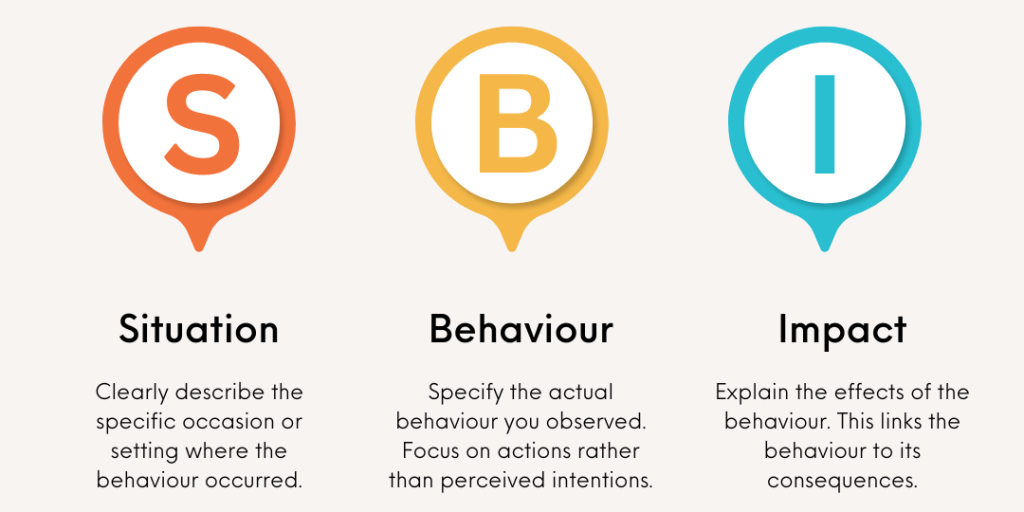
Image Source: Matt Rutherford
Before you reach for a phrase, anchor it in reality using three elements:
Situation: When did this happen? (“During Q3 product launch…”) Behavior: What specifically did the employee do? (“…you coordinated cross-team updates daily…”) Impact: What was the result? (“…which reduced customer escalations by 30% during the rollout.”)
A phrase built on SBI sounds like: “During the Q3 product launch, you coordinated daily cross-team updates that reduced customer escalations by 30%.” That is specific, fair, and actionable.
Without SBI, it sounds like: “You communicate well.” That tells the employee nothing about what to repeat or strengthen.
Why Specific Feedback Actually Moves the Needle
The language you use in a performance review is not just a documentation choice. It is a performance driver.
The mechanism is simple: vague feedback leaves the employee guessing. Specific behavioral feedback removes ambiguity, increases perceived fairness, and gives employees something concrete to act on. That combination is what drives change after the review ends.
Three questions to ask before writing any phrase:
- Can I point to a real example that supports this feedback?
- Does this phrase tell the employee what to keep doing or what to change?
- Would this phrase feel fair if the employee read it independently?
If you cannot answer yes to all three, rewrite.
75+ Performance Review Phrases Examples You Can Actually Use
Use these performance appraisal keywords and phrases to move from blank-page stress to clear, consistent feedback. These performance review phrases designed to help you write reviews that are specific, fair, and easy to act on.
If you want all of these phrases pre-organized in a copy-paste Excel file, along with a 360 feedback grid, a manager review template, and a self and peer review guide, download the free toolkit below and skip the blank page entirely.
Achievements
Achievements are where I always start. They anchor the conversation in results and signal to the employee that their effort was seen and connected to something real. Get this section right, and the rest of the review lands with more credibility.
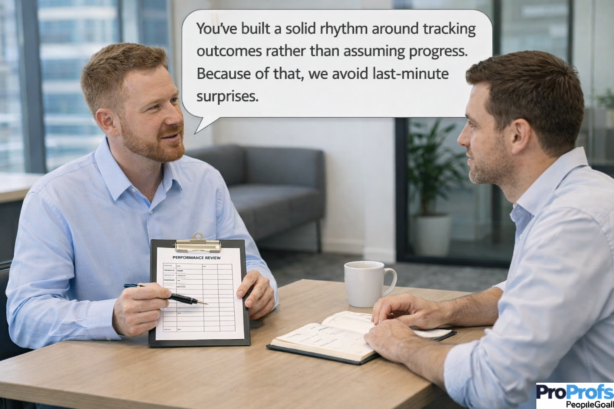
Positive Phrases
| Phrase | Why It Works |
| “Sets well-thought-out goals and consistently works to achieve them without needing close supervision. This self-direction contributed to [specific result] this quarter.” | Names the behavior (self-directed goal pursuit) and ties it to an outcome, making it repeatable and credible. |
| “Demonstrated a results-driven approach across all key projects. Your improvement in [specific metric] by [X%] reflects sustained focus and commitment.” | Anchors praise in a measurable metric, which gives the employee a clear signal of what success looks like. |
| “Makes informed decisions based on research and data rather than assumptions. This approach consistently leads to higher-quality outcomes for the team.” | Distinguishes the behavior (data-informed decisions) from generic praise, so the employee knows what to keep doing. |
| “Has taken full accountability for results, including when outcomes didn’t meet expectations. That ownership mindset builds credibility and trust with the team.” | Recognizes a rare and coachable behavior—owning misses—which reinforces psychological safety and integrity. |
| “Exceeded the [specific goal] target set at the beginning of the review period, delivering [X outcome] through consistent effort and strong prioritization.” | Connects the result directly to the effort and habits that produced it, not just the number itself. |
Constructive Phrases
| Phrase | Why It Works |
| “There are opportunities to strengthen goal-setting habits. Establishing clearer milestones at the start of each project would make it easier to track progress and course-correct earlier.” | Points to a specific, actionable habit change rather than a character flaw, making it easier to act on. |
| “Some decisions this quarter were made without sufficient data, which led to [specific outcome]. Building a habit of researching before acting will sharpen results.” | Grounds the feedback in a real consequence, which clarifies the stakes without sounding punitive. |
| “Accountability in the face of missed targets needs development. Taking ownership of outcomes, even challenging ones, is a critical skill for future growth.” | Names the behavior gap specifically (ownership) rather than using a vague label like “attitude.” |
| “Focus in [specific area] has been inconsistent. Working with your manager to prioritize key responsibilities will help direct energy where it matters most.” | Frames the fix as a collaborative next step, reducing defensiveness and opening the door to a coaching conversation. |
Productivity
Productivity feedback is most useful when it goes beyond “you work hard” or “you need to do more.” The quality of work someone produces, and the consistency with which they produce it, tells a more complete story than activity volume alone. That is why effective quality of work performance review phrases should focus on observable patterns, output quality, reliability, and the real impact an employee’s work has on the team.
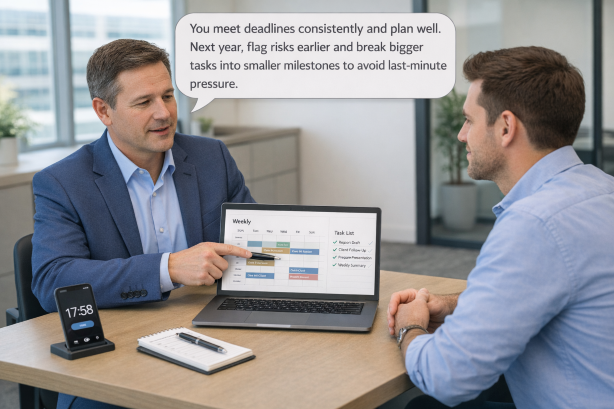
Positive Phrases
| Phrase | Why It Works |
| “Significantly improved [specific metric] since the last review cycle. Your consistent output has directly contributed to overall department performance.” | Ties output quality to a measurable trajectory, not just a single data point. |
| “Demonstrates strong organizational and time-management skills. You consistently meet deadlines without compromising quality, even during peak workload periods.” | Distinguishes volume (meeting deadlines) from quality (not cutting corners), which captures the full picture. |
| “Identifies process gaps and inefficiencies before they become problems. That proactive habit protects the team’s capacity and keeps projects on track.” | Recognizes upstream thinking, not just execution, which signals the employee’s potential for broader ownership. |
| “Positively contributes to team targets through reliable, high-quality work. These are exactly the kind of positive comments for evaluation that reflect sustained performance and team impact.” | Connects individual work quality to collective outcomes, reinforcing why it matters beyond the individual. |
Constructive Phrases
| Phrase | Why It Works |
| “Task completion has been inconsistent this review period. Building a clearer daily prioritization system would help close open items more reliably.” | Offers a structural fix (prioritization system) rather than a personal critique, making it actionable. |
| “Initiative tends to wait for direction rather than emerging independently. Taking ownership of smaller decisions will free up management bandwidth and accelerate your development.” | Reframes the gap as a development opportunity, not a failure, which is more likely to land constructively. |
| “Work quality in [specific area] has not met the team standard set in previous cycles. Let us create a specific improvement plan to address this together.” | Signals collaboration rather than judgment, which makes the feedback feel like a coaching moment. |
Communication Skills
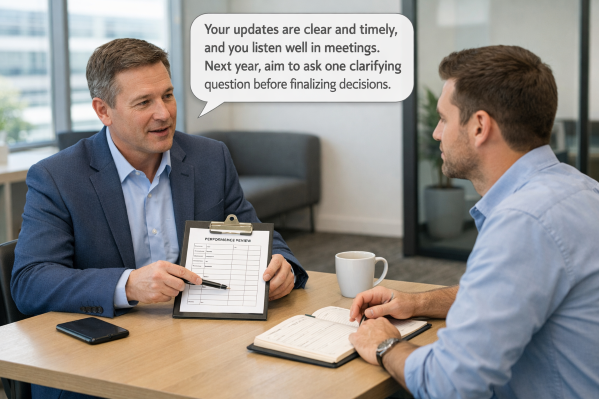
Communication is the one skill I see managers struggle most to give specific feedback on. It feels subjective until you break it into behaviors. Once you do that, it becomes one of the most coachable areas in any review.
Positive Phrases
| Phrase | Why It Works |
| “Demonstrates strong active listening skills. In team meetings, you consistently reflect ideas back before offering your own, which improves the quality of decisions.” | Names a specific micro-behavior (reflecting before responding) that is concrete and observable. |
| “Communicates clearly with colleagues, managers, and clients. Even in high-pressure moments, you maintain a professional tone and structured delivery.” | Acknowledges performance under pressure, which is harder to sustain and worth recognizing explicitly. |
| “Raises difficult topics constructively and to the point. You have helped the team navigate [specific situation] without letting communication break down.” | Grounds the praise in a real scenario, which makes it specific and memorable rather than generic. |
| “Effectively facilitates group discussions and draws out quieter voices. This behavior strengthens team collaboration and surfaces better ideas.” | Recognizes inclusive facilitation, a skill that often goes unacknowledged and is directly tied to team output quality. |
Constructive Phrases
| Phrase | Why It Works |
| “Written communication could be clearer and more concise in [specific context, e.g., project updates or client emails]. Structuring messages around key actions and next steps will improve clarity.” | Gives a specific formatting suggestion, not just a vague directive to “communicate better.” |
| “There are moments where feedback or critique is resisted rather than absorbed. Developing a more open response to constructive input will accelerate professional growth.” | Addresses the behavior (resistance) without labeling the person as defensive, keeping the tone forward-looking. |
| “Questions tend to go unasked when issues need clarification, which sometimes leads to rework. Building the habit of checking assumptions early will save time for both you and the team.” | Connects the communication gap directly to a business cost (rework), which makes the case without sounding personal. |
Leadership
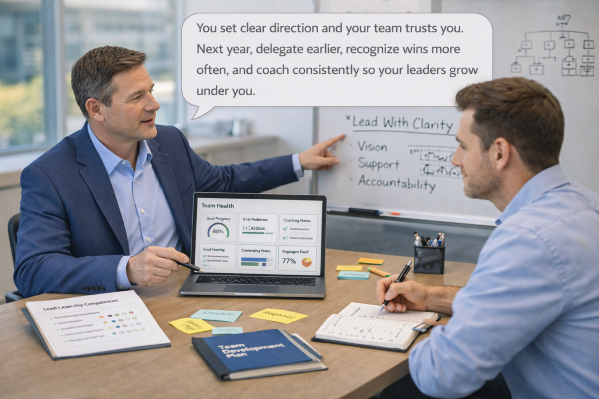
Leadership phrases go wrong in two directions: either too vague (“inspires others”) or too blunt with no path forward. What I have found works is focusing on the specific behaviors that show leadership in action rather than trying to describe the quality itself.
Positive Phrases
| Phrase | Why It Works |
| “Creates an inclusive team environment where people feel safe raising concerns and ideas. This behavior directly improves both morale and decision quality.” | Ties a cultural behavior directly to business outcomes (decision quality), not just feelings. |
| “Motivates direct reports and peers by consistently recognizing individual contributions and connecting daily work to the bigger picture.” | Describes the specific mechanism (recognition + context) rather than just saying “motivates people.” |
| “Proved themselves to be a genuine asset to the organization this review period. Your leadership instincts have strengthened the team’s ability to operate independently.” | Recognizes a team-level outcome (independence) that reflects well on the leader’s approach. |
| “Embodies the company’s values in how you communicate, prioritize, and make decisions. That consistency builds credibility across levels of the organization.” | Names three specific behavioral domains (communication, prioritization, decisions) rather than using abstract value language. |
Constructive Phrases
| Phrase | Why It Works |
| “Leadership presence needs development in [specific situation]. Team members would benefit from clearer direction and more visible support during complex projects.” | Anchors the gap in a context (complex projects) rather than making a blanket assessment. |
| “Micromanagement tendencies in some situations prevent others from owning their work fully. Coaching rather than directing will unlock more from your team.” | Names the impact on the team (reduced ownership), which reframes the feedback as being in the leader’s own interest to address. |
| “Recognition of team members’ contributions has been inconsistent. Building a more regular practice of acknowledging effort will strengthen engagement and trust.” | Offers a simple, habitual fix (regular recognition) rather than a vague directive to “be more supportive.” |
Teamwork
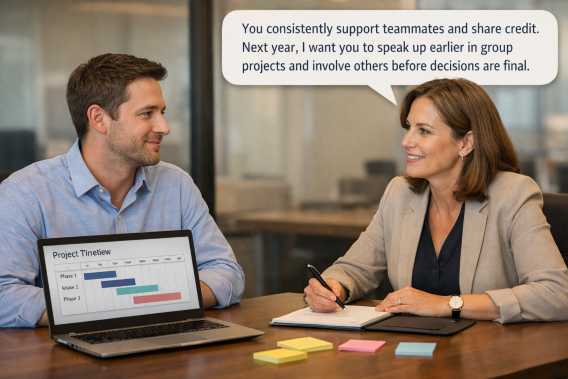
Strong teamwork is visible if you know what to look for. When I write teamwork phrases, I describe what I actually observed, not a general impression of whether someone is “a team player.” That distinction changes how the feedback lands.
Positive Phrases
| Phrase | Why It Works |
| “Collaborates effectively across the team and with other departments to hit shared targets. You give context, take initiative on coordination, and follow through on commitments to others.” | Breaks teamwork into three observable behaviors (context-giving, coordination, follow-through) rather than leaving it abstract. |
| “Shares knowledge generously and proactively. When you worked through [specific challenge], you created shared documentation that continues to benefit the team.” | Points to a lasting artifact (shared documentation) as evidence, giving the feedback staying power. |
| “Brings positivity and energy that strengthens team cohesion. Your attitude during [specific difficult period] helped keep the team focused and motivated.” | Anchors the impact in a real difficult moment, which makes the recognition feel earned rather than routine. |
| “Delegates effectively, balancing team workload while maintaining quality standards. This skill is critical to the team’s ability to scale.” | Connects delegation to a business outcome (scalability), not just operational convenience. |
Constructive Phrases
| Phrase | Why It Works |
| “Relationships with some team members could be strengthened. Being more approachable and consistent in communication will build the trust needed for better collaboration.” | Specifies two behavioral levers (approachability, communication consistency) rather than leaving the employee guessing what to change. |
| “Information sharing has been siloed in some cases. Making it a habit to loop in relevant team members earlier will reduce duplication and improve outcomes.” | Names the business cost (duplication) and offers a timing-based fix (loop in earlier) that is immediately actionable. |
| “Contributing beyond individual responsibilities is an area for growth. Participating more actively in shared team challenges would increase overall impact and visibility.” | Reframes the gap as a career opportunity (visibility), which makes the feedback personally motivating. |
Creativity and Innovation
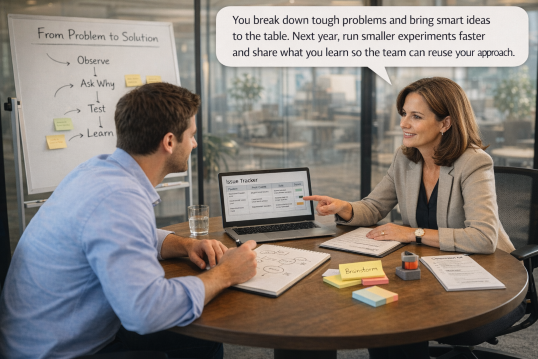
Innovation feedback is easy to get wrong because it often ends up being either over-the-top praise or frustratingly vague criticism. I focus on the specific moments where someone either brought something new to the table or stayed in a comfortable lane when the situation needed more.
Positive Phrases
| Phrase | Why It Works |
| “Consistently brings fresh perspectives to team discussions. Your suggestion to [specific idea] in [project/meeting] changed our approach and improved the outcome.” | Grounds the praise in a specific idea and its downstream impact, making it credible rather than hollow. |
| “Identifies creative solutions to challenges rather than defaulting to established methods. This approach has added measurable value to [specific area].” | Distinguishes creative problem-solving from conventional execution, signaling exactly what behavior to replicate. |
| “Has a clear vision for how the team can improve and backs it up with actionable ideas. That combination of vision and execution is rare and highly valuable.” | Recognizes both components (vision and execution), which is more precise than saying someone is “innovative.” |
Constructive Phrases
| Phrase | Why It Works |
| “Taking creative risks is an area for growth. Some high-value opportunities were left on the table this period because the approach stayed too close to what had worked before.” | Connects risk-aversion to a tangible cost (missed opportunities), framing the feedback in strategic terms. |
| “Unconventional thinking in team discussions is something to develop. Encouraging yourself to propose at least one alternative approach per project will build this muscle.” | Gives a specific, low-stakes behavioral target (one alternative per project) that makes the development feel achievable. |
| “The team’s creative output would benefit from more active contributions in brainstorming sessions. Your perspective has value, and it should be in the room.” | Reframes the gap as a loss to the team rather than a personal failing, which is less defensive and more motivating. |
Problem-Solving
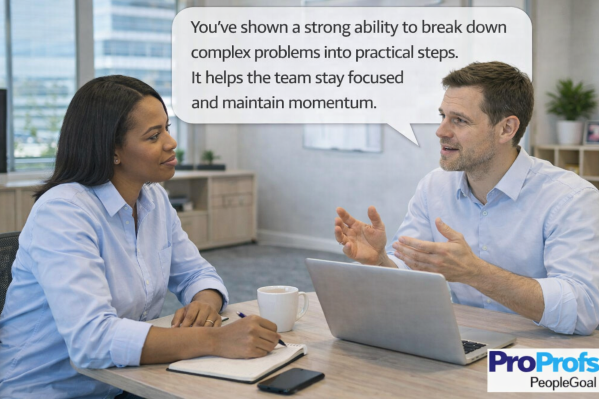
Problem-solving is one of the most business-critical skills I evaluate, and it is also one of the hardest to describe without sounding generic. The key is getting specific about how someone approached the problem, not just whether they solved it.
Positive Phrases
| Phrase | Why It Works |
| “Approaches complex challenges methodically, breaking problems into steps rather than jumping to assumptions. This results in faster, more accurate resolutions.” | Names the method (structured decomposition) as the source of the outcome, giving the employee something precise to repeat. |
| “Identifies root causes rather than surface symptoms. In [specific example], your analysis prevented the same issue from recurring and saved the team significant time.” | Connects the analytical approach to a business outcome (time saved, recurrence prevented), which adds credibility. |
| “Shows strong analytical thinking and an ability to adapt processes when old methods are not delivering results. This skill is increasingly valuable as the team scales.” | Links the competency to a future-facing business context (scaling), making the recognition feel relevant and forward-looking. |
| “Demonstrates the ability to solve complex problems independently. You rarely need to escalate issues that fall within your scope, which improves team efficiency.” | Quantifies the team-level benefit of independent problem-solving (fewer escalations), not just the individual achievement. |
Constructive Phrases
| Phrase | Why It Works |
| “Some challenges this period took longer to resolve than expected. Developing a more structured troubleshooting approach will reduce time-to-resolution on complex cases.” | Identifies the cost (time) and offers a structural fix (troubleshooting framework) rather than a vague critique. |
| “When expectations are not met, the response has sometimes been to shift blame rather than focus on solutions. Reframing setbacks as problem-solving opportunities will strengthen both performance and reputation.” | Describes the observable behavior (blame-shifting) and its reputational consequence, making it harder to dismiss. |
Adaptability and Resilience
Adaptability is one of those competencies that becomes visible only under pressure. I look for how someone responds when the plan changes, when the workload spikes, or when something goes wrong. The phrases below are built around those real moments.
Positive Phrases
| Phrase | Why It Works |
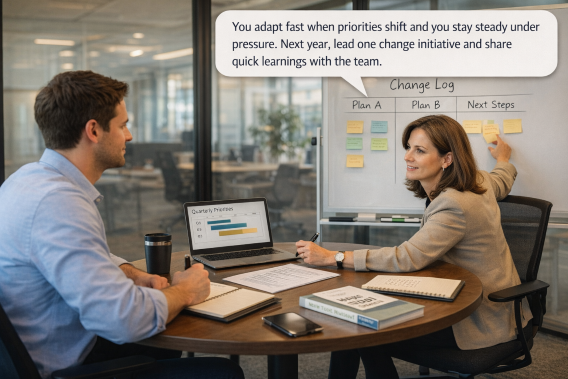
| “Demonstrates a remarkable ability to adapt when priorities shift. During [specific change], you adjusted your approach quickly and maintained quality output throughout.” | Ties the adaptability to a real situation and a quality outcome, not just a willingness to change. |
| “Consistently bounces back from setbacks with a learning mindset. When [specific challenge] happened, you identified what went wrong and applied those lessons immediately.” | Recognizes the learning loop (identify + apply), which is more specific than saying someone “handles setbacks well.” |
| “Maintains composure during uncertainty and high pressure. That steadiness has a stabilizing effect on the people around you.” | Acknowledges the team-level impact of individual composure, which elevates the feedback beyond personal praise. |
| “Quickly applies new tools, processes, and methodologies without needing extended hand-holding. This agility reduces onboarding friction and accelerates team progress.” | Connects the behavior (fast uptake) to a team-level benefit (less onboarding friction), grounding the praise in outcomes. |
| “Serves as a visible role model for resilience. The way you handled [specific difficult period] has influenced how others on the team approach adversity.” | Extends the impact beyond the individual to the team culture, which captures the full value of role-model behavior. |
Constructive Phrases
| Phrase | Why It Works |
| “When circumstances change unexpectedly, the response is sometimes resistance rather than adaptation. Building a habit of asking ‘how do I adjust?’ instead of ‘why is this changing?’ will accelerate growth.” | Offers a specific cognitive reframe (a replacement question), which is more actionable than “be more flexible.” |
| “High-pressure situations have occasionally impacted both output quality and team dynamics. Developing specific strategies for managing pressure will strengthen consistency.” | Identifies two consequences (output and team dynamics) and points toward a personal strategy-building process. |
Customer Focus
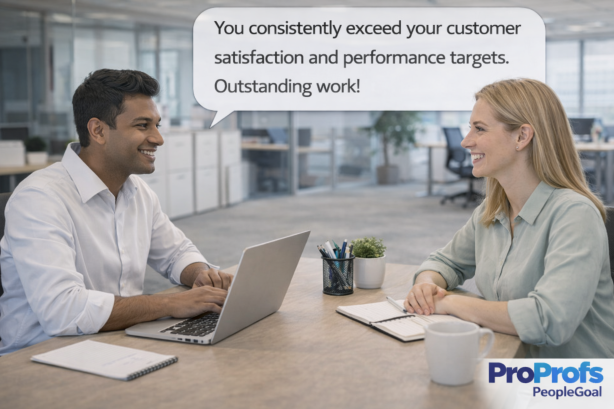
Customer focus shows up in the small habits as much as the big wins. I pay attention to whether someone is proactive about understanding customer needs or whether they are purely reactive. Both matter, and both deserve clear, specific language in a review.
Positive Phrases
| Phrase | Why It Works |
| “Consistently puts customer needs first without being prompted. This orientation is reflected in strong satisfaction feedback and repeat positive engagement.” | Connects the proactive behavior to measurable customer signals (satisfaction scores, repeat engagement). |
| “Proactively gathers customer feedback and uses it to improve processes. This habit strengthens both the product and the team’s relationship with users.” | Recognizes the feedback loop (gather + act), not just the collection step, which is more complete and more valuable. |
| “Builds long-term trust with customers through empathy, reliability, and clear communication. That relationship quality directly impacts retention.” | Names the three specific trust-building behaviors and ties them to a business metric (retention). |
| “Goes above and beyond to resolve difficult customer situations. In [specific example], your handling of a complex complaint turned a frustrated customer into a loyal one.” | Uses a real outcome (loyalty from a difficult situation) as the measure of above-and-beyond, not effort alone. |
Constructive Phrases
| Phrase | Why It Works |
| “Customer follow-through has been inconsistent. Setting a clear personal standard for response times and closure communication will improve satisfaction scores.” | Proposes a self-managed standard (response time, closure communication), which gives the employee a concrete ownership lever. |
| “In some interactions, solutions were offered before the customer’s full concern was understood. Slowing down to confirm understanding before moving to resolution will reduce repeat contacts.” | Names the business cost (repeat contacts) of the behavior gap, making the case without sounding critical. |
Learning and Development
Development phrases are the ones I see rushed most often. They tend to be either generic encouragement or vague suggestions. I write them around what the employee actually did to grow this period and where the next real opportunity sits.
Positive Phrases
| Phrase | Why It Works |
| “Actively seeks out learning opportunities without waiting to be directed. Your initiative in [specific training, certification, or skill] has already delivered results in [specific context].” | Connects the development behavior to a business outcome, not just the activity of learning. |
| “Applies newly acquired knowledge quickly and effectively. The [specific skill] you developed this period was visible within weeks in [specific outcome].” | Names a timeline (within weeks) and an outcome, which makes the praise specific and credible. |
| “Shares learning generously with the team. Your habit of passing on insights from complex challenges creates a culture of continuous growth.” | Recognizes the multiplier effect of shared learning, not just the individual’s development. |
| “Demonstrates a growth mindset in how you respond to feedback and setbacks. Challenges appear to fuel your development rather than slow it down.” | Describes the mindset through observable behavior (response to feedback/setbacks) rather than a trait label. |
| “Sets ambitious development goals and creates real plans to achieve them. That intentionality is what separates strong performers from exceptional ones.” | Distinguishes intention (goals) from execution (plans) and frames both as the source of high performance. |
Constructive Phrases
| Phrase | Why It Works |
| “Development goals set at the start of the review period were not fully acted on. Reconnecting on specific steps and accountability structures will help translate intent into progress.” | Separates intent (goals set) from execution (action) and offers a structural fix (accountability), not blame. |
| “Feedback from previous cycles has not been consistently applied. Treating developmental input as actionable data rather than optional guidance will significantly accelerate growth.” | Reframes feedback as data rather than criticism, which is more likely to shift the employee’s orientation toward it. |
Self-Review Phrases
Self-reviews require a different kind of language. The employee is no longer receiving feedback, they are constructing a narrative about their own contribution. Strong self-review phrases are evidence-based, outcomes-anchored, and honest about growth areas without being either self-deprecating or promotional.
Positive Self-Review Phrases
| Phrase | Why It Works |
| “This review period, I delivered [specific outcome] by [specific approach]. The result was [measurable impact], which contributed directly to [team or company goal].” | Structures the achievement with approach + outcome + impact, which is harder to dismiss than general claims. |
| “I took ownership of [specific challenge] when it emerged, coordinated with [relevant stakeholders], and resolved it within [timeframe]. This prevented [specific downstream impact].” | Documents a problem-solving moment with specificity, demonstrating both initiative and follow-through. |
| “I actively sought feedback on [specific skill or project] and applied it by [specific change]. The difference in outcome was visible in [specific result].” | Shows the feedback loop in action, which is one of the strongest signals of professional growth. |
| “I consistently met my core responsibilities while also contributing to [team-level initiative]. This balance reflects my commitment to both individual and collective performance.” | Demonstrates breadth without self-aggrandizement, grounding the claim in observable behavior. |
Constructive Self-Review Phrases
| Phrase | Why It Works |
| “An area I am actively working on is [specific skill]. In [specific situation], I noticed [gap or impact], and I am addressing it by [specific action].” | Demonstrates self-awareness and agency, which is far stronger than either ignoring the gap or over-apologizing for it. |
| “I underestimated the complexity of [specific project or task], which affected [specific outcome]. Going forward, I will [specific behavioral change] to improve my planning approach.” | Owns the miss and proposes a specific fix, which shows maturity and reduces the need for the manager to dwell on it. |
| “I would like to develop stronger skills in [specific area]. I have already taken the step of [specific learning action] and plan to apply it in [upcoming context].” | Frames the development gap as a next chapter rather than a current failure. |
Peer Review Phrases
Peer feedback is most valuable when it focuses on observable behaviors and shared work outcomes. Avoid personality judgments. Describe what you witnessed during collaboration, project work, or team interactions.
Positive Peer Review Phrases
| Phrase | Why It Works |
| “[Name] consistently follows through on commitments made to the team. In [specific project], their reliability kept the rest of us unblocked and on schedule.” | Grounds the praise in a concrete team impact (unblocking others), not a general character trait. |
| “[Name] communicates clearly when handing off work. I rarely need to follow up for context, which reduces friction and saves time across the team.” | Quantifies the benefit (less follow-up, less friction) in a way that makes the behavior’s value obvious. |
| “[Name] actively includes others in discussions and makes space for different viewpoints. This makes our team’s decisions more thorough.” | Ties inclusive behavior to decision quality, not just team atmosphere. |
| “When [Name] disagrees, they do it constructively. They name their concern, explain why, and stay focused on the outcome. That approach keeps conflict productive.” | Describes a specific pattern of constructive disagreement, which is one of the most valuable and rare team behaviors. |
Constructive Peer Review Phrases
| Phrase | Why It Works |
| “There are times when [Name]’s updates arrive late in the project cycle, which limits the team’s ability to adjust. Earlier communication would improve our coordination.” | Focuses on a timing behavior and its team impact, without attributing intent or making it personal. |
| “[Name] sometimes moves forward on shared work without checking alignment first. A quick sync before major changes would reduce the need for rework.” | Names a specific coordination gap and proposes a simple, low-friction fix. |
| “In high-pressure moments, [Name]’s communication style can become short, which creates tension in the team. A brief acknowledgment of others’ contributions in those moments would go a long way.” | Describes a situational pattern (under pressure) rather than a general trait, which makes it more accurate and easier to act on. |
Remote and Hybrid Work Performance Review Phrases
Remote and hybrid work introduces a distinct set of performance challenges, including async communication, digital tool proficiency, and maintaining visibility and engagement without in-person cues. The following phrases address these directly.
Positive Phrases
| Phrase | Why It Works |
| “Communicates asynchronously with exceptional clarity. Your written updates are thorough enough that teammates rarely need to follow up for context, which is a significant productivity multiplier in a distributed team.” | Names the specific format (async written updates) and its team-level impact (fewer follow-ups). |
| “Has built strong relationships with remote teammates despite geographic distance. Your habit of proactively reaching out for informal check-ins has strengthened team cohesion noticeably.” | Recognizes proactive relationship-building, which is harder to sustain remotely and often goes unacknowledged. |
| “Demonstrates strong digital tool proficiency across [specific tools: Slack, Notion, Jira, etc.]. Your ability to leverage these platforms reduces coordination friction for the whole team.” | Ties tool proficiency to a team-level outcome (reduced friction), making it feel like a strategic contribution. |
| “Maintains high engagement and visibility in distributed meetings. You contribute meaningfully in video calls and follow up async when you have additional input, keeping collaboration active across time zones.” | Acknowledges both synchronous and asynchronous participation, capturing the full picture of remote engagement. |
| “Manages your own schedule and workload with strong self-discipline. You consistently deliver on commitments without needing the structure of an in-office environment to stay on track.” | Recognizes the autonomy required in remote work and frames it as a professional capability, not just a situation. |
Constructive Phrases
| Phrase | Why It Works |
| “Async updates have been inconsistent this review period. The team has occasionally been blocked waiting for status on open items. Establishing a consistent cadence for status communication would significantly reduce that friction.” | Names the downstream cost (team blocked) and proposes a systemic fix (cadence), not a personal critique. |
| “Visibility in virtual meetings has been limited. Contributing more actively in calls and following up with written summaries would signal engagement and keep alignment strong across the team.” | Offers two concrete behaviors (verbal participation + written follow-up) rather than a vague directive to “be more present.” |
| “There are digital collaboration tools the team relies on that have not been fully adopted. Prioritizing proficiency in [specific tool] would reduce handoff delays and improve team-wide coordination.” | Specifies the tool and its link to workflow outcomes, making the gap concrete and the fix obvious. |
| “Response times on async channels have extended beyond what the team expects. Establishing and communicating your availability windows would help teammates plan around your schedule more effectively.” | Reframes response-time expectations as a communication issue, not a work ethic issue, which is more accurate and more actionable. |
DEI and Inclusion Performance Review Phrases
Inclusion is a competency, not a personality trait. These phrases evaluate observable behaviors that build or undermine psychological safety, belonging, and equitable participation. Use them when the review cycle includes DEI as a formal dimension, or when behavioral gaps or strengths are significant enough to name directly.
Positive Phrases
| Phrase | Why It Works |
| “Consistently creates space for underrepresented voices in team discussions. In [specific meeting or setting], you actively redirected conversation to ensure [colleague or group] could contribute fully.” | Names the specific behavior (redirecting conversation) and grounds it in an observable moment. |
| “Seeks out diverse perspectives before forming a final position. This practice has visibly improved the quality and inclusivity of decisions in [specific project or context].” | Connects inclusive behavior to decision quality, making the case in business terms, not just values terms. |
| “Challenges exclusionary language or behavior when it surfaces, and does so constructively. That willingness to intervene is one of the most concrete contributions an individual can make to a psychologically safe team culture.” | Recognizes active allyship (intervention) rather than passive non-participation, which is a meaningfully higher bar. |
| “Adapts communication style to meet colleagues where they are, including across language backgrounds, neurodiversity, and working styles. This flexibility strengthens team-wide collaboration.” | Describes a specific set of dimensions (language, neurodiversity, working style) and connects them to collaboration outcomes. |
Constructive Phrases
| Phrase | Why It Works |
| “In some team discussions, contributions from certain colleagues have not received equal engagement. Being more intentional about acknowledging all perspectives, especially those less frequently heard, would strengthen team equity.” | Describes a pattern (unequal engagement) without attributing it to bias, which keeps the feedback factual and actionable. |
| “Feedback has occasionally been delivered differently across team members in similar situations. Applying consistent standards regardless of tenure, role, or background will improve both fairness and trust.” | Names the consistency gap as a fairness issue, which is more compelling than framing it as a procedural concern. |
| “There are opportunities to more actively amplify the contributions of colleagues who have less visibility. Credit attribution in team settings is a small habit with a significant impact on equity and morale.” | Frames credit attribution as a habit, not a character question, which makes it easier to act on. |
| “Team norms around inclusion could be more explicitly reinforced. Taking a more visible role in setting expectations for respectful, equitable participation would strengthen the team culture you are already trying to build.” | Acknowledges positive intent while pointing to an opportunity to do more, balancing recognition with direction. |
What Performance Review Phrases Work Best for Specific Roles?
Generic phrases cover the foundations, but the most useful feedback speaks to the specific context someone works in every day. A phrase that lands well for a sales rep reads completely differently to an engineer. Here is a quick reference for four roles I see managers struggle with most.
| Role | Positive Phrase Example | Constructive Phrase Example |
| Managers and Team Leads | “Your one-on-ones have become genuine development touchpoints, not status updates. Several team members have cited your coaching directly when discussing their own growth.” | “When the team hits friction, the instinct is sometimes to solve rather than coach through. Building the habit of asking ‘what would you do?’ before offering a solution will develop your team faster.” |
| Customer Support | “Your first-contact resolution rate shows you are solving the actual problem, not just closing the ticket. That habit reduces repeat contacts and builds genuine customer trust.” | “In difficult conversations, empathy statements sometimes arrive after the solution rather than before it. Customers who feel validated first are more receptive to the answer. Shifting that sequence will improve both satisfaction scores and call outcomes.” |
| Engineers and Technical Staff | “You translate complex technical constraints into language non-technical stakeholders can act on. That skill is rare and has directly improved cross-functional alignment on [specific project].” | “Documentation of your work has been inconsistent. Treating documentation as part of done, not optional, will significantly improve team-wide continuity.” |
| Sales Professionals | “You handle objections without becoming defensive or discounting prematurely. In [specific deal], that discipline preserved margin and still closed the deal.” | “Conversion at [specific stage] has dropped despite strong activity volume. Reviewing your qualification criteria early in the cycle will help identify where fit is being misjudged before too much time is invested.” |
What Are the Most Common Performance Review Mistakes and How Do You Avoid Them?
Even the most well-intentioned managers fall into these traps. Here is what to watch for and how to fix it before review season starts.
1. Vague Praise
Generic compliments like “great team player” or “hard worker” feel good in the moment, but leave employees with no idea what behavior to repeat. Strong positive comments for evaluation are specific, behavior-based, and tied to outcomes. Specificity is what makes praise actually stick.
Fix it:
- Name the exact behavior: what the person did, when, and in what context
- Connect it to a measurable outcome or team impact
- Replace “You did a great job this quarter” with “You resolved the [project] bottleneck that had been stalling the team for three weeks, which unblocked two downstream teams and kept us on schedule.”
2. Recency Bias
Basing a full-year review on the last four to six weeks is one of the most common fairness failures in performance management. It rewards recent visibility, not actual sustained contribution.
Fix it:
- Keep a running note of notable moments throughout the year, not just at year-end
- Review your check-in notes, project logs, and peer feedback before writing a single phrase
- Use PeopleGoal’s continuous check-in and feedback logging to capture real-time observations so your year-end review is a synthesis, not a memory exercise
3. Personality Feedback
“You have a bad attitude” is not feedback. It is a character judgment, and it opens you up to biased claims while giving the employee nothing concrete to act on.
Fix it:
- Describe the observable behavior, not the trait you think causes it
- Anchor every criticism to a specific situation: when it happened, what was said or done, and what the impact was
- Replace “You come across as impatient” with “In three team meetings this quarter, you interrupted colleagues before they finished speaking, which shut down discussion and left ideas incomplete.”
4. Review-Season Surprises
If an employee is hearing something critical for the first time in a formal review, that is a management failure, not a performance conversation. Formal reviews should summarize what has already been discussed, not introduce new concerns under high stakes.
Fix it:
- Ask yourself before writing: has this person heard this feedback before?
- If the answer is no, address it in a one-on-one before the formal cycle, not during it
- Use reviews to confirm direction and set next steps, not to deliver news
5. Metric-Only Feedback
Numbers without context feel clinical and often unfair. A metric gap almost always has a story behind it, and leaving that story out makes the feedback harder to act on.
Fix it:
- Always pair a number with the context that shaped it
- Acknowledge contributing factors before pointing to gaps
- Replace “Your handle time was 14% above target” with “Your handle time ran above target in Q3, which reflects the complexity of cases you were managing. Let us look at where we can build efficiency without cutting quality”
How Can Managers Make Reviews More Consistent Across Teams?
Inconsistency is one of the fastest ways to lose employee trust in the review process. When managers in the same organization use different standards, employees in similar roles get radically different feedback quality, and that creates resentment, not growth. Here are three things I have seen work.
1. Calibrated Rating Scales
Before review season opens, managers need to agree on what different performance levels actually look like in practice. This is also the right moment to standardize the performance appraisal keywords and phrases used across teams, so language is consistent regardless of who is writing the review.
- Run a calibration session before reviews are written, not after
- Use real anonymized examples to align on what each rating level looks like for your team
- PeopleGoal’s 360 Feedback Software lets you benchmark specific competencies like communication, leadership, and collaboration with custom rating criteria that stay consistent across teams and review cycles
2. Multi-Rater Input
A single manager’s perspective is inherently limited. They see one slice of someone’s work. Bringing in peer and cross-functional feedback makes the review fuller and the assessment harder to dispute.
- Collect input from at least two or three raters beyond the direct manager
- Weight feedback by relevance, someone who works with the employee daily carries more signal than someone who interacts with them once
- As Bibiana Mercuri, Global Talent Director at Ataway, put it: “Most tools I looked at could only compute feedback from one manager about one employee. PeopleGoal was the only tool that could extend this to multiple managers evaluating one employee.”
3. Year-Round Documentation
Reviews built on 12 months of documented observations are more consistent and more defensible than reviews built on memory. The manager who logs notable moments throughout the year writes better reviews in half the time.
- Keep a simple running note for each direct report, updated after significant moments, project completions, or feedback conversations
- Review those notes alongside check-in history and peer input before writing a single phrase
- PeopleGoal’s continuous check-in and feedback logging creates that trail automatically, so year-end evaluation is a structured synthesis rather than a last-minute reconstruction
Make Performance Reviews Easier and More Effective
The phrases in this guide give you language. But language without structure only gets you so far. The real challenge is making performance reviews consistent, scalable, and connected to actual outcomes like goal progress, development plans, and engagement data.
PeopleGoal brings goals, 360-degree feedback, check-ins, and performance reviews into one place. Managers build review workflows that match how their teams actually work.
Feedback is collected continuously, not scrambled together at year-end. And because everything lives in one system, review conversations are grounded in real data rather than impressions.
If your current review process still relies on spreadsheets, email threads, or disconnected tools, it is worth seeing what a structured approach looks like.
Frequently Asked Questions

How do you phrase constructive criticism without sounding harsh?
Ground the feedback in a specific observable behavior rather than a character judgment. Use future-facing language: "Going forward, [behavior] would improve [outcome]" is less personal than "You have been doing [behavior]." Acknowledge what the employee does well before naming what needs to change, but avoid the classic "sandwich method" where critical feedback gets buried and lost.
What should a manager write when an employee has shown mixed performance?
Address both sides explicitly and separately. Acknowledge the specific strengths with examples, then address the gaps with equal specificity. Avoid averaging them out into vague neutral language. Mixed performance needs a clear map of what to grow and what to protect.
How do you write a performance review phrase for someone who meets expectations but never exceeds them?
Start by recognizing the consistency itself as a strength. "You reliably deliver quality work that meets the standards of your role" is honest and fair. Then frame growth as an opportunity rather than a criticism: "The next opportunity for development is [specific area], which would position you for [specific outcome or advancement path]."
What phrases should managers avoid entirely in performance reviews?
Avoid personality labels ("you have a bad attitude"), unverifiable generalizations ("you always do X"), and comparisons to other employees. Also, avoid vague positive language like "great team player" or "hard worker" that offers no direction. Replace all of these with specific, behavior-based, impact-focused language.
What are performance appraisal keywords and phrases used in competency-based reviews?
Competency-based phrases evaluate specific, defined skills, like communication, leadership, problem-solving, or customer focus, against a consistent benchmark. They are more useful for calibration across teams, promotion decisions, and identifying training needs. General feedback is situational. Competency-based feedback is structured.
How do you write performance review phrases that support a development plan?
The phrase needs to name the specific skill or behavior to develop, provide a concrete example of where the gap showed up, and point to a measurable outcome the employee should aim for. "In the next 90 days, I would like to see [specific behavior change] applied in [specific context], which should result in [specific improvement]."
What is the difference between a performance review and a performance improvement plan?
A performance review covers the full scope of an employee's contribution over a review period: strengths, achievements, and areas for development. A performance improvement plan (PIP) is a targeted, time-bound document focused specifically on addressing a defined performance gap that has not responded to standard coaching. PIPs require more specific language, clearer measurement criteria, and formal timelines.
How should managers handle a performance review when data is unavailable?
When you do not have strong metrics, lean on documented behavioral examples from the review period. This is why logging check-in notes, project outcomes, and feedback moments throughout the year is so valuable. PeopleGoal's continuous check-in features help managers maintain a running record so reviews are never dependent on memory alone.
What role does 360-degree feedback play in performance review phrases?
360 feedback brings in perspectives from peers, direct reports, and cross-functional partners that a single manager simply cannot observe. It makes review phrases more comprehensive and reduces the risk of single-perspective bias. When multiple raters independently flag the same strength or gap, that pattern carries more credibility than one manager's impression.
What is the difference between a self-review phrase and a manager review phrase?
Self-review phrases focus on individual contributions and measurable achievements. Employees are expected to highlight their impact using data and specific examples. Manager review phrases focus on observed behavior, performance outcomes, and future expectations. They should be structured, objective, and forward-looking to guide employee growth.
Ready to 3x Your Teams' Performance?
Use the best performance management software to align goals, track progress, and boost employee engagement.