
I’ve spoken to dozens of HR leaders who run performance reviews every year and still can’t answer one question: “Did last year’s reviews actually change anything?” Most can’t. Not because they didn’t care, but because the process was built to produce forms, not outcomes.
What I’ve seen is simple. When feedback happens at the right time and in the right way, engagement changes fast. Gallup research in 2024 found that about 80% of employees who receive meaningful feedback in a given week are fully engaged. That tells you where the real impact comes from.
So yes, reviews matter. But only when they are part of a real system, not just a calendar exercise.
In this guide, I’ll break down what actually makes performance reviews work and how to turn them into a system that drives real growth.
What Are Performance Reviews and Why Do They Matter for Organizations?
I want to be direct about something most content on this topic glosses over: a performance review is only as useful as the system behind it.
The form itself does nothing. What matters is the goal-setting that happened 6 months before, the feedback that was documented along the way, and the development plan that gets created after.
Here is what structured employee performance reviews actually deliver when the system is working, and the real value of performance reviews shows up:
- Expectation clarity: Employees know exactly what they are being evaluated against before the review happens, not during it.
- Development focus: Reviews surface skill gaps and ties them directly to training, mentorship, or project opportunities.
- Engagement signal: Regular, meaningful employee feedback helps them stay connected to their work and feel valued.
- Retention impact: When employees see clear investment in their growth, they are more likely to stay longer and commit to the organization.
- Decision infrastructure: Aggregated review data informs compensation, succession planning, and workforce strategy. Inconsistent data leads to inconsistent decisions.
Why Most Performance Reviews Fail in Practice
Most performance reviews fail for the same reason: the system is broken, not the people running it. The most common failures are recency bias, surprise feedback, conflated pay and development conversations, top-down monologues, and manual processes that collapse past 50 employees. Here is what each one looks like and how to fix it.
If you’ve worked with reviews long enough, you already know the intent sounds great on paper. Development, growth, alignment. But when I look at how most companies actually run them, the experience feels very different. And I’m guessing you’ve seen this too inside your own teams.
1. Recency Bias Wrecks the Fairness of the Whole Process
Managers evaluate the last 4 weeks, not the last 12 months. An employee with an outstanding Q1 and a rough Q3 is judged on what is freshest in memory. This is not a character flaw in managers. It is a structural failure that documentation and continuous check-ins would fix entirely.
2. Feedback Arrives as a Surprise
Problems that surfaced in March show up for the first time in a December review. By then, nothing can be corrected. The employee feels blindsided and unsupported. The community consensus on this is clear: a review should contain zero information that hasn’t already been discussed.
If feedback only arrives during the annual review, employees lose the chance to improve when it matters most. The strongest performance review systems replace one big conversation with regular check-ins that keep goals, feedback, and development moving throughout the year.
Watch this quick video to learn why annual reviews often fail and how continuous feedback helps managers coach employees in real time instead of looking backward once a year.
3. Pay and Development Get Conflated
The moment a review feels like a compensation negotiation, honest growth conversations disappear. Employees manage their narrative upward. Managers hedge their feedback. Both lose.
4. It Is a Top-Down Monologue
One manager’s opinion, once a year, with no input from peers, direct reports, or the employee. That is not an evaluation. That is a verdict.
5. Manual Systems Collapse at Scale
Spreadsheets, PDFs, and email chains work for a 15-person team. Past 50 employees, HR spends entire weeks chasing form completions instead of analyzing results.
I have worked with teams running a full review cycle through Microsoft Forms, manual Excel exports, and Power BI dashboards built from scratch every cycle. They had data technically. But no insight, no automation, and no ability to act in time.
What Should Be Included in a Performance Review?
A complete performance review should include six elements: performance against goals, core competency assessment, strengths and achievements, development areas using the SBI model, forward-looking goals with a development plan, and employee self-assessment. Here is what each element actually looks like in practice.
This is where most guides list seven generic elements or different types of performance reviews and call it done. I want to show you what they look like when they’re working, because the gap between knowing the list and building a process around it is where most organizations get stuck.
1. Performance Against Goals
Before you can evaluate performance, you need goals that were set correctly at the start of the cycle. That means SMART goals: Specific, Measurable, Achievable, Relevant, and Time-bound. Goals that cascade from company priorities down to the individual. Without this, the review becomes a conversation about impressions rather than evidence.
A goal that works: “Increase customer satisfaction scores from 78% to 85% by the end of Q3 by implementing a new follow-up survey and resolving the top three complaint categories.”
A goal that does not work: “Improve customer relationships.”
The difference is traceability. One gives you something to measure at review time. The other gives you room for bias.
2. Core Competency Assessment
Goals tell you what someone has achieved. Competencies tell you how they achieved it. For every role, evaluate behavioral competencies like communication, collaboration, problem-solving, and adaptability, grounded in observable examples rather than impressions.
Instead of: “Needs to improve communication.” Write: “During the March launch meeting, complex project updates were summarized clearly, ensuring the whole team understood next steps. This level of written clarity should now be applied to cross-functional updates as well.”
The specificity is the point. Vague feedback produces vague improvement.
3. Strengths and Key Achievements
Start here. Specific, evidence-backed employee recognition sets a constructive tone before development conversations begin. Connect achievements directly to business impact.
Example that lands: “Your initiative to restructure the onboarding checklist saved the team 5 hours per new hire and directly contributed to our Q2 time-to-productivity target.”
Example that doesn’t: “Good job this year.”
4. Development Areas Using the SBI Model
For every area of improvement, use the Situation-Behavior-Impact (SBI) framework. Name the situation where the behavior occurred, the specific behavior, and the impact it had.
SBI in action: “During the Q3 product launch (Situation), when the timeline shifted, the team spent two days reworking deliverables that were already complete (Behavior), which delayed the client handover by five days (Impact). Adding a change management step before scope decisions would prevent this.”
This is what separates developmental feedback from criticism. Context plus behavior plus consequence plus next step.
5. Forward-Looking Goals and a Development Plan
A review without a development plan is just an assessment. Co-create the plan with the employee. Define:
- The focus behavior or skill to build
- The specific practice or learning method (training, project, mentorship)
- A 30-60-90 day timeline with checkpoints
- What “improvement” looks like in measurable terms
If a manager and employee can’t describe what success looks like in 90 days, the development plan is not concrete enough yet.
6. Employee Self-Assessment
Employees who complete a structured self-assessment before the review are more engaged in the conversation, more open to feedback, and more likely to follow through on plans. Build this into every cycle. It also surfaces things managers genuinely don’t see from their vantage point.
How the Framework Applies by Role
The framework stays the same across departments, but the metrics and examples should reflect the realities of each role. A strong performance review feels relevant to the employee’s day-to-day responsibilities, not like a generic template reused across the organization.
| Role | What Reviews Should Focus On | Common Performance Metrics |
| Sales Roles | Quota attainment, pipeline growth, deal velocity, renewal rates, forecasting accuracy, and collaboration with customer success or account management teams. | Revenue contribution, quota achievement %, pipeline conversion rate, renewal rate, average deal cycle length |
| Customer Service Roles | Service quality, escalation handling, communication during customer interactions, and consistency in resolving issues efficiently. | CSAT scores, first-contact resolution rate, ticket volume, response time, escalation rate |
| Product & Engineering Roles | Roadmap execution, sprint delivery, deployment quality, cross-functional collaboration, and problem-solving during shifting priorities. | Sprint completion rate, deployment success rate, roadmap milestone completion, bug resolution time, delivery timelines |
How Do You Build a Structured Performance Review Framework From Scratch?
Building a performance review framework from scratch requires four stages: setting expectations before the cycle begins, collecting evidence continuously, gathering multi-source input through 360-degree feedback, and turning the review into a development plan. Here is how each stage works in practice.
Most guides explain what a review is. They don’t explain how to build the system around it. That’s the gap I want to close here.
Stage 1: Set Performance Expectations Before the Cycle Begins
The review conversation starts months before the review meeting. Before any cycle begins, every employee needs to know:
- What goals they are working toward, and how those goals connect to team and company priorities
- Which competencies they will be evaluated on, and what “good” looks like behaviorally
- What the review process looks like, who provides input, and when
This sounds obvious. Most organizations skip it. Then they wonder why review conversations feel adversarial.
With PeopleGoal’s OKR and SMART Goal Tracking, goals set at the start of a cycle stay live and visible throughout the period. Managers see real-time progress. Employees update their status without chasing HR for forms.
Here’s a quick video to understand this better:
Stage 2: Collect Evidence Continuously, Not Just at Review Time
Collecting evidence continuously means documenting observations throughout the cycle, not just at review time. The biggest driver of biased, inaccurate reviews is memory. You fix it by treating feedback as a running record rather than a year-end recap.
Practically, this means:
- Brief notes after meaningful one-on-ones (takes 3 minutes, eliminates recency bias)
- Documented observations tied to specific projects or timeframes
- Peer input collected throughout the year, not just during review season
The rule I use: every rating should be supported by examples from at least two different quarters. If you can’t do that, you don’t have enough evidence to evaluate fairly.
Stage 3: Gather Multi-Source Input Through 360-Degree Feedback
A manager-only review captures one angle of an employee’s performance. It misses how they collaborate with peers, how they lead or influence without authority, and how they show up in cross-functional work.
That’s what PeopleGoal’s 360 Feedback Software helps with. From my experience, it collects structured input from managers, peers, direct reports, and external stakeholders in one place. It supports anonymous response collection, automated evaluator selection, and weighted scoring so multi-rater feedback produces patterns, not noise.
What makes 360 feedback credible versus performative:
- Use behavior-based questions, not personality ratings. “Does this person remove obstacles or create more of them?” generates usable input. “Rate their leadership out of 5” does not.
- Require a minimum rater mix: at least 3 direct reports, 2 peers, 1 senior leader.
- Report themes across raters, not individual comments. HR synthesizes patterns. Individual remarks stay anonymous.
Stage 4: Turn the Review Into a Development Plan, Not Just a Score
This is where most processes stop producing value. Ratings get delivered. Forms get signed. Nothing changes.
After every review, you must create a development plan before the conversation ends. It should include:
| Element | What It Looks Like |
| Focus behavior | Specific skill or behavior to improve, not a trait |
| Practice cadence | Weekly or monthly routine to build the skill |
| Support provided | Coaching, training, or project assignment |
| Timeline | 30-60-90 day checkpoints |
| Evidence of improvement | Observable outcome that signals progress |
Example: If the gap is unclear communication in cross-functional meetings, “be clearer” is not a plan. The plan is: “Write a one-paragraph project brief before every cross-functional meeting for the next 60 days. Review with the manager at week 4 and week 8.”
How Do You Move From Annual Reviews to Continuous Performance Management?
Continuous performance management replaces the single annual review with regular check-ins, live goal tracking, ongoing feedback, and pulse surveys throughout the year. It doesn’t eliminate formal reviews. It makes them more accurate and less stressful because nothing gets left to memory.
This shift has fundamentally changed how many organizations approach performance management. Traditional annual reviews often create delays between performance issues and actionable feedback, making it harder for employees and managers to adjust in real time.
Here’s how this approach works in practice:
- Regular check-ins: Instead of relying on one annual conversation, organizations increasingly use shorter monthly or quarterly check-ins, often structured like quarterly performance review consultations. These focused conversations help teams discuss progress, blockers, priorities, and support needs before small issues grow larger.
- Live goal tracking: Goals should evolve alongside business priorities. Updating goals in real time helps employees stay aligned with changing expectations and reduces surprises during formal review cycles.
- Ongoing feedback: Continuous feedback allows recognition to happen when achievements occur and enables managers to address performance gaps while improvements are still actionable.
- Pulse surveys: Pulse surveys and engagement surveys help managers identify team sentiment early before concerns affect morale, productivity, or retention. They provide one of the fastest feedback mechanisms between formal reviews.
This model works best when the process is streamlined rather than manually driven.
With PeopleGoal’s Customizable Workflows, organizations can automate check-in schedules, feedback requests, and recurring review cycles. The system maintains consistency while HR teams focus on tracking completion, identifying trends, and improving performance outcomes rather than chasing submissions.
How Do You Conduct a Performance Review Meeting That Actually Works?
A performance review meeting that works follows three phases: manager preparation before the meeting, a structured two-way conversation during it, and documented follow-through after. Here is what each phase looks like.
The meeting is where most of the value either gets created or destroyed. Here is the structure that works.
Before the meeting (manager prep):
- Review goal progress data and documented observations from the full cycle, not just recent weeks
- Read the employee’s self-assessment before forming your own conclusions
- Identify 2-3 specific achievements to open with and 1-2 development areas with concrete examples and next steps ready
During the meeting:
- Open with strengths: Not as a softening tactic, but because accurate recognition motivates more than criticism. Connect achievements to business impact specifically.
- Use two-way dialogue, not a monologue: Ask the employee, “How do you feel about your performance on the recent project? What were your biggest wins and your biggest challenges?” Listen before you respond. Let their self-assessment shape the conversation.
- Deliver development feedback using SBI: Name the situation, the behavior, the impact, and the proposed next step. Do not deliver a list of character traits to fix.
- Set goals collaboratively: Goals for the next period should be agreed on together, not handed down. An employee who helped set the goal is far more likely to pursue it.
- End with the development plan: Before the meeting closes, both parties should be able to articulate: what changes, what support is available, and when you will check in next.
After the meeting:
- Document everything that was agreed on
- Schedule the first follow-up check-in before leaving the conversation
- HR tracks completion and flags where development plans are missing
To dive deeper, watch this video on performance management review:
How Do You Prevent Bias From Corrupting Your Performance Appraisal Process?
The five most common types of performance review bias are recency bias, the halo and horn effect, similarity bias, forced ranking, and leniency or strictness inflation. Most bias in reviews isn’t intentional. It is structural, which means it can be fixed structurally.
Performance review bias is the single biggest threat to a fair evaluation process. Here is the breakdown and the fix for each.
| Bias Type | What Happens | Fix |
| Recency bias | Ratings focus on recent weeks instead of the full year | Require documented examples from at least two different quarters and maintain notes throughout the year |
| Halo and horn effect | One strong success or failure influences the entire review | Evaluate each competency separately using specific behavioral evidence |
| Similarity bias | Employees similar to the manager get better ratings | Include peer and direct report feedback to balance perspectives |
| Forced ranking | Employees are labeled low performers due to quotas, not actual performance | Base ratings on documented behavior instead of forced distribution |
| Leniency or strictness inflation | Managers rate everyone too high or too low | Conduct calibration sessions using shared standards and evidence |
PeopleGoal’s Real-Time Analytics and Reporting gives HR visibility into rating distributions across managers and teams. Systemic bias becomes visible and addressable before reviews go out, not after employees see their scores.
Here’s a resource you need to prepare, conduct, and follow up on reviews that drive real improvement.
How to Set Up a Performance Review Cycle in PeopleGoal (Step-by-Step)
Setting up a structured performance review system doesn’t have to take months. Here is how to do it in PeopleGoal:
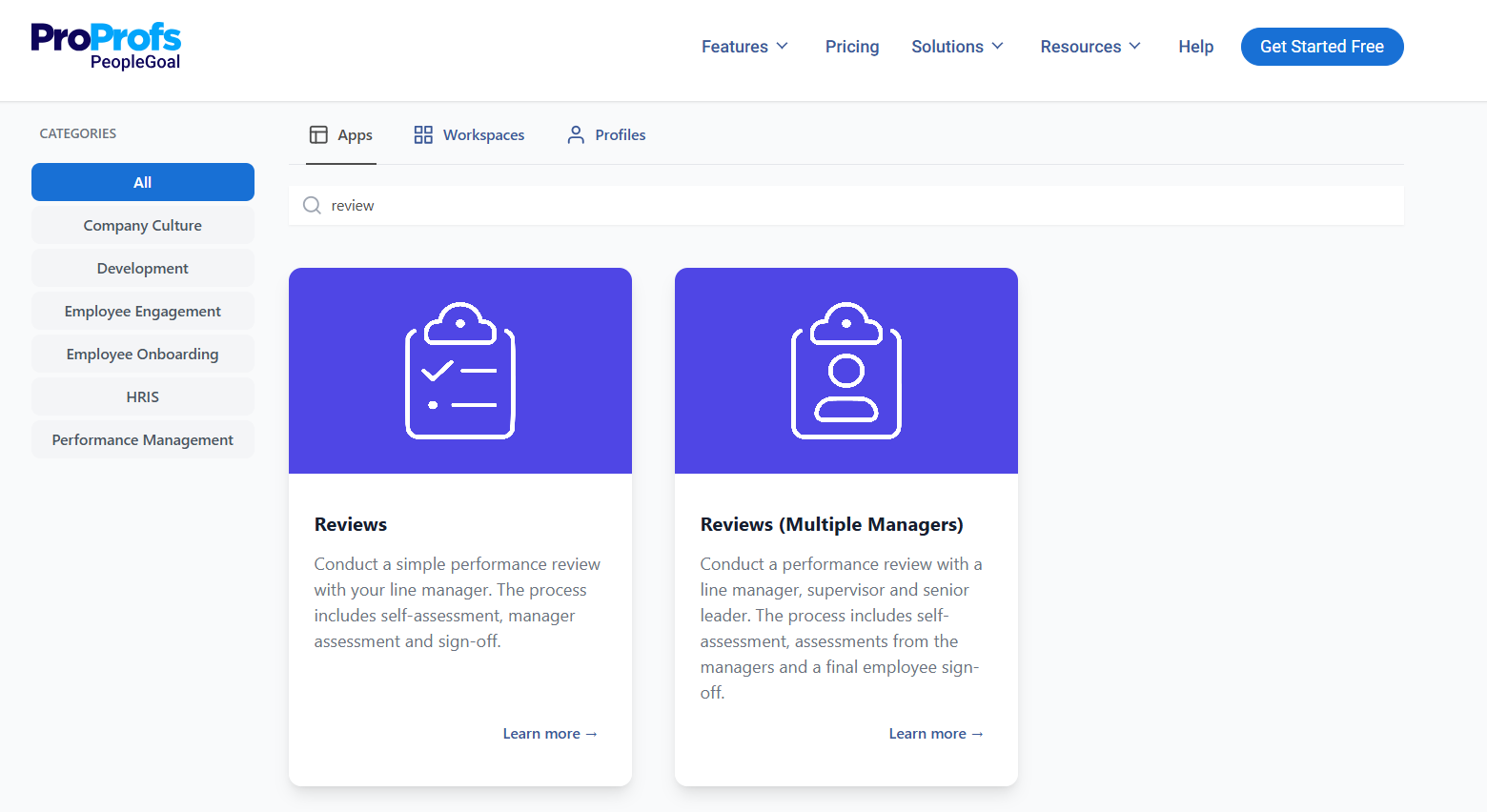
Step 1: Install the Reviews App Template
Go to your PeopleGoal dashboard. Click “Create a new app” and browse the App Store templates. Add the review app to your workspace. You are starting with a proven structure, not building from scratch.
Step 2: Customize the Review Template
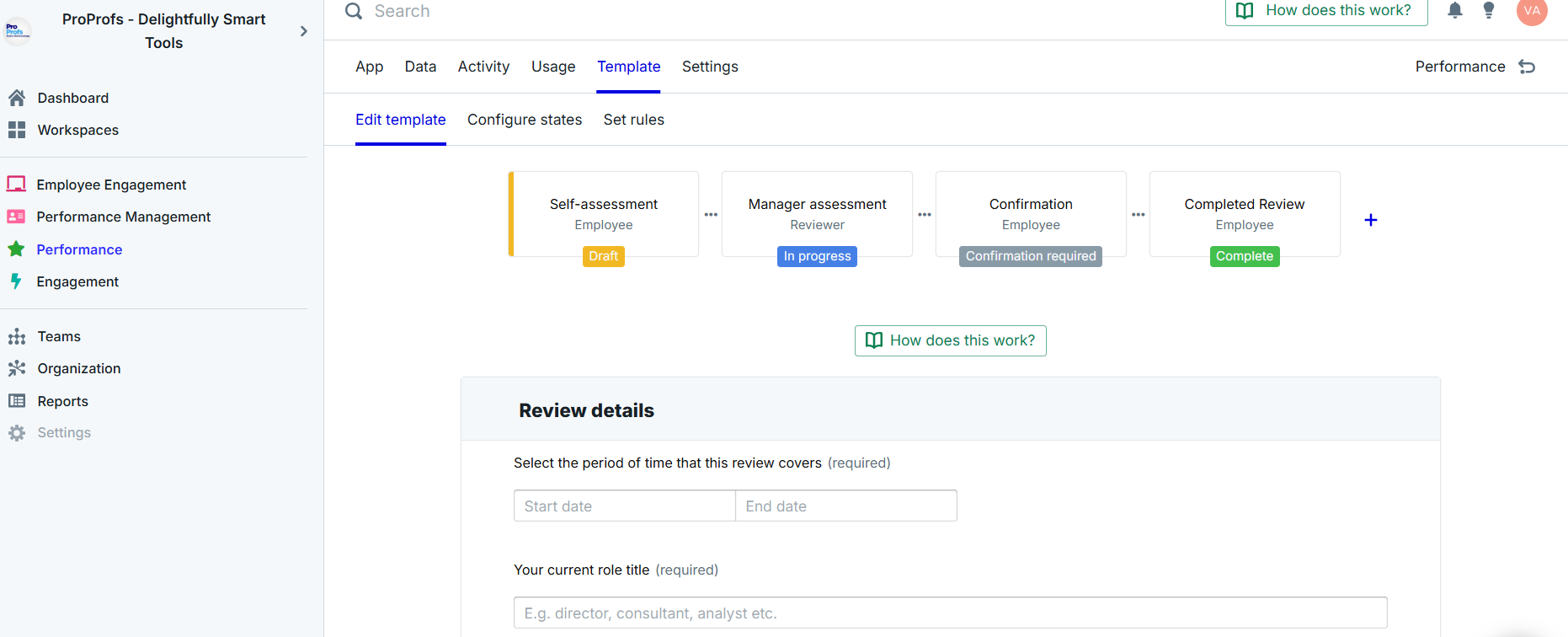
Navigate to Template, then Edit Template. Define your review stages: self-assessment, line manager review, supervisor sign-off, and, as needed, senior leader input. Add form fields that match your evaluation criteria, including text, numerical ratings, and multi-select options.
Step 3: Configure Permissions and Anonymity
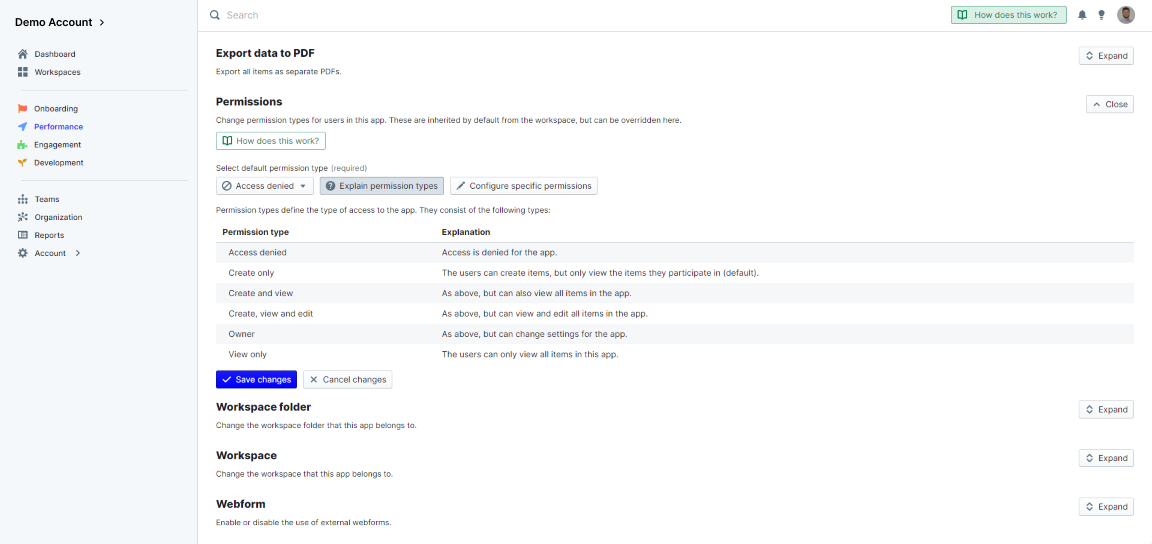
Under Settings and Permissions, set who can access the app, who provides feedback, and what visibility each reviewer has. This step is where you protect anonymity for peer and direct report input.
Step 4: Launch the Review Cycle
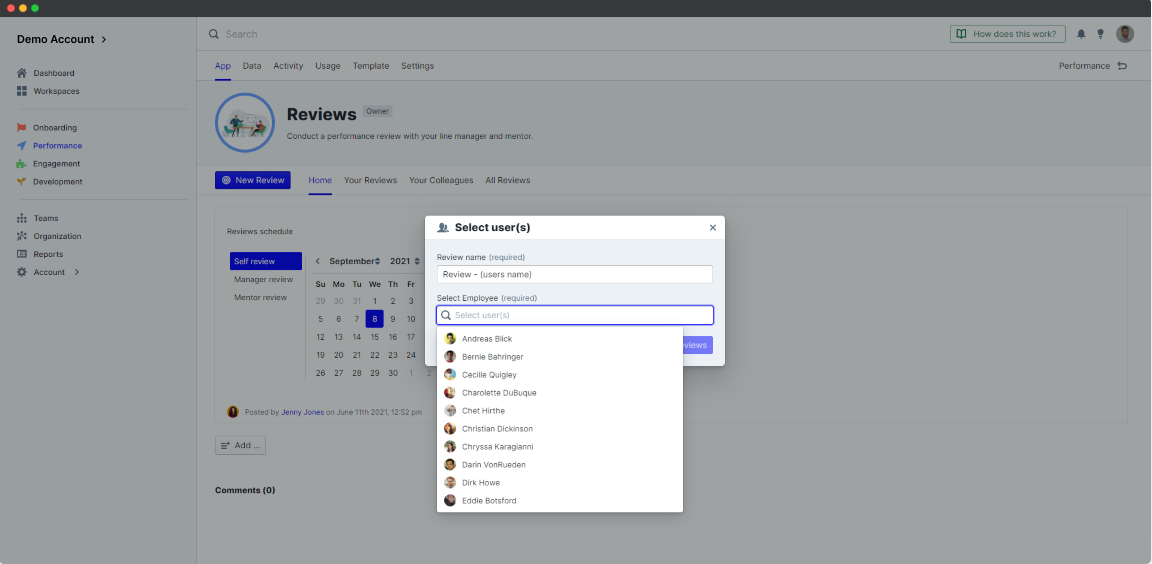
From the App Home, click New Review, select employees or teams, and initiate the cycle. You can run reviews for individuals and cohorts simultaneously.
Step 5: Automate Recurring Cycles
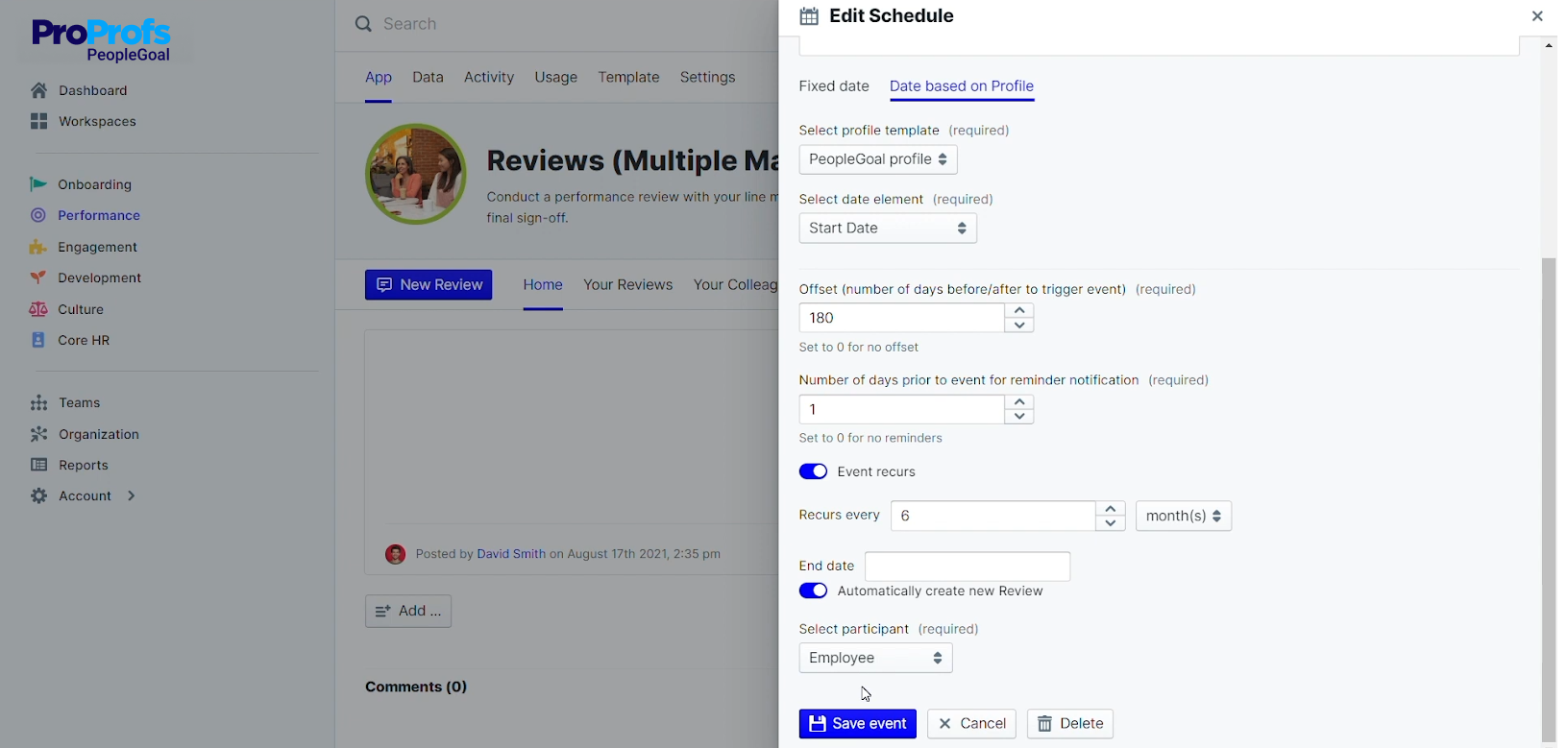
Use the Schedule feature to trigger reviews automatically. Set reviews to launch 180 days after a hire date, recur every 6 months, or align to any calendar period. The system manages reminders. HR tracks completion in the dashboard instead of chasing individuals.
Make Performance Reviews the Engine of Growth, Not the End of It
If there’s one thing I want you to take away from this, it’s this: performance reviews don’t fail because of intent, they fail because of the system behind them. When you move from one-time evaluations to a structured, continuous process, everything changes. Feedback becomes actionable, goals stay relevant, and decisions are backed by real data instead of memory.
That’s exactly where tools like PeopleGoal make a difference. It brings your entire process into one place, from goal tracking and 360-degree feedback to automated review cycles and real-time insights. You’re not chasing forms anymore. You’re actually managing performance.
If you’re serious about fixing your review process, start simple. Map your current gaps, define your review structure, and run your next cycle with a system that supports it end-to-end.
Frequently Asked Questions

What is the difference between a performance review and a performance appraisal?
A performance appraisal focuses on ratings and evaluations. A performance review is broader. It includes feedback, goal-setting, development planning, and a two-way discussion about growth and future performance.
How do you prevent bias in the employee evaluation process?
Collect feedback throughout the year, not just at review time. Use structured criteria, include multiple reviewers, and run calibration sessions. Decisions based on documented evidence reduce the risk of bias.
How often should performance reviews be conducted?
Annual reviews alone are not enough. Most organizations benefit from monthly or quarterly check-ins to keep feedback timely and actionable.
What should managers avoid during performance reviews?
Avoid vague feedback and surprises. Issues should be discussed earlier, not introduced for the first time during the review.
How do you measure if performance reviews are effective?
Look at outcomes. Improved performance, goal completion, and regular feedback conversations indicate the process is working.
What is the biggest mistake companies make with performance reviews?
Relying only on annual reviews. Without continuous feedback and goal tracking, the process becomes a formality instead of driving real improvement.
Ready to 3x Your Teams' Performance?
Use the best performance management software to align goals, track progress, and boost employee engagement.