
I once spent a whole weekend copying survey questions into five languages for a team spread across three countries. Halfway through, I swore I’d never do it by hand again. That’s the kind of pain a tool like CultureMonkey takes away, and it’s a big reason teams love it. It’s also why I get surprised when someone asks me about CultureMonkey alternatives, until they explain that the survey part works great and they’re now asking what comes next.
I’ve helped teams pick, launch, and switch engagement tools for years, and I’ve noticed that surveys are only the first step. After the answers come in, people want to turn them into goals, check-ins, and real changes. CultureMonkey does a lot right, especially for surveys, but every team has its own size, budget, and plans, so it’s smart to know what else is out there.
So I wrote this guide the way I’d explain it to a friend. I compared pricing, walked through how each tool is set up, and thought about what it’s really like for HR teams and managers week after week. By the end, you’ll know which CultureMonkey competitor deserves your free trial.
What Are the Best CultureMonkey Alternatives?
The best CultureMonkey alternatives in 2026 are PeopleGoal, Culture Amp, Leapsome, 15Five, Lattice, and Officevibe. These platforms cover employee engagement with different pricing, setup styles, and extras like goals, reviews, and recognition. If you’ve seen the name written as Culture Monkey, it’s the same tool, and these are the same alternatives.
Why Switch From CultureMonkey?
A study by Gallup in 2026 shows that only 20% of employees worldwide were engaged at work in 2025, the lowest level since 2020. That’s a strong reason to pick a tool that helps you act on what people say. CultureMonkey holds a strong 4.7 out of 5 on G2 from about 60 reviews, and reviewers praise its ease of use and support. Still, a few things come up when teams compare it with other options:
- Pricing isn’t public. G2 shows no pricing for CultureMonkey, and it uses a per-user model, so you’ll need a sales conversation to get a quote.
- The review base is small. With about 60 reviews on G2, there’s much less feedback to read than for larger tools. In one comparison, Lattice had over 3,800 reviews against CultureMonkey’s 57.
- It’s survey-first. CultureMonkey is built for engagement surveys and feedback, so if you also want performance reviews, goals, and development plans in one place, you’ll likely need other tools alongside it.
- Satisfaction scores trail the big names. G2 reviewers report that Culture Amp and Lattice have significantly higher overall G2 scores, even though CultureMonkey’s star rating is strong.
- It may not cover the whole employee experience. One review summary notes it may not cover all aspects of the employee experience, which matters if you want recognition or career tools too.
- It’s a younger vendor. CultureMonkey has served customers since 2019, so it has a shorter track record than long-established platforms.
None of this makes CultureMonkey a bad choice. It makes it a strong pick for teams that want easy, well-supported surveys, including for frontline and multilingual teams. If you want a clearer price, a bigger community of reviewers, or tools that help managers act, one of the tools below is worth a look.
Make Every Survey Lead to a Real Change
12 Best CultureMonkey Alternatives
Here’s a quick side-by-side of how each CultureMonkey alternative stacks up on use case and pricing, before we get into the details.
| Tool | Best For | Starting Price | G2 Rating |
| PeopleGoal | Best fully customizable platform for performance reviews, OKRs & employee development | Free plan available. Paid plans start at $4/user/month. | 4.5/5 |
| Culture Amp | People-science-backed engagement analytics | Custom quote | 4.5/5 |
| Leapsome | All-in-one performance, learning & engagement | Custom quote | 4.8/5 |
| 15Five | Continuous check-ins and manager coaching | $4/user/month | 4.6/5 |
| Lattice | Connecting performance reviews directly to OKRs | Starts at $11/seat/month | 4.7/5 |
| Officevibe | Budget-friendly pulse surveys | Starts at $5/user/month | 4.3/5 |
| WorkTango | Employee voice and lifecycle surveys at scale | Custom quote | 4.7/5 |
| Quantum Workplace | Combining engagement surveys with performance data | Custom quote | 4.3/5 |
| Workday Peakon | Clean employee listening inside Workday | Custom quote | 4.6/5 |
| Winningtemp | Simple pulse surveys with clear pricing | Starts at about €400/year | 4.6/5 |
| Qualtrics Employee Experience | Enterprise survey benchmarking | Custom quote | 4.3/5 |
| Motivosity | Peer-to-peer recognition | Custom quote | 4.7/5 |
Ratings sourced from G2.com as of 2026. Pricing changes often, so confirm current rates directly with each vendor before you buy.
1. PeopleGoal: Fully Customizable Platform for Performance Reviews, OKRs & Employee Development
I moved a team to PeopleGoal when we wanted survey results to lead straight to action. Engagement surveys, goals, check-ins, and feedback all lived in one place, so when the answers came in, I could create next steps right from the same screen.
The survey side was easy to get going. I used a ready-made template with Likert-scale questions and eNPS, picked the anonymity settings, and sent it out. Pulse questions kept the data small enough to actually use.
The App Store was a bonus. I started from a review template, then changed the questions, rating scale, and approval steps with a drag-and-drop builder, without asking a developer for help.
Pros:
- Run pulse surveys, in-depth engagement surveys, and eNPS with configurable anonymity, polls, and an anonymous feedback channel.
- Turn results into action with OKRs, SMART goals, and cascading tasks tracked in real time.
- Collect 360-degree feedback, including anonymous no-login forms, and run structured 1-to-1 meetings.
- Link results to development plans, skills tracking, career pathing, and succession planning.
- Build custom forms and HR apps with the no-code builder, sync with Slack, Teams, Workday, and ADP, and see all features.
Cons:
- No downloadable or on-premise version
- Dark user interface option is not available
How PeopleGoal Compares to CultureMonkey: CultureMonkey is a focused survey platform with great translation and frontline support, and PeopleGoal gives you surveys plus the tools to act on them, including goals, check-ins, feedback, and development plans. You also get a flat, published price instead of a quote. PeopleGoal’s no-code builder lets HR reshape forms and workflows without waiting on a vendor. CultureMonkey still makes sense if multilingual, frontline-friendly surveys are your top priority.
G2 Rating: 4.5/5
Pricing:
Free plan available. Paid plans start at $4/user/month.
2. Culture Amp: Best for People-Science-Backed Engagement Analytics
I leaned on Culture Amp when I needed to understand why one team’s mood kept dipping. The reports turned a pile of survey answers into a story I could share with leadership, and that alone made it worth the setup.

The comment summaries were my favorite part. After a big survey, I used to spend days reading hundreds of open-text answers. Now I get the main themes in minutes and can spend my time on fixes instead.
What I missed was goal tracking depth. I ended up running a simple goals process on the side, so don’t expect it to replace a full performance tool.
Pros:
- Survey design backed by an in-house team of people scientists.
- Large benchmark data lets you compare scores by industry and region.
- Ready-made onboarding, exit, and DEI surveys.
- Storyboards and Slack shoutouts turn data into a clear story, as we explain in our guide to employee engagement survey questions.
Cons:
- There’s no published pricing or free trial.
- Admin customization can feel limited at scale.
How Culture Amp Compares to CultureMonkey: In a G2 comparison, reviewers said Culture Amp has a significantly higher overall G2 score, backed by more than 1,500 reviews, while CultureMonkey is a strong contender for teams that value ease of use. Culture Amp goes deeper on benchmarks and AI summaries. Both use quote-based pricing. Choose Culture Amp if survey depth and a big review base matter most.
G2 Rating: 4.5/5
Pricing:
Custom quote.
3. Leapsome – Best for All-in-One Performance, Learning and Engagement
I tried Leapsome when I wanted reviews and learning to finally talk to each other. After a review, I could assign a learning path based on the skills gap we’d spotted, and that felt like the first time development was actually connected to feedback.
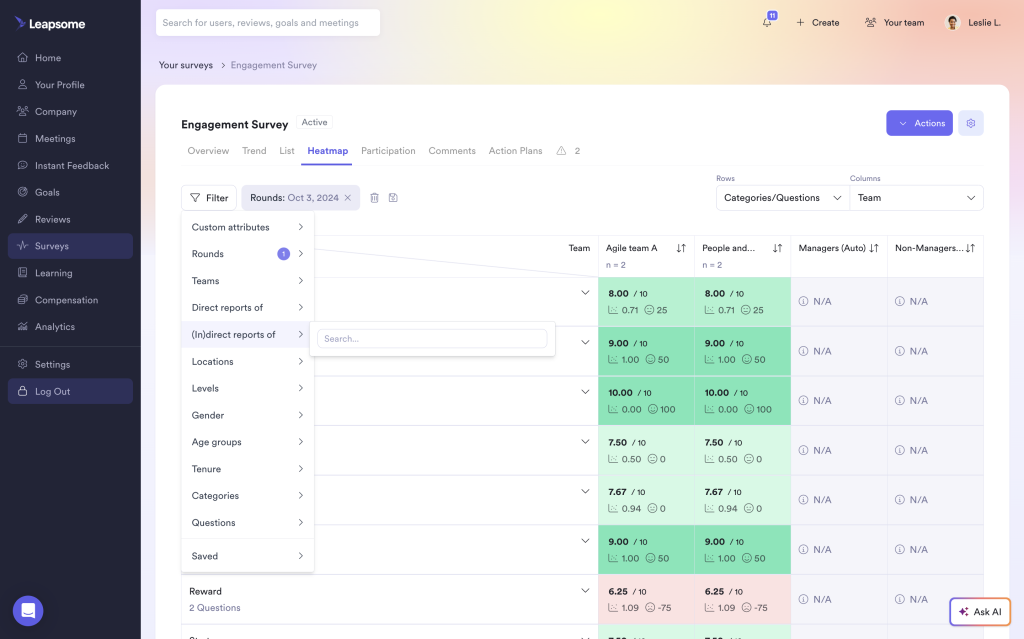
The AI writing help saved me real time. Instead of staring at a blank box during review season, I’d get a starting draft and just edit it to sound like me.
Setup took patience. Getting templates and cycles the way I wanted took longer than I expected, but once it was running, it mostly ran itself.
Pros:
- Reviews, 360 feedback, OKRs, surveys, and learning live in one platform.
- Learning paths link directly to review results.
- AI drafts review language and summarizes open-text survey answers.
- A modern interface that new admins pick up quickly.
Cons:
- Initial setup takes real configuration time.
- Per-module costs can climb as your team grows.
How Leapsome Compares to CultureMonkey: CultureMonkey focuses on surveys, while Leapsome combines surveys with reviews, OKRs, and learning, so a survey result can become a goal or training plan. Leapsome has a higher rating and thousands more reviews. CultureMonkey is praised for easier setup and support, while Leapsome takes more effort upfront. Choose Leapsome if you want engagement and performance in one platform.
G2 Rating: 4.8/5
Pricing:
Custom quote.
4. 15Five: Best for Continuous Check-Ins and Manager Coaching
I rolled out 15Five to a team where managers only talked about performance twice a year. Within a month, the short weekly check-ins had become a habit, mostly because they took about five minutes and nobody felt put on the spot.
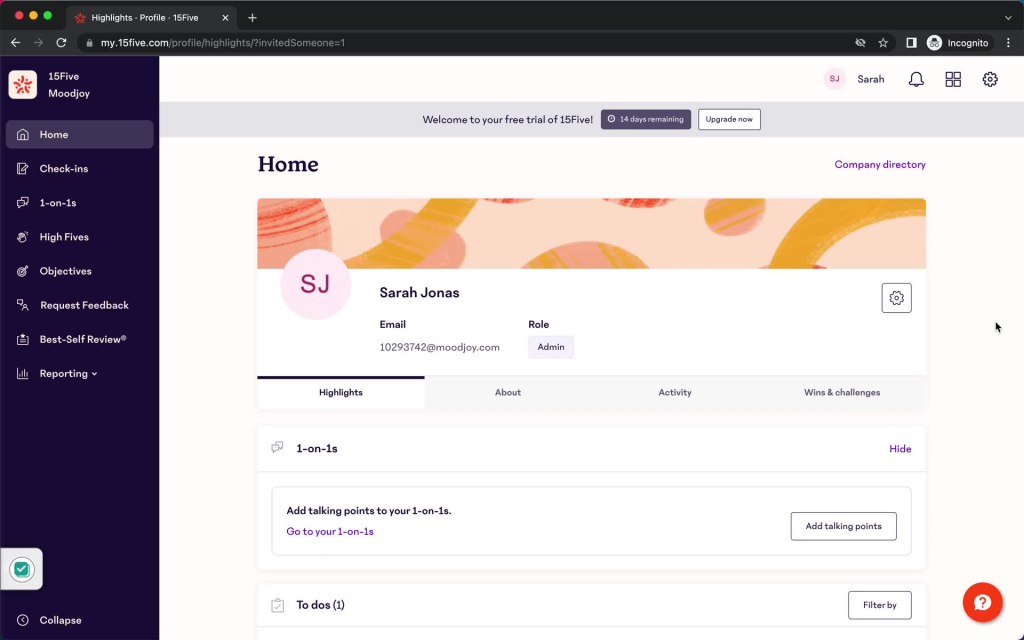
The pulse surveys came with the entry plan, so I got a regular read on morale without running a big survey project. And the manager coaching prompts gave people a clear next step after each result.
It took my managers a few cycles to trust the Best-Self Review approach. It leans toward reflection and growth rather than hard scores, which felt unfamiliar at first.
Pros:
- Short weekly check-ins keep managers and employees talking between reviews.
- Pulse surveys are included in the entry plan.
- Built-in coaching prompts help managers act on feedback.
- The Best-Self Review framework supports continuous feedback and growth.
Cons:
- Advanced reporting and configuration sit in higher tiers.
- It can feel pricey for very small teams.
How 15Five Compares to CultureMonkey: In a G2 comparison, CultureMonkey stood out for exceptional customer service and strong surveying, while 15Five is built around weekly check-ins and manager coaching. 15Five has about 1,800 reviews against CultureMonkey’s 60 and publishes its entry price. Choose 15Five if your managers need help acting on feedback, and CultureMonkey if survey quality is the goal. If 15Five isn’t quite right, our 15Five alternatives roundup covers a few more options.
G2 Rating: 4.6/5
Pricing:
Starts at $4 per user per month, billed annually.
5. Lattice: Best for Connecting Performance Reviews Directly to OKRs
I used Lattice during a quarter when our goals and our reviews felt like two separate worlds. Seeing each person’s goal progress sitting right next to their review made calibration chats so much easier. I stopped digging through old spreadsheets to remember what someone had promised in January.
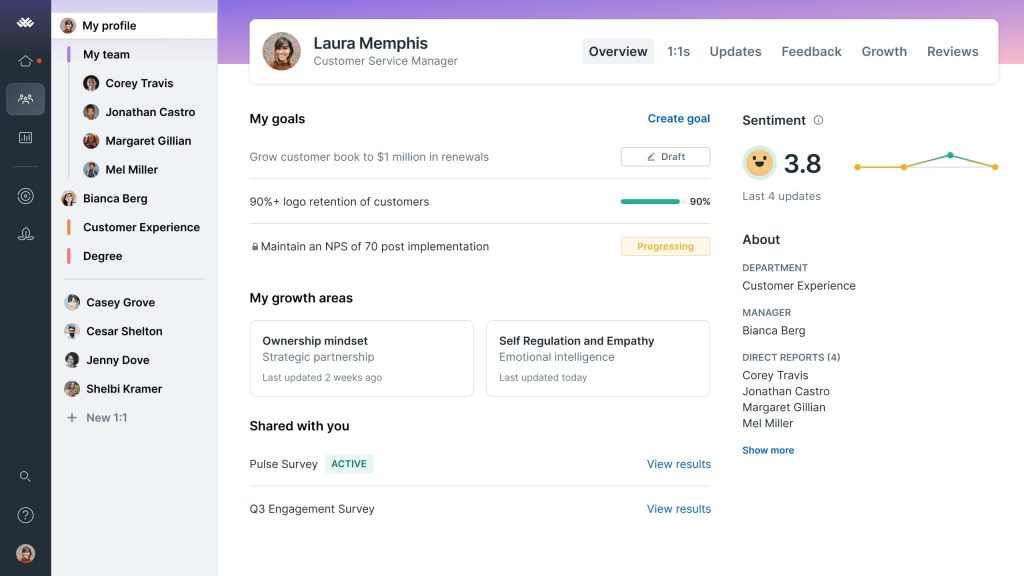
The 1:1 agendas were a quiet favorite. My managers actually used them, mostly because they pulled in goals and past notes automatically, so nobody had to start from a blank page.
The part I’d warn you about is cost creep. I started with the core plan, then added engagement and growth modules later, and the total was noticeably higher than the number I first saw.
Pros:
- Goal progress shows inside each review, a link explained in our guide to OKR software.
- Start with core performance and add engagement, growth, or compensation later.
- Built-in 1:1 agendas pull in goals and past notes.
- Custom review templates, calibration, and sentiment analysis on comments.
Cons:
- Contracts are mostly annual with limited monthly flexibility.
- It depends on an outside HRIS for some employee data.
How Lattice Compares to CultureMonkey: CultureMonkey is survey-first, while Lattice is performance-first with engagement as an add-on. G2 reviewers report that Lattice has a significantly higher overall G2 score and over 3,800 reviews, with a published starting price of $11 per seat. CultureMonkey is simpler and more focused on surveys. Choose Lattice if turning goals into better reviews is your main job.
G2 Rating: 4.7/5
Pricing:
Starts at $11 per seat per month.
6. Officevibe – Best for Budget-Friendly Pulse Surveys
I used Officevibe (now part of Workleap) to check in on a team’s mood every week, and the short anonymous surveys made people more honest than I expected. A quiet designer once flagged that stand-ups felt rushed, and we fixed it within days.

The best part was how light it felt. A few questions a week meant no giant reports, and the manager tips told me what to try next.
It’s not a full performance tool, though. I used it alongside a separate review system, and I wouldn’t expect it to replace one.
Pros:
- Short, anonymous pulse surveys encourage honest answers.
- Gives managers practical next-step suggestions, not just scores.
- Good Vibes lets colleagues send quick thank-yous, which supports an employee recognition habit.
- A built-in 1:1 planner turns survey results into conversations.
Cons:
- Reporting is fairly basic.
- Performance review and goal tools are lighter.
How Officevibe Compares to CultureMonkey: Both tools make surveys simple, but Officevibe leans toward quick weekly pulses, while CultureMonkey offers deeper survey building, translations, and driver-level reports. Officevibe publishes its starting price and has a much larger review base, though it has a 10-user minimum. Choose Officevibe if you want light, regular listening at a clear price.
G2 Rating: 4.3/5
Pricing:
Starts at $5 per user per month for a minimum of 10 users, billed annually.
7. WorkTango: Best for Employee Voice and Lifecycle Surveys at Scale
I tried WorkTango with a team whose people rarely sat at a desk, and the mobile app made a real difference. Surveys that used to get ignored suddenly got answers because people could respond from their phones.
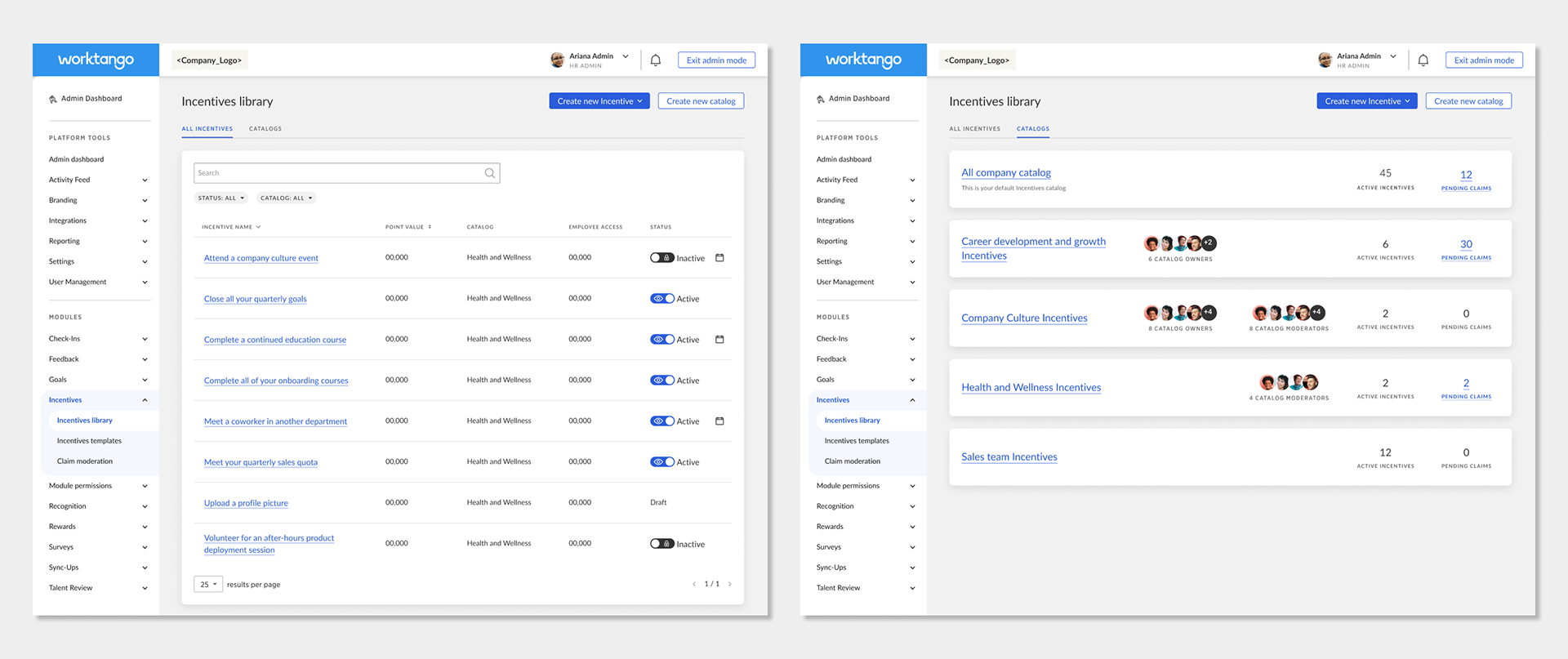
The recognition tools sat right next to the survey engine, so shoutouts tied to company values showed up in the same dashboards as engagement scores. That gave me a fuller picture of morale than surveys alone.
Because the recognition features are newer than the survey tools, I leaned on the vendor’s team more than I expected during rollout.
Pros:
- Deep employee voice and lifecycle surveys.
- Strong DEI analytics and dashboards for HR and managers.
- Recognition data feeds into engagement dashboards.
- A mobile app that works well for frontline and distributed teams.
Cons:
- Recognition features are newer than the survey tools.
- Implementation can need more hands-on guidance.
How WorkTango Compares to CultureMonkey: Both tools reach frontline and distributed teams, and both share a 4.7 star rating on G2. WorkTango adds recognition and rewards and has a far larger review base of about 1,300 reviews, while CultureMonkey scores slightly higher for ease of use and is praised for responsive support. Both use custom pricing. Choose WorkTango if you want surveys and recognition together.
G2 Rating: 4.7/5
Pricing:
Custom quote.
8. Quantum Workplace: Best for Combining Engagement Surveys With Performance Data
I started using Quantum Workplace because I was tired of pulling survey results from one place and review scores from another. Putting them side by side let me see, for the first time, which teams were happy and also doing well.
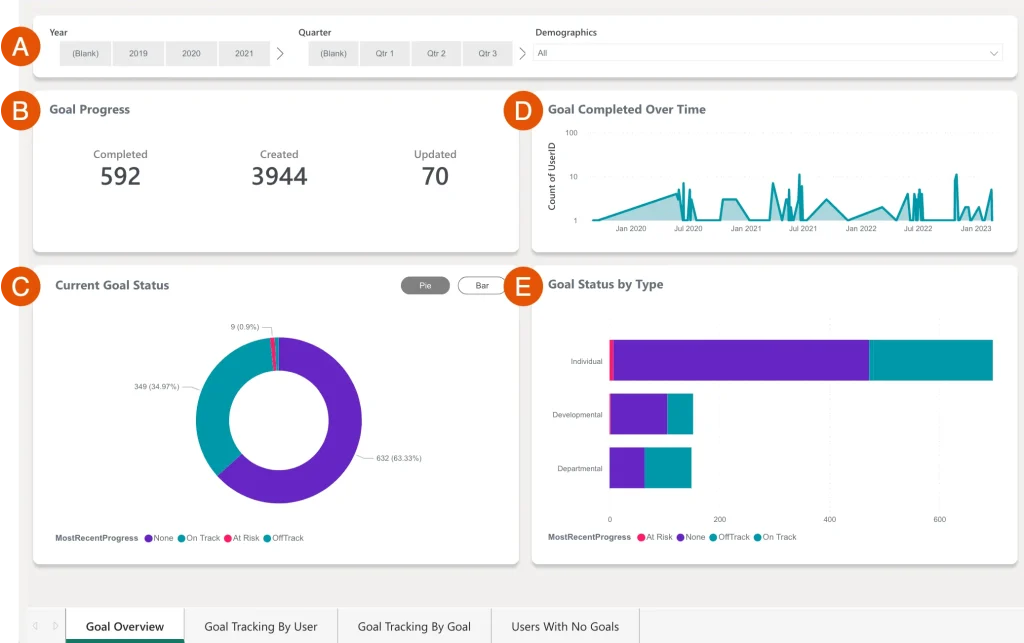
Recognition and check-ins sat in the same view, so I could spot which teams were giving and receiving praise and how that lined up with engagement scores.
Setup needed more planning than I’d expected, so I’d block out some time at the start rather than rushing it.
Pros:
- Engagement surveys, reviews, goals, and recognition in one view.
- Writing suggestions during reviews and goal setting.
- Benchmarks backed by years of workplace research.
- Integrations with BambooHR, Workday, and SAP SuccessFactors.
Cons:
- Customization can feel rigid.
- No published starting price for the full bundle.
How Quantum Workplace Compares to CultureMonkey: CultureMonkey is a focused survey platform, while Quantum Workplace connects engagement data with performance reviews and goals. That helps managers act, but it also means more to set up. Quantum Workplace has hundreds of reviews and a long research base. Choose it if you want engagement and performance in one place.
G2 Rating: 4.3/5
Pricing:
Custom quote.
9. Workday Peakon: Best for Clean Employee Listening Inside Workday
I tried Peakon (now Workday Peakon Employee Voice) with a team that already used Workday, and the first thing I noticed was how clean it felt. Surveys were short, results were easy to read, and managers could respond to comments quickly.
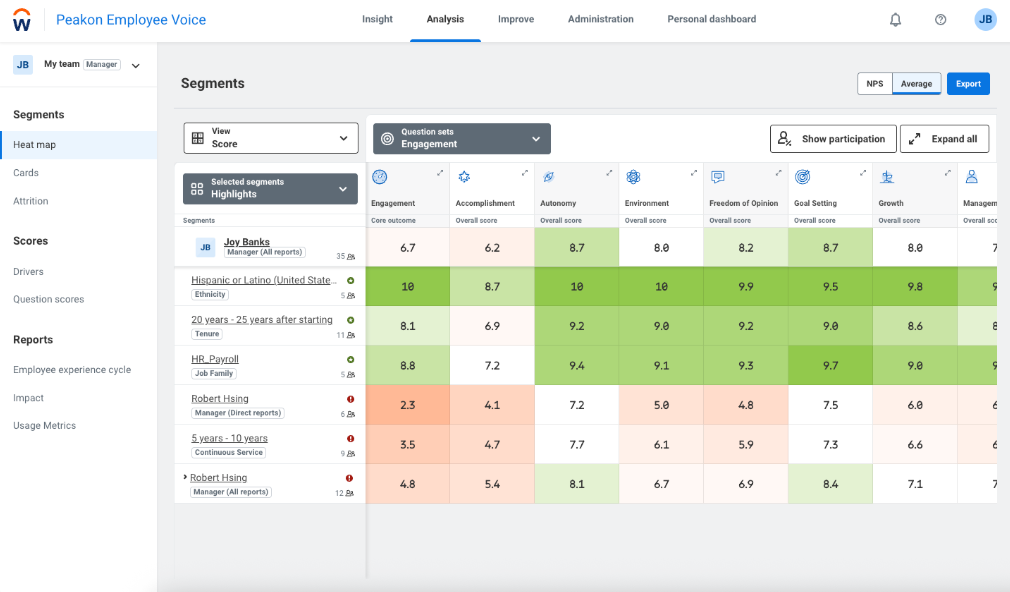
Support was a highlight. When I had questions during setup, I got helpful answers without a long wait.
It’s a listening tool first, so I paired it with a separate platform for goals and reviews.
Pros:
- A clean, quick survey experience that employees find easy.
- Strong pulse survey and reporting scores from G2 reviewers.
- Highly rated customer support.
- Works naturally for teams already on Workday.
Cons:
- Performance reviews and goals aren’t the focus.
- It has a smaller review base than the largest tools.
How Workday Peakon Compares to CultureMonkey: Both tools are listening-first, with strong support and clean experiences, and both have smaller review bases on G2. Peakon is tied to the Workday ecosystem, while CultureMonkey is a standalone survey platform with strong multilingual and frontline features. Both use quote-based pricing. Choose Peakon if you run on Workday, and CultureMonkey if you want a standalone survey tool.
G2 Rating: 4.6/5
Pricing:
Custom quote.
10. Winningtemp: Best for Simple Pulse Surveys With Clear Pricing
I tried Winningtemp with a small, fast-moving team that wanted quick pulse surveys without a long rollout. Setup was light, and the first results came in within days.
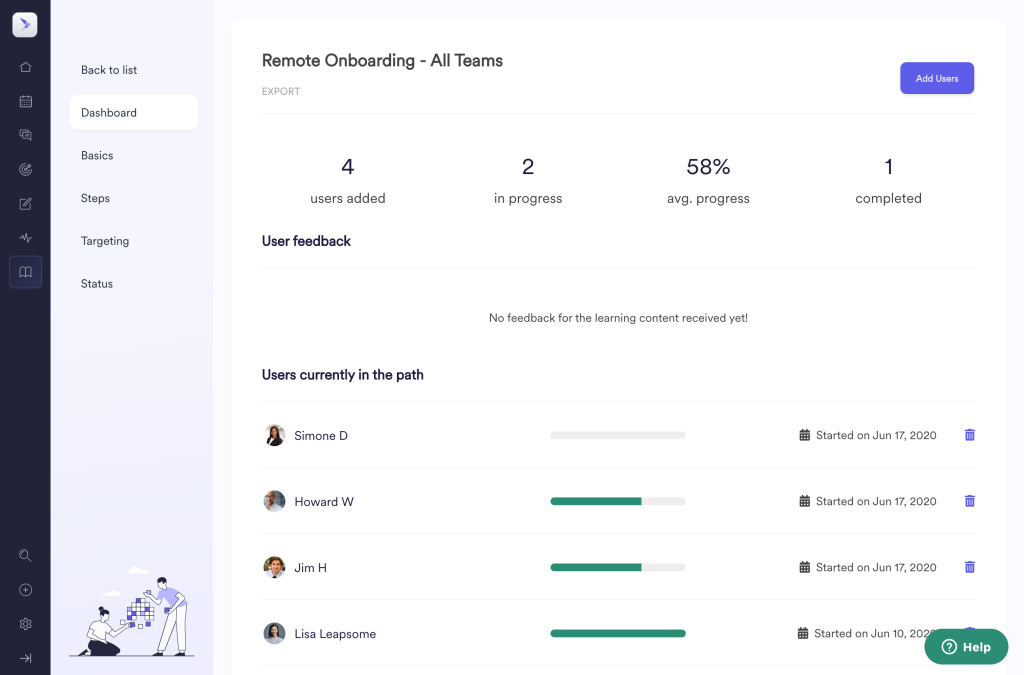
The published pricing was a relief. I could see what it would cost before talking to anyone, which isn’t common among listening tools.
It’s a focused pulse tool, so I wouldn’t expect deep performance features. I paired it with a simple review tool.
Pros:
- Simple pulse surveys that are quick to launch.
- Published pricing that starts at about €400 per year.
- Dashboards that show team mood at a glance.
- Strong 4.6 star rating from reviewers.
Cons:
- Reporting is lighter than in larger platforms.
- Performance reviews and goals aren’t part of the platform.
How Winningtemp Compares to CultureMonkey: Both are focused survey tools with strong ratings and smaller review bases. Winningtemp stands out for showing its pricing, while CultureMonkey stands out for multilingual surveys and driver-level reports. Choose Winningtemp if you want a clear price and quick pulse checks.
G2 Rating: 4.6/5
Pricing:
Starts at about €400 per year.
11. Qualtrics Employee Experience: Best for Enterprise Survey Benchmarking
I worked with Qualtrics Employee Experience at a large company that wanted its survey results compared against big industry data. The benchmarks gave leaders context, so a score never floated in a vacuum.
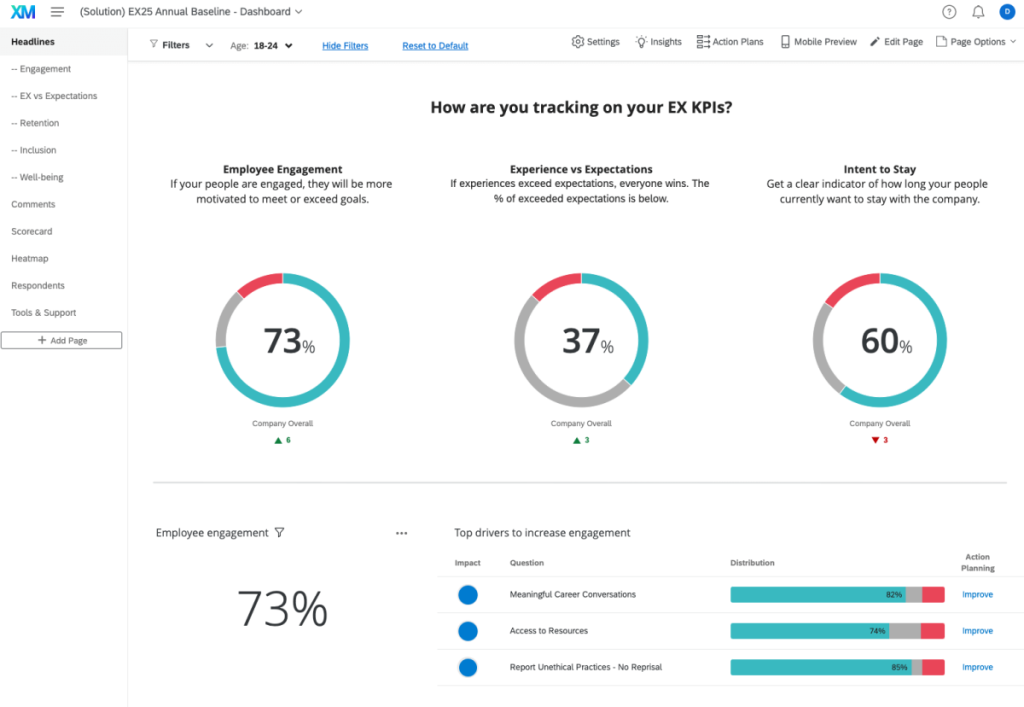
The comment theming was impressive. Thousands of open-text answers were grouped into clear topics without anyone touching a spreadsheet.
It isn’t simple to set up. Configuring it to match our workflow took time, and some admins found the learning curve steep.
Pros:
- A very large benchmarking dataset for context.
- Sentiment analysis and comment theming save manual work.
- Strong reporting across many business units.
- Enterprise-grade security and compliance.
Cons:
- A steeper learning curve for admins.
- It’s heavier than most mid-sized teams need.
How Qualtrics Employee Experience Compares to CultureMonkey: G2 lists Qualtrics among the suggested alternatives to CultureMonkey, and both serve large, global organizations. Qualtrics goes bigger on benchmark data and custom analysis, while CultureMonkey is praised for ease of use and quick setup. CultureMonkey feels lighter to run. Choose Qualtrics if survey science at enterprise scale is your priority. Our roundup of engagement and survey software covers more options.
G2 Rating: 4.3/5
Pricing:
Custom quote.
12. Motivosity: Best for Peer-to-Peer Recognition
I used Motivosity with a team that already had surveys running but nothing tying scores to everyday behavior. Employees could send a thank-you with a small bonus attached, and people noticed that it carried real weight.
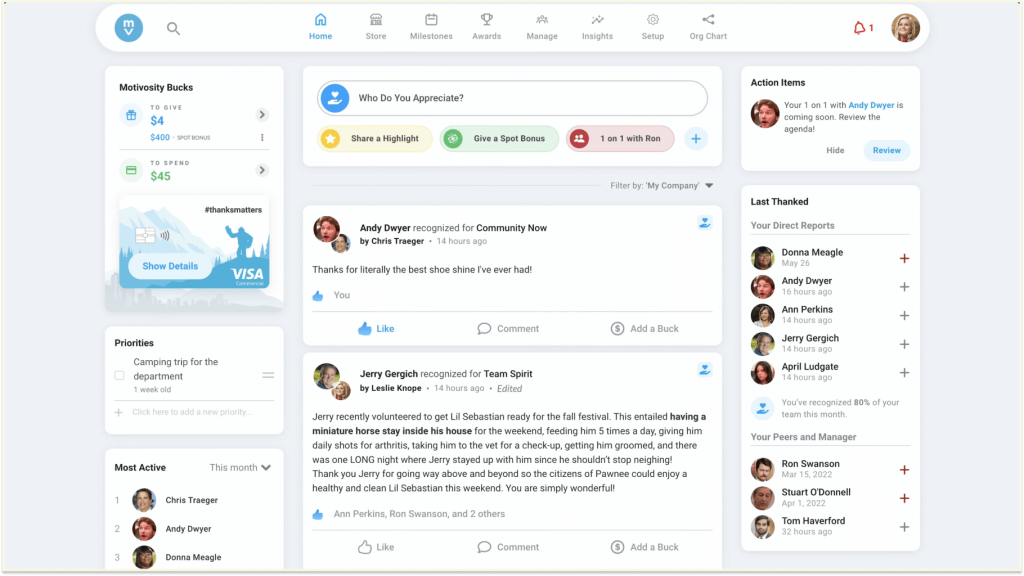
The company feed made appreciation visible, and within a couple of weeks the posts were coming steadily without reminders from me.
It’s recognition first, though. I paired it with a separate tool for surveys and deeper performance work.
Pros:
- Peer-to-peer recognition with small monetary rewards and gift cards.
- A social space where employees share interests and connect.
- Leadership tools for 1:1s, goals, and shared to-dos.
- Engagement surveys linked to recognition insights.
Cons:
- Rollout and administration take more effort than lighter tools.
- Survey benchmarking is lighter than in survey-first tools.
How Motivosity Compares to CultureMonkey: CultureMonkey centers on surveys, while Motivosity centers on recognition and rewards, with surveys as one module. Motivosity has a far bigger review base and a more social feel. CultureMonkey has deeper survey tools like driver-level reports and translations. Choose Motivosity if appreciation is the missing piece.
G2 Rating: 4.7/5
Pricing:
Custom quote.
How I Evaluated These Tools
When I put a list like this together, I don’t just skim feature pages. I look at how each tool holds up once real people are using it. Here’s the checklist I used:
- User Reviews / Ratings: I start with real user feedback on G2 to see what teams love and where they get stuck.
- Core Features & Functionality: I check what matters most in engagement software: surveys, reporting, action planning, and integrations. Our guide to how to choose performance management software covers the wider picture.
- Ease of Use: I pay attention to the moments I personally got stuck, like building a first survey or finding a report.
- Customer Support: I think about how helpful support was when I actually needed it, not just what the sales team promised.
- Value for Money: I compare the price with what you really get, and whether the number on the page is close to what you’ll end up paying.
- Personal Experience / Expert Insights: Wherever I can, I lean on my own time with these tools and on chats with HR peers who’ve run real survey cycles.
My Top 3 Picks for CultureMonkey Alternatives
After going through all 12, three stood out as the best CultureMonkey alternatives for most teams. Which one is right for you depends on what you want your survey data to do.
1. PeopleGoal
PeopleGoal is my top pick because it keeps surveys, goals, and feedback in one place, so results lead to action. I ran an engagement survey, turned the answers into goals and check-ins, and never had to ask for a quote to see the price.
2. Culture Amp
Culture Amp earns the second spot for teams that care most about survey quality. The benchmarks and comment summaries helped me turn answers into priorities, and its large review base made it easy to trust.
3. Leapsome
Leapsome is my third pick if you want engagement, performance, and learning working together. A survey result or review can turn into a learning path, so insight leads to action.
Find a CultureMonkey Alternative That Turns Surveys Into Action
Switching engagement tools isn’t about leaving something behind. It’s about picking a platform where survey answers turn into small, clear actions that managers can take this week, so listening actually changes things.
Think about what happens after a survey closes today. If managers feel stuck, a tool that connects results to goals and check-ins can help. If you need multilingual surveys or deep benchmarks, a survey-first platform may fit better. For ideas on better surveys, see our list of employee engagement survey questions.
Whatever you choose, run one real survey and follow-up cycle before you commit for the year. If you want a tool that bends around the way your team already works, PeopleGoal‘s free trial is a low-effort way to see if it fits.
Frequently Asked Questions
Is CultureMonkey the same as Culture Monkey?
Yes. CultureMonkey is sometimes written as Culture Monkey, and both names refer to the same employee engagement survey platform.
What is the best free alternative to CultureMonkey?
PeopleGoal offers a 14-day free trial with full access and no credit card required. Small teams can also try 15Five or Winningtemp, which publish their starting prices.
Is PeopleGoal cheaper than CultureMonkey?
CultureMonkey doesn't publish its pricing, so a direct comparison needs a sales call. PeopleGoal charges one flat, published rate of $4 per user per month with surveys, reviews, OKRs, and development plans included.
Which CultureMonkey alternative works best for frontline or multilingual teams?
WorkTango and Qualtrics are built for large, distributed workforces, and PeopleGoal supports surveys across teams with configurable anonymity. CultureMonkey itself is known for translations and reaching employees without email.
Which alternative works best for a small team?
PeopleGoal, Officevibe, and Winningtemp have low starting prices and quick setup. Our guide to performance management software for small businesses goes deeper.
How do I run a good engagement survey?
Keep it short, make it anonymous, and plan the follow-up before you send it. Our guides on employee engagement survey templates and employee survey results walk you through it.
Can I move my survey data to a new platform?
Most vendors support CSV or API-based imports, but depth varies. Ask whether the new tool can bring in past survey results and comments, not just employee profiles.
How long does it take to set up a CultureMonkey alternative?
PeopleGoal's pricing page says implementation takes about 1 to 6 weeks depending on company size and needs. Lighter tools like Officevibe and Winningtemp can be running in days.
Ready to 3x Your Teams' Performance?
Use the best performance management software to align goals, track progress, and boost employee engagement.