
I have spoken with HR leaders, managers, and L&D professionals who all shared a similar challenge. Low response rates, vague feedback, and no clear path from survey results to meaningful action.
Those conversations made one thing clear: the software matters as much as the intent behind it. If you are comparing employee engagement survey software right now, you already know why you need it.
You want honest feedback, real participation, and a way to turn results into action before your best people quietly check out. Here is everything I have learned from industry experts and hands-on research about picking the right tool, using it well, and getting your team to actually respond.
What Is Employee Engagement Survey Software?
I use the best HR software for employee engagement surveys because it solves problems a spreadsheet never could:
- Real-time signals: I see disengagement building before it shows up in exit interviews.
- Honest data: Anonymous responses give me feedback people would never say to my face.
- Faster decisions: Dashboards replace hours of manual data entry and guesswork.
- Proof of action: I can show leadership and employees that survey results actually change something.
- Retention impact: Catching low morale early costs far less than replacing someone who quietly quits.
10 Best Employee Engagement Survey Software
I have used or closely evaluated every tool on this list. Here is exactly where each one earns its spot, starting with the one I would set up first.
| Software | Best For | Starting Price | User Rating(G2) |
| PeopleGoal | Fully customizable platform for performance reviews, OKRs & employee development | Paid starts at $4/user/month. (14-day free trial) | 4.5/5 |
| ProProfs Survey Maker | AI-powered, pre-built employee surveys | Starts at $19.99/month | 4.3/5 |
| CultureMonkey | Enterprise and AI-Driven employee insights | Custom Quote | 4.7/5 |
| Culture Amp | Science-backed benchmarking data | Custom Quote | 4.5/5 |
| Officevibe (Workleap) | Affordable weekly pulse surveys | Starts at $4,999 | 4.3/5 |
| Qualtrics | Enterprise-grade experience management | Custom Quote | 4.4/5 |
| 15Five | Continuous feedback and check-ins | Starts at $4/user/month, billed annually | 4.6/5 |
| Lattice | Science-backed survey templates | Starts at $13/user/month | 4.7/5 |
| Motivosity | Boosting morale through recognition | Custom Quote | 4.7/5 |
| PerformYard | Flexible goals tied to engagement data | Starts at $5-10/person/month | 4.7/5 |
1. PeopleGoal – Fully Customizable Platform for Performance Reviews, OKRs & Employee Development
I use PeopleGoal’s engagement surveys to run pulse checks and full quarterly feedback without switching tools, and the expert-designed templates mean I am not staring at a blank page writing questions every cycle. Anonymous webform responses remove the fear factor, so people actually tell me what is wrong instead of what sounds safe in a meeting.
What genuinely changed how I work is watching engagement trends unfold over time, which lets me catch dissatisfaction weeks before it ever shows up in an exit interview. I follow the same five-step rhythm every single quarter: define the survey goal, choose the right format, lock in anonymity, automate distribution, then analyze and act on what comes back.
Sticking to that sequence is the real reason our engagement scores have actually moved instead of just being measured and quietly forgotten. It also means every manager on my team knows exactly what happens after a survey closes, which is half the reason people bother responding honestly in the first place.
Pros:
- Goals, OKRs, and engagement surveys stay in one platform, keeping performance and engagement data unified.
- Build fully customized surveys with Likert scales, eNPS, and open-ended questions for balanced feedback.
- Anonymous webform responses encourage honest feedback that employees would not put their name on.
- Automated trend analysis flags disengagement and dissatisfaction before they turn into retention problems.
- BambooHR, Workday, and Slack integrations eliminate manual employee data syncing.
- Responsive support ensures smooth setup and faster rollout.
Cons:
- No downloadable or on-premise version
- Dark UI mode is not currently available
User Rating: 4.5/5 (G2)
Pricing: 14-day free trial. Paid starts at $4/user/month.
2. ProProfs Survey Maker – Best for AI-Powered, Pre-Built Employee Surveys
When someone needs a survey to live in an hour, not after a week of vendor back and forth, this is what I open first. ProProfs Survey Maker gives me over 100 ready-to-use templates for satisfaction, engagement, and pulse surveys, so I am never starting from a blank page when a leader asks for a survey by Friday.
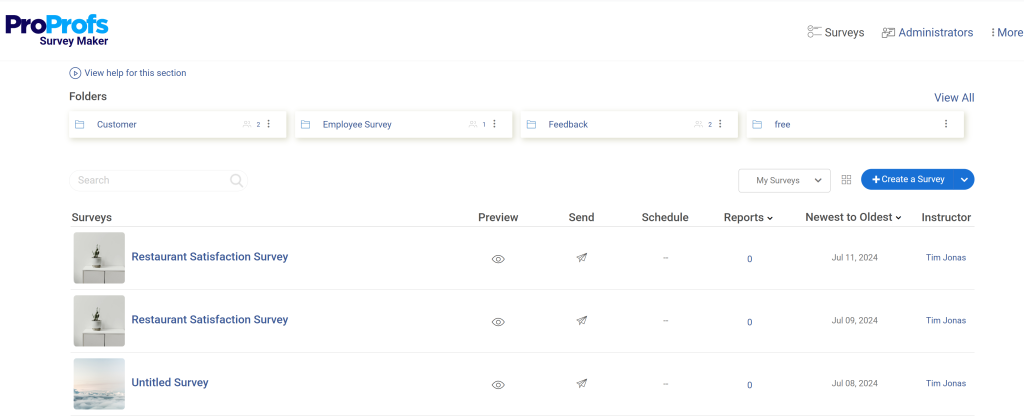
The branching logic adapts questions based on how someone answered the last one, which keeps the survey feeling relevant instead of generic and repetitive. Anonymous surveys and automated reminders keep response rates healthy without me manually chasing anyone down.
And the advanced reporting turns raw data into exportable charts I can drop straight into a leadership update without reformatting anything. For a small HR team without a dedicated analyst, that alone saves a real afternoon every single quarter.
Pros:
- Covering satisfaction, engagement, and exit surveys, so I can launch something relevant without writing questions from scratch.
- Questions adapt based on prior answers, which keeps surveys feeling personal instead of generic.
- Logos and colors match our company identity, so surveys feel like ours instead of a third-party form.
- Reports and trend charts drop straight into a leadership deck, saving me hours of manual formatting.
Cons:
- No dedicated admin support on the free plan
- No downloadable or on-premise version
- No dark mode
User Rating: 4.3/5 (G2)
Pricing: Start at $19.99/month.
3. CultureMonkey – Best for Enterprise and AI-Driven employee insights
Half my workforce never sat at a desk, so email-only surveys were quietly missing every one of them. CultureMonkey covers engagement, pulse, lifecycle, onboarding, and exit surveys in one system, so I stopped juggling three separate tools just to hear from every employee.
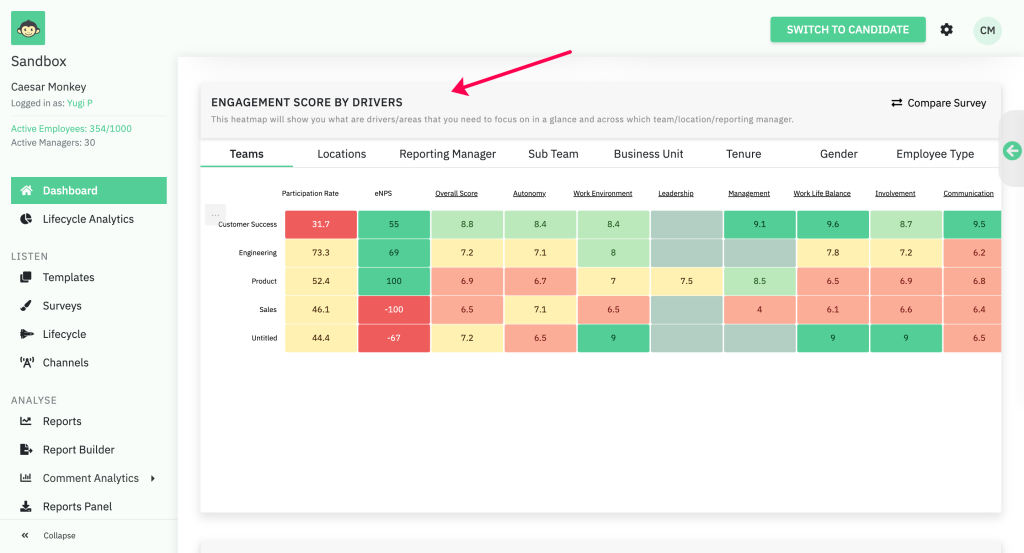
This reaches people over SMS, WhatsApp, QR codes, and kiosk mode when email simply does not work, which meant our warehouse and retail staff finally started responding at the same rate as our office team. The AI-powered sentiment analysis on open-text responses saved me hours I used to spend reading comments manually, and it surfaces recurring themes I would have missed on my own.
What sold me long term was the native HRIS integration. Workday, SAP SuccessFactors, BambooHR, and ADP all sync cleanly, so engagement data sits right next to the rest of my HR system instead of living in a separate spreadsheet.
Pros:
- Engagement, pulse, onboarding, and exit surveys all live in one platform, so I don’t have to stitch data together from different tools.
- SMS, WhatsApp, QR codes, and kiosk mode get responses from deskless employees who would otherwise never see an email survey.
- This multilingual employee engagement survey software lets global teams respond in their own language, boosting participation across regions.
- Action planning with progress tracking is built in, so results become owned tasks rather than sitting in a report.
- Workday, BambooHR, and ADP sync automatically, eliminating manual data uploads each cycle.
- Structured implementation support makes it easier to pass a security review with our legal team.
Cons:
- No published per-user pricing, so budgeting requires a sales conversation
- Implementation runs for a structured five weeks, longer than some lighter tools
User Rating: 4.7/5 (G2)
Pricing: Custom Quote
4. Culture Amp – Best for Science-Backed Benchmarking Data
Leadership wanted proof our numbers meant something against companies our size, and this is where I turned. Culture Amp brings actual organizational psychology into survey design instead of generic marketing questions, with pre-built templates for engagement, exit, and even well-being checks that I did not have to validate myself.

Heat maps break results down by location, team, or function, so I can spot a struggling department in seconds instead of digging through a spreadsheet. The benchmark library is genuinely one of the deepest I have used, and it is the reason I bring this tool in whenever a leadership team wants proof that our scores mean something against similar companies, not just against ourselves.
It takes real setup time to get the most out of it, and it works best with someone on the team comfortable reading statistical detail, but for organizations that need defensible, research-backed numbers in front of a board, I have not found a stronger option.
Pros:
- Deep comparisons of data across industries and company sizes help me defend our scores in front of leadership.
- Engagement, exit, and pulse surveys are ready to launch, so I am not building question sets from scratch.
- Results break down by location, team, or function, making it easy to spot exactly where morale is slipping.
- Trusted by large, well-known organizations, which makes it an easier sell when leadership wants proof that the platform is reliable.
Cons:
- Pricing is not published and typically requires a sales conversation
- Can feel rigid for smaller teams without a dedicated people analytics resource
- No free trial or free plan available
User Rating: 4.5/5 (G2)
Pricing: Custom Quote
5. Officevibe (Workleap) – Best for Affordable Weekly Pulse Surveys
Smaller HR teams that want continuous listening without an enterprise budget tend to end up here. Officevibe sends automated weekly pulse surveys covering ten engagement metrics, recognition, wellness, and relationship with manager, among them, so I get a current read on morale instead of waiting for one big annual number.
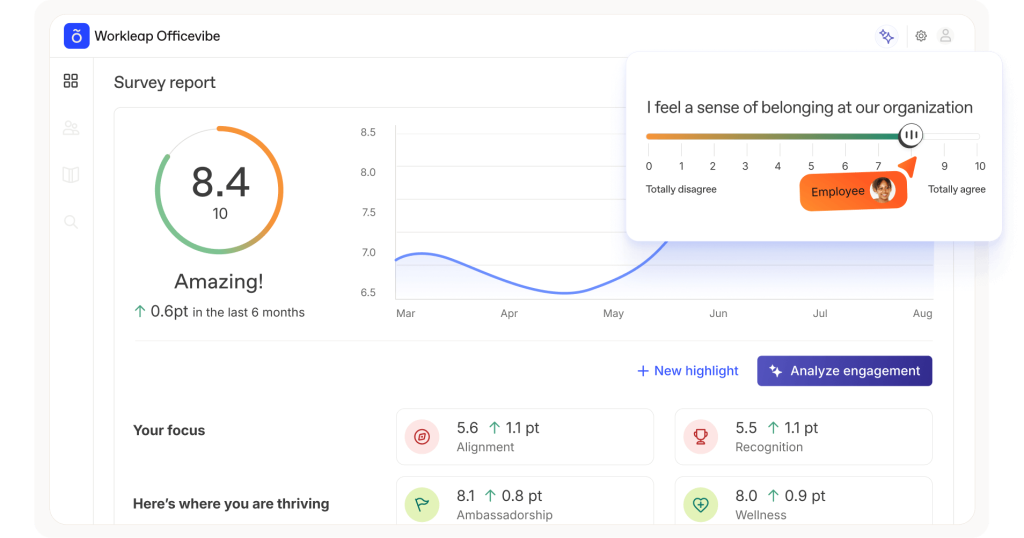
The anonymous feedback channel lets employees message their manager directly without revealing who sent it, and that single feature has surfaced issues that formal surveys and one-on-ones never picked up.
I brought this in for a 40-person team that did not need Culture Amp’s depth or Qualtrics’ price tag, and it hit exactly the right level of simplicity. Setup took an afternoon, not a project plan, and the built-in recognition feed gave managers an easy way to acknowledge good work without adding another separate tool to the stack.
Pros:
- Ten engagement metrics get tracked continuously, so I see morale shifts in real time instead of once a year.
- Employees can flag issues directly and privately, which surfaces problems formal surveys tend to miss.
- A built-in feed lets managers acknowledge good work without adding a separate recognition tool.
- Simple pricing and quick onboarding make it realistic for smaller teams without a dedicated HR analyst.
Cons:
- Not a full performance management platform on its own
- Analytics depth is lighter than Culture Amp or Qualtrics for advanced statistical needs
- Smaller integration ecosystem than enterprise-focused platforms
User Rating: 4.3/5 (G2)
Pricing: Starts at $4,999
6. Qualtrics – Best for Enterprise-Grade Experience Management
One client needed customer, employee, and brand experience measured under a single umbrella, not three separate tools. Qualtrics goes well beyond basic surveys with predictive analytics that flag trends before they become real problems, so leadership sees a risk forming rather than reading about it after someone has already resigned.
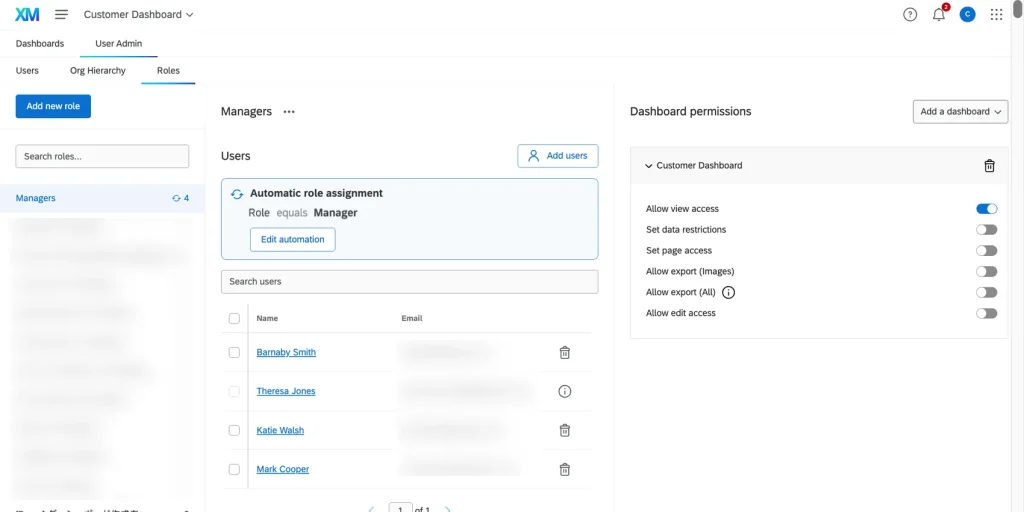
The action-planning tools turn raw feedback into structured next steps with assigned owners, which is rare at this level of enterprise scale. The open API means it plugs into almost any existing tech stack without forcing a rebuild, and I have used it to pull employee experience data into the same dashboards as customer and product feedback for one client, which made the entire experience management story easier to tell to their board.
It is genuinely one of the most capable platforms on this list, but the price and the setup effort only make sense once you are operating at real enterprise scale, with a team ready to actually use everything it can do.
Pros:
- Flags emerging trends and sentiment shifts before they become retention problems, giving leadership a real head start.
- Feedback converts into next steps with clear ownership, not just a chart nobody follows up on.
- Connects to almost any existing tech stack, so I am not forced into a system rebuild to adopt it.
- Multiple language support makes it realistic to run one consistent survey across international offices.
Cons:
- Perceived as expensive, particularly for smaller organizations
- Long surveys can cause respondent fatigue if not carefully designed
- Platform updates have occasionally disrupted existing workflows
User Rating: 4.4/5 (G2)
Pricing: Custom Quote
7. 15Five – Best for Continuous Feedback and Check-Ins
Teams that want engagement data inside weekly manager conversations, not a separate report, tend to land here. 15Five bundles weekly check-ins, OKR tracking, and one-on-one meeting agendas together, so engagement survey results feed straight into the conversations managers are already having, instead of sitting in a report nobody revisits.
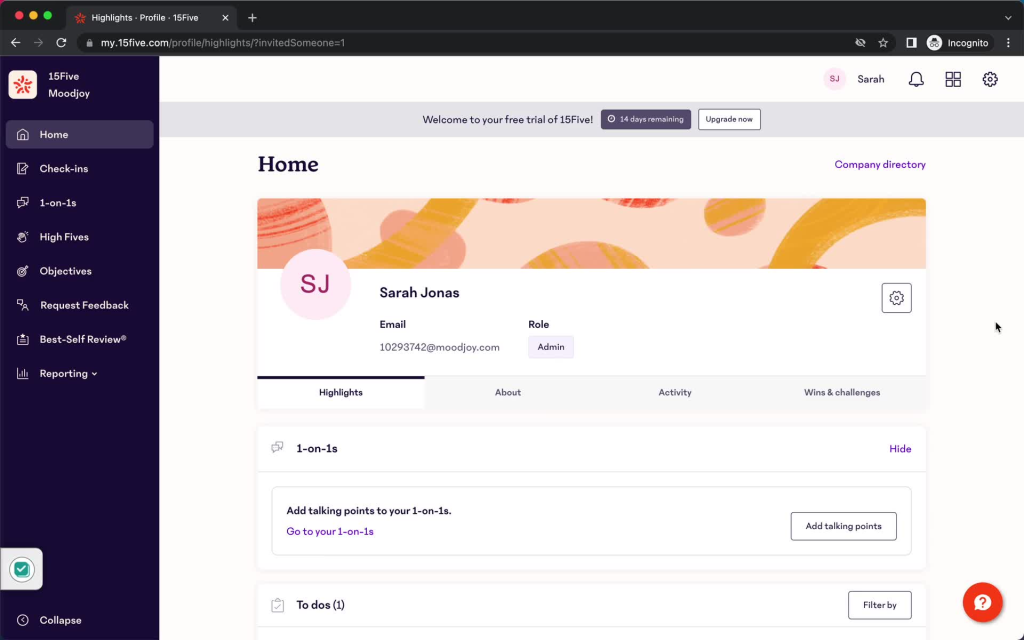
I like that a manager can see a dip in someone’s sentiment on Monday and actually bring it up in that week’s one-on-one, rather than waiting for a quarterly review to notice. The Engage plan is specifically built for engagement surveys, delivering actionable insights without forcing smaller teams into the full performance management suite before they are ready.
Rollout was faster than I expected because most managers were already living in the check-in workflow, so adding engagement data on top felt like an extension of something familiar rather than a brand-new system to learn, and nobody needed a separate onboarding session to get started.
Pros:
- Keep engagement data current between formal survey cycles, so managers catch dips before the next quarterly report.
- Goals and engagement data live in the same platform, connecting sentiment directly to what someone is working toward.
- Meeting agenda templates give managers a natural place to act on survey results immediately.
- Distributed and remote teams can check in and respond from anywhere, which keeps participation consistent.
Cons:
- Customization options are limited for organizations wanting a fully branded experience
- Getting full value out of every feature takes real training investment
- Heavy emphasis on positive feedback can soften honest performance signals
User Rating: 4.6/5 (G2)
Pricing: Starts at $4/user/month, billed annually.
8. Lattice – Best for Science-Backed Survey Templates
A company I worked with wanted engagement surveys and performance reviews to actually talk to each other. Lattice combines customizable engagement surveys with automated performance reviews and goal management, so a low engagement score can trigger a real coaching conversation instead of getting buried in a dashboard nobody opens.
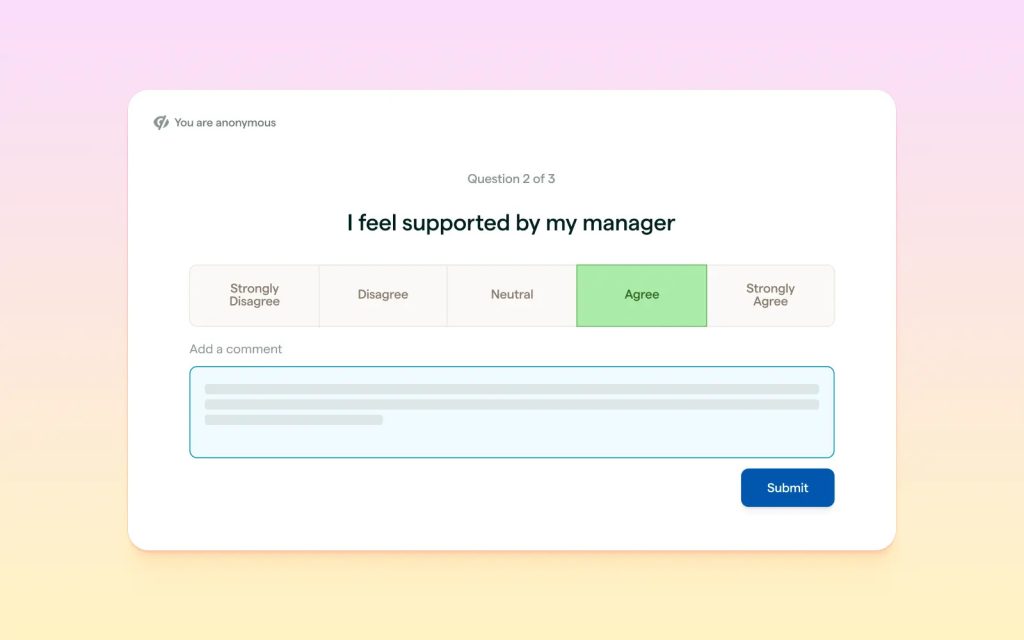
I set up a survey once and watched a manager pull the results straight into that employee’s next review cycle without exporting a single spreadsheet, which is exactly the kind of connection most standalone survey tools cannot offer.
The interface is intuitive enough that adoption was fast across both HR and frontline managers, and I did not need a lengthy training session to get people comfortable with it. It leans more toward performance management than deep survey science, so if benchmarking and statistical depth matter most to you, this will feel lighter than Culture Amp, but if you want engagement and reviews genuinely talking to each other, it earns its place.
Pros:
- Built for flexibility, so questions match exactly what I need to track for a specific team or cycle.
- Cuts administrative overhead significantly, freeing up time that used to go into manual review tracking.
- A genuinely user-friendly interface meant HR and frontline managers picked it up without a long training cycle.
- Engagement data ties directly to performance goals, so a low score can prompt a real coaching conversation.
Cons:
- Learning management features are limited compared to dedicated LMS tools
- Integration with complex existing tech stacks can require extra setup work
- Heavy reliance on metrics may overshadow qualitative engagement signals
User Rating: 4.7/5 (G2)
Pricing: Starts at $13/user/month.
9. Motivosity – Best for Boosting Morale Through Recognition
Sometimes the real problem is not a lack of data, it is a lack of visible appreciation between teammates, and that is where this fits. Motivosity centers on peer-to-peer recognition through a social feed where employees celebrate each other’s wins in public, which changed the tone of one team I worked with almost immediately.
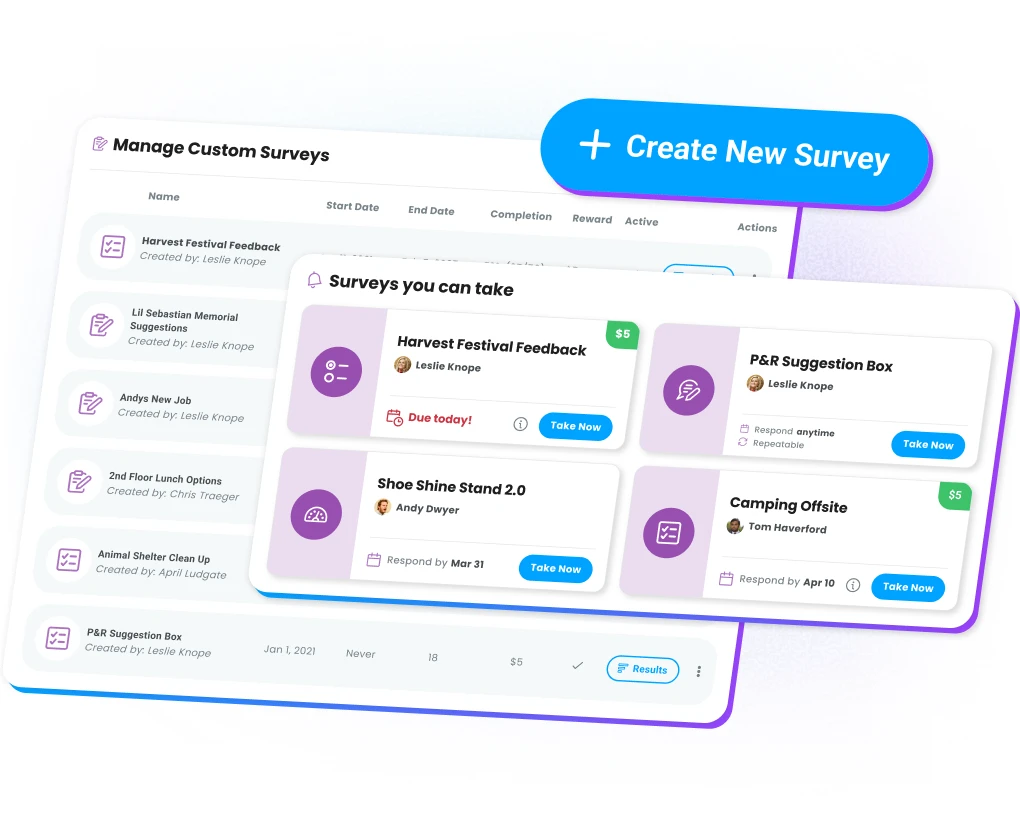
It is paired with employee feedback and survey tools that capture sentiment alongside the recognition data, so I can see whether visible appreciation is actually moving engagement scores or just generating likes on a feed.
Rewards, gift cards, and bonuses give teams a tangible way to reinforce good work instead of only tracking it on a dashboard, and the personalized dashboard makes it easy for someone to see their own recognition history at a glance.
Pros:
- A public social feed lets teammates celebrate wins directly, which lifts morale faster than data alone ever does.
- Gift cards and bonuses give recognition real weight instead of just a thumbs-up on a feed.
- Employees can see their own recognition history in one place, reinforcing that contributions are actually noticed.
- Turns recognition into an engaging, ongoing habit rather than a one-time event tied to reviews.
Cons:
- Reward options can feel limited for organizations wanting more variety
- Effectiveness depends heavily on consistent employee participation
- Occasional friction adjusting to platform updates
User Rating: 4.7/5 (G2)
Pricing: Custom Quote
10. Perform Yard – Best for Flexible Goals Tied to Engagement Data
One HR team wanted engagement insight without inheriting a rigid, one-size-fits-all review process, and this filled the gap. PerformYard keeps performance reviews structured but flexible, with goal setting, individual development plans, and automated workflows that reduce the manual chasing most HR teams get stuck doing every review cycle.
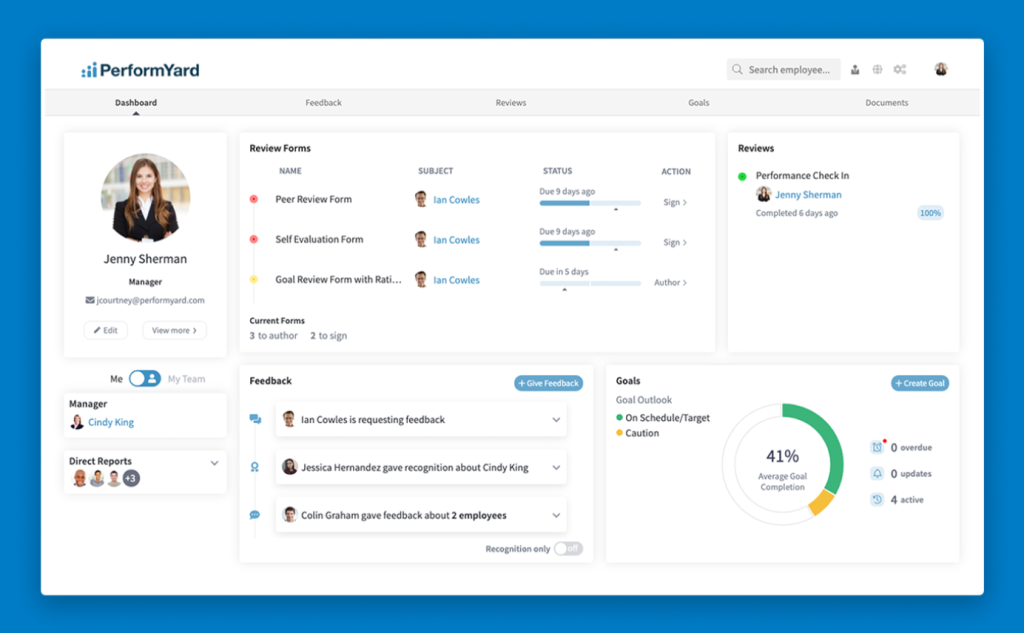
What made it worth including here is the separate Employee Engagement Plan, which lets you add survey capability without paying for the full performance management suite if you are not ready for that investment yet.
I used this with a client who wanted engagement data but had already built their own review process and did not want to replace it, and PerformYard slotted in without forcing a rebuild. The customizable performance metrics allowed us to tailor reporting to their specific industry, rather than settling for a generic template.
Pros:
- Connects directly to individual development plans, so growth conversations have real data to back them up.
- Performance review tasks run on autopilot, cutting down the manual chasing HR teams usually get stuck doing.
- Lets you add survey capability without paying for the full performance suite before you are ready.
- Reporting adapts to specific industries or roles rather than forcing every team into a single generic template.
Cons:
- Interface customization has some limitations for specific branding needs
- Learning curve for teams new to structured performance management
- Complex custom reports can be harder to configure
User Rating: 4.7/5 (G2)
Pricing: Starts at $5-10/person/month
My Top 3 Employee Engagement Survey Software Picks
After reviewing features, ease of use, reporting, and real user feedback, these are the three tools I would recommend most.
1. PeopleGoal
PeopleGoal is my top choice because it combines engagement surveys with performance management, OKRs, 360-degree feedback, 1:1 meetings, and career development in one platform. Instead of collecting feedback and switching to another tool to act on it, HR teams can connect survey insights directly to employee growth and manager action plans.
2. ProProfs Survey Maker
ProProfs Survey Maker rounds out my top three because it makes employee engagement surveys fast and accessible for organizations of any size. AI-powered survey creation, ready-made templates, anonymous feedback, multilingual support, and easy-to-understand reports help HR teams launch surveys quickly and turn results into actionable insights.
3. CultureMonkey
CultureMonkey earns the second spot for its strong focus on improving participation, especially among frontline and deskless employees. Its multilingual surveys, mobile-first experience, AI-powered insights, and action planning tools make it a great fit for organizations with distributed or global teams.
How I Evaluated These Employee Engagement Survey Tools
When I evaluate employee engagement survey software for a list like this, I do not just rely on feature lists or marketing claims.
I look at how these employee engagement survey tools actually perform in real-world scenarios. Here is the framework I used to make sure every recommendation is practical, reliable, and worth considering.
- User Reviews / Ratings: I start by looking at real user feedback from platforms like G2. This gives me a clear picture of how teams actually experience the tool day to day, what they love, and where it falls short.
- Core Features & Functionality: I focus on what truly matters in employee engagement survey software. This includes pulse surveys, anonymity, templates, reporting, and integrations. If a tool cannot handle these well, it does not make the cut.
- Ease of Use: I pay close attention to how intuitive the platform feels. A tool might be powerful, but if employees and managers struggle to adopt it, it defeats the purpose. Clean interface, simple navigation, and quick onboarding are non-negotiable for me.
- Customer Support: From my experience, implementation is where many tools fail. I evaluate how responsive and helpful the support team is, especially during setup and ongoing use. Fast, reliable support makes a big difference in adoption.
- Value for Money: I compare pricing with what the tool actually delivers. This is not about picking the cheapest option, but about whether the features, flexibility, and performance justify the cost.
- Personal Experience / Expert Insights: Wherever possible, I rely on my own hands-on experience with these tools. I also consider insights from HR leaders and community threads from people who run these surveys in real environments. This helps me go beyond surface-level reviews and highlight what actually works.
How to Actually Increase Survey Participation
I stopped chasing response rates with reminder emails alone. Here is what actually moved the number.
- Manager Activation Rate: This matters more than participation rate. It tracks the percentage of managers who log in and take documented action after results are available. Since managers drive most of the variance in team engagement, a tool that does not activate them is quietly failing you.
- Omni-channel delivery: Email-only surveys miss your frontline and deskless employees entirely. Add SMS, WhatsApp, QR codes, or kiosk mode if any part of your workforce is not sitting at a laptop all day.
- Automated nudges: Scheduled reminders through Slack or Teams get you responses without a single manual follow-up email.
- Shorter cycles: Long annual surveys cause fatigue. Short, frequent pulse checks keep participation higher because the ask feels smaller every time.
- Visible follow-through: Employees respond less each cycle if they never see what happened to their last set of answers. Close the loop publicly, even briefly.
Build a More Engaged Workforce With the Right Tool
Choosing the right employee engagement survey software is about turning feedback into meaningful action, not just collecting responses.
Look for features like anonymous surveys, pulse surveys, AI-powered insights, actionable reporting, and seamless HR integrations. If you want engagement, goals, OKRs, and performance management to work together, PeopleGoal is an excellent choice.
It combines all of these in one customizable platform, helping HR teams identify issues early, assign follow-up actions, and measure progress over time instead of managing disconnected tools.
Start a free trial with PeopleGoal or book a personalized demo to see how it can improve employee engagement across your organization.
Frequently Asked Questions
Is an engagement survey the same as a satisfaction survey?
Not quite. Satisfaction measures how content someone is with their job. Engagement measures whether they feel motivated, connected to company goals, and willing to go beyond the basics. Most modern platforms track both, but they are separate metrics worth reading independently.
How long should an engagement survey actually be?
Keep pulse surveys under 10 questions and even a full quarterly survey under 20. Completion rates drop sharply once a survey passes the 10-minute mark, and long surveys tend to produce rushed, less honest answers toward the end.
Can a small team, under 20 people, run a real engagement program?
Yes, but skip anything requiring a minimum seat count or a lengthy sales cycle. Tools with flat, low per-user pricing and self-serve setup work better at this size than enterprise platforms built for 500-plus employee rollouts.
Do employees actually trust that surveys are anonymous?
Only if the platform can explain how anonymity is enforced, not just claim it exists. Aggregate anonymity shows only combined totals, threshold anonymity suppresses results for groups below a minimum respondent count, and true anonymity removes any login or identifiable metadata from a response. Ask which one your vendor actually uses.
What compliance standards should employee survey software meet?
At a minimum, confirm GDPR alignment if you have employees in the EU, SOC 2 Type II for how the vendor handles data, and HIPAA considerations if you are collecting any wellness-related responses. Most established vendors list these on a trust or security page.
What happens to survey results after we collect them?
Results should land in manager dashboards automatically and get turned into flagged priorities with a named owner and a deadline, not sit in an HR inbox. If a platform cannot show you where an action item lives after the survey closes, feedback tends to die there instead of turning into change.
Should we only survey once a year?
No. The stronger programs I have seen listen across the whole employee lifecycle, a short onboarding check in the first few weeks, regular pulse surveys throughout the year, and a structured exit survey when someone leaves, rather than relying on one high-stakes annual form.
How soon after making changes should we survey again?
Give changes at least one full quarter to show up in behavior before re-surveying on the same drivers. Surveying too soon after a change usually just captures optimism, not results.
What ROI can I actually expect from this software?
Most of the return comes from catching disengagement before it turns into a resignation, since replacing an employee typically costs a multiple of their salary in recruiting and lost productivity. Gallup's engagement research also consistently ties highly engaged teams to meaningfully higher profitability and lower turnover, and automated reporting alone tends to save HR teams real hours every cycle.
Is multilingual support necessary if my team is fully domestic?
No, but it becomes critical the moment you have contractors, remote hires, or acquisitions in other countries. Check this before you scale internationally, not after your first non-English-speaking hire joins.
Can I run OKRs and engagement surveys in the same platform?
Yes, and I would recommend it. Tools like PeopleGoal and Lattice let you connect low engagement scores directly to specific goals or coaching conversations instead of managing two disconnected systems.
Ready to 3x Your Teams' Performance?
Use the best performance management software to align goals, track progress, and boost employee engagement.