
The first time I sat through a ClearCompany demo, I remember thinking how neat it was to see hiring, onboarding, and reviews all living under one roof. A few months in, I noticed my team was opening the hiring screens every day and the performance screens only when a review was due. That gap is usually what gets people searching for ClearCompany alternatives, and it’s exactly where I started too.
I’ve spent a good chunk of my career setting up and comparing HR platforms, and one thing I’ve learned is that “all-in-one” can mean two very different things. Sometimes it’s a dream, because everything talks to everything. Other times it means you’re paying for a big suite when what you really wanted was a great performance tool. ClearCompany does the first part well for a lot of teams, but not every team wants the whole package.
So I put this guide together the way I’d want a friend to explain it to me. I checked current G2 ratings, looked at how each tool is priced, and thought about what each one is actually like to live in week after week. Read on, and you’ll have a clear idea of which tool is worth a free trial.
What Are the Best ClearCompany Alternatives?
The best ClearCompany alternatives in 2026 are PeopleGoal, Lattice, 15Five, Leapsome, Culture Amp, and BambooHR. These performance management platforms suit teams that want strong reviews, goals, and feedback without buying a hiring-led suite. If you’ve seen the name written as Clear Company, it’s the same tool, and these are the same alternatives.
Why Switch From ClearCompany?
A study by Gallup in 2026 shows that only 20% of employees worldwide were engaged at work in 2025, the lowest level since 2020. That tells me the tools we pick for reviews and feedback matter more than ever. ClearCompany holds a strong 4.6 out of 5 on G2 across roughly 500 reviews, and people like its clean interface. Still, a few things come up again and again when teams compare it with other options:
- It’s built around hiring first. ClearCompany connects recruiting, onboarding, learning, performance, engagement, and compensation, but its roots are in applicant tracking. If your biggest need is reviews and goals, you may be paying for a lot of hiring features on the side.
- Pricing isn’t public. G2 lists ClearCompany pricing as custom, so you can’t see a per-user price before talking to sales. That makes budgeting and quick comparisons harder.
- Some features feel rigid. G2 reviewers mention that certain parts of the platform are not very flexible, which can be frustrating when your review process doesn’t match the default setup.
- Reporting could be more flexible. Reviewers also point to reporting tools that are harder to bend around your own questions, so HR teams often end up exporting data to build the view they need.
- Connecting other systems takes effort. G2 reviewers describe integrations with other tools as complicated, which matters if you already run a separate payroll or HRIS.
None of this makes ClearCompany a poor choice. It makes it a specific kind of choice: great for teams that want hiring and people management in one suite. If you mostly care about performance, goals, and development, one of the tools below may fit better.
12 Best ClearCompany Alternatives
Here’s a quick side-by-side of how each ClearCompany alternative stacks up on use case and pricing, before we get into the details.
| Tool | Best For | Pricing | G2 Rating |
| PeopleGoal | Fully customizable performance reviews, OKRs & employee development | Free plan available. Paid plans start at $4/user/month. | 4.5/5 |
| Lattice | Connecting performance reviews directly to OKRs | Starts at $11/seat/month | 4.7/5 |
| 15Five | Continuous check-ins and manager coaching | $4/user/month | 4.6/5 |
| Leapsome | All-in-one performance, learning & engagement | Custom quote | 4.8/5 |
| Culture Amp | People-science-backed engagement analytics | Custom quote | 4.5/5 |
| BambooHR | Comprehensive HRIS with light performance tools | Custom quote | 4.4/5 |
| HiBob | Culture-first HR with performance built in | Custom quote | 4.5/5 |
| PerformYard | Straightforward, HR-run review cycles | $5 to $15/person/month | 4.7/5 |
| Betterworks | Enterprise OKR alignment and calibration | Starts around $8/user/month | 4.4/5 |
| Trakstar | Deep, customizable review cycles | Custom quote | 4.3/5 |
| Quantum Workplace | Combining engagement surveys with performance data | Custom quote | 4.3/5 |
| Small Improvements | Lightweight performance management & 360s | Starts at $3/user/month | 4.3/5 |
Ratings sourced from G2.com as of 2026. Pricing changes often, so confirm current rates directly with each vendor before you buy.
1. PeopleGoal – Fully Customizable Platform for Performance Reviews, OKRs & Employee Development
When I switched a team over to PeopleGoal, the first thing I noticed was how quiet the setup felt. I wasn’t clicking through hiring screens to find the performance bits. Reviews, goals, and development plans were the whole point, so I could get a review cycle running in a few days instead of a few weeks.
What I enjoyed most was the App Store. I picked a review template that was close to what we already used, then changed the questions, rating scale, and approval steps myself with a simple drag-and-drop builder. No developer and no support ticket, which was a real relief after years of working around rigid defaults.
I also liked the anonymous feedback links. I sent a 360 form to a few outside partners who didn’t have logins, and they filled it out in minutes. That kind of thing used to take me a whole afternoon of account setup.
Pros:
- No-code customization for review forms, approval chains, and rating scales
- One flat, published price with everything included
- Anonymous, no-login feedback collection for outside evaluators
- Multi-dimensional org charts for matrixed teams
- Free 14-day trial with full access and no credit card required
Cons:
- No downloadable or on-premise version
- Dark user interface option is not available
How PeopleGoal Compares to ClearCompany: For me, the big difference was focus. ClearCompany is a hiring-led suite with performance as one piece, while PeopleGoal puts reviews, OKRs, and development at the center, with a price you can see upfront. ClearCompany still makes sense if you want recruiting and onboarding in the same tool as your reviews.
G2 Rating: 4.5/5
Pricing:
Free plan available. Paid plans start at $4/user/month.
2. Lattice – Best for Connecting Performance Reviews Directly to OKRs
I used Lattice during a quarter when our goals and our reviews felt like two separate worlds. Seeing each person’s goal progress sitting right next to their review made calibration chats so much easier. I stopped digging through old spreadsheets to remember what someone had promised in January.
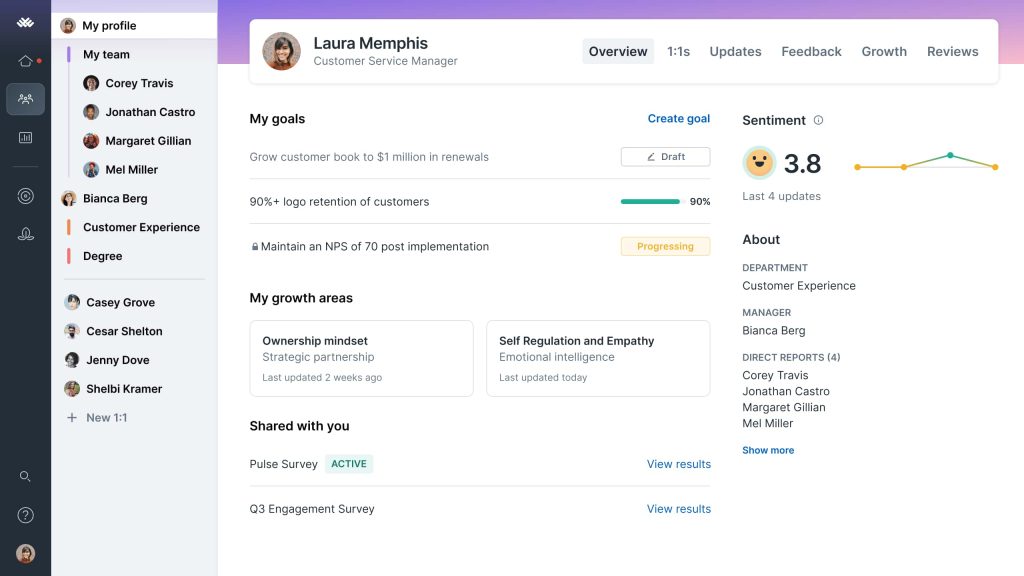
The 1:1 agendas were a quiet favorite. My managers actually used them, mostly because they pulled in goals and past notes automatically, so nobody had to start from a blank page.
The part I’d warn you about is cost creep. I started with the core plan, then added engagement and growth modules later, and the total was noticeably higher than the number I first saw.
Pros:
- OKRs connect directly to reviews, so calibration uses real goal data
- Built-in 1:1 agendas that managers actually use
- Dashboards that make it easy to compare departments
- Strong integrations with Slack, Teams, and HR systems
Cons:
- Annual contracts with limited monthly flexibility
- Full-suite costs climb once you add engagement and compensation
How Lattice Compares to ClearCompany: Lattice goes deeper on goals and reviews, while ClearCompany goes wider into hiring and onboarding. I’d pick Lattice if performance is your main job, and ClearCompany if you want one platform from job post to promotion.
G2 Rating: 4.7/5
Pricing:
Starts at $11 per seat per month.
3. 15Five – Best for Continuous Check-Ins and Manager Coaching
I rolled out 15Five to a team where managers only talked about performance twice a year. Within a month, the short weekly check-ins had become a habit, mostly because they took about five minutes and nobody felt put on the spot.
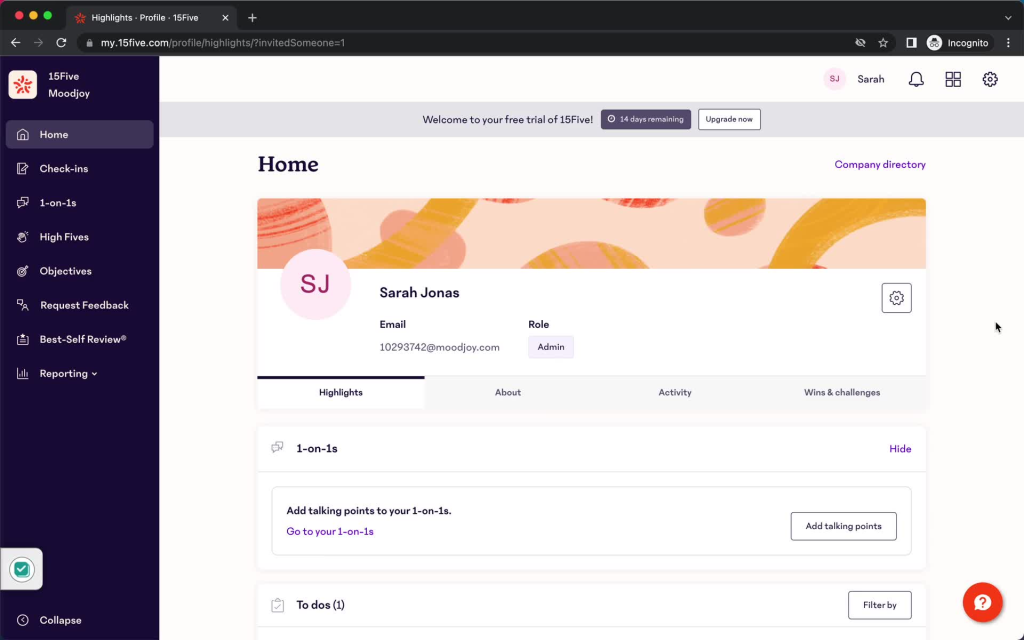
The coaching prompts surprised me. I’m not someone who naturally knows what to ask in a 1:1, and having gentle suggestions right there made my conversations feel less stiff and more useful.
It took my managers a few cycles to trust the Best-Self Review approach. It leans toward reflection and growth rather than hard scores, which felt unfamiliar at first.
Pros:
- Weekly check-ins build a steady feedback habit
- Coaching prompts help new managers have better 1:1s
- Pulse surveys included from the entry plan
- AI Copilot suggests talking points during 1:1s
Cons:
- Advanced reporting and configuration sit in higher tiers
- Can feel pricey for very small teams
How 15Five Compares to ClearCompany: ClearCompany is a broad suite, while 15Five is all about the everyday conversation between a manager and their team. If your real problem is managers going quiet between reviews, 15Five solved that for me far faster. If it still isn’t quite right, our 15Five alternatives roundup covers a few more options.
G2 Rating: 4.6/5
Pricing:
Starts at $4 per user per month, billed annually.
4. Leapsome – Best for All-in-One Performance, Learning and Engagement
I tried Leapsome when I wanted reviews and learning to finally talk to each other. After a review, I could assign a learning path based on the skills gap we’d spotted, and that felt like the first time development was actually connected to feedback.
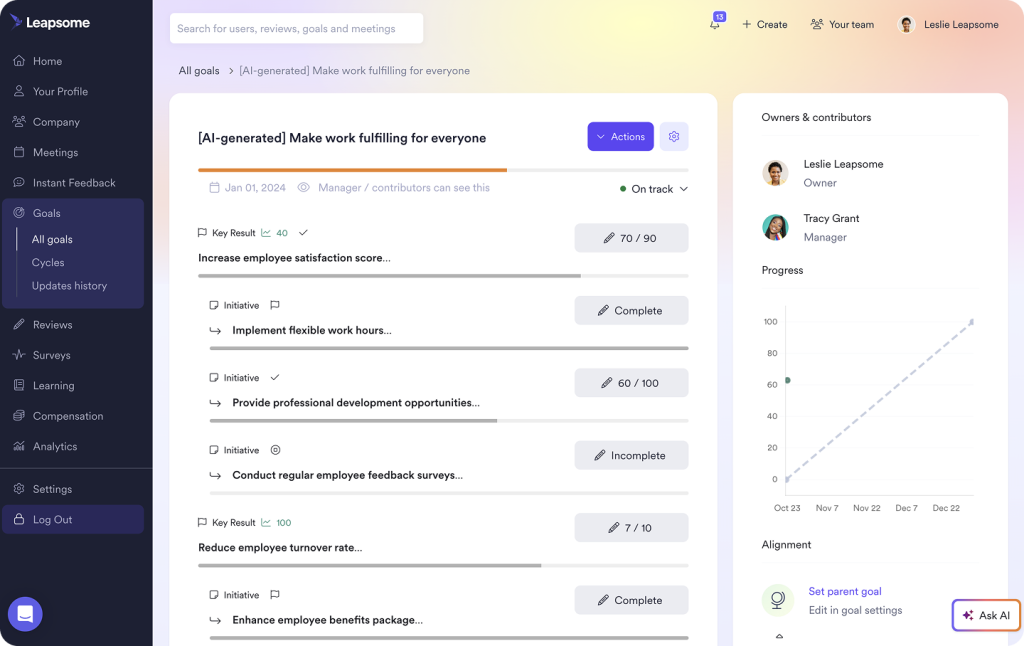
The AI writing help saved me real time. Instead of staring at a blank box during review season, I’d get a starting draft and just edit it to sound like me.
Setup took patience. Getting templates and cycles the way I wanted took longer than I expected, but once it was running, it mostly ran itself.
Pros:
- Performance, 360 feedback, OKRs, surveys, and learning in one place
- Learning paths linked to review results
- AI helps draft review language and summarize survey themes
- Modern interface that new admins pick up quickly
Cons:
- Initial setup takes real configuration time
- Per-module costs can climb as you grow
How Leapsome Compares to ClearCompany: Both aim to be a one-stop shop, but they start from different places. ClearCompany starts from hiring, while Leapsome starts from performance and learning. If development is what you care about most, Leapsome felt more natural to me.
G2 Rating: 4.8/5
Pricing:
Custom quote.
5. Culture Amp – Best for People-Science-Backed Engagement Analytics
I leaned on Culture Amp when I needed to understand why one team’s mood kept dipping. The reports turned a pile of survey answers into a story I could share with leadership, and that alone made it worth the setup.

The comment summaries were my favorite part. After a big survey, I used to spend days reading hundreds of open-text answers. Now I get the main themes in minutes and can spend my time on fixes instead.
What I missed was goal tracking depth. I ended up running a simple goals process on the side, so don’t expect it to replace a full performance tool.
Pros:
- Survey design backed by an in-house people science team
- Quick summaries of open-text feedback
- Large benchmark data to compare against
- Good language support for global teams
Cons:
- No published pricing or free trial
- Admin customization can feel limited at scale
How Culture Amp Compares to ClearCompany: ClearCompany treats engagement as one part of a bigger suite, while Culture Amp makes it the main event with deeper benchmarking. Choose it if understanding your people matters most. See our guide to employee engagement software if surveys are your focus.
G2 Rating: 4.5/5
Pricing:
Custom quote.
6. BambooHR – Best for Comprehensive HRIS With Light Performance Tools
I moved to BambooHR when I wanted one place for employee records, time off, and onboarding. Having everything in a single system meant I stopped copying data between tools, which honestly saved me hours every month.
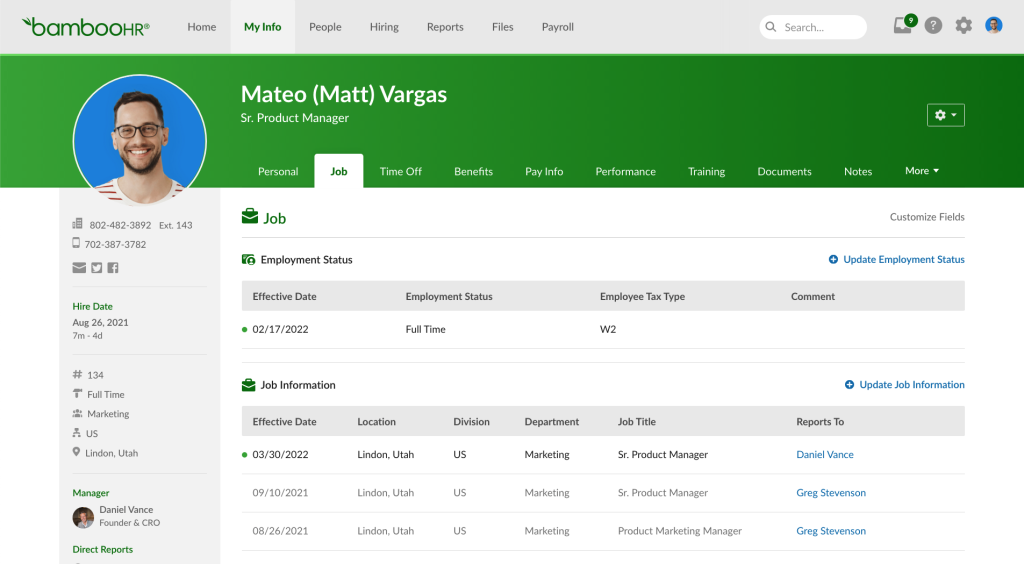
The onboarding checklists were a quiet win. New hires got their paperwork and tasks in one flow, and I didn’t have to chase people by email.
On the performance side, I found it lighter than a dedicated tool. It’s fine for simple reviews, but I wouldn’t lean on it for deep 360s or calibration.
Pros:
- Full HRIS with payroll and applicant tracking
- Central employee records in one place
- Time-off tracking built in
- Friendly interface with a short learning curve
Cons:
- Performance features are lighter than dedicated tools
- Limited customization for complex approval chains
How BambooHR Compares to ClearCompany: Both bundle several HR jobs together. ClearCompany leans toward hiring and talent, while BambooHR leans toward core HR records and payroll. I’d choose BambooHR if the HR basics are your biggest headache.
G2 Rating: 4.4/5
Pricing:
Custom quote based on modules selected.
7. HiBob – Best for Culture-First HR With Performance Built In
I spent a few months on HiBob (often called Bob) with a fast-growing team, and what stood out was how friendly it felt. People actually opened it to check time off or see who sat where, so when review season came, nobody was seeing the tool for the first time.
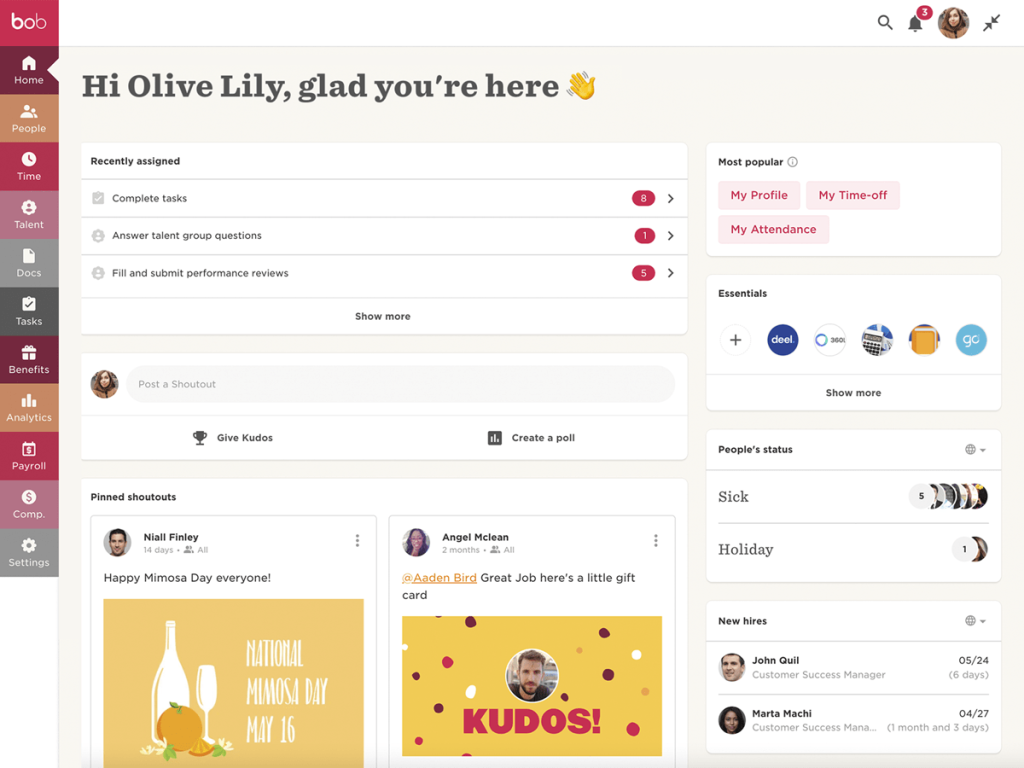
The Slack tie-in helped a lot. Everyday requests could happen right in chat, which kept adoption high without me nagging anyone.
Performance features felt like a nice extra rather than the star. For simple review cycles it was fine, but I’d pair it with a dedicated tool for anything complex.
Pros:
- Modern HRIS with performance and engagement built in
- Slack integration for everyday HR tasks
- Easy for non-HR people to pick up
- Automated onboarding workflows
Cons:
- Pricing isn’t published
- Less flexible for niche review workflows
How HiBob Compares to ClearCompany: ClearCompany is a hiring-led talent suite, while HiBob is a culture-first HR system. I’d pick HiBob if everyday employee experience matters more to you than recruiting tools.
G2 Rating: 4.5/5
Pricing:
Custom quote.
8. PerformYard – Best for Straightforward, HR-Run Review Cycles
PerformYard was the tool I picked when I wanted to copy our existing review process instead of changing it. I rebuilt our forms and approval steps almost exactly as they were on paper, and managers hardly noticed the switch, which is the best compliment a tool can get.
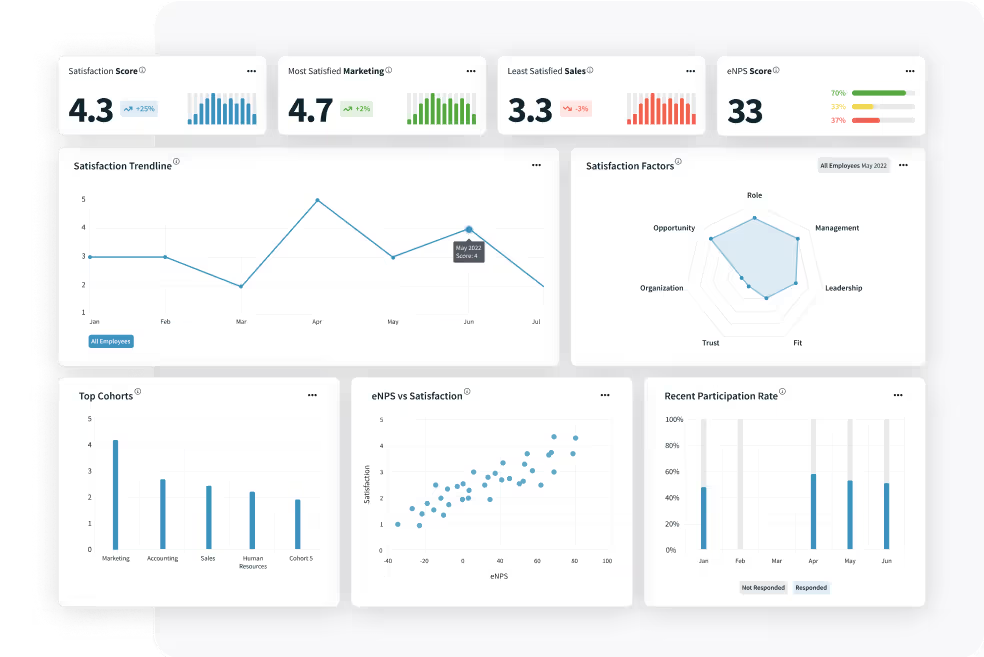
I liked that I could run annual reviews, 360s, and project reviews side by side. Before that, I had been juggling different tools or spreadsheets for each type.
The gap I felt was engagement. It doesn’t really do pulse surveys, so if you need those, plan on a second tool.
Pros:
- Rebuild your exact review process
- Annual, 360, continuous, and project reviews together
- AI help for drafting reviews and meeting notes
- Integrations with ADP, BambooHR, Workday, Gusto, and Slack
Cons:
- No built-in learning management
- Per-person pricing can add up for big teams
How PerformYard Compares to ClearCompany: ClearCompany covers hiring through performance, while PerformYard does reviews and does them well. If reviews are your only pain point, PerformYard felt simpler and quicker to set up. See our PerformYard alternatives list for more review-focused picks.
G2 Rating: 4.7/5
Pricing:
Starts at $5 to $15 per person per month.
9. Betterworks – Best for Enterprise OKR Alignment and Calibration
I worked with Betterworks at a much larger company, and the scale is what I remember. Goals cascaded across many departments and still stayed easy to follow, which would have been a mess in a simpler tool.

The calibration sessions changed how our leaders talked about ratings. Seeing everyone’s scores side by side made it harder for one manager to quietly rate too high or too low.
It’s not a quick setup. I’d say plan for a real project, not an afternoon, and don’t pick it for a very small team.
Pros:
- Goal cascading built for large organizations
- Calibration sessions that make ratings fairer
- AI insights that flag unusual performance trends
- Strong integrations with Salesforce, Jira, and Workday
Cons:
- Too heavy for smaller teams
- No free trial and demo-led sales
How Betterworks Compares to ClearCompany: ClearCompany covers a wide range of HR jobs for mid-sized teams, while Betterworks goes deep on goals and calibration for big organizations. For more enterprise-scale picks, check our Betterworks alternatives breakdown.
G2 Rating: 4.4/5
Pricing:
Starts around $8 per user per month per module.
10. Trakstar – Best for Deep, Customizable Review Cycles
I picked Trakstar (now part of Mitratech) for a team that wanted weighted scoring across several skills, not just one overall rating. Building those competency frameworks took a little effort, but the reviews that came out felt much more thoughtful.
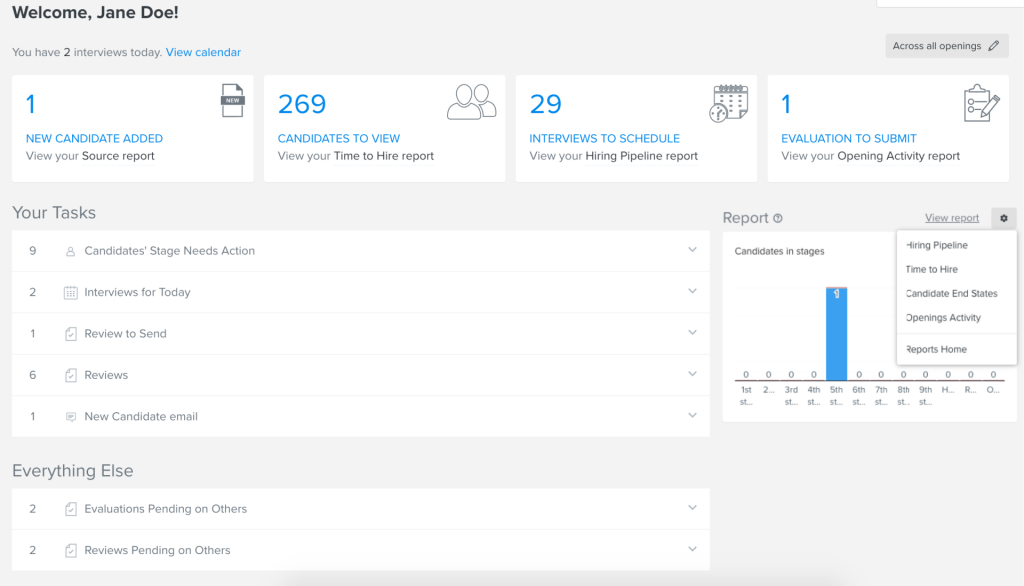
The calibration views helped me spot one department that was rating much harder than the rest. I’d never have caught that from a spreadsheet.
What I missed was everyday check-ins. Trakstar is about the formal review, so I paired it with a lighter tool for weekly 1:1s.
Pros:
- Detailed templates with weighted competencies
- Calibration views that expose uneven ratings
- Annual, semi-annual, quarterly, or project cycles
- 360 feedback with anonymity controls
Cons:
- No built-in continuous feedback or 1:1 tools
- Learning is a separate product
How Trakstar Compares to ClearCompany: ClearCompany bundles hiring and performance, while Trakstar goes deeper on review design and calibration. Our Trakstar alternatives guide digs into a few more options if calibration depth matters most to you.
G2 Rating: 4.3/5
Pricing:
Custom quote.
11. Quantum Workplace – Best for Combining Engagement Surveys With Performance Data
I started using Quantum Workplace because I was tired of pulling survey results from one place and review scores from another. Putting them side by side let me see, for the first time, which teams were happy and also doing well.
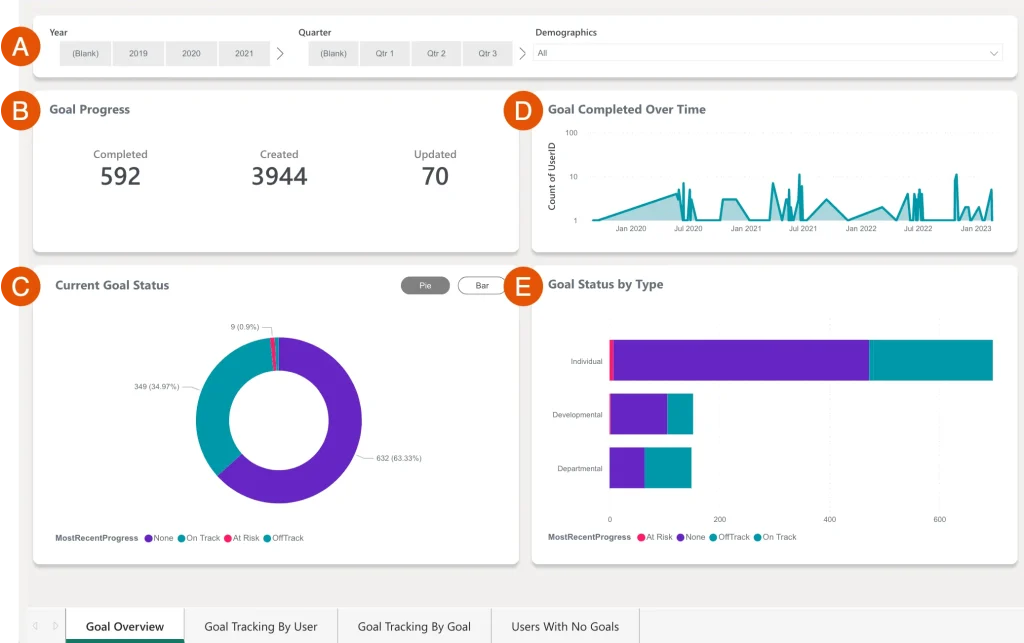
The suggestions while writing reviews were a gentle nudge. They didn’t write the review for me, but they helped me get past that blank page faster.
Setup needed more planning than I’d expected, so I’d block out some time at the start rather than rushing it.
Pros:
- Engagement surveys, reviews, and recognition in one view
- Writing suggestions during reviews and goal setting
- Benchmarks backed by years of workplace research
- Integrations with BambooHR, Workday, and SAP SuccessFactors
Cons:
- Limited customization for complex review flows
- Needs more planning during setup
How Quantum Workplace Compares to ClearCompany: ClearCompany adds hiring to the mix, while Quantum Workplace focuses on connecting engagement and performance. See our Quantum Workplace alternatives guide for more connected-data options.
G2 Rating: 4.3/5
Pricing:
Custom quote.
12. Small Improvements – Best for Lightweight Performance Management & 360s
I tried Small Improvements with a small team that just wanted simple reviews and feedback. We were up and running in an afternoon, which still surprises me when I think back on it.
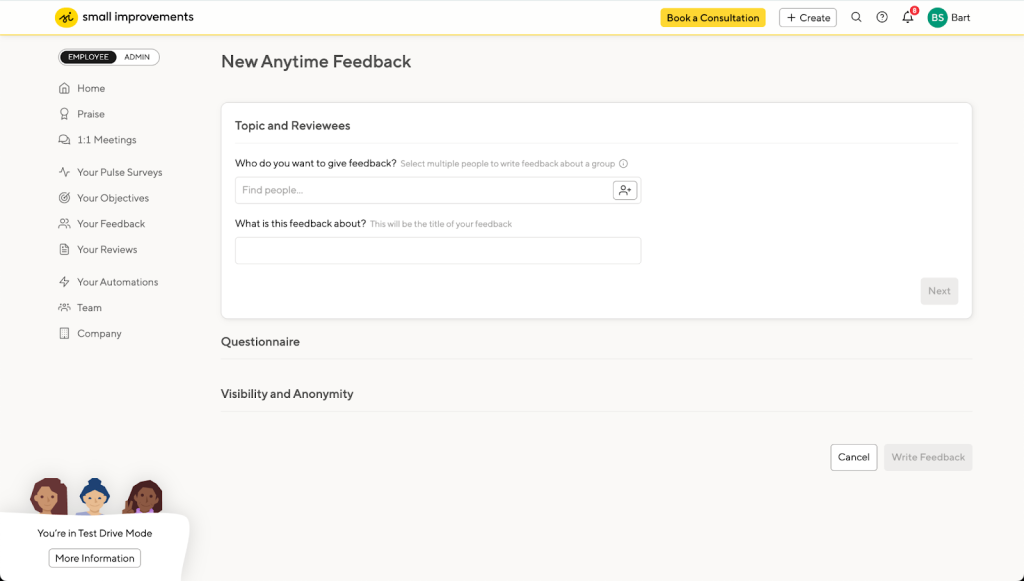
The shared 1:1 agendas were what we used the most. Both the manager and the employee could add topics before a meeting, so conversations started with real things to talk about.
As the team grew, I missed having a deeper goal structure. It keeps goals simple on purpose, which is great early on but something we eventually outgrew.
Pros:
- Easy review and 360 templates
- Shared 1:1 agendas for ongoing conversation
- Simple goal tracking without a heavy setup
- Manager-friendly interface
- 30-day free trial
Cons:
- Less depth in OKR structure
- Lighter reporting and history
- Limited engagement survey depth
How Small Improvements Compares to ClearCompany: ClearCompany is a big suite, and Small Improvements is the opposite: small and simple. Choose it if you want the basics done well without a long rollout.
G2 Rating: 4.3/5
Pricing:
Starts at $3 per user per month, billed annually. 30-day free trial available.
How I Evaluated These Tools
When I put a list like this together, I don’t just skim feature pages. I look at how each tool holds up once real people are using it. Here’s the checklist I used:
- User Reviews / Ratings: I start with real user feedback on G2 to see what teams love and where they get stuck.
- Core Features & Functionality: I check what matters most in performance management software: goals, feedback, review cycles, reporting, and integrations.
- Ease of Use: I pay attention to the moments I personally got stuck, like building a first review cycle or finding a report.
- Customer Support: I think about how helpful support was when I actually needed it, not just what the sales team promised.
- Value for Money: I compare the price with what you really get, and whether the number on the page is close to what you’ll end up paying.
- Personal Experience / Expert Insights: Wherever I can, I lean on my own time with these tools and on chats with HR peers who’ve run real review cycles.
My Top 3 Picks for ClearCompany Alternatives
After going through all 12, three stood out as the best ClearCompany alternatives for most teams. Which one is right for you depends on what you wished ClearCompany did differently.
1. PeopleGoal
PeopleGoal is my top pick because it keeps the focus where most HR teams actually spend their time: reviews, goals, and development. I could shape the review process myself with the no-code builder, and the price was one flat number I could see before talking to anyone.
2. Lattice
Lattice earns the second spot for teams that care most about tying goals to reviews. Seeing goal progress right inside each review made my calibration conversations calmer and more fair.
3. 15Five
15Five is my third pick if your biggest gap is manager habits. The weekly check-ins and coaching prompts got my managers talking regularly, without much extra work from me.
Pick a ClearCompany Alternative You’ll Actually Use
Switching HR tools isn’t about leaving one logo for another. It’s about finding something your managers open on their own because it makes their week easier, not harder.
Think about what you really use ClearCompany for today. If it’s mostly hiring, you may want to keep it. If most of your time goes to reviews, goals, and feedback, a more focused tool can feel lighter and simpler to run.
Whatever you choose, run one real review cycle before you commit for the year. If you want a tool that bends around your process instead of the other way around, PeopleGoal‘s free trial is an easy way to see if it fits.
Frequently Asked Questions
What is the best free alternative to ClearCompany?
PeopleGoal offers a 14-day free trial with full access and no credit card required, so you can test a flat-priced option before committing. Small Improvements also offers a 30-day free trial for teams that want something lighter.
Is PeopleGoal cheaper than ClearCompany?
ClearCompany doesn't publish its pricing, so it's hard to compare without a sales call. PeopleGoal charges one published rate of $4 per user per month with everything included, which makes budgeting easier from day one.
Can I move my performance data from ClearCompany to a new platform?
Most vendors support CSV or API-based imports, but depth varies. Ask whether the new tool can bring in past review scores and goal history, not just employee profiles.
Which ClearCompany alternative works best for a small team?
Small Improvements and PeopleGoal both have low starting costs and quick setup, which suits smaller teams exploring performance management software for small businesses.
Does ClearCompany have a free plan?
G2 lists ClearCompany pricing as custom, so there's no public free plan. You'll need to talk to sales to see what's included.
Which alternative is best for onboarding?
BambooHR and HiBob both handle onboarding workflows well as part of a wider HR system. PeopleGoal also supports automated onboarding, and our guide to employee onboarding software goes deeper if that's your priority.
Do these platforms support anonymous 360-degree feedback?
Yes. PeopleGoal, Trakstar, and Culture Amp all offer anonymity settings, and PeopleGoal's anonymous forms need no login, even for outside evaluators. See our guide to 360 feedback software for more.
How long does it take to set up a ClearCompany alternative?
PeopleGoal's pricing page says implementation takes about 1 to 6 weeks depending on company size and needs. Lighter tools like Small Improvements can be running in a few days.
Ready to 3x Your Teams' Performance?
Use the best performance management software to align goals, track progress, and boost employee engagement.