
The performance appraisal process is supposed to help organizations evaluate performance, develop employees, and make better decisions.
But in reality, it often falls short.
In fact, a 2025 Deloitte study found that 61% of managers and 72% of employees don’t trust their performance management process. That’s not just a perception issue—it’s a system problem.
Many companies still rely on inconsistent criteria, delayed feedback, and scattered tools. The result? Confused managers, unclear expectations for employees, and decisions that don’t always feel fair or accurate.
A well-designed appraisal process fixes this. It brings structure, clarity, and data into the picture—so performance reviews actually lead to improvement.
If you’re trying to fix or build your process, this guide walks you through everything step by step.
Here’s what I’ll cover in this blog:
- Why most performance appraisal processes fail and how modern systems compare
- How the appraisal process works (step-by-step, frameworks, and setup)
- Common mistakes, biases, and how to avoid them
- How to improve, scale, and run appraisals using tools and real-world practices
Why Do Most Performance Appraisal Processes Fall Short?
I’ve worked with enough HR teams to know that most performance appraisal processes don’t fail because people don’t care. They fail because the system is broken from the start.
A study by Gallup in 2024 found that only 14% of employees say performance reviews motivate them to improve. That number should concern every HR leader and manager reading this. If your appraisal process isn’t moving the needle on motivation, development, or performance, something fundamental needs to change.
Here’s what I see going wrong most often:
1. Subjectivity and vibe-based ratings: Managers score employees based on gut feel rather than documented performance data. The result is inconsistent, unfair evaluations that erode trust fast.
2. Recency bias: The last two months of work get over-weighted. An employee who struggled in Q1 but recovered brilliantly by Q4 still ends up with a mediocre rating because their manager didn’t track the full year.
3. Visibility bias: Remote workers and introverted employees often receive lower ratings than colleagues who are more visible to leadership. This is one of the most damaging patterns I see, and it quietly drives your best people out the door.
4. No “No Surprises” culture: Year-end reviews should be a summary of feedback that has already been given, not the first time an employee hears about a problem. When appraisals surface issues that were never discussed during the year, trust breaks down immediately.
5. Lack of documentation and follow-through: Review conversations happen, a form gets filed, and nothing changes. There’s no employee development plan, no goal update, no follow-up. The appraisal becomes a checkbox, not a growth driver.
The fix isn’t a better form. It’s a better system. One that’s structured, consistent, and built around continuous feedback rather than a once-a-year scramble. That’s exactly what this guide walks you through.
How Do Traditional and Modern Performance Appraisal Systems Compare?
Before you redesign your process, it helps to understand what you’re moving away from and what you’re moving toward.
Traditional appraisals feel like annual rituals filled with awkward silences, outdated criteria, and rushed feedback. Modern systems are faster, fairer, and far more useful for both managers and employees.
Here’s a side-by-side view:
| Aspect | Traditional Appraisals | Modern Appraisals |
|---|---|---|
| Frequency | Annual or semi-annual only | Ongoing check-ins with weekly, quarterly, or monthly reviews alongside annual |
| Feedback Style | Top-down, one-way | Two-way dialogue with employee input |
| Purpose | Focused on past performance and salary decisions | Balanced focus on past, present, and future development |
| Criteria | Often vague or generic | Role-specific, goal-oriented, and aligned with company strategy |
| Documentation | Heavy paperwork, often filed and forgotten | Lightweight, digital, and continuously updated |
| Bias Risk | High; relies on manager memory and subjectivity | Reduced through real-time data, peer input, and structured scoring |
| Employee Experience | Stressful, demotivating, often seen as unfair | Supportive, collaborative, and geared toward growth |
| Timing of Feedback | Delayed, sometimes months after events occur | Immediate or near real-time |
| Link to Development | Rarely includes actionable next steps | Tied directly to training, mentoring, and career pathing |
| Technology Use | Limited or manual | Automated, cloud-based tools with performance analytics |
Who Actually Uses the Performance Appraisal Process and Why Does It Matter?
Performance appraisals are not just an HR formality. They’re strategic tools used at every level of an organization to make informed decisions, drive accountability, and support growth.
So who actually uses them and what are they trying to accomplish?
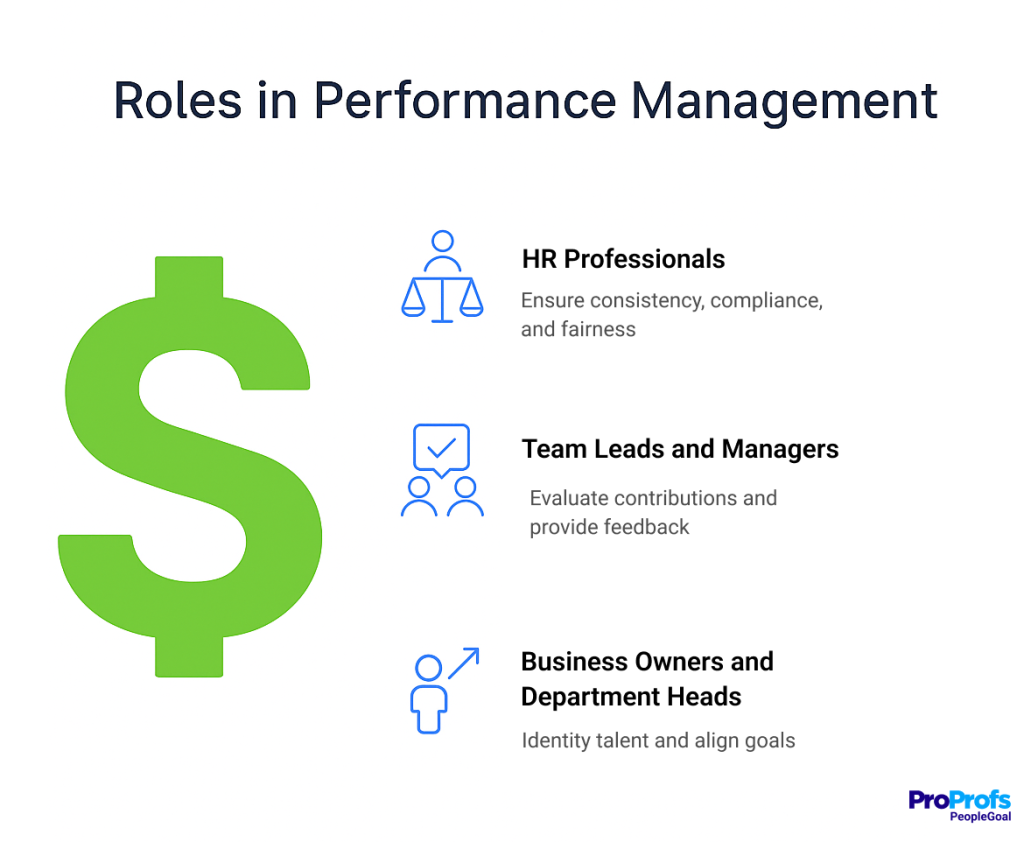
- HR professionals use appraisals to ensure consistency, compliance, and fairness across teams. They need a system that scales, reduces manual effort, and produces reliable data.
- Team leads and managers use them to evaluate contributions, give meaningful feedback, and make decisions about promotions, raises, and role changes.
- Business owners and department heads rely on them to identify high-potential talent, address underperformance before it becomes a bigger problem, and align individual output with business goals.
People don’t leave jobs where they feel seen, heard, and coached. They leave jobs where they feel invisible or misunderstood.
Here’s what that looks like in practice:
Example Scenario 1. An HR manager in a 100-person company implements quarterly reviews with role-based scorecards. Within two cycles, managers report 30% more clarity when reviewing performance, and employee satisfaction with the review process improves by 18%.
Example Scenario 2. A tech startup team lead switches from annual reviews to monthly one-on-ones with structured templates and shared goal dashboards. Within three months, missed deadlines drop by 22% and peer feedback submissions triple, giving managers far more context to work with.
The point is simple. When the performance appraisal process works, it doesn’t just improve scores on a form. It changes how people work, how teams collaborate, and how leaders make decisions.
Organizational structure also plays a role here. Having clear org charts helps managers understand reporting lines, cross-functional dependencies, and evaluation scope. Tools like PeopleGoal include built-in org charts so appraisal design aligns with how teams actually work.
How Does the Performance Appraisal Process Work?
The performance appraisal process steps work in a defined sequence: from setting clear expectations and choosing an evaluation framework to collecting feedback, running appraisal conversations, and following up with development plans.
Each step builds on the previous one to create a fair, consistent, and scalable system.
Here’s how to set it up the right way.
Step 1: Clarify the Purpose and Scope
Before anything else, get clear on why you’re running appraisals. Is the goal to inform compensation decisions? Support career development? Improve team alignment? Or all three?
Your purpose shapes every other decision, from how often you run reviews to what criteria you include. Also define the scope: who will be reviewed, who will review them, and whether you’ll include peer or 360-degree feedback.
Use this GPT prompt to define your appraisal purpose:
Run this with your HR leadership before the cycle starts. The output gives you a one-paragraph purpose statement you can share with managers and employees so everyone enters the process with the same understanding.
Step 2: Choose the Right Evaluation Framework
Select an appraisal method that reflects your company’s values, pace, and structure. The most commonly used frameworks include:
- Rating scales for structured, comparable scoring across teams
- Narrative reviews for qualitative insight into behaviors and contributions
- Management by Objectives (MBO) for results-focused roles with clear output metrics
- 360-degree reviews for leadership roles and cross-functional positions
- BARS (Behaviorally Anchored Rating Scales) for reducing subjectivity with behavioral examples
Quick framework selector:
| our Situation | Best Fit Framework |
|---|---|
| You need consistency across large teams | Rating scales |
| You're evaluating senior leaders | 360-degree review |
| Roles have clear, measurable output | MBO |
| You want to reduce manager subjectivity | BARS |
| You want qualitative depth | Narrative review |
| You want the most complete picture | Combination of rating scale + narrative + peer input |
Step 3: Define Clear Performance Criteria
Vague expectations are one of the biggest reasons appraisals feel unfair. Every role should have tailored performance standards aligned with company goals.
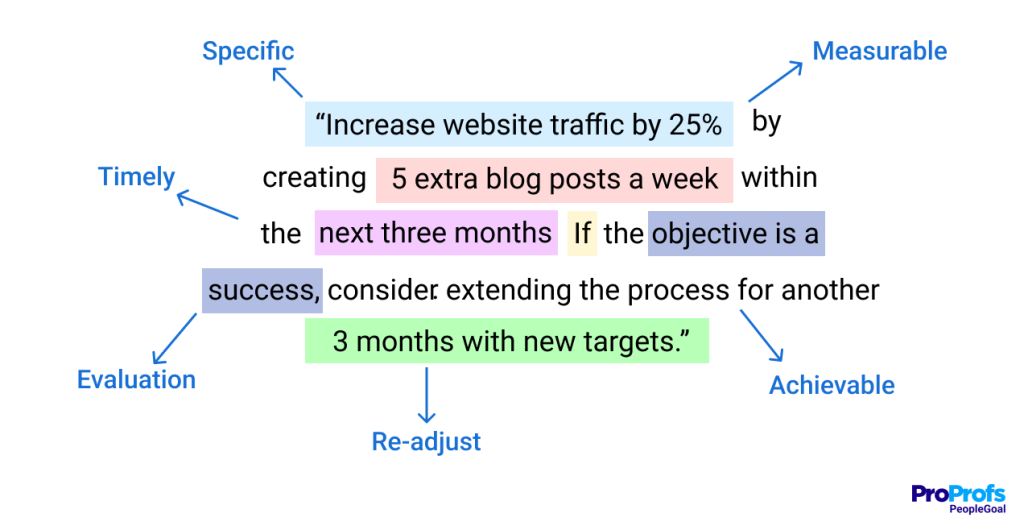
SMART Standards: Performance criteria should be Specific, Measurable, Achievable, Relevant, and Time-bound. Criteria like “good attitude” or “team player” are not measurable and lead to inconsistent, subjective evaluations.
Criteria typically fall into three categories:
- Deliverables: Projects completed, client feedback scores, revenue generated
- Behaviors: Collaboration, ownership, decision-making quality
- Goal progress: OKR or KPI completion rates
Use this GPT prompt to build role-specific criteria:
Run this for each role type in your organization. You’ll have a role-specific criteria set in under five minutes that you can drop directly into your appraisal templates.
Step 4: Set the Right Frequency and Timeline
Annual reviews are outdated in most fast-moving environments. A more effective model is quarterly or biannual formal reviews supported by monthly check-ins and ongoing feedback.
Here’s a simple frequency guide:
| Review Type | Recommended Frequency | Purpose |
|---|---|---|
| Formal appraisal | Quarterly or biannual | Structured evaluation and documentation |
| Manager check-in | Monthly | Progress tracking and early intervention |
| Peer feedback | Per project or quarterly | 360-degree perspective |
| Self-assessment | Aligned with formal appraisal | Employee reflection and input |
For instance, a logistics company that switches to quarterly appraisals with monthly check-ins can catch underperformance earlier and cut delivery errors within six months.
According to a Gallup study in 2024, employees who have quarterly progress check-ins with their managers are 90% more likely to be engaged and 2.1× more likely to perceive the review process as fair.
Build your review calendar in 3 steps:
- Pick your formal appraisal months. For quarterly: January, April, July, October. For biannual: January and July.
- Work backwards 3 weeks. That’s when self-assessments open and manager review forms go live.
- Block monthly check-in dates in manager calendars for the full year upfront. If it’s not in the calendar at the start of the year, it won’t happen.
A simple shared Google Calendar or a task in your performance management tool is enough to hold the structure in place.
Step 5: Build Templates and Toolkits
Review forms should be simple, structured, and consistent. A good appraisal template includes:
- Goal tracking and progress ratings
- Competency rating scales with behavioral anchors
- Open comment fields for context and examples
- A forward-looking development plan section
A forward-looking development plan section tied to career planning, helps employees see how current performance connects to future roles and growth paths
Starter appraisal template structure you can use today:
| Section | What to Include |
|---|---|
| Goal Review | List agreed goals. Rate progress: On Track / Partially Met / Not Met. Add one line of context. |
| Competency Ratings | Rate 4 to 6 competencies on a 1 to 5 scale. Include one behavioral example per rating. |
| Manager Comments | Strengths observed this period. One area for development. Specific example for each. |
| Employee Comments | What went well. What support would help. Career direction. |
| Development Plan | 2 to 3 goals for next period. Resources or training needed. Follow-up date. |
Copy this structure into your preferred tool, whether that is Google Docs, Notion, or a dedicated performance management platform like PeopleGoal as it offers pre-built templates. Keep it to one page. The longer the form, the lower the quality of responses.
Step 6: Train and Prepare Managers
Even the best-designed system fails if managers don’t know how to use it well. Training should cover:
- How to give specific, actionable, and unbiased feedback
- Common rating errors to avoid: recency bias, halo effect, central tendency
- How to facilitate two-way conversations rather than monologues
- How to set follow-up development goals that are realistic and trackable
Got it. Here’s the tightened version:
How to build your manager training program inside PeopleGoal:
- Create a Manager Training Plan: Use tools like ProProfs Training Maker to build a development roadmap for managers covering feedback quality, bias awareness, and appraisal conversation skills. Tie each module to a competency so progress is trackable.
- Run pre-cycle Development 1-to-1s: Before each appraisal season, use PeopleGoal’s Development 1-to-1s for a short HR-to-manager conversation covering what slipped last cycle and what to focus on this round. Targeted beats generic every time.
- Build a manager readiness checklist: Use PeopleGoal’s no-code workflow builder to create a pre-appraisal sign-off flow: bias refresher done, goals reviewed, 1-to-1s scheduled. HR tracks completion before the cycle opens.
Step 7: Launch, Communicate, and Improve
Roll out the process with a clear internal communication plan. If you’re onboarding new hires, this is also where structured onboarding workflows matter. Tools like PeopleGoal let you connect onboarding tasks, early goals, and first-cycle appraisals into one continuous process instead of treating them separately.
After each cycle, gather anonymous feedback from both sides. Ask what worked, what felt unclear, and what took too long. The best appraisal processes are not set-and-forget. They evolve based on what your team tells you.
3-question post-cycle pulse survey to send after every appraisal round:
- On a scale of 1 to 5, how fair did the appraisal process feel this cycle?
- What was the most useful part of your appraisal conversation?
- What is one thing we should change about the process for next time?
You can run this directly inside PeopleGoal using built-in pulse and quarterly employee engagement surveys, so feedback stays tied to the same system as your appraisals.
Three questions take less than two minutes to answer. The response rate stays high, and you get the signal you need to make one meaningful improvement before the next cycle starts. That compounds fast. Two cycles of one improvement each produce a substantially better process by the end of the year.
Here’s a quick video if you’d like to explore some hacks of performance reviews:
How Do You Integrate 360-Degree Feedback Into the Appraisal Process?
360-degree feedback is one of the most requested features in any performance appraisal system, and for good reason. It gives you a complete picture of how an employee performs across relationships, not just how they look from a manager’s desk.
1. What 360-Degree Feedback Actually Is
360-degree feedback collects performance input from multiple sources: direct managers, peers, cross-functional collaborators, and in some cases, direct reports. It creates a multi-directional view of an employee’s contributions, behaviors, and impact.
It’s particularly valuable for leadership roles, collaborative environments, and any position where stakeholder relationships matter.
2. Where 360 Feedback Fits in the Appraisal Process
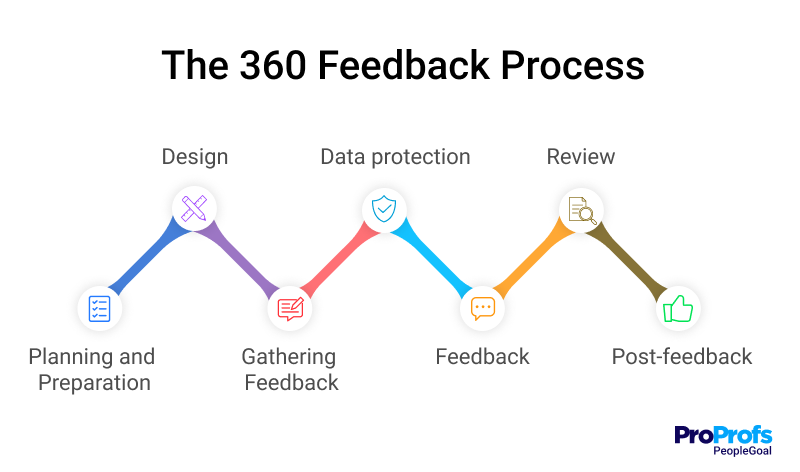
360-degree feedback works best as an input to the formal appraisal, not a replacement for manager evaluation. Here’s how it typically flows:
- Self-assessment is submitted by the employee
- Peer and cross-functional feedback is collected (anonymously, where possible)
- Manager review is completed using both observations and the collected feedback
- Appraisal conversation synthesizes all inputs into a coherent, balanced evaluation
3. How to Ensure Anonymity and Reduce Bias
Anonymous feedback encourages honesty. Without it, peer reviewers often soften their input to avoid conflict. A few practical ways to protect the process:
- Use a platform that anonymizes responses before the manager sees them
- Set a minimum number of reviewers (typically 3 to 5) so individual responses can’t be traced
- Train reviewers on what good feedback looks like: specific, behavioral, and focused on work rather than personality
4. When NOT to Use 360-Degree Feedback
360 feedback is not always the right tool. Avoid it when:
- The team is too small for responses to remain truly anonymous
- Trust levels within the team are low and peer feedback could be weaponized
- The organization hasn’t trained reviewers on how to give constructive input
- You’re using it purely for compensation decisions rather than development
Used correctly, 360-degree feedback turns your appraisal process from a one-dimensional snapshot into a well-rounded evaluation that employees actually respect.
How Do You Align Performance Appraisals With Business Goals?
One of the most common frustrations I hear from HR leaders is that performance appraisals feel disconnected from what the business is actually trying to achieve. Employees get reviewed on criteria that no longer match company priorities.
Managers evaluate behavior without any link to strategic outcomes. And by the time the review is done, neither party is clear on what the results mean for the future.
The fix is goal alignment, and it starts at the top.
1. Connect Individual Goals to Company Objectives
Effective appraisals cascade goals from the organizational level down to the individual. Here’s what that looks like in practice:
| Level | Example Goal |
|---|---|
| Company | Grow revenue by 20% |
| Team | Increase qualified pipeline by 30% |
| Individual | Run 15 outbound campaigns per quarter with a 25% conversion target |
When an employee can see exactly how their work connects to the company’s direction, performance conversations become more meaningful. They stop feeling like administrative checkboxes and start feeling like real conversations about impact.
2. Use SMART Goals to Set Clear Expectations
A SMART goal removes ambiguity from the evaluation entirely. Every individual target should be:
- Specific: clearly defined, not open to interpretation
- Measurable: tied to a number, rate, or outcome
- Achievable: realistic given resources and constraints
- Relevant: connected to team and company priorities
- Time-bound: with a clear deadline
Vague goal: Improve customer satisfaction.
SMART goal: Increase NPS score from 34 to 45 by the end of Q3 by reducing first-response time on support tickets to under 4 hours.
That’s a goal a manager can evaluate objectively and an employee can actually work toward.
3. MBO: The Framework Behind Goal-Driven Appraisals
“What is Management by Objectives (MBO)” you may ask. MBO is a performance management framework developed by Peter Drucker in which managers and employees jointly set specific, measurable objectives at the start of an appraisal period. Progress is tracked throughout, and final evaluation is based on whether those agreed objectives were met.
“Management by objectives works if you know the objectives. Ninety percent of the time, you don’t.”-Peter Drucker, Management consultant and author of The Practice of Management.
MBO works particularly well for roles with clear output metrics: sales, operations, customer success, and project management. It gives both the manager and the employee a shared reference point for the entire appraisal cycle, removing the subjectivity that makes so many reviews feel unfair.
4. A Practical Goal Cascading Example
Here’s how goal alignment flows in a real SaaS company trying to reduce customer churn:
| Company OKRReduce customer churn by 15% in two quarters ↓ Team GoalImprove 90-day onboarding completion rates from 60% to 85% ↓ Individual Appraisal Goal Handle onboarding for 20 new accounts per month Completion rate above 80% Post-onboarding NPS above 40 |
Now the appraisal conversation is grounded in numbers the business cares about. Both sides know exactly what success looks like before the cycle even begins.
What Are Common Performance Appraisal Mistakes and How Do You Avoid Them?
Even well-designed performance appraisal systems produce poor results when the people running them fall into predictable traps. These aren’t dramatic failures. They’re subtle, recurring patterns that quietly destroy the credibility of your process over time.
Here are the ones I see most often, and exactly how to fix them.
Mistake 1: Recency Bias Skews the Entire Evaluation
What it looks like: A manager mentally reviews only the last 6 to 8 weeks when filling out an appraisal form, ignoring 10 months of documented performance.
Why it’s damaging: Employees who had a strong first half but a difficult final quarter get penalized unfairly. Employees who coasted all year but performed well in December get rewarded.
The fix: Require managers to maintain running performance notes throughout the year. Even a brief monthly log of wins, challenges, and observations produces a dramatically more balanced annual review.
Mistake 2: Vague and Undocumented Criteria
What it looks like: Rating scales that say “meets expectations” without defining what those expectations are. Comments like “great attitude” or “could improve communication” with no specific examples.
Why it’s damaging: Employees can’t improve from feedback they don’t understand. Managers can’t defend ratings that aren’t backed by evidence. Vague criteria also increase legal risk.
The fix: Build role-specific, SMART-aligned criteria into your templates before the review cycle begins. Every rating should be backed by at least one documented behavioral example.
Mistake 3: Visibility Bias Disadvantages Remote and Introverted Employees
What it looks like: Managers unconsciously rate employees who are more visible in meetings, Slack channels, or office hallways higher than those who quietly deliver excellent work in the background.
Why it’s damaging: This pattern drives your highest-quality individual contributors out of the organization. It also creates a culture where performance theater matters more than actual output.
The fix: Weight evaluations on documented deliverables and measurable outcomes, not presence or personality. Peer feedback and self-assessments help surface contributions that managers may not directly observe.
Mistake 4: Mixing Development and Compensation in One Conversation
What it looks like: A manager opens with “Here’s your rating” and then tries to discuss growth plans and career development while the employee is still processing whether they got the raise they wanted.
Why it’s damaging: Once compensation enters the room, nobody hears the development feedback. The two conversations work against each other.
The fix: Run two separate meetings. The first focuses entirely on performance, feedback, and development planning. The second, ideally a few days later, covers compensation. Both conversations become cleaner and more productive.
Mistake 5: Calibration and Forced Distribution Problems
What it looks like: A company decides that only 10% of employees can receive a top rating, regardless of actual performance distribution. Managers are forced to downgrade strong performers to meet the curve.
Why it’s damaging: It creates resentment, destroys trust in the process, and is particularly damaging in small, high-performing teams where the forced curve doesn’t reflect reality.
The fix: Use calibration sessions where managers compare ratings across teams to ensure consistency, but avoid rigid forced distributions. The goal of calibration is fairness, not a predetermined quota.
Mistake 6: No Follow-Up After the Appraisal Meeting
What it looks like: A productive appraisal conversation happens. A development plan gets mentioned. Then nothing. No check-in, no goal update, no accountability.
Why it’s damaging: Employees conclude that appraisals don’t actually lead to anything. Engagement drops, and the process loses credibility with every cycle.
The fix: End every employee appraisal with a written action plan that includes two to three specific goals, a timeline, and a scheduled follow-up date. Make the follow-up non-negotiable, not a nice-to-have.
How Do You Run Performance Appraisals Using Online Tools?
If your current performance appraisal system runs on spreadsheets, emailed PDFs, and manual reminders, you already know the problem. Tracking who submitted what, chasing incomplete reviews, and trying to make sense of scattered data across inboxes is exhausting. It also produces inconsistent results.
A performance management platform changes that entirely. It centralizes the process, automates the admin work, and gives HR the reporting visibility they’ve been missing.
Here’s how it works in practice using PeopleGoal as an example.
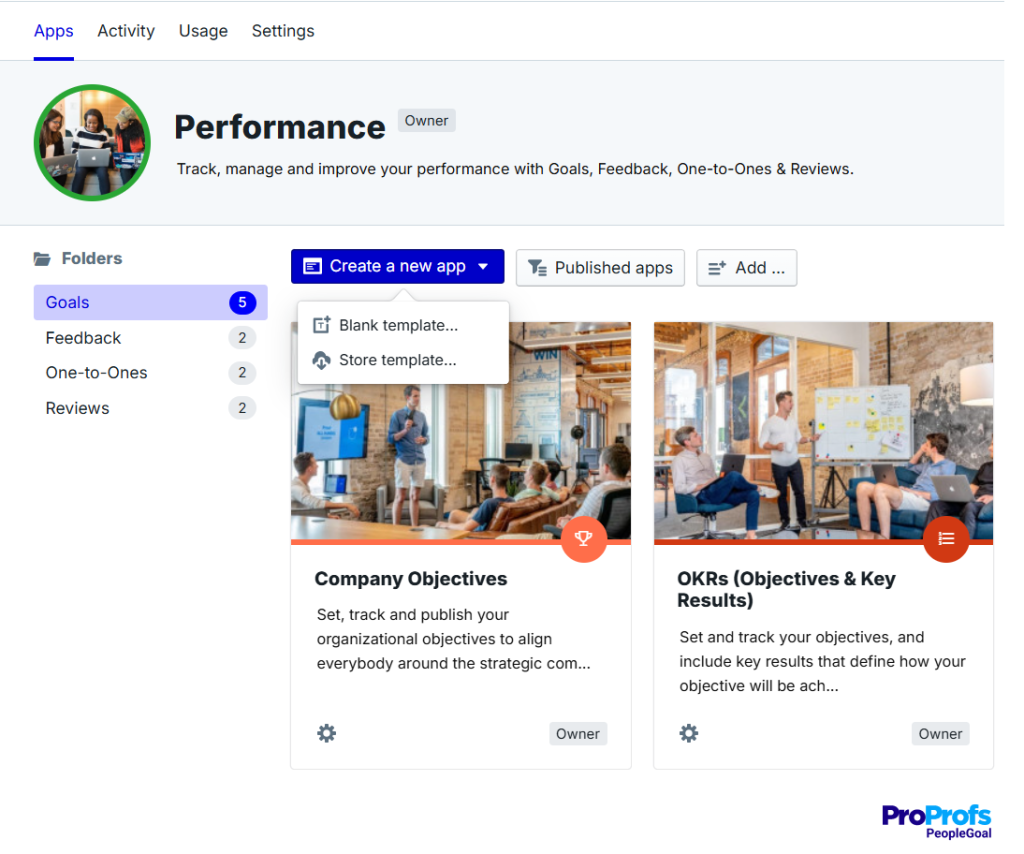
Step 1: Install a Ready-to-Use Template
Start with a pre-built performance review template from the PeopleGoal App Store. It comes with default criteria, workflow stages, and scoring structures out of the box. You can launch immediately or customize it to match your existing process.
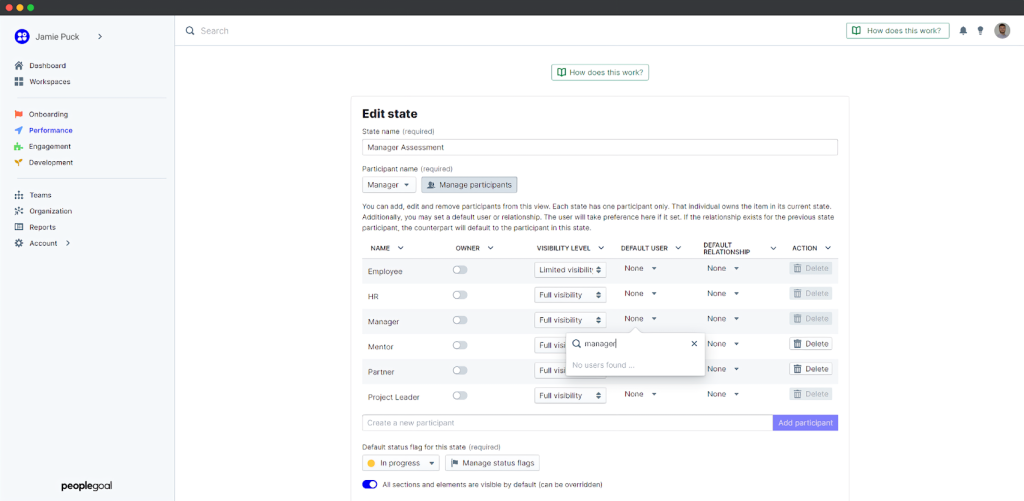
Step 2: Assign Roles and Set Visibility
Decide who participates: employees, direct managers, HR, skip-level managers. Set visibility permissions at each stage so employee feedback stays confidential where it needs to be and transparent where it should be.
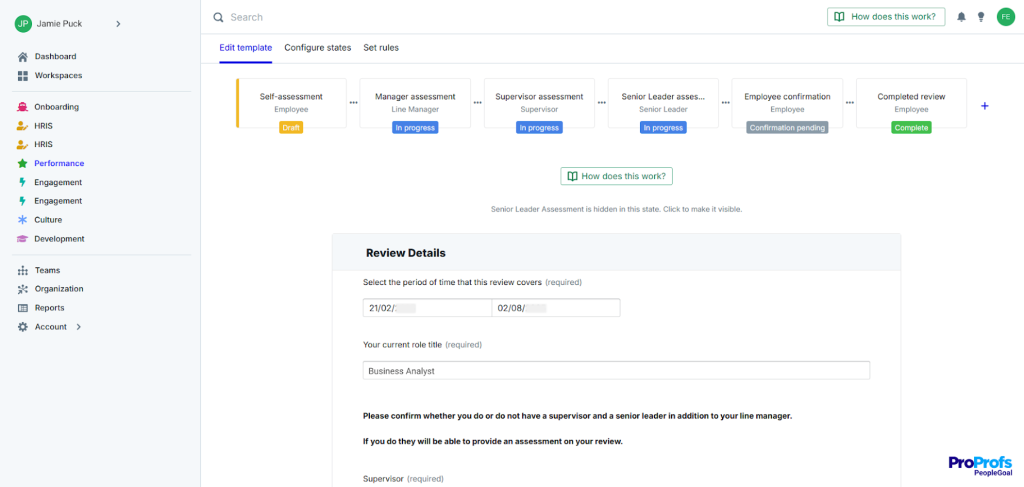
Step 3: Customize Your Review Workflow
Use drag-and-drop workflow states to build your appraisal flow. For example: self-assessment first, then manager review, then HR sign-off. Set permissions for each state in a few clicks. No development work required.
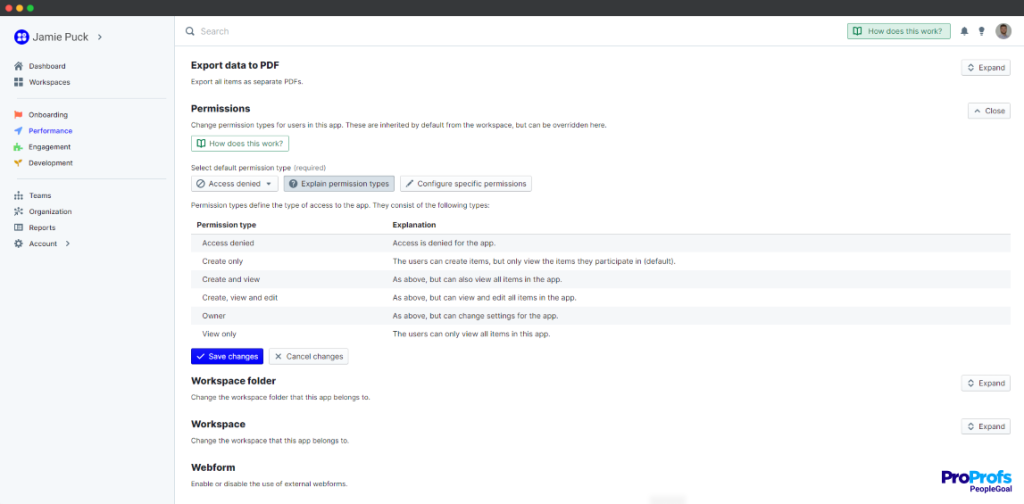
Step 4: Set Access Permissions and Launch
Control who can create, view, or edit appraisals across teams. Launch reviews in bulk for an entire department or individually based on hire dates and review cycles. Both options are available.
Step 5: Track Progress and Build Reports
Monitor completion rates in real time. Generate custom reports to analyze performance score distributions, identify teams with low engagement, and track development plan progress over time. The data that used to live in a folder now lives in a dashboard you can actually use.
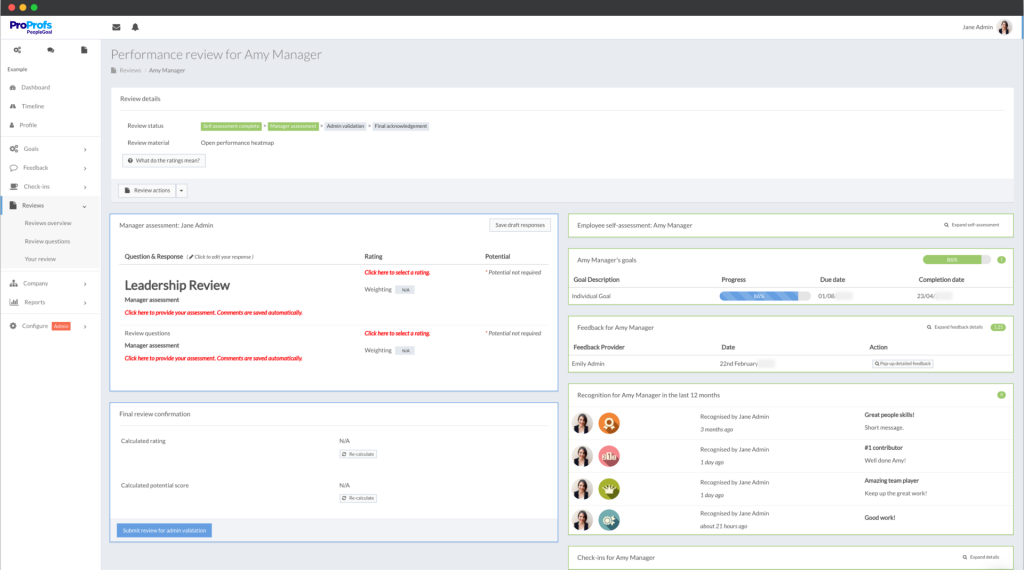
The data that used to live in a folder now lives in a dashboard you can actually use. PeopleGoal also integrates with tools like HRIS platforms, Slack, and other business systems, so performance data connects with your broader workflows instead of sitting in isolation.
How Can Companies Improve Their Performance Appraisal Process?
Building the process of performance appraisal is step one. Making it better over time is the real work. Here are the practices I consistently see in organizations that get performance appraisals right.
| Practice | What It Means | Example / Impact |
|---|---|---|
| Make Feedback Frequent, Not Annual | Move beyond yearly reviews. Use monthly check-ins or quarterly reviews to keep feedback continuous. | Appraisals become a recap instead of a surprise, reducing gaps in performance understanding. |
| Align Appraisal Criteria With Company Goals and Culture | Update evaluation criteria to reflect current priorities and values. | A support team shifted focus to customer experience, recognizing employees for empathy and resolution quality. |
| Include Multiple Perspectives Through 360-Degree Input | Gather feedback from peers, cross-functional teams, and direct reports. | Even 3–5 peer inputs improve fairness and give a fuller picture of performance. |
| Separate Development From Compensation Discussions | Conduct separate meetings for growth discussions and salary reviews. | Keeps development conversations meaningful instead of being overshadowed by pay discussions. |
| Train Managers to Give Bias-Free Feedback | Equip managers with skills to provide structured, objective, and actionable feedback. | A short training on rating errors and feedback techniques improves the entire review process. |
| Use Technology to Track, Streamline, and Analyze | Implement tools to automate workflows, centralize feedback, and generate insights. | Reduces manual effort and helps HR make informed decisions on promotions and development. |
| End Every Appraisal With a Forward-Looking Plan | Create a clear action plan with specific goals and timelines after each review. | Employees leave with direction, such as a 90-day growth plan tied to follow-ups. |
What Should Be on a Performance Appraisal Process Checklist for HR Teams?
A structured checklist ensures consistency across managers, teams, and locations. Use this before, during, and after each appraisal cycle.
Pre-Appraisal
- Define or update performance criteria for each role
- Align criteria with current company goals and OKRs
- Select or update appraisal templates and rating scales
- Set review cycle timeline and communicate it to all stakeholders
- Assign reviewers and configure visibility permissions
- Train or re-brief managers on feedback quality and bias awareness
- Open self-assessment forms for employees
During Appraisal
- Confirm self-assessments are submitted before manager review begins
- Collect peer or 360-degree feedback where applicable
- Ensure manager reviews include behavioral examples, not just ratings
- Check for common bias patterns: recency, halo, visibility
- Schedule appraisal conversations with enough time for two-way discussion
- Separate development conversations from compensation discussions
- Document agreed outcomes and next steps during or immediately after the meeting
Post-Appraisal
- Confirm written development plans are created for each employee
- Schedule follow-up check-ins within 30 to 60 days
- Run completion and quality reports to identify gaps
- Collect anonymous feedback from employees and managers on the process
- Update appraisal templates based on feedback before the next cycle
- Share performance insights with leadership for promotion and compensation decisions
- Archive completed appraisals in a centralized, searchable system
Real-Life Case Studies
Real-world examples show how organizations move from fragmented, manual appraisal systems to structured, scalable processes. These case studies highlight how the right approach and tools can improve consistency, visibility, and overall effectiveness across teams.
1. Ataway
Ataway needed to standardize performance management across global offices while keeping the process flexible enough to work across different teams and functions. By using PeopleGoal, they streamlined their appraisal workflows, improved consistency across locations, and gave managers a centralized view of performance data they didn’t have before.
2. Forney Corporation
Forney Corporation was running appraisals manually, with scattered forms and limited visibility into who had completed reviews and when. After moving to PeopleGoal, they digitized the entire process, increased manager participation rates significantly, and cut the administrative time spent on review coordination.
Build a Performance Appraisal Process That Drives Real Results
A well-designed performance appraisal process is one of the most powerful tools an organization has. When it works, it creates clarity around expectations, builds a culture of honest feedback, and gives leaders the data they need to make better decisions about their people.
The key is building a process of performance appraisal that is structured, consistent, and future-focused. One that connects individual goals to business outcomes, integrates multiple feedback perspectives, and produces development plans that people actually act on.
Doing all of that manually, with spreadsheets and email chains, is not sustainable. The organizations that get this right combine a strong strategy with the right technology.
PeopleGoal helps HR teams and managers build performance appraisal systems that are scalable, customizable, and easy to adopt. Start with PeopleGoal’s pre-built review template. Customize it in 30 minutes. Launch your next cycle with a structured process that HR can track from one dashboard. Request a demo to see how it fits your team.
Frequently Asked Questions
What is the difference between a performance appraisal and a performance review?
The process of performance appraisal is formal and tied to ratings, promotions, or pay. A performance review is more conversational, focusing on feedback and growth. Most modern systems blend both into one structured process.
How do you handle an unfair performance appraisal?
Start by documenting examples that don’t match your rating. Then request a discussion with your manager or HR. A good system allows review or calibration. If bias is consistent, it points to a flawed process, not just one manager.
What role does self-assessment play in the appraisal process?
Self-assessments let employees reflect on their work, highlight achievements, and share challenges. They reduce surprises and make the conversation more balanced. When used well, they increase ownership and engagement in the process.
How do you calibrate performance ratings across teams?
Managers meet to compare ratings and align standards. The goal is consistency so the same rating means the same across teams. It’s not about forcing rankings, but ensuring fairness and shared expectations.
Should compensation and development be discussed in the same appraisal meeting?
No. When pay enters the conversation, feedback takes a back seat. Separate meetings keep development discussions focused and more productive, while compensation can be handled independently.
How do you measure the effectiveness of a performance appraisal system?
Look at completion rates, employee feedback, and the quality of development plans. Also check if appraisals actually lead to better performance or promotions. Short post-review surveys can reveal what’s working.
What is Management by Objectives (MBO) and how does it apply to appraisals?
MBO sets clear, measurable goals agreed upon at the start. Performance is then judged based on results. It reduces subjectivity and works well for roles with defined outcomes.
What are common problems in the performance appraisal process?
Common issues include recency bias, unclear criteria, and inconsistent ratings across teams. Some employees get overlooked due to low visibility. Many systems also fail to follow through after reviews or mix pay with development discussions.
Ready to 3x Your Teams' Performance?
Use the best performance management software to align goals, track progress, and boost employee engagement.