
Every HR team reaches a point where someone asks, “Do we have an employee performance appraisal template for this?” On the surface, it sounds like a simple request. Share a form, complete the review, and move on.
But in my experience, performance reviews rarely fail because the document is missing. They fail because the process behind the document is unclear.
A good employee performance appraisal template should help managers give specific feedback, evaluate performance fairly, and create more productive conversations with employees.
It should also reduce vague ratings, inconsistent reviews, and last-minute surprises during appraisal meetings.
In this guide, I’ll walk through 10 practical performance appraisal templates for different situations: Annual reviews
- Quarterly check-ins
- Self-assessments
- 360 feedback
- OKR reviews
- Onboarding reviews
- Performance improvement plans
You’ll also see when each template works best, what to include, and where review processes usually break down as teams grow.
What Is an Employee Performance Appraisal?
I want to be direct about something before we go further. An appraisal is not a rating. A rating is just one output of a well-run appraisal. What the appraisal process actually does, when it is designed properly, is create the conditions for an honest conversation that would not happen otherwise.
The process typically covers three things:
- Backward review: What did the employee actually accomplish, and where did performance fall short of what was agreed?
- Behavioral assessment: How did they work, not just what did they deliver? Communication, collaboration, ownership, adaptability.
- Forward planning: What are the goals for the next period, and what does the employee need to grow?
Without all three, you have a form, not an appraisal. The template is the container. The quality of the conversation is what determines whether any of it sticks.
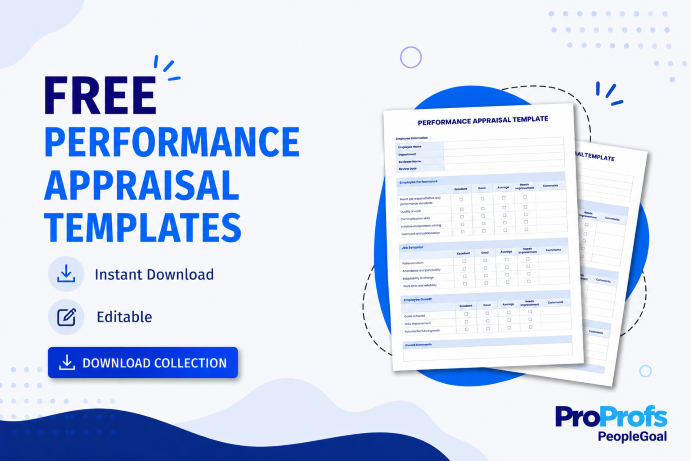
To help you run every type of appraisal properly, I’ve put together ready-to-use templates covering every scenario you’ll encounter.
10 Employee Performance Appraisal Templates
I’ve seen companies use the same review form for every situation, and it almost always creates confusion instead of clarity.
The right employee performance appraisal template depends on what you’re actually trying to evaluate, whether it’s long-term growth, project impact, leadership skills, or early onboarding progress.
That’s why I’ve broken down the most effective templates by real review scenarios so you can choose one that actually fits the conversation you need to have.
| Review Situation | Best Template | Best Used For |
| Annual evaluation cycle | Annual Performance Review Template | Formal year-end or biannual reviews |
| Fast-moving teams | Quarterly Check-In Template | Course correction and continuous feedback |
| Employee reflection | Self-Assessment Template | Capturing employee context before manager reviews |
| Cross-functional roles | 360-Degree Feedback Template | Managers, senior ICs, and collaborative roles |
| Behavior-based evaluation | Competency-Based Appraisal Template | Roles where how someone works matters as much as output |
| Goal-based teams | OKR Performance Review Template | Organizations using objectives and key results |
| People leaders | Manager Performance Review Template | Evaluating leadership quality and team development |
| New hires | 30-60-90 Day Review Template | Onboarding and early performance alignment |
| Project-based work | Project-Based Review Template | Consulting, product launches, campaigns, initiatives |
| Underperformance | Performance Improvement Plan Template | Clear expectations, support, and accountability |
1. Annual Performance Review Template
Best For: Annual or biannual review cycles where employees are evaluated against goals, competencies, achievements, and development needs over a defined period.
This is the most common appraisal form template for employee performance because it gives HR and managers a formal record of performance. It is especially useful for companies that need a consistent process across departments.
What Problem This Template Solves:
The annual review template creates a structured summary of the employee’s performance over a longer period.
Used well, it helps answer:
- What did the employee accomplish?
- How did they perform against agreed goals?
- What behaviors or competencies stood out?
- Where do they need to improve?
- What should they focus on next?
Used badly, it becomes a memory test.
The biggest risk with annual reviews is recency bias. Managers often remember the last few weeks more clearly than the previous ten months. That is why the template should force managers to reference evidence, not just impressions.
What the template includes:
| STANDARD ANNUAL REVIEW Employee: _______________________ | Role: _______________________ Manager: _______________________ | Period: _____________________ GOAL REVIEW COMPETENCY RATINGS (1 = Below 3 = Meets 5 = Exceptional) MANAGER ASSESSMENT OVERALL RATING NEXT PERIOD — TOP 3 GOALS Signatures: Employee __________________ Manager __________________ Date _______ |
Sample Prompts
Use these prompts inside the form:
Goal Review:
- Which goals were completed, partially completed, or missed?
- What evidence supports this assessment?
- Were there external factors that affected the outcome?
Manager Feedback:
- What did this employee do especially well during the review period?
- Where did performance fall short of expectations?
- What specific examples support the rating?
Development Planning:
- What is the most important skill or behavior for this employee to strengthen next?
- What support, coaching, or resources will be provided?
- How will progress be reviewed?
Sample Rating Scale
| Rating | Description |
| 5 — Exceptional | Consistently exceeds expectations and creates measurable impact beyond role scope |
| 4 — Strong | Frequently exceeds expectations and delivers high-quality work with limited guidance |
| 3 — Meets Expectations | Reliably fulfills role responsibilities and achieves agreed goals |
| 2 — Needs Improvement | Inconsistent performance or recurring gaps in execution, behavior, or ownership |
| 1 — Unsatisfactory | Performance is below expectations and requires immediate improvement |
Where This Template Usually Fails
The annual review template fails when it is treated as the only performance conversation of the year.
By the time the annual review arrives, the important work should already have happened: goal setting, regular feedback, documentation, coaching, and check-ins. The annual review should summarize a year of known performance, not introduce surprises.
A stronger annual review process pulls from ongoing check-ins, goal progress, feedback notes, and prior conversations. This is where a performance management system can help. Platforms like
PeopleGoal make it easier to keep goals, feedback, review notes, and development plans connected throughout the year instead of rebuilding context when review season starts.
2. Quarterly Check-In Template
Best For: Teams that move quickly, reset priorities often, or want feedback to happen before issues become serious.
Quarterly check-ins are especially useful for startups, distributed teams, sales teams, product teams, and organizations trying to move away from annual-only reviews.
What Problem This Template Solves:
Quarterly check-ins reduce surprise feedback.
They help managers and employees pause every 90 days to ask:
- Are priorities still clear?
- Are goals on track?
- What is blocking progress?
- What feedback needs to be addressed now?
- What should change next quarter?
This template is not a mini annual review. It should be lighter, faster, and more focused on course correction.
What the template includes:
| QUARTERLY CHECK-IN Employee: _______________________ | Q__ 20__ | Manager: _______________ GOAL STATUS (G = On track A = At risk R = Off track) ONE WIN THIS QUARTER ONE DEVELOPMENT AREA BLOCKERS & SUPPORT NEEDED NEXT QUARTER — TOP 3 GOALS Agreed by: Employee __________________ Manager __________________ Date _______ |
Sample Check-In Questions
For the Employee:
- What progress are you most proud of this quarter?
- Which goal needs more support or clarity?
- What slowed you down?
- What feedback would help you perform better next quarter?
For the Manager:
- What is the employee doing well?
- What should they adjust before the next review period?
- Are expectations still realistic?
- What support will the manager provide?
Where This Template Usually Fails
Quarterly check-ins fail when they become too heavy.
The value of this template is its rhythm. If the form becomes long, formal, and ratings-heavy, managers will delay it and employees will treat it like another annual review.
Keep it focused. One page is enough.
The output should be clear:
- What changed
- What continues
- What needs attention
- What happens next
For growing teams, quarterly check-ins become much more useful when they are connected to goals and feedback history. PeopleGoal can support this by helping teams track check-ins, goals, and review conversations in one place so each quarter builds on the last.
3. Employee Self-Assessment Template
Best For: Every review cycle.
A self-assessment should not be optional. It gives employees the chance to reflect on their work before the manager writes the evaluation.
What Problem This Template Solves:
Managers do not see everything.
They may not know:
- How difficult a project was
- What invisible work the employee handled
- Which blockers slowed progress
- Where the employee wants to grow
- What support the employee needed but did not receive
A good employee performance appraisal form template should include self-assessment because performance is easier to evaluate when both sides bring evidence.
The self-assessment is not there so employees can rate themselves generously. It is there to surface context.
What the template includes:
| EMPLOYEE SELF-ASSESSMENT Employee: _______________________ | Role: ________________________ Period: _________________________ | Complete before manager review. TOP 3 CONTRIBUTIONS REFLECTION SELF-RATINGS (1–5 with one example each) DEVELOPMENT Overall self-rating: [ ] Below expectations [ ] Meets [ ] Exceeds Signature: ______________________________ Date: ______________________ |
Weak vs. Strong Self-Assessment Examples
| Weak Example | Strong Example |
| “I worked on onboarding.” | “I rebuilt the onboarding checklist, which reduced new hire ramp time from 10 weeks to 7 weeks.” |
| “I helped the team.” | “I supported three new team members during their first projects and created a shared FAQ that reduced repeated process questions.” |
| “I improved communication.” | “I introduced weekly project updates, which reduced missed handoffs between product and customer success.” |
Where This Template Usually Fails
Self-assessments fail when employees are given vague prompts.
A blank box that says “employee comments” will usually produce shallow responses. Employees either understate their contributions or write broad summaries that are hard to evaluate.
The prompts need to push for:
- Evidence
- Impact
- Context
- Learning
- Future development
Self-assessments are also more valuable when employees complete them before the manager writes the review. Otherwise, the manager’s assessment can influence the employee’s reflection and reduce honesty.
4. 360-Degree Feedback Template
Best For: Managers, team leads, senior individual contributors, cross-functional roles, and anyone whose performance depends heavily on collaboration and influence.
What Problem This Template Solves:
A manager sees only part of an employee’s performance.
Peers see collaboration. Direct reports see leadership behavior. Cross-functional partners see reliability, communication, and follow-through.
A 360-degree feedback template gives a fuller view by collecting input from multiple perspectives.
This is especially useful when evaluating:
- people managers
- project leads
- senior individual contributors
- customer-facing leaders
- employees being considered for promotion
What the template includes (separate forms for each reviewer type):
| 360-DEGREE FEEDBACK Subject: ________________________ | Reviewer relationship: Period: _________________________ | [ ] Manager [ ] Peer [ ] Direct report RATINGS (1 = Rarely 3 = Consistently 5 = Role model) FOR DIRECT REPORTS ONLY OPEN QUESTIONS One thing they should change or improve: Overall impression: |
Sample 360 Feedback Questions
For Peers:
- How effectively does this person collaborate with others?
- Can you rely on them to follow through on commitments?
- What is one behavior they should continue?
- What is one behavior they could improve?
For Direct Reports:
- Does this manager set clear expectations?
- Do they provide useful feedback?
- Do they create space for questions, disagreement, or concerns?
- What could they do to better support the team?
For Managers:
- How well did this employee deliver against goals?
- What strengths were most visible this period?
- What development area should be prioritized next?
360 Feedback Rating Scale
| Rating | Meaning |
| 5 | Consistently demonstrates this behavior at a high level |
| 4 | Frequently demonstrates this behavior |
| 3 | Demonstrates this behavior adequately |
| 2 | Demonstrates this behavior inconsistently |
| 1 | Rarely demonstrates this behavior |
Always include open-text fields. Ratings without examples are rarely useful.
Where This Template Usually Fails
360 feedback fails when HR underestimates the coordination work.
The process involves:
- Selecting reviewers
- Sending forms
- Reminding people to respond
- Protecting anonymity
- Consolidating responses
- Summarizing themes
- Sharing feedback constructively
That is manageable for a handful of employees. It becomes difficult across departments.
This is one of the clearest places to introduce a system like PeopleGoal. A platform can help manage reviewer workflows, reminders, anonymity settings, and response aggregation so HR is not running the entire proscess manually in spreadsheets and email threads.
5. Competency-Based Appraisal Template
Best For: Roles where behavior, judgment, and working style matter as much as measurable output.
This includes:
- Managers
- Client-facing employees
- Sales teams
- Customer success teams
- Leadership roles
- Roles with complex collaboration needs
What Problem This Template Solves:
Some performance issues are not about whether work got done. They are about how the work got done.
For example:
- Did the employee communicate clearly?
- Did they solve problems independently?
- Did they collaborate well?
- Did they adapt when priorities changed?
- Did they take ownership?
A competency-based appraisal template gives managers a structured way to evaluate these behaviors.
What the template includes:
| COMPETENCY-BASED APPRAISAL Employee: _______________________ | Role: ________________________ Manager: ________________________ | Period: _____________________ RATING SCALE COMPETENCY MANAGER EMPLOYEE EVIDENCE OVERALL SCORE: _____ / 5 SUMMARY Overall rating: Signatures: Employee __________________ Manager __________________ Date _______ |
Sample Behavioral Anchors
| Rating | Behavioral Description |
| 5 | Anticipates problems, takes responsibility beyond assigned tasks, and drives outcomes without needing reminders |
| 4 | Consistently follows through and takes responsibility for work quality and deadlines |
| 3 | Completes assigned work reliably with normal guidance |
| 2 | Needs frequent reminders or misses follow-through on important commitments |
| 1 | Avoids responsibility or repeatedly fails to complete agreed work |
Where This Template Usually Fails
Competency reviews fail when the company has not defined the competencies clearly.
A manager’s idea of “strong communication” may be very different from another manager’s. Without behavioral anchors, competency ratings can feel subjective.
The fix is to define what each rating means in observable terms.
For example, do not just ask managers to rate “collaboration.” Define what strong collaboration looks like:
- Shares context early
- Follows through on cross-functional commitments
- Handles disagreement constructively
- Supports team outcomes, not just individual tasks
That is what makes the template fairer.
6. OKR Performance Review Template
Best For: Organizations that already use OKRs to set goals.
This template works best when objectives and key results were clearly defined before the review period began.
What Problem This Template Solves:
OKR reviews connect performance conversations to measurable outcomes.
They help managers and employees separate:
- Effort from results
- Individual contribution from team outcomes
- Missed goals from poor performance
- Ambitious targets from unrealistic expectations
This distinction matters. An employee can work hard and still miss a key result because priorities changed, resources shifted, or the target was too aggressive.
Watch this quick video on how you can best implement OKRs:
What the template includes:
| OKR REVIEW Employee: _______________________ | Cycle: ______________________ Manager: ________________________ | 0.7+ = strong result OBJECTIVE 1: __________________________________________________________ OBJECTIVE 2: __________________________________________________________ OVERALL GRADE: __ /1.0 | Next cycle OKRs set: [ ] Yes [ ] In progress Signatures: Employee __________________ Manager __________________ Date _______ |
Example
| Objective | Improve customer onboarding experience |
| KR 1 | Reduce average onboarding time from 14 days to 10 days |
| Actual | Reduced to 11 days |
| Score | 0.8 |
| Reflection | Improved documentation and handoff process helped, but implementation delays slowed full completion |
| Next Step | Continue improving onboarding automation and customer education resources |
Where This Template Usually Fails
An OKR review fails when OKRs were not written well in the first place.
Common problems include:
- Vague objectives
- Too many key results
- Unclear ownership
- Targets that are impossible to measure
- Goals that change without documentation
If the OKR system is weak, the review template cannot rescue it.
The review should not simply ask whether the employee “hit the number.” It should ask what happened, what changed, what was learned, and whether the goal was the right goal.
7. Manager Performance Review Template
Best For: People managers, team leads, department heads, and anyone responsible for developing others.
What Problem This Template Solves:
Many companies evaluate individual contributors carefully but evaluate managers too loosely.
That creates a serious problem.
Managers shape:
- Employee trust
- Team performance
- Retention
- Feedback quality
- Psychological safety
- Workload clarity
- Development opportunities
A manager performance review template holds leaders accountable for the environment they create, not just the work they personally complete.
What the template includes:
| MANAGER PERFORMANCE REVIEW Manager: ________________________ | Role: ________________________ Reviewed by: ____________________ | Period: _____________________ TEAM METRICS LEADERSHIP COMPETENCIES (1 = Below 3 = Meets 5 = Exceptional) UPWARD FEEDBACK SUMMARY (from direct report data) MANAGER SELF-REFLECTION DEVELOPMENT COMMITMENT Overall rating: Signatures: Manager __________________ Reviewer __________________ Date _______ |
Sample Manager Review Questions
- Does this manager set clear expectations?
- Does the team understand priorities?
- Does this manager give timely and useful feedback?
- Do employees feel supported in their development?
- Does this manager address performance issues directly?
- Does this manager create an environment where people can raise concerns?
- What leadership behavior should this manager improve next?
Where This Template Usually Fails
Manager reviews fail when they only measure team output.
A team can hit goals under a poor manager, at least for a while. But the hidden costs may show up later through burnout, attrition, low trust, or weak development.
A good manager review looks at both:
- Business outcomes
- Leadership behaviors
For a more complete picture, manager reviews should often include upward feedback from direct reports. That feedback should be collected carefully, summarized responsibly, and protected where anonymity is needed.
8. 30-60-90 Day Review Template
Best For: New hires, internal transfers, promoted employees, or anyone moving into a significantly different role.
What Problem This Template Solves:
Waiting until the annual review to evaluate a new hire is too late.
The first 90 days should answer:
- Does the employee understand the role?
- Are expectations clear?
- Is the onboarding process working?
- Is the employee receiving enough support?
- Are there early performance or fit concerns?
- What needs to change before habits solidify?
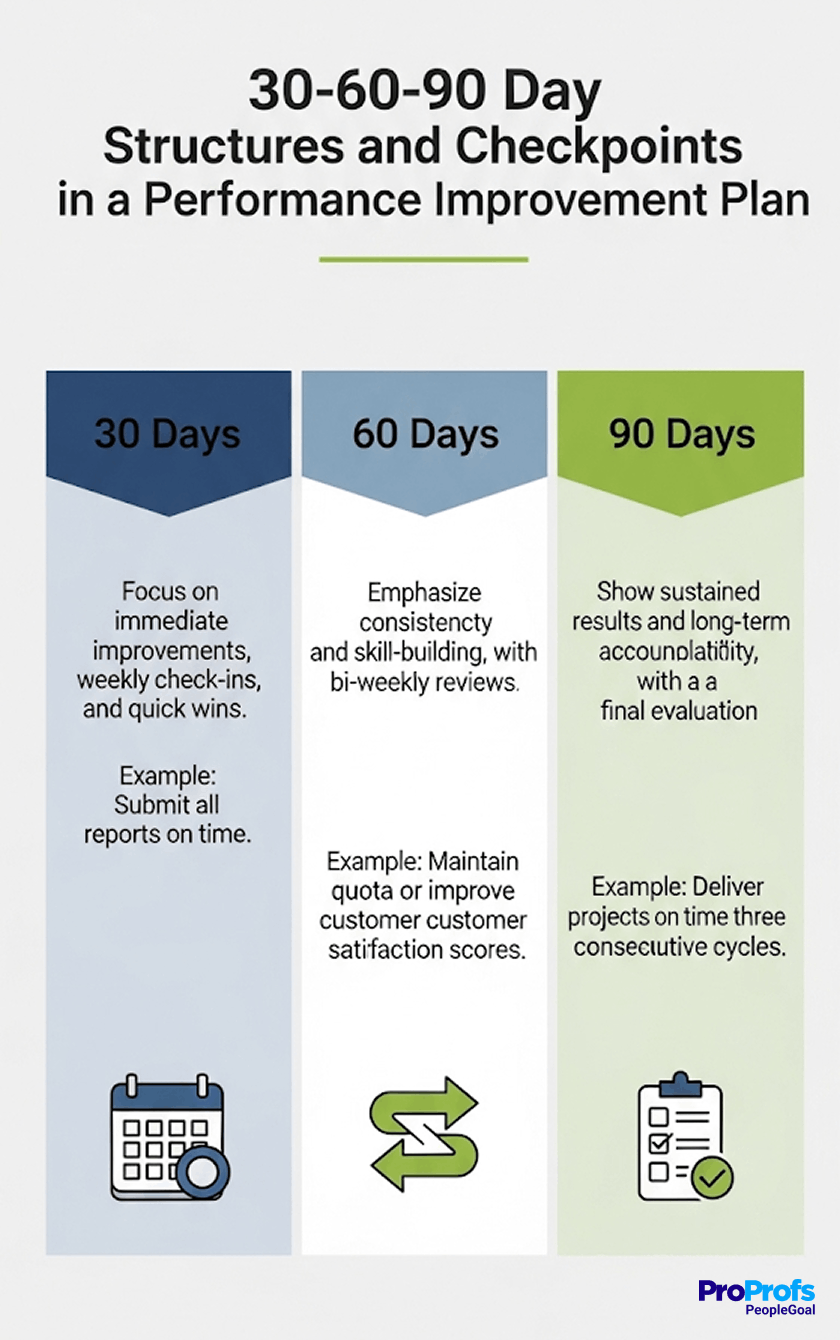
A 30-60-90 day review template creates structured checkpoints during the ramp period.
What the template includes:
| 30-60-90 DAY ONBOARDING REVIEW Employee: _______________________ | Role: ________________________ Start date: _____________________ | Manager: ____________________ ──── 30-DAY CHECK (Date: _____________) ──────────────────────────────── ──── 60-DAY CHECK (Date: _____________) ──────────────────────────────── ──── 90-DAY CHECK (Date: _____________) ──────────────────────────────── FIRST FORMAL GOALS Signatures: Employee __________________ Manager __________________ Date _______ |
30-Day Review Questions
- Do you understand your role and responsibilities?
- What still feels unclear?
- Do you have access to the tools, people, and information you need?
- What has gone well so far?
- What support would make the next 30 days easier?
60-Day Review Questions
- What work have you started owning independently?
- What feedback have you received and applied?
- Where do you still need guidance?
- Are expectations still clear?
- What should be prioritized before the 90-day mark?
90-Day Review Questions
- Is the employee meeting early role expectations?
- What strengths are becoming visible?
- What gaps need attention?
- What goals should be set for the next quarter?
- Is the onboarding process complete, or is more support needed?
Where This Template Usually Fails
This template fails when the milestones are created after the employee starts.
A strong 30-60-90 process begins before day one. The manager should already know what success looks like at each stage.
The goal is not to over-evaluate a new hire. The goal is to prevent drift.
New employees should never have to guess whether they are on track.
9. Project-Based Performance Review Template
Best For: Project-based teams, consulting teams, agencies, product launches, campaigns, cross-functional initiatives, and employees whose most important work happens in defined projects.
What Problem This Template Solves:
Annual reviews can bury important project contributions.
Someone may do exceptional work on a critical launch, but by the time the annual review arrives, the details are fuzzy. A project-based review captures performance while the work is still fresh.
This is especially useful when the project involved:
- Tight deadlines
- Cross-functional work
- High ambiguity
- Customer impact
- Leadership visibility
- Stretch responsibilities
What the template includes:
| PROJECT-BASED APPRAISAL Employee: _______________________ | Project: ____________________ Manager: ________________________ | Duration: ___________________ PROJECT SCOPE DELIVERY COLLABORATION STRETCH PERFORMANCE LESSONS LEARNED Overall project rating: Signatures: Employee __________________ Manager __________________ Date _______ |
Sample Questions
- What was the employee responsible for?
- Did they deliver what was expected?
- How did they handle ambiguity or pressure?
- Did they communicate risks early?
- What impact did their work have?
- What should they repeat in future projects?
- What should they improve next time?
Where This Template Usually Fails
Project reviews fail when they become disconnected from the main performance record.
A project-based review should not live in isolation. It should feed into the employee’s broader performance history.
Otherwise, valuable evidence gets lost.
This is another reason growing companies eventually need a connected performance system. Project feedback, quarterly check-ins, annual reviews, and goals should all inform one another.
10. Performance Improvement Plan Template
Best For: Employees whose performance is below expectations and who need a structured path to improve.
A Performance Improvement Plan, or PIP, should be used after direct feedback has already been given. It should not be the first time an employee hears there is a serious issue.
What Problem This Template Solves:
A PIP creates clarity.
It defines:
- What is not working
- What standard must be met
- What support will be provided
- What timeline applies
- What happens if performance improves
- What happens if it does not
A PIP should not be written as a punishment. It should be written as a structured intervention.
What the template includes:
| PERFORMANCE IMPROVEMENT PLAN Employee: _______________________ | Role: ________________________ Manager: ________________________ | Start date: _________________ Note: This plan formalises conversations already held directly with the employee. PERFORMANCE GAPS (with evidence and dates) EXPECTED STANDARD (what “meeting expectations” looks like) MANAGER SUPPORT COMMITMENTS MILESTONES 60 days (Date: _________) Success criteria: ________________________ 90 days (Date: _________) Success criteria: ________________________ OUTCOME STATEMENT Signatures: Employee __________________ Manager __________________ HR __________________ Date _______ |
Example PIP Goal
Performance Gap: Reports have repeatedly been submitted late and required significant rework.
Expected Standard: Reports are submitted by the agreed deadline, follow the approved format, and require only minor edits.
30-Day Milestone: Submit all weekly reports on time with no missing sections.
60-Day Milestone: Maintain on-time submission and reduce manager edits by at least 50%.
90-Day Milestone: Consistently meet quality and deadline expectations without additional reminders.
Support Provided: Weekly check-ins, report template, examples of strong reports, manager review before submission for the first four weeks.
Where This Template Usually Fails
PIPs fail when expectations are vague.
Statements like “improve communication” or “be more proactive” are not enough. The employee needs to know exactly what behavior must change.
A stronger version would say: “Send a written project status update every Friday by 3 p.m., including progress, risks, blockers, and next steps.”
That is observable. It can be evaluated.
The other common failure is using a PIP too late. If the manager has avoided feedback for months, the PIP can feel sudden and unfair. A good performance management process addresses concerns early, before a formal plan becomes necessary.
What Most Employee Performance Appraisal Templates Miss
Templates help. They create structure, consistency, and documentation.
But a template is not the same thing as a performance management process.
The best employee performance appraisal free template will still fail if the company has not answered a few basic questions:
- What does good performance look like in this role?
- How often are goals reviewed?
- Are managers documenting feedback throughout the year?
- Are employees receiving feedback before the formal review?
- Are ratings calibrated across teams?
- Are development plans actually followed up on?
This is where many review cycles fall apart.
The form gets completed. The meeting happens. The rating is entered. Then everyone moves on until the next cycle.
That is not performance management. That is performance documentation.
A stronger process creates a continuous thread between:
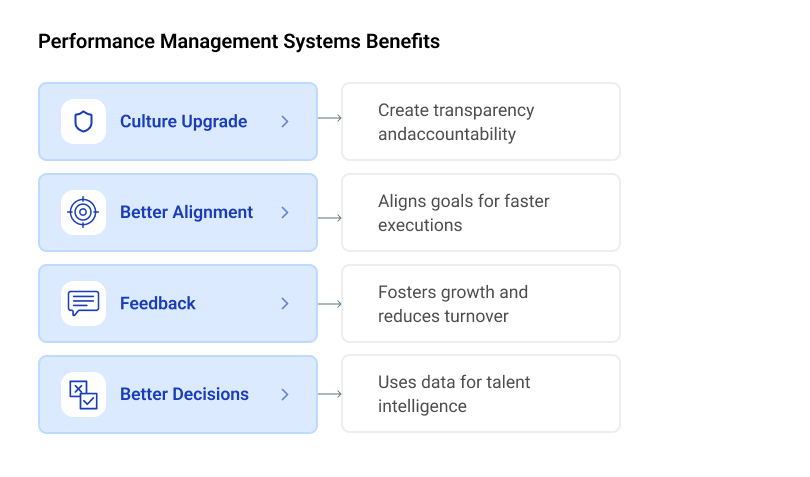
- Goals
- Feedback
- Check-ins
- Reviews
- Development
- Recognition
- Performance decisions
When those pieces are disconnected, reviews become less credible.
Why Employees Stop Trusting Performance Reviews
Employees usually do not reject feedback itself.
They reject feedback that feels:
- Surprising
- Vague
- Inconsistent
- Political
- Unsupported by examples
- Disconnected from growth or compensation decisions
Here are the most common reasons employees lose trust in appraisal processes.
1. Feedback Arrives Too Late
No employee should hear about a serious performance concern for the first time in an annual review.
When that happens, the employee does not experience the review as helpful. They experience it as unfair.
Good appraisal processes make feedback ongoing. The formal review should summarize known conversations, not introduce hidden concerns.
2. Ratings Feel Subjective
A rating without evidence creates frustration.
For example: “Meets expectations.”
That may be true, but it is not useful by itself.
Better: “Meets expectations because you consistently delivered weekly reporting on time, supported the customer success team during two escalations, and completed the CRM cleanup project by the agreed deadline. The main development area is presenting insights more clearly to senior stakeholders.”
The second version gives the employee something to understand and act on.
3. Different Managers Use Different Standards
One manager gives high ratings easily. Another rarely gives anything above average.
Employees notice.
This is where calibration matters. Before ratings are finalized, leaders should compare review patterns across teams and ask whether standards are being applied consistently.
A “4” should mean the same thing across departments.
4. Reviews Do Not Lead to Development
A review that ends with a rating but no development plan is incomplete.
Employees want to know:
- What should I keep doing?
- What should I change?
- What opportunities can I grow into?
- What support will I get?
- How will progress be measured?
Without follow-through, the review becomes an administrative event instead of a growth conversation.
What High-Trust Performance Reviews Have in Common
Fair reviews are not perfect. But they are consistent, evidence-based, and clear.
High-trust appraisal processes usually include six things.
1. Clear Expectations Before the Review Period Begins
Employees should know what they are being evaluated against before the cycle starts.
That means:
- Role expectations are clear
- Goals are documented
- Competencies are defined
- Success measures are agreed
- Managers and employees have the same understanding of priorities
No template can fix unclear expectations after the fact.
2. Ongoing Documentation
Managers should not rely on memory.
They should keep track of:
- Wins
- Missed expectations
- Feedback conversations
- Goal changes
- Project outcomes
- Employee growth moments
- Customer or peer feedback
This does not need to be complicated. But it does need to happen consistently.
3. Behavioral Examples
The most useful reviews describe specific behavior.
Weak: “Needs to communicate better.”
Strong: “In the last two project meetings, key timeline changes were not shared with the implementation team until after deadlines shifted. Next quarter, project updates should be sent every Friday with risks and next steps clearly documented.”
Specific feedback is easier to act on.
4. Calibration
Calibration prevents review quality from depending entirely on manager style.
It helps identify:
- Rating inflation
- Overly harsh scoring
- Inconsistent standards
- Missing evidence
- Promotion-readiness gaps
- Potential bias
Calibration is not about forcing ratings into a curve. It is about making sure decisions are fair and defensible.
5. Employee Voice
Employees should have space to share context.
That includes:
- Accomplishments the manager may not have seen
- Blockers that affected results
- Support they needed
- Career goals
- Feedback for the manager or organization
A review should not be something done to an employee. It should be a conversation with them.
6. Follow-Through
The review is not over when the form is submitted.
The next step should be clear:
- What goals were agreed?
- What development actions were committed?
- What will the manager do?
- When will progress be checked?
- What support is required?
This is where many companies lose credibility. Employees remember whether commitments made during reviews are actually honored.
Where Spreadsheet Review Processes Break
Spreadsheets and documents can work when the company is small.
At 10 or 15 employees, HR can manually track forms, remind managers, and consolidate feedback.
But as the company grows, the review process becomes harder to manage.
Common problems include:
- Managers using different versions of forms
- Self-assessments getting lost in email
- HR manually chasing completion
- Reviewer feedback arriving late
- Calibration happening without enough data
- Goals living in one document and reviews in another
- No historical record of previous feedback
- Development plans not being revisited
- Leadership lacks visibility into review progress
This is the core issue:
Templates solve structure problems. They do not solve coordination problems.
Once multiple managers, departments, review types, and approval steps are involved, the process needs more than a downloadable form.
This is where organizations often move from static templates to a dedicated performance management system.
A platform like PeopleGoal helps teams turn appraisal templates into repeatable workflows by centralizing goals, feedback, self-assessments, review forms, reminders, and historical records. The purpose is not to replace manager conversations. It is to make those conversations easier to run consistently across the organization.
How to Turn Templates Into a Repeatable Performance Review System
A strong review process does not need to be overly complex. But it does need to be repeatable.
Here is a practical sequence.
Step 1: Choose the Right Template for the Situation
Do not use the same form for every review.
An annual review, 360 review, onboarding check-in, and PIP serve different purposes. The structure should match the decision being made.
Step 2: Define the Standard Before the Review
Before managers evaluate performance, define:
- Goals
- Competencies
- Rating scale
- Evidence expectations
- Review timeline
- Calibration process
This reduces inconsistency later.
Step 3: Train Managers on Evidence-Based Feedback
Managers should know how to move from vague impressions to specific examples.
Instead of: “Great attitude.”
Use: “You stayed calm during the customer escalation, clarified next steps for the team, and followed up with the client within the agreed timeline.”
The best reviews are built from evidence.
Step 4: Collect Employee Input First
Ask employees to complete self-assessments before managers finalize reviews.
This helps managers avoid missing important context and creates a more balanced conversation.
Step 5: Calibrate Before Sharing Ratings
Managers should compare ratings and rationales before reviews are delivered.
This prevents inconsistent standards from becoming final decisions.
Step 6: Connect Reviews to Development
Every review should end with a next step.
That may be:
- A new goal
- A development plan
- A coaching commitment
- A training opportunity
- A promotion readiness plan
- A follow-up check-in
A review without follow-through creates little value.
Rethink How You Evaluate Employee Performance
An employee performance appraisal template is useful only when it supports a better conversation.
The right template helps managers prepare, gives employees a voice, creates a record of performance, and connects feedback to future development. But the template is just the structure.
The real work is building a review process that is consistent enough for managers to use, clear enough for employees to trust, and repeatable enough for HR to scale.
Start with the templates that match your current review needs. Keep them simple. Add evidence-based prompts. Train managers to use specific examples. Calibrate ratings before they are shared. And most importantly, make sure every review leads to a clear next step.
As your organization grows, static forms will eventually reach their limit. That is the point where a system like PeopleGoal can help turn disconnected templates into a continuous performance management process — one where goals, feedback, reviews, and development stay connected all year.
Ready to 3x Your Teams' Performance?
Use the best performance management software to align goals, track progress, and boost employee engagement.