
An employee Performance Improvement Plan (PIP) conversation is one of the hardest moments in management because it forces leaders to answer a question most avoid: “What happens when feedback alone is no longer working?”
You see the missed deadlines, inconsistent work, and growing frustration across the team. But without structure, most managers either delay action or handle it emotionally.
According to Gartner HR Research in 2026, only 39% of employees say their manager provides clear developmental feedback, which explains why performance conversations often become reactive instead of constructive.
That is where a well-built PIP matters.
A good PIP is not a punishment document or a surprise attack. It is a structured, fair, and measurable process that gives employees clarity, managers accountability, and HR proper documentation.
In this guide, I’ll walk you through templates, examples, timelines, conversations, and the systems that make PIPs actually work.
What Is a Performance Improvement Plan?
A good PIP usually includes the performance issue, specific examples, expected standards, SMART goals, timeline, support resources, check-in schedule, success criteria, and consequences if improvement does not happen.
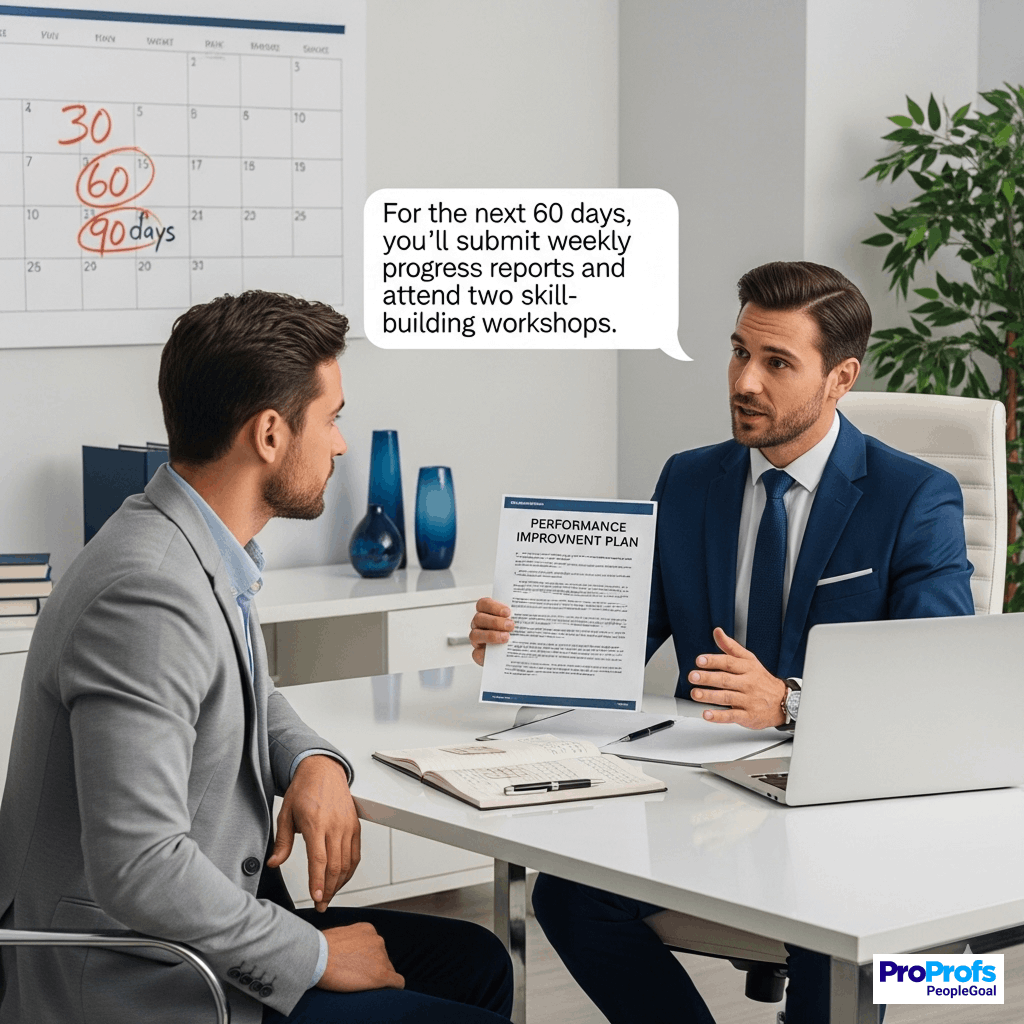
A PIP is typically used when:
- Performance issues continue despite feedback
- Goals or deadlines are repeatedly missed
- Work quality remains below expectations
- Behavior affects team performance
- Customer or stakeholder complaints continue
- Coaching efforts have not led to improvement
- Expectations are clear, but performance is still lacking
- Managers need a consistent and documented improvement process
That is the structure. But the mindset matters just as much.
Performance Improvement Plan Template
Let’s start with the basic template. This is the structure I recommend when I want a PIP to be clear, fair, and easy to follow. You can copy this format into a document, spreadsheet, or performance management platform.
If you’re running short on time, you can download the PIP toolkit here:
Personally, I prefer managing PIPs inside a system like PeopleGoal because it keeps goals, regular check-ins, feedback, reminders, and documentation in one place. But even if you are starting manually, this structure will help.
1. Simple PIP Template
Employee Name: [Employee name] Job Title: [Role] Department: [Department] Manager: [Manager name] PIP Start Date: [Date] PIP End Date: [Date] Review Period: 30 days / 60 days / 90 days
Reason for the PIP: Clearly describe the performance concern.
Example: The employee has missed agreed-upon project deadlines in three of the last four reporting cycles, causing delays for the marketing and design teams.
Performance Areas That Need Improvement: List the specific areas.
Example:
- Timely completion of assigned work
- Quality of submitted reports
- Communication with stakeholders
- Follow through on agreed priorities
Current Performance Gap: Describe what is happening now.
Example: Reports are often submitted two to three days late, and updates are not shared in advance when deadlines are at risk.
Expected Standard: Describe what good performance looks like.
Example: Reports should be submitted by 5 PM every Friday, with any risks or blockers communicated at least 24 hours before the deadline.
Improvement Goals: Use measurable goals.
Example:
- Submit all weekly reports on time for the next 30 days.
- Provide written progress updates every Wednesday by 3 PM.
- Reduce report revisions from an average of five edits to no more than two edits per report.
Support Provided: List what the company or manager will provide.
Example:
- Weekly one-on-one coaching with the manager
- Access to report examples and templates
- Time management support
- Priority alignment every Monday morning
Check-In Schedule: Define how often progress will be reviewed.
Example:
- Weekly check-ins every Friday at 11 AM
- Midpoint review after 15 days
- Final review at the end of 30 days
Success Criteria: Define what must happen for the PIP to be completed successfully.
Example: The employee must meet at least 90 percent of agreed deadlines, maintain quality standards, and communicate blockers proactively throughout the review period.
Consequences If Improvement Does Not Happen: Be clear but professional.
Example: If the required improvement is not achieved, further action may be taken, which may include extension of the PIP, reassignment, disciplinary action, or termination of employment, depending on company policy.
Employee Comments: Give the employee space to respond. Manager Signature: [Name and date] Employee Signature: [Name and date] HR Signature: [Name and date]
Now, this is the simplest version. It works well for small teams, early-stage companies, or managers who need a quick structure. But when the performance issue is serious, repeated, or tied to business outcomes, I recommend using a more detailed version.
2. 30-Day PIP Template
A 30-day PIP works best when the performance issue is specific, urgent, and measurable.
I use a 30-day PIP when the employee already understands the role, has received prior feedback, and needs to show immediate improvement.
Best for:
- Missed deadlines
- Attendance issues
- Communication gaps
- Quality issues
- Failure to follow process
- Short-term performance decline
Sample 30-Day PIP Structure
Week 1: Clarify expectations
- Review the performance issue.
- Confirm success metrics.
- Share resources and examples.
- Schedule weekly check-ins.
Week 2: Monitor early progress
- Review first set of deliverables.
- Identify blockers.
- Provide coaching.
- Document progress.
Week 3: Correct remaining gaps
- Compare actual performance against expectations.
- Give direct employee feedback.
- Adjust support if needed.
- Confirm whether progress is on track.
Week 4: Final review
- Evaluate performance against goals.
- Decide whether the PIP is complete, extended, or escalated.
- Document the outcome.
Example Goal for a 30-Day PIP
For the next 30 days, the employee must submit all assigned client reports by the agreed deadline, maintain an error rate below 5 percent, and provide a written status update every Wednesday and Friday.
This works because the employee knows exactly what success looks like.
3. 60-Day PIP Template
A 60-day PIP works better when the issue needs behavior change, skill development, or consistency over time.
I use this when the employee can improve, but they need more than a few weeks to build habits.
Best for:
- Inconsistent performance
- Poor stakeholder communication
- Role transition issues
- Skill gaps
- Repeated coaching needs
- Missed goals across multiple cycles
Sample 60-Day PIP Structure
Days 1 to 15: Diagnosis and alignment
- Review the issue.
- Confirm expectations.
- Identify root causes.
- Provide training or examples.
Days 16 to 30: Early execution
- Track deliverables.
- Review quality.
- Provide coaching.
- Document progress.
Days 31 to 45: Consistency check
- Look for repeated improvement.
- Address recurring issues.
- Compare performance to success metrics.
Days 46 to 60: Final evaluation
- Assess whether improvement is sustainable.
- Decide next steps.
- Document outcome.
Example Goal for a 60-Day PIP
Over the next 60 days, the employee must maintain at least 95 percent attendance, complete all assigned tasks within agreed timelines, and receive no more than one quality-related escalation from internal stakeholders.
4. 90-Day PIP Template
A 90-day PIP is useful when the employee is in a complex role or when the improvement area involves multiple skills.
I do not use 90 days just to delay a hard decision. I use it when the employee genuinely needs time to show sustainable change.
Best for:
- Sales performance improvement
- Leadership behavior change
- Manager effectiveness
- Cross-functional collaboration
- Complex technical roles
- Role realignment
Sample 90-Day PIP Structure
Days 1 to 30: Set the foundation
- Clarify expectations.
- Review past performance.
- Identify root causes.
- Provide coaching and resources.
Days 31 to 60: Measure improvement
- Track output and behavior.
- Review metrics.
- Give structured feedback.
- Adjust support where necessary.
Days 61 to 90: Confirm sustainability
- Evaluate consistency.
- Confirm whether improvement is independent or manager-dependent.
- Decide final outcome.
Example Goal for a 90-Day PIP
Over the next 90 days, the employee must achieve at least 85 percent of monthly sales quota, maintain complete CRM updates for all active opportunities, attend weekly pipeline reviews, and demonstrate consistent follow-up with all qualified prospects within two business days.
Performance Improvement Plan Examples by Role
Now let’s make this more practical.
In my experience, most managers do not just want a blank template. They want to see how a PIP actually looks in real workplace situations. Here are some live performance improvement plan examples you can use as a reference.
Example 1: PIP for Missed Deadlines
Situation: A project coordinator repeatedly misses internal deadlines and does not communicate delays early.
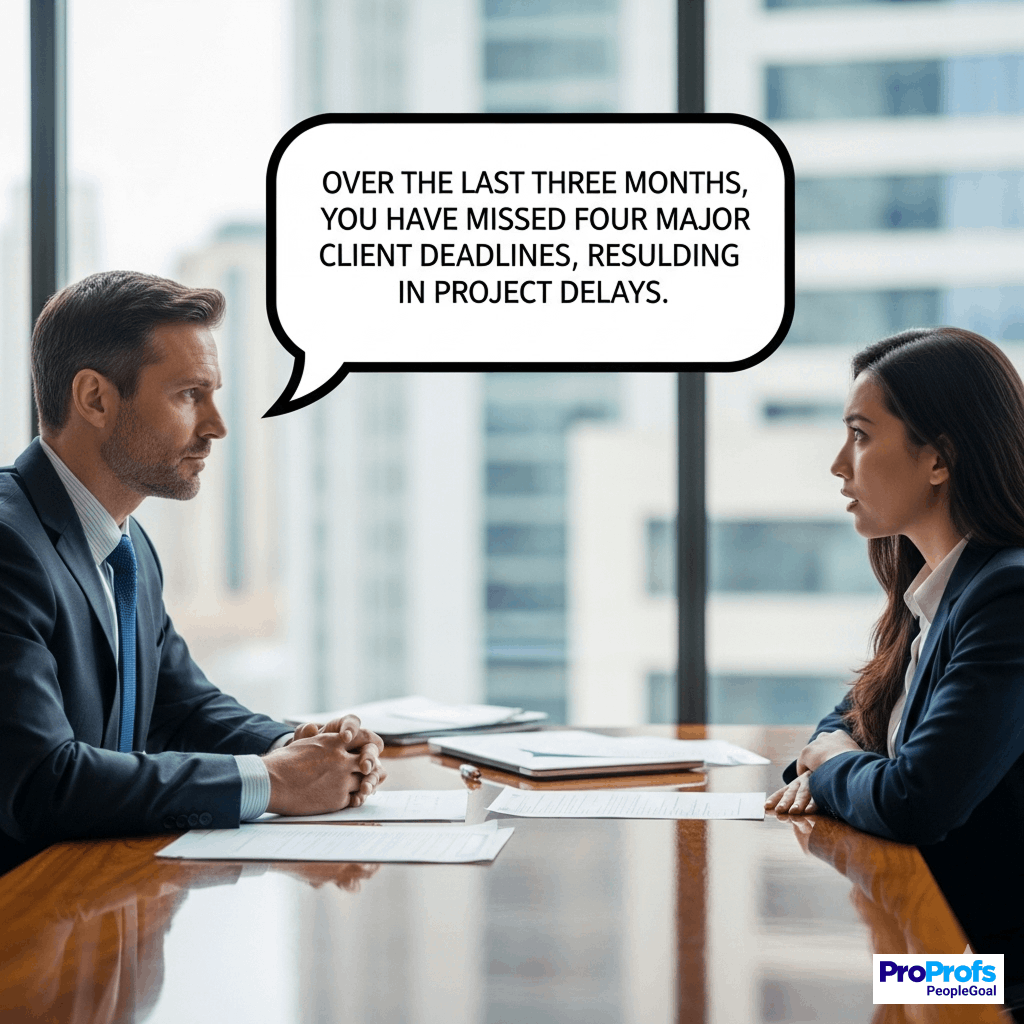
Performance Issue: The employee has missed three major project milestones in the last six weeks. In each case, the manager or another team member discovered the delay after the deadline had passed.
Expected Improvement: The employee must meet all agreed project deadlines and communicate risks before they affect delivery.
PIP Goals:
- Submit all assigned deliverables by the agreed deadline for the next 30 days.
- Send progress updates every Tuesday and Thursday.
- Notify the manager at least 24 hours in advance if any deadline is at risk.
- Use the project tracker daily to update task status.
Support Provided:
- Weekly prioritization meeting with manager
- Project planning template
- Coaching on workload estimation
- Access to team delivery calendar
Success Criteria: No missed deadlines during the PIP period, unless the delay is approved in advance due to a valid dependency or business reason.
Example 2: PIP for Poor Quality of Work
Situation: A customer support representative resolves tickets quickly but makes repeated mistakes, leading to reopened tickets and unhappy customers.
Performance Issue: The employee’s ticket quality score has remained below the team standard for two consecutive months.
Expected Improvement: The employee must improve accuracy, follow the support process, and reduce reopened tickets.
PIP Goals:
- Maintain a ticket quality score of at least 90 percent for the next 45 days.
- Reduce reopened tickets to fewer than 5 percent of total closed tickets.
- Follow the approved troubleshooting checklist for every technical ticket.
- Attend two coaching sessions with the support lead.
Support Provided:
- Review of quality scorecards
- Access to knowledge base articles
- Shadowing sessions with senior agents
- Weekly feedback from manager
Success Criteria: The employee consistently meets quality standards and shows improved customer handling across the review period.
Example 3: PIP for Sales Performance
Situation: A sales representative has missed quota for three consecutive months and has low CRM activity.
Performance Issue: The employee has achieved less than 60 percent of quota for the last quarter and has not maintained accurate pipeline records.
Expected Improvement: The employee must improve sales activity, pipeline hygiene, and revenue outcomes.
PIP Goals:
- Complete at least 40 qualified outbound activities per week.
- Update CRM records daily.
- Attend weekly pipeline coaching sessions.
- Achieve at least 75 percent of monthly quota during the PIP period.
- Follow up with all qualified leads within one business day.
Support Provided:
- Sales coaching
- Call review sessions
- Updated pitch scripts
- Pipeline review with manager
- Access to product training
Success Criteria: The employee shows measurable improvement in sales activity, pipeline quality, and quota achievement.
Example 4: PIP for Manager Performance
Situation: A team manager has high turnover, poor team engagement, and inconsistent one-on-one meetings.
Performance Issue: The manager has not held regular one-on-ones, has delayed feedback conversations, and has not followed through on team development plans.
Expected Improvement: The manager must improve communication, team support, and performance management practices.
PIP Goals:
- Hold documented one-on-one meetings with each direct report every two weeks.
- Create development plans for all underperforming team members.
- Respond to team escalations within one business day.
- Improve the team engagement pulse score by the next review cycle.
- Submit weekly team performance updates to the department head.
Support Provided:
- Coaching from senior manager
- People management training
- One-on-one meeting template
- Access to engagement survey results
- HR support for difficult conversations
Success Criteria: The manager demonstrates consistent people management habits and improves team communication and accountability.
Example 5: PIP for Remote Employee Performance
Situation: A remote employee is missing meetings, responding late, and creating visibility issues for the team.
Performance Issue: The employee has missed recurring team meetings, delayed responses to priority messages, and failed to update task progress consistently.
Expected Improvement: The employee must improve availability, communication, and task visibility.
PIP Goals:
- Attend all required team meetings unless leave is approved.
- Respond to priority messages within four business hours.
- Update task status daily in the project management tool.
- Complete assigned work by agreed deadlines.
- Join weekly check-ins with the manager.
Support Provided:
- Clarified communication expectations
- Shared team availability guidelines
- Weekly workload planning
- Access to collaboration tools
Success Criteria: The employee becomes consistently reachable, reliable, and transparent in remote work routines.
How to Write a Performance Improvement Plan
Here is the process I follow.
Step 1: Start With the Performance Gap
I start with the gap. I ask myself, “What is the employee doing or not doing that falls below expectations?”
| Avoid | Instead Write |
| “John needs to be more responsible.” | “John has missed four client follow-up deadlines in the last six weeks, and two clients escalated due to lack of response.” |
That is specific. That gives us something to work with.
Step 2: Use Evidence
A PIP should include examples. Not gossip. Not assumptions. Not “everyone feels like.”
Use facts like:
- Missed the deadline on March 3
- Customer complaint received on March 8
- Quality score below 80 percent in February
- Three unapproved absences in 30 days
- CRM is not updated for 12 active deals
Evidence protects everyone. It protects the company from inconsistency and employee from vague criticism.
Step 3: Define the Expected Standard
Once I describe the gap, I define what good performance looks like. This is where many PIPs fail.
They say what is wrong, but they do not clearly say what must happen next. Good expectations remove guesswork.
| Weak Standard | Better Standard |
| “Improve communication.” | “Send a written project update every Monday and Thursday by 3 PM, including completed work, blockers, and next steps.” |
| “Be more accurate.” | “Maintain an error rate below 3 percent on weekly financial reports for the next 30 days.” |
Step 4: Set SMART Goals
A PIP without measurable goals is just a complaint in document form. I always use SMART goals:
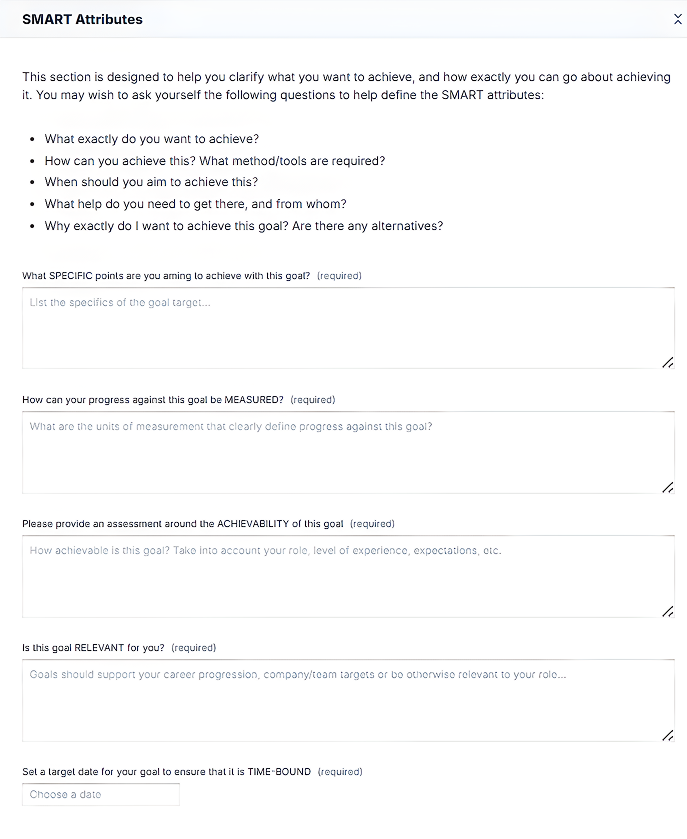
- Specific
- Measurable
- Achievable
- Relevant
- Time-bound
Here is a simple formula I use: “By [date], the employee will [specific action or outcome], measured by [metric or evidence], with [quality or frequency standard].”
| Bad Example | Good Example |
| “The employee should improve reporting quality.” | “By the end of the 30-day PIP period, the employee will submit all weekly reports by Friday at 5 PM, with no more than two manager-requested revisions per report.” |
Step 5: Include Support
This part is non-negotiable for me. If I am asking an employee to improve, I need to say how the company will support that improvement. For example, employees in software development or QA roles may benefit from additional training, mentoring, and automated testing tools that help them identify issues earlier and improve the quality and consistency of their work.
Support can include:
- Coaching
- Training
- Job aids
- Templates
- Mentoring
- Clearer priorities
- Weekly check-ins
- Reduced ambiguity
- Process documentation
- Role clarification
This is also where a platform like PeopleGoal can help because support activities, check-ins, goals, and progress notes can be connected inside one performance workflow instead of being scattered across email, spreadsheets, and meeting notes.
That matters because support only counts if it actually happens.
Step 6: Schedule Check-Ins
A PIP should never be handed over and then ignored until the final day. I schedule check-ins in the form of 30-60-90 day plan from the beginning.
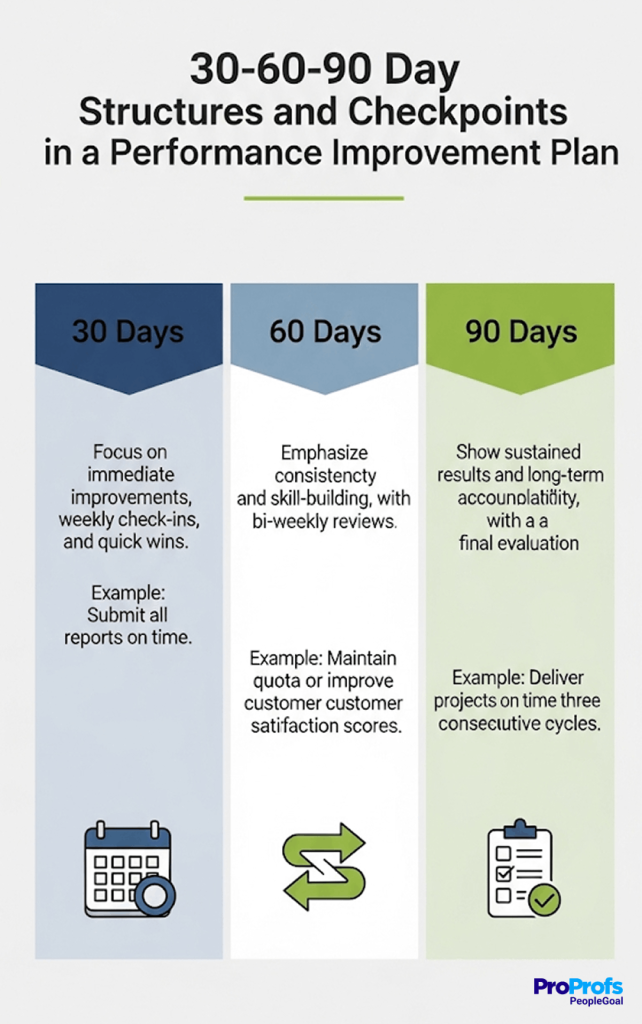
- For a 30-day PIP, I prefer weekly check-ins.
- For a 60-day PIP, I usually recommend weekly or biweekly check-ins.
- For a 90-day PIP, I still want regular touchpoints because waiting too long creates surprises.
Each check-in should answer:
- What progress has been made?
- What goals are on track?
- What is still not improving?
- What blockers exist?
- What support is needed?
- What happens before the next check-in?
And yes, I document each one.
Step 7: Define the Final Outcome
The employee should not be left guessing. At the end of the PIP, there are usually four possible outcomes:
- The employee successfully completes the employee performance improvement plan.
- The PIP is extended because progress is visible but incomplete.
- The employee is moved to a better-fit role, if appropriate.
- Further employment action is taken.
Be clear. Be respectful. Be consistent.
How to Talk to an Employee About a PIP
This is the part managers dread. I understand why. Nobody enjoys telling someone they are not meeting expectations. But avoiding the conversation does not protect the employee. It usually makes the situation worse.
Here is the conversation structure I use:
1. Open with clarity: “Thanks for meeting with me today. I want to talk through some ongoing performance concerns and the formal improvement plan we are putting in place.”
2. State the issue directly: “The main concern is that your project deadlines have been missed several times over the last six weeks, and the delays have affected the wider team.”
3. Share examples: “For example, the client report due on March 3 was submitted two days late, and the campaign tracker due on March 10 was not updated until after the review meeting.”
4. Explain why it matters: “When these deadlines are missed, other teams cannot complete their work on time, and it creates pressure across the project.”
5. Introduce the PIP: “This plan is designed to give you clear expectations, structured support, and a defined timeline to improve.”
6. Walk through expectations: “During the next 30 days, the expectation is that all assigned deliverables are submitted by the agreed deadline, and any risk to a deadline is communicated at least 24 hours in advance.”
7. Explain support: “We’ll meet every Friday to review progress, and I’ll also help you prioritize your workload every Monday morning.”
8. Invite their perspective: “I want to hear your view as well. Are there blockers or context I should understand?”
9. Confirm next steps: “We’ll document today’s conversation, and our first check-in will be this Friday.”
What to Include in a PIP Checklist
Here is a quick checklist I would include:
Before issuing the PIP:
- Has the employee already received feedback?
- Has the manager shared clear examples?
- Are expectations documented?
- Is the issue related to performance, not personality?
- Has HR reviewed the plan?
- Are the goals measurable?
- Is the timeline realistic?
- Is support included?
- Are check-ins scheduled?
- Are consequences clearly stated?
During the PIP:
- Are check-ins happening on schedule?
- Is progress documented?
- Is the employee receiving support?
- Are blockers being addressed?
- Is feedback specific and timely?
At the end of the PIP:
- Were all goals reviewed?
- Is the outcome supported by documentation?
- Has HR reviewed the final decision?
- Has the employee received clear next steps?
- Is the final decision consistent with company policy?
5 Common PIP Mistakes I See Managers Make
I have seen good intentions fail simply because the PIP process was poorly handled. A strong PIP should create clarity, accountability, and support, not confusion or fear.
Mistake 1: Making the PIP Too Vague
Vague language leaves employees unsure about what actually needs to improve. The more specific the expectations, the better the outcomes usually are.
Fix it by:
- Using measurable expectations
- Including real examples of performance gaps
- Defining what success looks like
- Setting clear behavioral and performance standards
Mistake 2: Setting Unrealistic Goals
A PIP should push improvement, but the goals still need to feel achievable. If expectations feel impossible, employees quickly disengage.
Fix it by:
- Setting realistic timelines
- Aligning goals with the employee’s role and workload
- Making goals measurable and practical
- Providing the right support and resources
Mistake 3: Ignoring Root Causes
Sometimes poor performance is caused by unclear priorities, lack of training, or workload issues rather than lack of effort.
Fix it by:
- Identifying workplace barriers early
- Asking employees what support they need
- Clarifying priorities and responsibilities
- Providing training, tools, or coaching where needed
Mistake 4: Treating the PIP Like a Termination Notice
Employees can tell when a PIP is only being used as documentation before termination. That damages trust across the team.
Fix it by:
- Making improvement the actual goal
- Holding meaningful check-ins
- Recognizing progress during the process
- Creating achievable success criteria
Mistake 5: Not Documenting Check-Ins
The document alone is not enough. Ongoing conversations and progress tracking matter just as much.
Fix it by:
- Recording progress after every check-in
- Documenting support provided
- Tracking what improved and what did not
- Keeping all updates in one consistent system
What Happens After a PIP?
At the end of the PIP, I recommend a formal review meeting.
Outcome 1: The Employee Successfully Completes the PIP
This is the best-case outcome. Document the improvement, confirm expectations going forward, and continue regular check-ins.
I would say: “You have met the expectations outlined in the plan. We’ll close the formal PIP, and we’ll continue with normal performance conversations from here.”
Outcome 2: The PIP Is Extended
Sometimes the employee improves, but not enough. An extension may make sense when:
- Progress is visible.
- Goals were partially met.
- The employee is engaged.
- More time is reasonable.
- The business can support an extension.
Do not extend forever. Be clear about the new timeline and expectations.
Outcome 3: The Employee Moves to Another Role
Sometimes the issue is fit. The employee may be capable, but not in the current role.
A role change may work when:
- There is a genuine business need.
- The employee has strengths elsewhere.
- The performance issue is tied to role mismatch.
- The company can support the move.
Outcome 4: Employment Action Is Taken
If improvement does not happen, further action may be necessary. This might include disciplinary action or termination, depending on your policy and local requirements. I strongly recommend HR review before any final employment decision.
Watch: How to Conduct a Final PIP Review.
Build a Fairer and More Effective PIP Process
A Performance Improvement Plan should never feel like a rushed HR formality. When done well, it creates clarity, accountability, and a real opportunity for improvement. Throughout this guide, we covered how to structure a PIP, when to use one, common mistakes to avoid, timeline selection, communication strategies, and how to build a repeatable system that managers can actually follow.
The biggest takeaway is simple. Strong PIPs are specific, measurable, supportive, and consistently managed. They focus on performance behaviors, not personal criticism, and they rely on regular coaching instead of one final conversation.
As teams grow, managing all of this manually becomes difficult. That is why platforms like PeopleGoal make sense. It helps teams connect goals, reviews, feedback, check-ins, and documentation in one structured workflow, making the entire process easier to manage and more consistent across managers.
Your next step is simple. Review your current PIP process, identify the gaps, and start building a system that supports both accountability and employee growth.
Frequently Asked Questions
When should you not use a Performance Improvement Plan (PIP)?
A PIP improvement plan should not be used for one-time mistakes, unclear expectations, lack of training, personal conflicts, or situations caused mainly by workload or company issues. It also should not be used when a manager has already decided to terminate the employee. A PIP should offer a real opportunity to improve, not just create documentation.
How can companies make a Performance Improvement Plan feel fair?
A PIP feels fair when employees clearly understand the issue, expectations, and success criteria. Companies should apply consistent standards, provide meaningful support, measure progress using evidence, and communicate regularly throughout the process. Employees may not enjoy the process, but they should feel they were given a genuine opportunity to improve.
How long should a Performance Improvement Plan last?
Most PIPs last 30, 60, or 90 days depending on the situation. Shorter timelines work for specific issues with quick measurable improvements, while longer timelines are better for complex roles, coaching needs, or behavior changes that require consistent progress over time.
How can companies build a repeatable PIP system?
Companies can build a repeatable PIP system by standardizing templates, defining approval workflows, scheduling regular check-ins, documenting every conversation, and connecting PIPs to performance data like goals, reviews, and feedback. A structured process improves consistency, reduces confusion, and helps managers handle performance issues more fairly and effectively.
What are the PIP best practices for creating an effective Performance Improvement Plan?
An effective PIP should start early, include measurable goals, provide real support, and maintain regular communication throughout the process. Managers should focus on specific behaviors instead of personal criticism, avoid surprises during reviews, and involve HR to ensure the process stays fair, professional, and consistent for everyone involved.
Ready to 3x Your Teams' Performance?
Use the best performance management software to align goals, track progress, and boost employee engagement.