

I’ve sat across the table from enough performance reviews to know the exact moment employees freeze up. It’s not the review itself. It’s the blank self-assessment form staring back at them the night before, with a due date and zero memory of what they did in March.
That’s what this list fixes. I’ve pulled together self-assessment questions for employees, organized by exactly what you’re being asked to reflect on: goals, achievements, strengths, growth areas, competencies, career stage, and review type.
Every question comes with sample answers and a quick note on why that answer works, so you’re not just filling in blanks. You’re building a self-assessment that actually holds up in the room.
60+ Self Assessment Questions for Every Review
Whether you’re preparing for an annual review, a promotion discussion, or a quarterly check-in, these categorized questions help you reflect on every important aspect of your performance.
Goals and Results Questions
I always tell people to start here, because goals are the easiest thing to quantify and the easiest thing to forget. These questions push you to connect what you did to what you were actually asked to deliver.
| Self-Assessment Question | Why It Works |
| What goals were you assigned for this review period, and what percentage of each did you complete? | Forces a measurable, side-by-side comparison instead of a vague “I did well.” |
| Which goal are you proudest of hitting, and what specific actions got you there? | Connects the result to the behavior, which is what managers actually want to see repeated. |
| Did any goals change mid-cycle, and how did you adapt your approach? | Shows adaptability without you having to claim it outright. |
| What KPI or metric best represents your impact this period? | Anchors your self-assessment in the same language your manager uses to evaluate you. |
| Which goal did you miss, and what got in the way? | Framed around obstacles, not blame, which keeps it constructive. |
| How did your goals this period connect to your team’s or company’s broader objectives? | Signals strategic awareness, a trait that shows up in every promotion rubric. |
| What would you set as your top goal for the next review period, and why? | Turns the self-assessment into a forward-looking planning document, not just a scorecard. |
| If you had one more month, what goal would you push to finish? | Surfaces near-misses and shows you’re already thinking about what’s next. |
Example answer: “I was assigned three goals this quarter: reduce onboarding time by 20%, launch the new client portal, and cross-train two teammates on the reporting tool. I hit the onboarding target at 24% and fully launched the portal two weeks ahead of schedule. Cross-training is at 80% complete, with the final session scheduled for next week.”
Why it works: It leads with the exact goals as assigned, reports real percentages instead of “mostly done,” and is honest about the one goal that’s still in progress instead of rounding up.
Example answer: “My biggest goal this cycle was migrating our reporting stack without any downtime for the sales team. I mapped every dependency two weeks before the cutover, ran a dry migration on a Friday evening, and caught a data mapping error before it hit production. The actual migration had zero reported issues.”
Why it works: It names the specific risk that was avoided, not just the outcome, which shows judgment rather than luck.
Achievements and Impact Questions
Achievements are where the “blank page” problem hits hardest, because most people underestimate the small wins that add up. These questions are built to jog your memory and push you toward numbers.
| Self-Assessment Question | Why It Works |
| What accomplishment from this period had the biggest impact on the team or business? | Filters for significance instead of a laundry list of tasks. |
| What is one thing you did that no one asked you to do, but that made a difference? | Surfaces initiative, which rarely shows up unless directly asked. |
| Can you quantify the impact of your work in time saved, revenue generated, or costs reduced? | Pushes past “helped improve things” into numbers a manager can cite upward. |
| What positive feedback did you receive from a colleague, client, or manager this period? | Brings in outside validation without sounding like you’re bragging. |
| What project are you most proud of, and what was your specific role in it? | Prevents team credit from diluting your individual contribution. |
| Where did you step outside your job description to help the team succeed? | Captures cross-functional value that formal goals often miss. |
| What’s one recurring problem you solved that used to eat up time or cause friction? | Rewards process improvement, not just project delivery. |
Example answer: “When our biggest client’s account manager left with two weeks’ notice, I volunteered to cover their account on top of my own workload. I kept response times under four hours for both accounts, and the client renewed their contract early, citing our team’s responsiveness as a key reason.”
Why it works: It shows initiative under pressure, includes a concrete metric, and ties the outcome to a business result that a manager can repeat in their own report.
Example answer: “I noticed our support team was manually re-entering the same customer data across two systems, costing about five hours a week. I built a simple import template that cut that down to under one hour and shared it with two other teams facing the same issue.”
Why it works: It quantifies the time saved, and the last line shows the impact extended past the person’s own role.
Strengths Questions
I’ve noticed people either undersell their strengths out of modesty or oversell them without proof. These questions are designed to get a specific, evidence-backed answer either way.
| Self-Assessment Question | Why It Works |
| What skill or strength did you rely on most this period, and how did it show up in your work? | Requires a real example, not just a trait like “good communicator.” |
| What do colleagues or your manager consistently come to you for? | Uses other people’s behavior as proof of your strength. |
| Which strength helped you the most when things didn’t go according to plan? | Ties strength to resilience, which reads better than a static list of traits. |
| What’s a skill you’ve grown noticeably stronger at compared to your last review? | Frames strength as a trend, which is more convincing than a one-time claim. |
| If your manager asked your teammates to describe your biggest strength, what would they say? | Forces you to think from an outside perspective, reducing self-assessment bias. |
| What strength do you bring that isn’t fully reflected in your current role or title? | Opens the door to promotion or role-expansion conversations naturally. |
Example answer: “My biggest strength this period was staying calm under deadline pressure. When our launch date moved up by two weeks, I reorganized the team’s task list, flagged the two riskiest items first, and we still shipped on time without anyone working a weekend.”
Why it works: It picks one strength, backs it with a specific scenario, and shows the outcome for the team, not just for the individual.
Areas for Improvement Questions
This is the section people dread most, because it feels like handing a manager ammunition. The trick is framing growth areas around specific situations and a plan, not vague self-criticism.
| Self-Assessment Question | Why It Works |
| What is one skill you’d like to strengthen, and why does it matter for your role? | Keeps the answer forward-looking instead of just self-critical. |
| Describe a situation where a different approach would have led to a better outcome. | Uses a real scenario, which reads as self-aware rather than defensive. |
| What feedback have you received that you’re actively working to apply? | Shows you’re listening to feedback, which matters more to managers than the flaw itself. |
| What’s a task or responsibility you tend to avoid, and what’s one step to get more comfortable with it? | Names the avoidance honestly while pairing it with action. |
| Where do you think your manager would say you have the most room to grow? | Aligns your self-view with theirs before the conversation happens. |
| What’s one habit or process change you plan to make next period to address a weakness? | Converts the weakness into a concrete plan, not just an admission. |
| If workload or time weren’t a constraint, what would you improve about how you work? | Separates genuine growth areas from things caused by bandwidth, which matters for fairness. |
Example answer: “I tend to hold onto tasks longer than I should before asking for help, which slowed down the Q2 report by about two days. Going forward, I’m setting a rule for myself: if I’m stuck on something for more than a day, I flag it to my manager instead of trying to solve it solo.”
Why it works: It names a specific, low-stakes instance rather than a sweeping character flaw, and pairs it with a concrete rule instead of a vague promise to “communicate more.”
Competency-Based Questions
Most companies score reviews against a competency framework, so these questions map directly to the traits that usually show up on that rubric: communication, leadership, teamwork, problem-solving, adaptability, and ownership.
| Competency | Self-Assessment Question | Why It Works |
| Communication | Describe a time you had to explain something complex to a non-technical audience. | Tests real communication, not just confidence in meetings. |
| Communication | How do you make sure your team or manager stays informed without over-communicating? | Shows judgment about communication frequency, a subtler skill than just “talking clearly.” |
| Leadership | Describe a moment you influenced a decision without having formal authority over the outcome. | Captures leadership for individual contributors, not just people managers. |
| Leadership | How did you support a teammate’s growth or success this period? | Shows leadership through others’ results, which is harder to fake than self-reported confidence. |
| Teamwork | Describe a conflict or disagreement you navigated well this period. | Conflict handling is a stronger teamwork signal than simply “I work well with others.” |
| Teamwork | What did you do to make a cross-functional project easier for the other team involved? | Rewards collaboration outside your immediate team, which often goes unnoticed. |
| Problem-Solving | Walk through a problem you solved that didn’t have an obvious answer. | Requires a real process, not just a claimed outcome. |
| Problem-Solving | What’s a recurring issue you addressed at the root cause instead of patching it temporarily? | Distinguishes real problem-solving from quick fixes. |
| Adaptability | Describe a change in priorities, tools, or process you had to adjust to this period. | Change is unavoidable in most roles, so this question always has a real answer. |
| Adaptability | What did you do differently the second time you faced a similar challenge? | Shows learning over time, not just a single instance of flexibility. |
| Ownership | Describe a mistake you caught and fixed before it became a bigger problem. | Ownership shows best in prevention, not just cleanup after something goes wrong. |
| Ownership | What’s something you took full responsibility for, even though it wasn’t entirely your fault? | Separates real accountability from blame-shifting, which managers notice quickly. |
Example answer (Problem-Solving): “Our checkout page had an intermittent error that support couldn’t reproduce. Instead of waiting for more complaints, I pulled three weeks of session logs, found the pattern was tied to a specific browser and payment combination, and worked with engineering to patch it before it affected more than 12 customers.”
Why it works: It shows a specific investigative process, not just “I fixed a bug,” and quantifies the scope of the issue.
Career Growth and Development Questions
These questions push the self-assessment beyond “how did I do” into “where am I headed,” which is exactly what most performance management systems are actually trying to measure.
| Self-Assessment Question | Why It Works |
| What skill do you want to develop most in the next six to twelve months? | Frames growth around a specific window, making it easier to track later. |
| What would you need from your manager or company to reach your next career milestone? | Shifts part of the responsibility for growth onto the organization, which is a fair and normal ask. |
| What’s a stretch project you’d like to take on if the opportunity came up? | Signals ambition concretely instead of a vague “I want to grow.” |
| How has your role evolved since your last review, and where do you see it going next? | Documents growth already in motion, which strengthens a promotion case. |
| What training, certification, or mentorship would help you close a specific skill gap? | Turns development into an actionable request, not just an aspiration. |
| If you were promoted today, what would be the hardest part of the new role for you? | Surfaces gaps honestly while showing you’re already thinking about the next level. |
| What does success look like for you one year from now? | Gives your manager a clear picture to plan development conversations around. |
Example answer: “Over the next year, I want to build stronger data analysis skills so I can move from reporting on metrics to actually shaping the strategy behind them. I’ve started an internal analytics course, and I’d like to shadow one strategy meeting per quarter to see how that data gets used at the decision-making level.”
Why it works: It names a specific skill gap, shows action already taken, and makes a concrete, easy-to-approve request instead of a vague wish.
Start, Stop, Continue Questions
This framework is one of the fastest ways to structure a self-assessment when you’re short on time, because it forces three clean, distinct answers instead of one long reflection.
| Self-Assessment Question | Why It Works |
| What’s one thing you should start doing to be more effective in your role? | Keeps the focus on a new, specific behavior rather than a general resolution. |
| What’s one habit, task, or approach you should stop doing? | Names something concrete to cut, which is often more useful than adding more. |
| What’s one thing that’s working well that you should keep doing? | Reinforces good habits so they don’t get lost among all the “improvement” talk. |
Questions by Career Stage and Role
Not every self-assessment reads the same for a new hire and a team lead. I’d recommend picking the row that matches where you actually are right now.
| Role | Self-Assessment Question | Why It Works |
| Individual Contributor | What technical or specialized skill did you deepen during this period, and how did you apply it? | Focuses on depth of expertise rather than management scope, which is the right lens for ICs. |
| Individual Contributor | How did your work directly support a team or company goal you don’t own? | Shows strategic awareness even without formal ownership of the goal. |
| Manager | How did you support your direct reports’ individual goals this period? | Shifts the self-assessment from personal output to team enablement, which is how managers are actually evaluated. |
| Manager | What decision did you make this period that you’d stand behind again, even knowing the outcome? | Tests decision quality rather than just decision confidence. |
| Remote Employee | How did you make sure your work stayed visible to your manager and team without being in the office? | Addresses the specific challenge remote workers face around visibility bias. |
| Remote Employee | What did you do to stay connected to team culture or context while working remotely? | Covers a dimension in-office reviews often skip entirely. |
| New Hire | What has surprised you most about the role compared to what you expected coming in? | Gives useful onboarding feedback while being an easy, low-pressure question to answer honestly. |
| New Hire | What’s one thing you needed in your first 90 days that you didn’t get, or got too late? | Surfaces onboarding gaps constructively, without sounding like a complaint. |
Questions by Review Type
The same question can land differently depending on whether it’s a 90-day regular check-in or a promotion case. Here’s how I’d adjust for each.
| Review Type | Self-Assessment Question | Why It Works |
| Quarterly | What’s the single biggest shift in your performance or focus since last quarter? | Keeps quarterly reviews short and comparative instead of repeating a full annual reflection. |
| Quarterly | What’s one goal you’re carrying into next quarter, and why? | Keeps momentum going between review cycles instead of starting from zero each time. |
| Annual | Looking back at the full year, what pattern do you notice in your growth or performance? | Rewards a longer view that a quarterly question can’t capture. |
| Annual | What would you tell someone starting your role today, based on what you learned this year? | Demonstrates a full year of accumulated expertise in a single answer. |
| Probation | What have you learned in your first few months that you couldn’t have known before starting? | Frames the probation period as a learning curve, which is exactly what it’s meant to be. |
| Probation | What support or resources would help you succeed fully in this role going forward? | Gives the reviewer a clear, actionable way to help you pass probation. |
| Promotion | What evidence would you point to that shows you’re already operating at the next level? | Directly answers the core question a promotion committee is asking. |
| Promotion | What’s one responsibility from the target role you’ve already taken on informally? | Shows readiness through existing behavior, not just potential. |
6 Common Mistakes to Avoid
Even the strongest accomplishments can lose their impact if your self-assessment is poorly written. Here are the most common mistakes I see and how you can avoid them.
1. Vague Claims
Saying you “did a great job” doesn’t tell your manager what you actually achieved.
Fix:
- Include measurable results whenever possible.
- Mention the specific project, task, or responsibility.
- Explain the outcome or business impact.
2. Selling Yourself Short
Many employees downplay their contributions, making their performance seem less valuable than it really was.
Fix:
- Highlight achievements confidently.
- Include responsibilities you took ownership of.
- Back up claims with examples or metrics.
3. Taking All the Credit
Claiming full ownership of a team’s success can hurt your credibility.
Fix:
- Clearly explain your individual contribution.
- Acknowledge teammates where appropriate.
- Focus on the value you personally added.
4. Waiting Until the Last Minute
Trying to remember months of work right before the review usually leads to incomplete answers.
Fix:
- Keep a running list of accomplishments throughout the year.
- Save positive feedback from managers and peers.
- Record completed goals and major milestones regularly.
5. Reusing Old Answers
Copying responses from a previous review makes your assessment feel generic and outdated.
Fix:
- Reflect only on the current review period.
- Update examples with recent accomplishments.
- Tailor every response to your latest goals and responsibilities.
6. Listing Weaknesses Without a Plan
Simply admitting a weakness shows self-awareness, but not growth.
Fix:
- Be honest about areas for improvement.
- Explain the steps you’re taking to improve.
- Connect each challenge to a clear development plan.
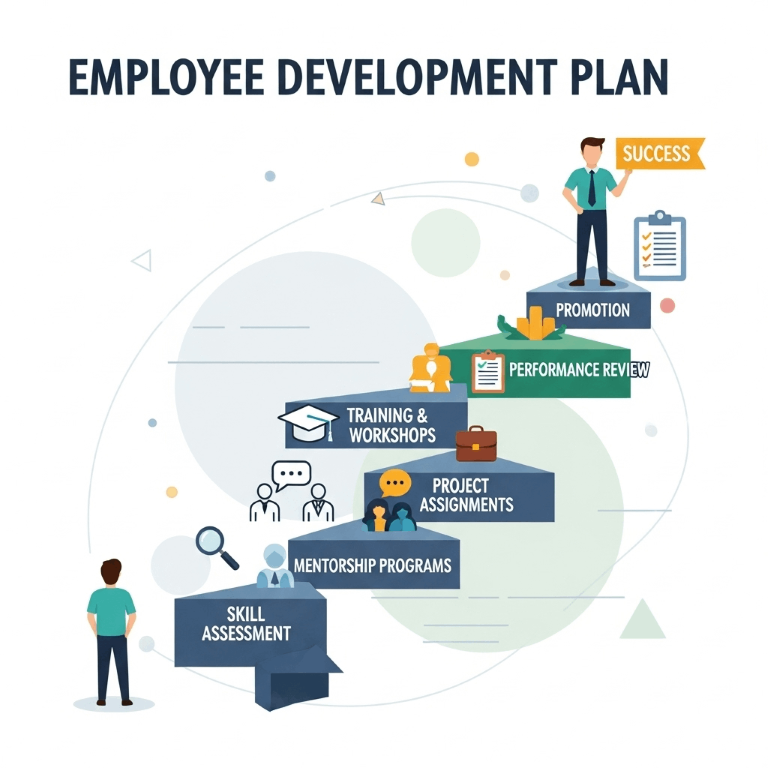
How to Turn Your Answers Into a Development Plan
A self-assessment shouldn’t end the moment you hit submit. Here’s how to make it actually useful afterward.
- Rank your answers: Pull out the two or three responses with the clearest evidence and lead your review conversation with those.
- Flag the gaps: Take every growth-area answer and turn it into one specific action with a deadline, not just an intention.
- Connect it to your goals: Match your strongest achievements back to the KPIs or OKRs your manager already tracks, so the connection is obvious without extra explanation.
- Bring it into the conversation: Don’t just submit the form. Reference your specific answers out loud in the review so your manager knows you meant what you wrote.
If your company runs self-assessments through a system like PeopleGoal’s 360 Feedback Software, your answers here don’t have to live in a document that gets forgotten after the review.
They sit alongside manager and peer feedback in one weighted, benchmarked view, so the growth areas you flag actually turn into tracked development plans instead of a one-time confession.
And if your goals are already logged as OKRs inside PeopleGoal, most of your goals-and-results answers are half-written for you before you even open the form.
Reflect, Improve, and Move Forward
A strong self-assessment is your chance to highlight your impact with clear examples, measurable results, and honest reflection. The best responses showcase achievements, acknowledge growth areas with an action plan, and connect your work to team and business goals.
If your organization uses a performance management platform like PeopleGoal, it’s easier to track goals, feedback, and development throughout the year instead of relying on memory before review season.
Now, pick the questions that match your role and review cycle, draft evidence-backed answers, and revisit them regularly to make every performance conversation more productive.
Frequently Asked Questions
How honest should I be in a self-assessment?
Be fully honest about outcomes, but frame growth areas around specific situations and next steps rather than general self-criticism. Honesty builds trust with your manager and prevents surprises later in the review.
Should I use AI tools like ChatGPT to help write my self-assessment?
AI can help you turn rough notes into clean, professional language, but it can't supply your actual achievements, numbers, or context. Use it to polish, not to invent your evidence.
What if my self-assessment rating doesn't match my manager's rating?
A gap usually means a visibility problem, not a dishonesty problem. Bring specific examples from your self-assessment into the conversation so your manager can see what you saw.
How long should a self-assessment be?
Long enough to cover every goal and question asked, short enough that each answer stays specific. A tight, evidence-backed paragraph beats a long, vague one every time.
Can I reuse the same self-assessment for a promotion case?
You can reuse the underlying evidence, but reframe the questions around readiness for the next level rather than performance in your current one.
Should I mention feedback from other people in my self-assessment?
Yes. Referencing specific feedback from a colleague, client, or manager adds outside proof to your own claims and reduces the appearance of self-assessment bias.
Ready to 3x Your Teams' Performance?
Use the best performance management software to align goals, track progress, and boost employee engagement.