
Every HR tech vendor now has “AI” somewhere on its homepage. Some mean a genuinely useful assistant that drafts reviews from a year of check-ins. Others mean a chatbot bolted onto a form builder. Telling the two apart is the real job of anyone shopping for AI performance management software.
Employees are surprisingly ready for the change. A Gartner survey of nearly 3,500 employees found that 87% believe algorithms could give fairer feedback than their managers. The bar for getting AI right is high.
This guide compares the 10 best AI performance management software options for 2027: what each platform does well, where its AI genuinely helps, where it falls short, and what it costs, so you can find the right fit for your team.
What Is AI Performance Management Software?
You’ll also see the term generative AI performance management software. It refers specifically to tools that write: drafting review summaries, goals, feedback, and coaching suggestions from the data already in the system, rather than only automating reminders and workflows.
For a deeper look at where AI helps and where it falls short, read our guide to AI in performance management.
10 Best AI Performance Management Software
Here’s how the AI performance management tools in this guide compare at a glance:
| Tool | Best for | Key AI capabilities | Starting price |
| PeopleGoal | Fully customizable reviews, goals, and development | AI-ready, fully configurable reviews, goals, and feedback workflows built without code | FREE 14-day trial. Starts at $4/user/month. |
| 15Five | AI-assisted reviews built on check-ins | AI-assisted reviews, AMAYA assistant, 15Five Agents | $4/user/month (Engage); $11 for Perform |
| Lattice | All-in-one modular people management | AI Agent, review comment sentiment analysis | $13/seat/month (Foundations) |
| Culture Amp | AI coaching grounded in people science | AI Coach, AI comment summaries | Custom quote |
| Leapsome | AI agents across the employee lifecycle | Five AI agents, AI review writing, AI learning paths | $7/employee/month (Performance Reviews) |
| Betterworks | Enterprise goal alignment with AI | AI-Assisted Performance Summary, Goal Assist, Feedback Assist | Custom quote |
| Engagedly | Agentic AI for performance and learning | Marissa AI SuperAgent with four specialist agents | $5/user/month (Manage Performance) |
| PerformYard | Flexible review cycles with optional AI | PerformYard AI add-on for review summaries | $5/person/month |
| Peoplebox.ai | AI-powered OKRs and calibration | AI goals, review summaries, AI development areas | $8/employee/month |
| Effy AI | Affordable AI-drafted reviews for small teams | AI drafting, bias checks, AI summaries | Free up to 5 users; $3/seat/month |
Let’s take a closer look at all these tools, along with the features, pros, and cons of each, to get a better idea.
Each review below covers what the tool does best, where its AI genuinely helps, and where it falls short, so you can match the platform to the problem you’re actually trying to solve.
1. PeopleGoal
Best fully customizable platform for performance reviews, OKRs & employee development
PeopleGoal is the most flexible platform on this list, and that flexibility is exactly what makes it such a strong foundation for AI performance management. Instead of forcing your team into a fixed template, its no-code tools let HR design review forms, rating scales, approval flows, and goal cycles around the way your organization already works.
It also manages the conversations between reviews, with structured check-ins, one-on-one guidance, and continuous feedback that keep performance visible all year. Built-in reports and analytics, along with career planning and skill development tools, help HR turn every review into a clear next step for each employee.
That configurability pays off the moment AI enters the picture. AI is only as useful as the data beneath it, and PeopleGoal captures that data all year: goals, check-ins, 360 feedback, pulse surveys, and performance reviews in one connected workspace. Annual reviews for sales and quarterly reviews for engineering? Easy.
The result is a clean, structured performance record that makes every insight sharper and every review fairer.
Pros:
- A no-code app builder lets HR design custom review forms, rating scales, approval steps, and complete HR workflows without developer help
- Annual, quarterly, mid-year, and anniversary review cycles run side by side, each with its own reviewers and timelines
- 360-degree feedback with anonymous options and weighted performance measures gives every rating more than one perspective
- OKRs, SMART goals, and check-ins connect directly to reviews, building the clean, year-round data that AI-driven insights depend on
- Integrations with BambooHR, Workday, ADP, Okta, Slack, Microsoft Teams, and more keep employee data in sync automatically
Cons:
- No on-premise or downloadable version available.
- A dark user interface is not available on the web.
Pricing: FREE 14-day trial. Paid starts at $4/user/month.
Case Study:
Check how retail software company iQmetrix replaced scattered forms and SharePoint folders with one transparent, trackable performance process in PeopleGoal.
2. 15Five
AI-Assisted Reviews Built on Check-Ins
15Five is built around weekly check-ins, where employees share progress, priorities, and blockers with their managers. Those regular updates give its AI a steady source of context to draw on when review time arrives.
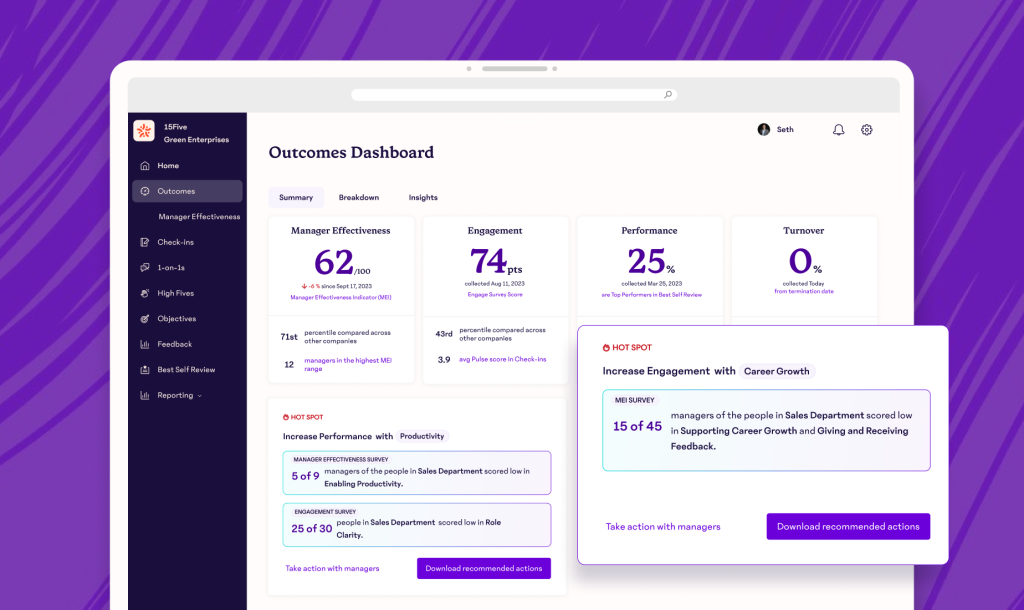
The Perform plan includes AI-assisted performance reviews, an AI assistant called AMAYA, 15Five Agents, and an Insights Dashboard, alongside OKRs, 360 feedback, a talent matrix, and career paths.
Managers can start reviews from AI drafts based on check-ins and goals rather than a blank page. Coaching tools such as Kona are sold separately, so organizations that want AI support in one-on-ones should budget for add-ons. 15Five suits teams that already value a weekly check-in rhythm and want AI layered on top of it.
Pros:
- AI-assisted performance reviews draft content from check-ins, goals, and feedback already logged in the platform
- The AMAYA AI assistant, an Insights Dashboard, and 15Five Agents are included in the Perform plan
- Weekly check-ins create a steady stream of performance context between formal review cycles
- OKRs and goals, 360-degree feedback, a talent matrix, and career paths all sit within the same plan
- Published per-user pricing makes it easy to estimate cost before speaking to sales
Cons:
- Performance reviews and AI review features require the Perform plan, because the entry-level Engage plan covers engagement surveys only
- Kona coaching tools are sold as add-ons, so the full AI coaching experience costs more than the base Perform price
Pricing: Starts at $4/user/month (Engage); performance features start at $11/user/month (Perform), billed annually.
3. Lattice
All-in-One Modular People Management Suite
Lattice is a modular people management platform that combines performance reviews, goals and OKRs, one-on-ones, engagement surveys, growth, and compensation, each sold as a separate module or bundle.
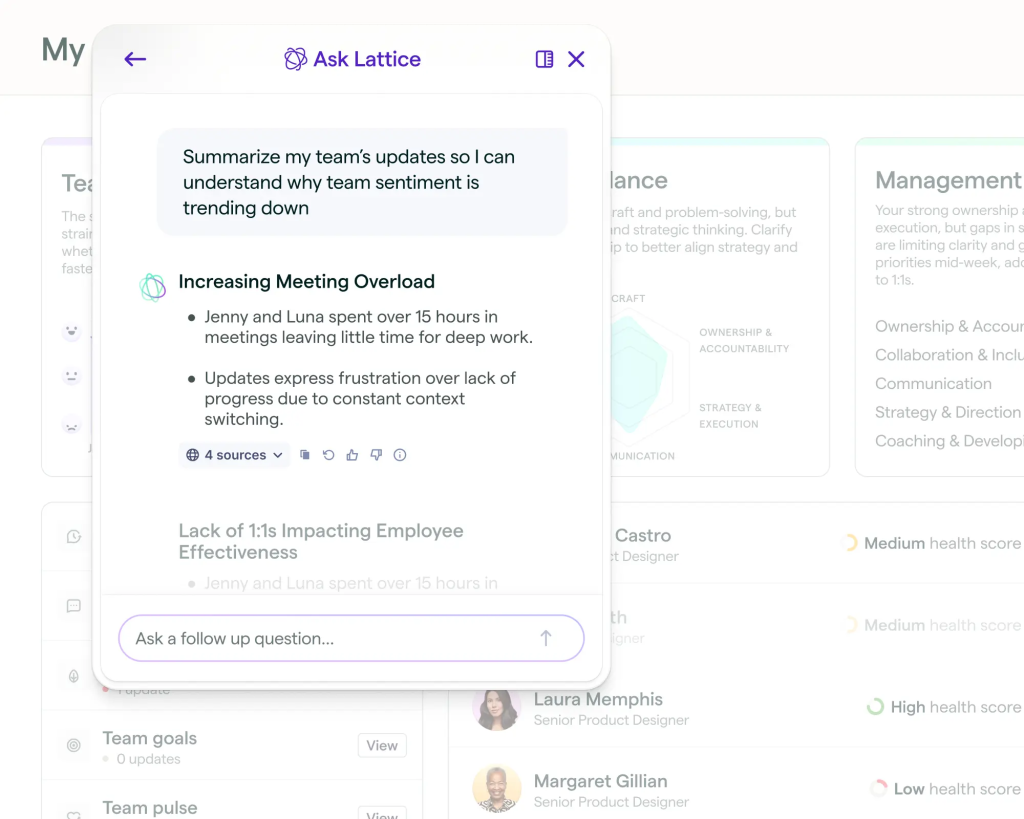
Its Foundations bundle includes an AI Agent along with performance, goals, analytics, and integrations, and analytics are included with every base product. Review tools include in-product calibration and sentiment analysis of written comments, which helps HR spot unusually harsh or vague feedback before results are shared.
The Engagement and Grow add-ons extend AI insights into survey analysis and growth plans. Lattice works best for companies that want several HR functions from one vendor. Smaller teams should weigh the annual billing and minimum contract value against how many modules they will actually use.
Pros:
- An AI Agent is included in the Foundations bundle, together with Analytics and Integrations
- Sentiment analysis of performance review comments helps HR spot overly harsh or vague feedback before results go out
- In-product calibration helps leaders align ratings across managers before decisions are finalized
- Add-on modules for Engagement, Grow, and Compensation extend AI insights into surveys and growth plans
- A broad integration ecosystem connects Lattice with major HRIS platforms and Slack
Cons:
- Contracts are billed annually with a $4,000 minimum annual agreement, which is steep for small organizations
- Modular pricing means total cost rises quickly as you add Engagement, Grow, or Compensation
Pricing: Starts at $13/seat/month for Foundations, billed annually.
4. Culture Amp
AI Coaching Grounded in People Science
Culture Amp combines employee engagement surveys with performance management and development tools, and its AI features draw on both. The platform is organized into Engage for surveys, Perform for reviews and goals, and development tools for skills and career growth.
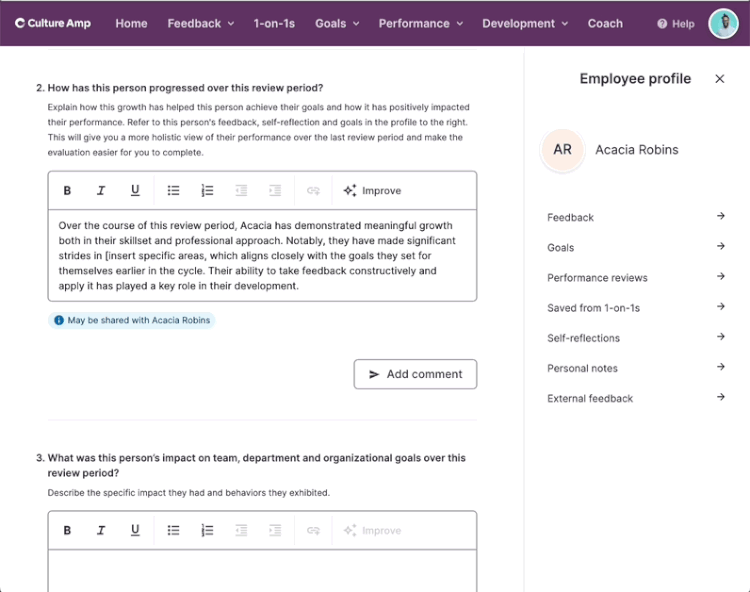
Its AI Coach, included in every plan, helps managers write reviews and prepare for difficult conversations using the company’s own survey, review, and feedback data. AI comment summaries group large volumes of open-text survey responses into themes, and Coach can draw on those summaries for free-text questions.
Every plan also includes SSO and HRIS, Slack, and Microsoft Teams integrations. Culture Amp is a good fit for organizations where engagement data shapes performance decisions. Pricing is quote-based with no free trial, so buyers need a sales conversation before testing the platform.
Pros:
- AI Coach is included in every plan, helping managers write reviews and prepare for difficult conversations
- AI comment summaries cluster thousands of open-text survey responses into clear themes
- The Perform product covers performance reviews with calibration, one-on-ones, goals, development plans, and performance insights
- Skills Coach delivers short daily micro-learning lessons to help managers build capability
- Every plan includes SSO, HRIS integrations, Slack and Microsoft Teams integrations, and Shoutouts for recognition
Cons:
- No published pricing, so every purchase starts with a sales conversation and a custom quote
- No free trial, which makes hands-on evaluation harder before you commit
Pricing: Custom pricing; request a quote on Culture Amp’s website.
5. Leapsome
AI Agents Across the Employee Lifecycle
Leapsome is a modular HR platform covering performance reviews, goals and OKRs, engagement surveys, learning, compensation, recruiting, and a core HRIS, with each module priced separately.
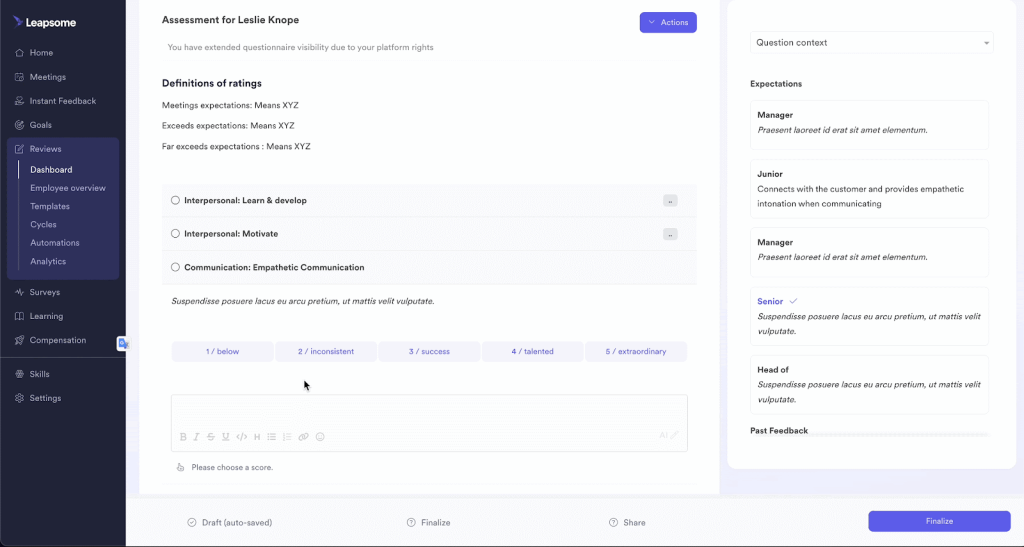
AI runs across these modules. Leapsome offers five EU-hosted AI agents, including a Development Coach and a Data Analyst, that work on each company’s own people data. In reviews, an AI writing assistant helps managers make feedback clearer, and after a review is shared, Leapsome AI can suggest up to three learning paths.
Calibration, review automations, and cross-cycle analytics support structured review programs. Leapsome suits organizations that want AI across the employee lifecycle, particularly those with European data requirements. Reviewers note that costs rise as more modules are added and that initial setup takes effort.
Pros:
- Five EU-hosted AI agents: Development Coach, Culture Advisor, Data Analyst, PeopleOps Partner, and HR Helpdesk
- AI-assisted review writing improves the clarity and actionability of manager feedback
- Leapsome AI suggests up to three personalized learning paths after a review is shared
- Performance reviews include drag-and-drop calibration, review automations, and cross-cycle analytics
- A modular platform covers reviews, goals and OKRs, surveys, learning, compensation, HRIS, and recruiting
Cons:
- Reviewers note that per-module pricing adds up as you activate more of the suite
- Setting up review templates and workflows can take meaningful effort at the start
Pricing: Starts at $7/employee/month for Performance Reviews.
6. Betterworks
Enterprise Goal Alignment With AI Assist
Betterworks is an enterprise performance management platform centered on goals and OKRs, with continuous feedback, conversations, calibration, and reviews built around them.
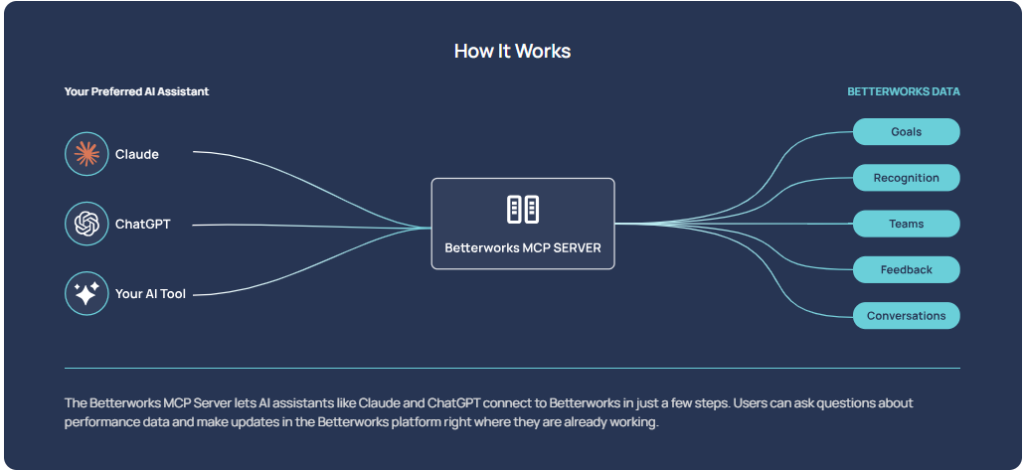
Its AI-native NextGen platform includes an AI-Assisted Performance Summary that combines goal achievement, feedback, conversations, and recognition into a draft review. Goal Assist helps employees write measurable goals aligned with team objectives, while Feedback Assist and Conversation Assist help managers give clearer feedback and coaching.
Calibration includes AI-driven bias detection, managers can coach from Slack and Microsoft Teams, and responsible AI controls help enterprises manage AI across business units and regions. Betterworks suits large organizations with complex goal structures. Pricing isn’t published, and the platform’s depth may be more than small and mid-sized teams need.
Pros:
- AI-Assisted Performance Summary consolidates goals, feedback, conversations, and recognition into a review draft
- Goal Assist helps employees write measurable goals aligned with team and company objectives
- Feedback Assist and Conversation Assist help managers give clearer, more constructive feedback and coaching
- Calibration with AI-driven bias detection supports fairer, more consistent ratings across large organizations
- Managers can coach inside Slack and Microsoft Teams without switching to a separate portal
Cons:
- Pricing isn’t published, so every plan requires a custom quote
- The platform’s enterprise depth is more than most small and mid-sized teams need
Pricing: Custom quote.
7. Engagedly
Agentic AI for Performance and Learning
Engagedly is a talent management platform that brings performance reviews, OKRs, 360 feedback, learning, engagement, and recognition together in one suite. Reviews support customizable templates and 30-, 60-, and 90-day reviews.
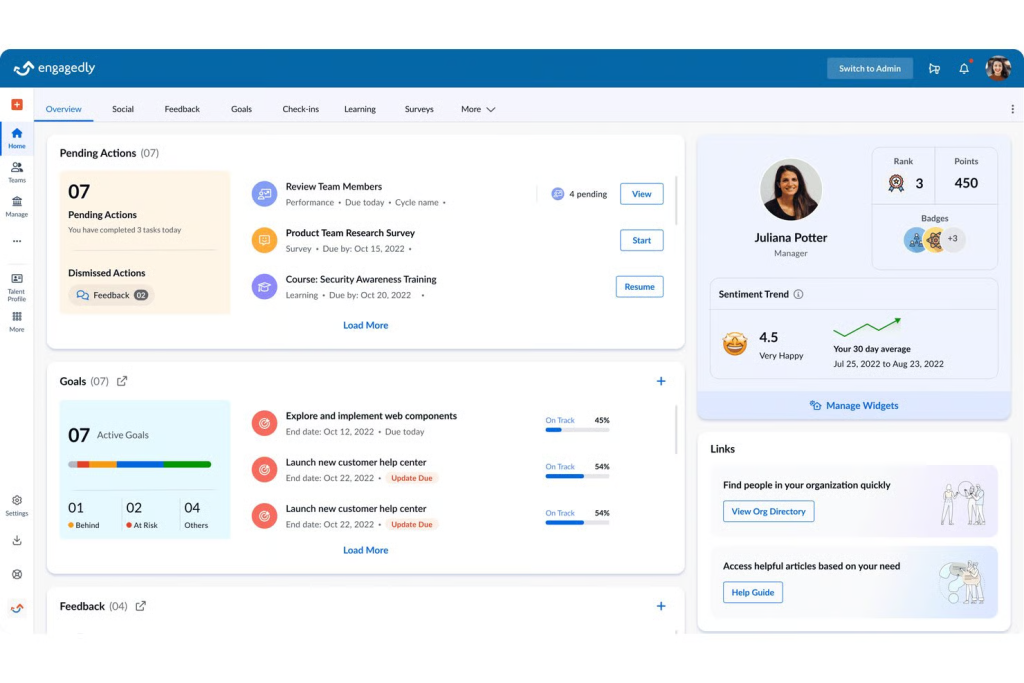
Its AI is organized around Marissa, which Engagedly describes as an AI SuperAgent supported by four specialist agents for talent management, performance management, learning, and growth. When a review highlights a skill gap, for example, the Learning Agent can recommend a learning path, while the Talent Management Agent identifies high-potential employees and drafts development plans.
Marissa AI Coach and an AI HR assistant are included in every suite. Engagedly fits mid-sized organizations that want performance and learning connected. Its pricing carries a $7,500 annual minimum, and some reviewers mention limits in customization and reporting.
Pros:
- The Marissa AI SuperAgent coordinates four specialist agents for talent, performance, learning, and growth
- Marissa AI Coach and an AI HR assistant are included in every suite at no extra cost
- AI-powered role-based recommendations and AI-enhanced skill suggestions support development planning
- Performance reviews include customizable templates, 30-60-90 day reviews, and 360-degree feedback
- Performance, learning, engagement, and recognition live together in one suite
Cons:
- A $7,500 minimum annual price puts it out of reach for many small teams
- Some reviewers mention challenges with customization and reporting
Pricing: Starts at $5/user/month for Manage Performance, billed annually.
8. PerformYard
Flexible Review Cycles With Optional AI
PerformYard is a performance management platform known for flexible review cycles. HR teams can run quarterly, project-based, and anniversary reviews for different groups at the same time, alongside check-ins, goals, and 360-degree peer reviews.
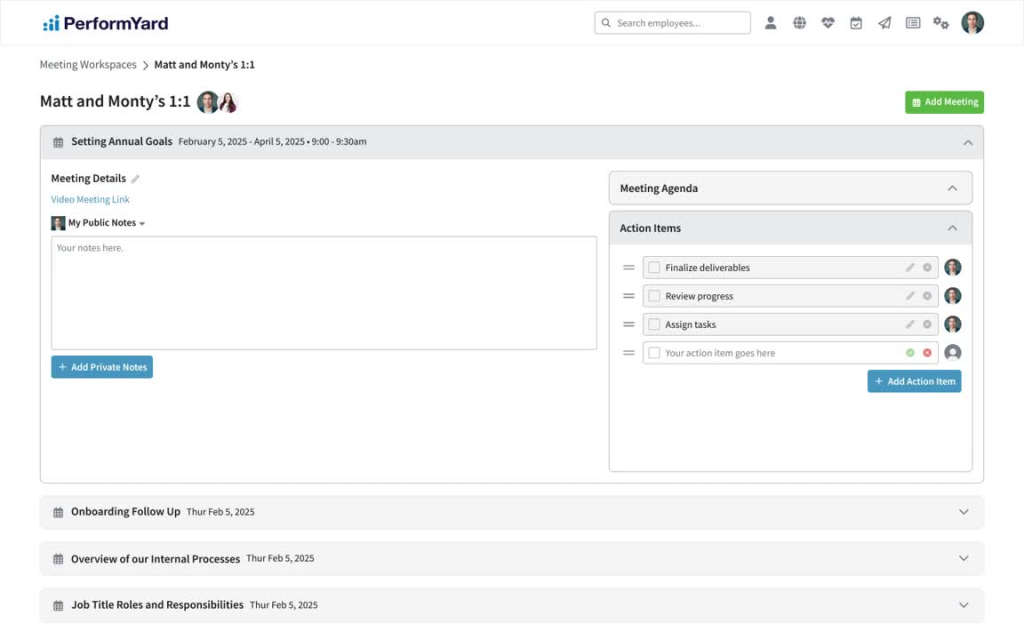
AI is available as an optional add-on rather than a core part of the product. PerformYard AI summarizes review content and highlights performance trends, which helps HR and managers work through large volumes of review data.
Every contract includes onboarding, unlimited employee training, and a dedicated customer support manager, and native connectors sync data from HRIS platforms such as ADP, BambooHR, and Rippling. PerformYard suits teams that want structured reviews with light AI support. Teams looking for deeply embedded generative AI may find its AI features more limited.
Pros:
- The optional PerformYard AI layer summarizes review content and highlights performance trends
- Quarterly, project-based, and anniversary review cycles can run at the same time for different groups
- The core plan covers reviews, check-ins, goal management, and 360-degree peer reviews
- Onboarding, unlimited employee training, and a dedicated support manager are included in every contract
- Native HRIS connectors sync data from ADP, BambooHR, Gusto, Rippling, UKG, and Paylocity
Cons:
- AI features are an add-on, so AI support costs extra on top of the base plan
- Minimum pricing applies, which makes it less economical for very small companies
Pricing: $5 to $10/person/month, billed annually.
9. Peoplebox.ai
AI-Powered OKRs and Review Calibration
Peoplebox.ai is a performance management platform that connects OKRs, performance reviews, one-on-ones, and check-ins, with optional modules for 360 feedback, engagement, development plans, and compensation. Business reviews give leaders a regular view of goal progress.
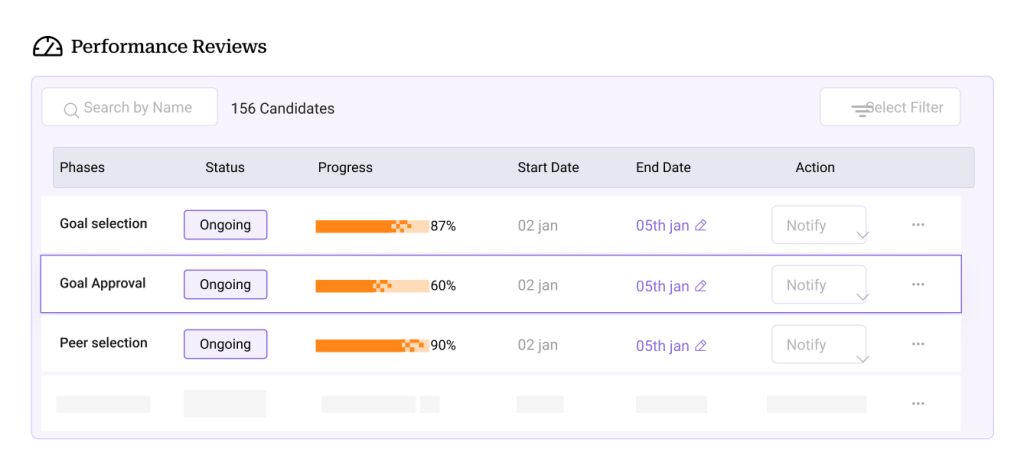
Its AI features focus on practical tasks: drafting goals, summarizing review feedback, and suggesting development areas and actions for each employee. HR can calibrate ratings inside the platform rather than in spreadsheets, and employees can complete reviews and one-on-ones in Slack or Microsoft Teams.
Its Nova AI Teammate extends the platform into hiring. Peoplebox suits growing teams that want goals and reviews closely linked. Several capabilities, including 360 feedback and engagement surveys, are paid add-ons, so total cost depends on the modules you need, and all plans are billed annually.
Pros:
- AI-powered goal drafting and review summaries are included in the Performance Management plan
- AI generates development areas and suggested actions in the Individual Development Plans add-on
- In-platform calibration lets HR align ratings without exporting data to spreadsheets
- Reviews, OKR updates, and one-on-ones can be completed inside Slack or Microsoft Teams
- Modular add-ons let teams buy only the capabilities they need
Cons:
- 360-degree feedback, engagement surveys, development plans, and compensation are each separate paid add-ons
- All plans are billed annually, with no month-to-month option
Pricing: Starts at $8/employee/month for Performance Management, billed annually.
10. Effy AI
Affordable AI-Drafted Reviews for Small Teams
Effy AI is a performance review tool designed for small and mid-sized teams, with AI built into the review process. It covers 360 feedback and performance reviews, and its higher plans add goals, OKRs, and check-ins.
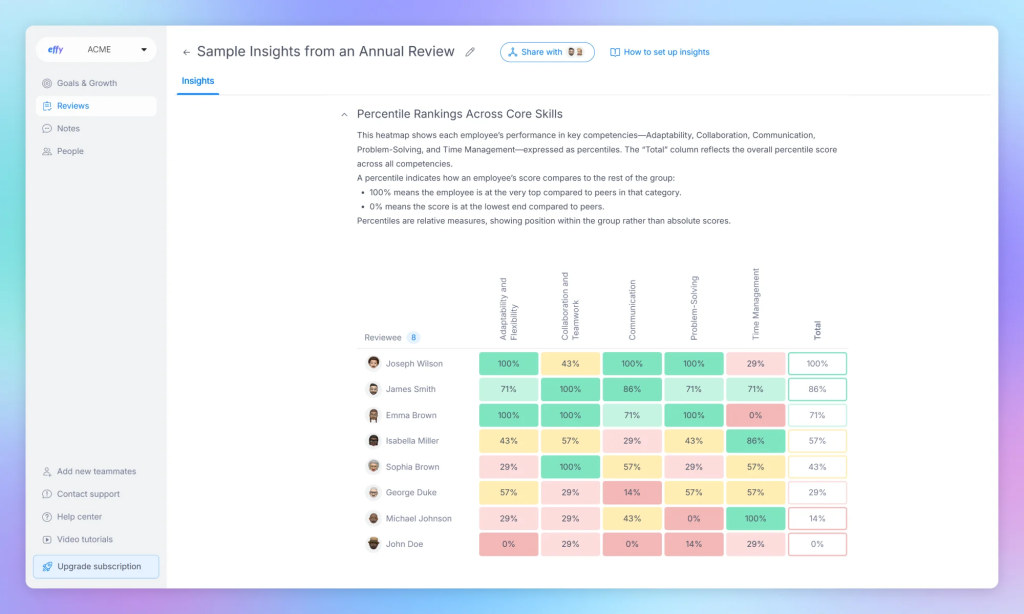
Its AI drafts review content, checks written feedback for biased language, and turns 360 responses into AI-generated summaries and reports, which reduces manual work for small HR teams. A free plan covers up to five users, and a one-time review plan suits companies that run a single review cycle each year.
Slack and Microsoft Teams integrations bring reviews into everyday tools. Effy AI is a good entry point for teams new to structured reviews, but organizations with complex, multi-department workflows may find it too light for their needs.
Pros:
- AI drafting helps managers and reviewers write review content faster
- Bias checks flag problematic language in written feedback before it’s shared
- AI-generated summaries and reports turn 360 responses into readable insights
- A free plan covers up to five users, and a one-time review plan suits teams that run one cycle a year
- Slack and Microsoft Teams integrations bring reviews into everyday tools
Cons:
- Goals, OKRs, and check-ins require the higher Performance suite plan
- It isn’t designed for complex, multi-department enterprise review workflows
Pricing: Free for up to 5 users; paid plans start at $3/seat/month, billed annually.
How I Chose These AI Performance Management Platforms
The tools in this article were evaluated using an unbiased, systematic approach designed to give you a fair, insightful, and well-rounded view of each platform. Every tool was assessed against the same six factors.
1. User Reviews and Ratings
I read recent verified reviews on G2, Capterra, and Software Advice, paying closest attention to comments about AI features in real review cycles. Recurring complaints, such as AI drafts that needed heavy editing or add-ons that raised costs, carried more weight than one-off praise.
2. Essential Features and Functionality
Every tool had to support the core of performance management: goals, feedback, and reviews. On top of that, I looked at how deeply AI is built into the workflow, from review drafting and feedback summaries to bias checks and development recommendations, and whether it solves real problems or simply decorates the interface.
3. Ease of Use
I considered how easily HR can set up a review cycle, how quickly a manager can turn an AI draft into a finished review, and how simple it is for employees to complete self-assessments. AI that saves time only works if people can find and use it without training.
4. Customer Support
I looked at the support each vendor offers during setup, rollout, and day-to-day use, including onboarding, training, and dedicated contacts. Introducing AI to skeptical managers is a change-management project, and good support makes it far smoother.
5. Value for Money
I compared starting prices from each vendor’s official pricing page with the AI features included at that price. I assessed tools that charge separately for AI, require annual minimums, or sell essential features as add-ons, on total cost, not headline rates.
6. Personal Experience and Experts’ Opinions
I combined my own analysis of each vendor’s product documentation, release notes, and pricing pages with the perspectives of industry experts and product leaders, including the vendors’ own explanations of how their AI is meant to support, not replace, managers.
Key AI Features to Look For in Performance Management Software
Using AI for performance management only pays off when it removes real work. These are the capabilities worth testing in every demo.
AI Review Drafting
The tool should draft review summaries from goals, check-ins, and feedback already logged in the system. The best drafts cite their evidence, so managers can see why the AI wrote what it wrote. Our guide to AI performance reviews covers what managers should and shouldn’t hand over to AI.
Feedback Summarization
AI should condense dozens of peer comments or survey responses into a handful of clear themes. This matters most for multi-rater programs like 360 feedback, where comment volume is highest.
Bias and Tone Checks
Look for writing checks that flag vague, harsh, or inconsistent language before you submit a review. It’s one of the simplest ways AI makes reviews fairer.
Goal Suggestions
AI should help employees write measurable goals that connect to team and company priorities, instead of leaving them to stare at a blank form. If you use OKRs, our guide to OKR performance management explains how to keep them connected to reviews without turning them into a scorecard.
Coaching and Development Recommendations
The strongest AI performance management tools turn review findings into next steps: suggested learning, development goals, or talking points for the next one-on-one. Regular check-ins give those recommendations a place to land.
Data Controls and Transparency
Check for the data and, whether it trains the vendor’s models, and whether managers can see the source behind every AI suggestion. Trustworthy AI is explainable AI.
My Top 3 AI Performance Management Software
Every tool on this list does something well. These three stand out for the widest range of HR teams.
1. PeopleGoal
PeopleGoal earns the top spot because it adapts to your process instead of forcing a template on you. Its no-code app builder, flexible review cycles, OKRs, 360 feedback, and engagement tools capture the year-round data that AI depends on, at a starting price of just $4 per user per month.
2. 15Five
15Five makes the list because its weekly check-ins give its AI something genuinely useful to work with. AI-assisted reviews, the AMAYA assistant, and 15Five Agents turn months of small updates into review drafts, making it a strong fit for teams that want AI deeply woven into the review process.
3. Leapsome
Leapsome stands out for the breadth of its AI. Five EU-hosted agents, AI review writing, and AI-suggested learning paths span performance, development, and HR operations. It suits organizations that want one modular platform with AI across the employee lifecycle, especially those with European data requirements.
Ready to Pick the AI Performance Management Software?
The right AI performance management software isn’t the one with the flashiest assistant. It’s the one that gives AI good data to work with and keeps managers in charge of every decision. Start with the problem you most need solved, whether that’s review writing, feedback overload, or inconsistent ratings, then test two or three tools against real data during a trial.
If I had to choose one place to start, I’d lean slightly toward PeopleGoal. Its no-code app builder, flexible review cycles, OKRs, 360 feedback, and engagement surveys capture the rich, year-round performance record that AI needs, and at $4 per user per month with a free 14-day trial, it’s easy to test.
Frequently Asked Questions
Can AI compile a year of performance data into a review?
Yes, this is one of the most useful things AI does in performance management. AI drafting tools can pull goals, check-ins, and feedback logged during the year into a review draft, so managers don’t start from memory. The draft is only as good as the data behind it, which is why platforms like PeopleGoal that keep goals, check-ins, and feedback in one place give AI a complete record to work from.
Is AI performance management software safe for employee data?
It can be, if you choose carefully. Ask each vendor where data is stored, whether it’s used to train AI models, and which security certifications they hold. PeopleGoal supports GDPR and privacy compliance, with features for data retention and user consent, plus SSO and multi-factor authentication. Avoid pasting employee information into public chatbots.
Does AI reduce bias in performance reviews?
It can reduce some kinds of bias, and introduce others. Writing checks catch vague or harsh language, and analytics reveal managers who rate far more strictly than peers. But AI trained on biased historical data can repeat those patterns at scale. Combining multiple perspectives, such as PeopleGoal’s 360-degree feedback and weighted performance measures, with human calibration remains essential.
How much does AI performance management software cost?
Published starting prices range from free plans for very small teams to around $13 per seat per month, while enterprise platforms often quote custom prices. Watch for AI features sold as paid add-ons and for annual minimums. PeopleGoal starts at $4 per user per month, with a free 14-day trial.
Are free AI performance management tools worth using?
For very small teams, they can be a useful way to test the approach. As headcount grows, you’ll usually need features that free plans limit, such as calibration, integrations, and admin controls. If you’d rather test a complete platform before committing, PeopleGoal offers a free 14-day trial that’s long enough to run a real review cycle.
What’s the difference between AI and traditional performance management software?
Traditional performance management software automates the process: forms, reminders, and workflows. AI performance management software also works with the content, summarizing feedback, drafting reviews, suggesting goals, and spotting patterns. Most modern platforms combine both, so the real question is how much AI you need and how clearly each suggestion is explained.
How do I introduce AI performance management tools to managers?
Start with one clear use case, such as drafting review summaries, and pilot it with a small group of managers. Ask them to edit every AI draft rather than accept it as is. Share a short policy on what AI can and can’t be used for, and expand only once managers trust the output.
Which AI tools for performance management work best for small teams?
Small teams need simple setup, affordable pricing, and room to grow. PeopleGoal starts at $4 per user per month and lets a small HR team configure reviews, goals, and feedback without developers. It suits teams of 20 to 50 people moving off spreadsheets, forms, or a platform that’s become too complex to manage.
Can AI performance management software integrate with our HRIS?
Most platforms connect with popular HR systems, so employee records, managers, and departments stay in sync. PeopleGoal integrates with BambooHR, Workday, ADP, and more. Ask vendors whichHRIS integrations are included in the base price and how often data syncs.
How long does it take to implement AI performance management software?
Most teams are ready to run a first cycle within a few weeks. PeopleGoal’s average implementation takes between one and six weeks, depending on company size and requirements. If you’re still comparing options, our guide on how tochoose performance management software covers trials, adoption tests, and common mistakes.
Should employees know when AI is used in their performance reviews?
Yes. Explain what AI does in your review process, what it doesn’t do, and who reviews its output before anything is shared. Transparency builds trust, while hidden AI use can make even a fair review feel suspect once employees find out.
Can managers just use general AI chatbots instead of AI performance management software?
They can draft text with general chatbots, but there are real trade-offs. Pasting employee information into public tools can expose sensitive data, and chatbots don’t have access to a year of goals, check-ins, and feedback, so their output is often generic. Platforms like PeopleGoal keep performance records inside one secure system, with SSO and multi-factor authentication.
Can AI help employees plan their own development?
Yes. AI can turn review feedback into suggested development areas, learning resources, and next-step goals, so employees leave each review with a clear direction. PeopleGoal supports career planning and skill development alongside goals and reviews, so development plans stay connected to real performance data.
Can AI performance management software still be customized to our process?
It depends on the platform. Some AI-first tools trade flexibility for simplicity, using fixed templates and review formats. PeopleGoal takes the opposite approach: its no-code app builder lets HR design review forms, rating scales, approval flows, and goal cycles around your existing process. If customization matters, ask vendors to change a template live during the demo.
Ready to 3x Your Teams' Performance?
Use the best performance management software to align goals, track progress, and boost employee engagement.