
I have implemented, tested, and migrated off more HR performance platforms than I care to count, and searching for Small Improvements alternatives is exactly how I found the one my team runs on today. Small Improvements gets the basics right: reviews, feedback, 1:1s, and praise in one clean interface.
But between 50 and 200 employees, most HR teams start to feel the edges of that simplicity. Goal tracking becomes harder to manage, review approvals confuse new managers, and the tool starts to feel too narrow for the business’s needs.
So I spent weeks digging into G2 and Capterra reviews, comparing features, and talking to HR peers who had already made the jump. This guide covers why teams switch, the top ten alternatives, how I chose them, and my top three picks.
Why Are HR Teams Switching From Small Improvements?
If you are reading this, you have probably already lived through at least a few of these. I am laying them out clearly, since these are the exact patterns that push HR teams to start browsing alternatives to small improvements in the first place.
- Goal tracking friction: Objective and goal tracking shows up again and again as the single most common frustration in user reviews, especially once a team grows past a handful of departments.
- Confusing navigation: Managers report getting lost around reviews, approvals, and the different objective views, which slows adoption for anyone who is not already a power user.
- Narrow day-to-day use: Some teams say the platform works well for structured review cycles, but “doesn’t have much other use” the rest of the year, so it sits mostly idle between cycles.
- Outgrowing a lightweight tool: As headcount scales past a few hundred people, the same features that felt simple at 50 employees start to feel thin at 300.
- Rigid goal structure: Teams that want deeper OKR cascading across levels and departments often find the goal module was never built for that kind of depth.
- Integration gaps: HR teams increasingly want clean, automatic data sync with an existing HRIS like Workday, ADP, or BambooHR instead of manual re-entry between systems.
- Comparison fatigue: Buyers want a direct, honest breakdown against named competitors like Lattice and 15Five, not vague marketing claims or a generic feature list.
Top 10 Small Improvements Alternatives for Employee Performance
I put this list together using verified G2 and Capterra ratings, product documentation, and pattern research across HR forums and community discussions. Every tool here solves at least one of the problems listed above in a meaningful way.
| Tool | Best For | User Rating | Price |
| PeopleGoal | Fully customizable performance reviews, OKRs & employee development | 4.5/5 (G2) | Free plan available; paid plans start at $4/user/month |
| Lattice | Connecting performance reviews directly to OKRs | 4.6/5 (G2) | Starts at $13/seat/month |
| 15Five | Continuous check-ins and manager coaching | 4.6/5 (G2) | Starts at $4/user/month |
| Culture Amp | People-science-backed engagement analytics | 4.5/5 (G2) | Custom quote |
| Leapsome | All-in-one performance, learning, and engagement | 4.8/5 (G2) | Custom quote |
| PerformYard | Straightforward, HR-run review cycles without the bloat | 4.7/5 (G2) | Starts at $5–$15/person/month |
| Trakstar | Deep, customizable review cycles | Not listed | Custom quote |
| Betterworks | Enterprise OKR alignment and calibration | 4.4/5 (G2) | Starts at $8/user/month |
| Bob (HiBob) | Culture-first HR with performance built in | 4.5/5 (G2) | Custom quote |
| Quantum Workplace | Connecting engagement and performance in one platform | 4.3/5 (G2) | Custom quote |
1. PeopleGoal: Best for Fully Customizable Performance Reviews, OKRs & Employee Development
I moved our review cycle over to PeopleGoal after watching our HR team lose an entire afternoon every quarter chasing down missed self-assessments, and it is still the tool I recommend first to anyone comparing Small Improvements alternatives.
The OKRs & SMART Goals module cascades company objectives down to individual key results, so nobody on my team was ever chasing a target that got misaligned three levels up the way it did on our old setup. What sold me was Customizable Workflows (No Code).
I rebuilt our entire review process, rating scales, approval steps, and all, without waiting on a developer or a vendor roadmap. Pair that with 360 Feedback Software for multi-rater reviews and Real Time Analytics & Reports for tracking it all, and you get a platform genuinely built to flex around exactly how your team actually grows people, not the other way around at all.
Pros:
- OKRs & SMART Goals cascade company objectives down to individual key results with full visibility across every level
- Built-in App Store offers ready-made apps, workspaces, and templates for faster setup.
- 360 Feedback Software supports multiple managers, peers, and external stakeholders reviewing one employee at once
- Customizable Workflows (No-Code) let you build reviews, onboarding, and attendance apps without a developer
- Real-Time Analytics & Reports replace manual exports with live, custom dashboards
- Multi-Dimensional Teams & Org Charts handle matrixed reporting structures without extra workarounds
- Third-party Integrations with 500+ platforms, including Workday, ADP, BambooHR, Slack, and Jira
Cons:
- No-code workflows are powerful, but building out custom apps takes some upfront configuration time
- Smaller teams may not need the full Talent Management System right away
How PeopleGoal Compares With Small Improvements: Small Improvements keeps your goals, reviews, and 1:1s inside a fairly fixed structure that works well until you outgrow it. PeopleGoal’s no-code workflows and OKR cascading let you rebuild your goal tracking, review cycles, and org chart around how your company actually operates, without waiting on a vendor roadmap.
User Rating: 4.5/5 (G2)
Price: Free plan available. Paid plans start at $4/user/month
2. Lattice: Best for Connecting Performance Reviews Directly to OKRs
A friend of mine leads people ops at a startup that recently ripped out its old review tool and rebuilt everything around Lattice, and the thing she keeps mentioning is how her goals and her reviews finally talk to each other.
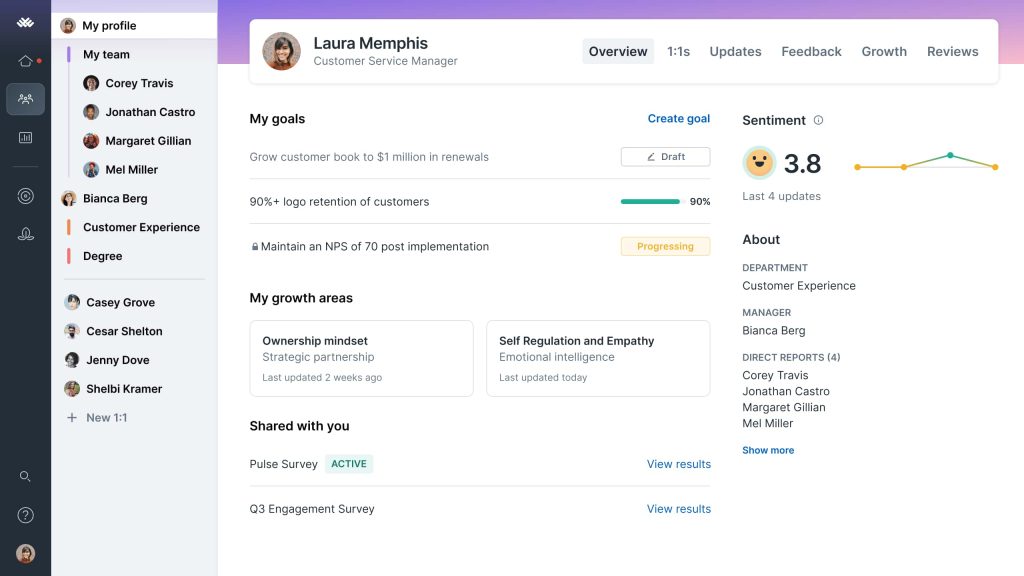
Every OKR here ties directly into the review cycle, so calibration conversations are grounded in actual goal progress instead of a manager’s memory of the last six months. The modular pricing structure appeals to her, too, since her team started with core performance management and only added engagement surveys once headcount actually justified the added monthly spend.
She called the goal to review the connection the platform’s single strongest feature, and structured, HR led programs tend to get the most out of it. Personalized one-on-one agendas and native HRIS integrations come included across every tier, which matters more than most buyers expect once a rollout actually gets underway.
Pros:
- OKRs connect directly to performance reviews, so calibration is backed by real goal data
- Modular structure lets you start with core performance management and expand later
- Strong marks for goal-tracking depth and cross-functional alignment visibility
- Personalized 1:1 agendas and Slack, Teams, and HRIS integrations included across all tiers
- Reporting dashboards make it easy to benchmark performance across departments
Cons:
- Sells almost exclusively on annual contracts, with limited monthly billing flexibility
- Full-suite pricing with engagement and compensation add-ons can climb quickly
How Lattice Compares With Small Improvements: Small Improvements treats goals and reviews as related but separate modules. Lattice unifies them so every calibration conversation happens with live goal progress in view, which suits teams that have outgrown a lighter, more standalone setup.
User Rating: 4.6/5 (G2)
Price: Starts at $13/seat/month
3. 15Five: Best for Continuous Check-Ins and Manager Coaching
Weekly check-ins actually stuck for once, that is the honest verdict from an HR manager I know who rolled out 15Five at a fast-growing company last year. 15Five built its reputation on one idea: performance should be an ongoing conversation, not an annual event.
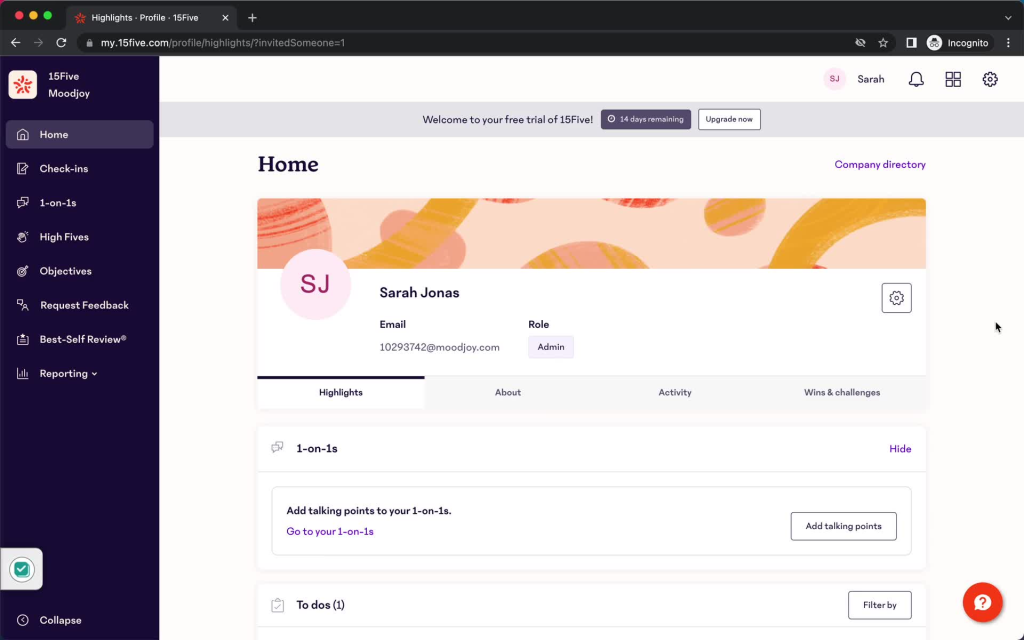
I have seen teams switch here specifically because their managers needed structure for weekly check-ins without the bureaucracy of a formal review cycle. The Best Self Management methodology ties check-ins, goal tracking, and recognition into a single weekly rhythm, and within a month, participation on her team had climbed noticeably.
Manager effectiveness is where this platform really separates itself, since optional coaching add-ons help first-time managers get better at giving feedback instead of just documenting it after the fact. Pulse surveys and sentiment tracking are included from the entry tier, too, which not every lightweight performance tool offers upfront.
Pros:
- Weekly check-ins build a continuous feedback habit instead of a once-a-year scramble
- Manager coaching add-ons help new managers improve real conversations, not just paperwork
- Strong retention data reported among teams using the platform consistently
- Pulse surveys and engagement tracking are included from the entry tier
- Fast, straightforward setup compared to heavier enterprise suites
Cons:
- Deeper configurability and advanced reporting sit behind higher-priced tiers
- Smaller teams report the pricing feels steep relative to lighter alternatives
How 15Five Compares With Small Improvements: Small Improvements covers reviews, feedback, and 1:1s well but does not build a weekly rhythm around them. 15Five is designed around continuous, weekly cadence, which suits teams that want performance conversations happening constantly rather than in scheduled review bursts.
User Rating: 4.6/5 (G2)
Price: Starts at $4/user/month
4. Culture Amp: Best for People-Science-Backed Engagement Analytics
I have always thought of Culture Amp as more of an engagement lab than a straightforward review tool, and a colleague of mine who leads people science at a mid-size tech company would agree completely. It earns its place firmly on this list for teams where engagement data, not just annual performance reviews, is the real ongoing priority.

Built by a team of organizational psychologists, the platform leans heavily on survey design and sentiment analysis, and that confidence shows in how her team acts on results without second-guessing the data. AI features summarize open text survey comments automatically, saving hours during a full engagement cycle that used to mean manually coding hundreds of responses by hand.
The same people science team designed the one-on-one conversation tools too, built specifically to help busy managers understand exactly what actually motivates each individual direct report on their growing team.
Pros:
- Survey design and benchmarking are backed by an in-house team of people scientists
- AI-generated summaries of open-text feedback save significant manual analysis time
- Goal tracking keeps teams aligned with clear ownership and accountability
- Shoutouts feature builds real-time recognition directly into Slack workflows
- Strong global language support for distributed and multinational teams
Cons:
- No published pricing, and no free trial to test before a sales conversation
- Rigid workflows and limited admin customization reported by reviewers at scale
How Culture Amp Compares With Small Improvements: Small Improvements includes engagement surveys as one feature among several. Culture Amp treats engagement analytics as the core product, with deeper benchmarking and sentiment analysis than a lighter, review-first platform typically offers.
User Rating: 4.5/5 (G2)
Price: Custom Quote
5. Leapsome: Best for All-in-One Performance, Learning, and Engagement
Four separate tools became one for an HR generalist I met at a people ops meetup, and Leapsome was the one she kept using long after the trial ended. It combines performance reviews, 360-degree feedback, OKRs, engagement surveys, and learning paths inside one connected platform, and reviewers consistently give it the highest overall satisfaction score on this entire list of options.
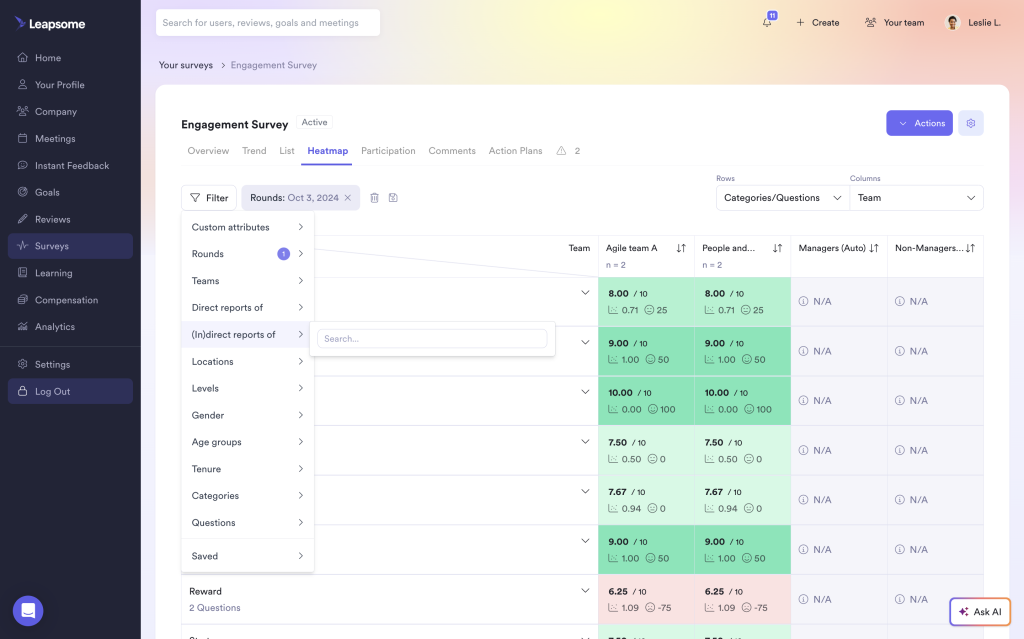
What really won her over was the learning paths feature, since she used it to build development programs tied directly to review data, turning a skills gap into an actual training assignment instead of a vague action item nobody followed up on.
AI shows up across the platform too, surfacing themes in survey responses and drafting review language for managers to edit rather than write from scratch. Getting there took real effort on her end, since setting up templates and organizing multiple cycle versions ate into her first quarter.
Pros:
- Combines performance, 360 feedback, OKRs, surveys, and learning in a single platform
- Learning paths connect directly to performance data for real development plans
- Highest reviewer satisfaction score among tools on this list
- AI surfaces themes from engagement survey responses automatically
- Clean, modern interface that reduces training time for new admins
Cons:
- Initial setup of review templates and cycles requires significant configuration time
- Per-module pricing can become expensive as headcount grows
How Leapsome Compares With Small Improvements: Small Improvements covers performance and feedback, but stops short of built-in learning management. Leapsome ties development plans directly into the same system, closing a gap that lighter tools often leave to a separate LMS.
User Rating: 4.8/5 (G2)
Price: Custom Quote
6. PerformYard: Best for Straightforward, HR-Run Review Cycles Without the Bloat
An HR manager I met through a local SHRM chapter switched to PerformYard when her 120-person company needed something simpler than the enterprise suites she kept getting pitched during her search. What sold her immediately was how closely PerformYard let her recreate the exact review process she already had on paper, rather than forcing her team into someone else’s rigid template.
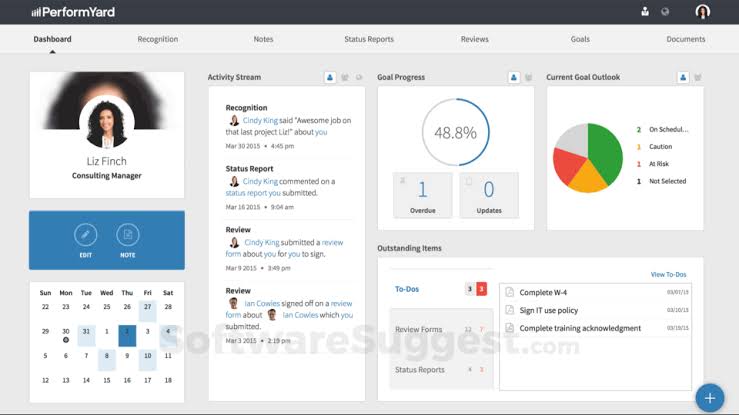
Review cycles support continuous feedback, 360 reviews, annual reviews, and project-based reviews side by side, and she said the customization rivaled platforms charging nearly twice as much for the same depth. AI-assisted review drafting and meeting notes are newer additions that saved her real time during her last cycle.
Native integrations with ADP, BambooHR, Workday, and Slack meant she was never stuck exporting spreadsheets after every single review period, which used to eat up nearly every single Friday afternoon on her calendar before she finally switched.
Pros:
- Recreate your exact existing review process instead of adapting to a rigid template
- Supports continuous feedback, 360 reviews, annual reviews, and project-based reviews together
- AI-assisted review drafting and meeting notes speed up cycle completion
- Native integrations with ADP, BambooHR, Workday, Gusto, Rippling, and Slack
- Reviewers consistently praise responsive, hands-on customer support during setup
Cons:
- Engagement surveys and goal tracking are lighter than dedicated engagement platforms
- No built-in learning management system for skill development
How PerformYard Compares With Small Improvements: Both platforms aim for a lighter, HR-run feel rather than an enterprise suite. PerformYard leans further into deep review cycle customization, which suits teams that have specific, established review workflows they want replicated exactly.
User Rating: 4.7/5 (G2)
Price: Starts at $5-15/person/month
7. Trakstar: Best for Deep, Customizable Review Cycles
Shallow review customization was the single biggest complaint I kept hearing from an HR director I have worked with, right up until she landed on Trakstar. Competency frameworks, weighted scoring, and true multi-reviewer support all make this one of the more genuinely configurable review engines you will actually find in this exact price range.
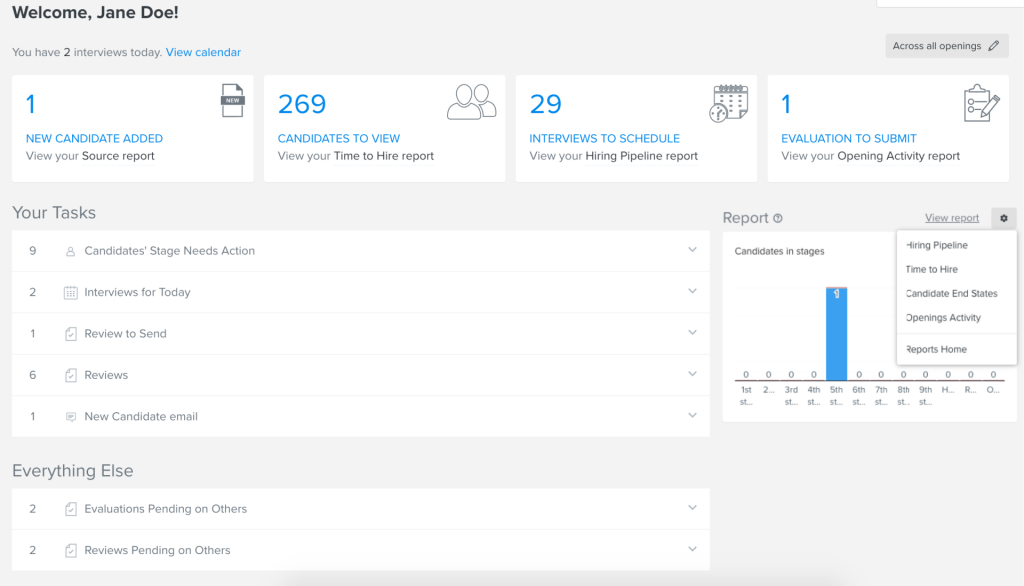
What impressed her most were the manager calibration views, which flag rating inconsistencies across departments before they turn into a fairness problem nobody caught in time. Review cycles here can run annual, semi-annual, quarterly, or project-based, giving her real flexibility depending on how a given team happens to be structured that quarter.
The 360-degree feedback module layers in peer, direct report, and self assessments with configurable anonymity settings built directly into the setup flow. One real gap did show up, though, since native continuous feedback tools are missing from the platform entirely.
Pros:
- Highly customizable review templates with weighted competencies and rating scales
- Manager calibration views catch rating inconsistencies across departments
- Flexible cycle types: annual, semi-annual, quarterly, or project-based
- 360-degree feedback with configurable anonymity settings
- Native mobile apps for managers and employees managing reviews on the go
Cons:
- No built-in continuous feedback or 1-on-1 meeting tools
- Learning management is a separate, sold-separately product
How Trakstar Compares With Small Improvements: Teams switching from Small Improvements to Trakstar frequently want deeper competency scoring and calibration tools that a lighter, more general platform either lacks or charges extra for.
Price: Custom Quote
8. Betterworks: Best for Enterprise OKR Alignment and Calibration
Thousands of employees spread across a dozen countries needed one cascading goal system, and that is exactly why a VP of people I consulted for chose Betterworks over everything else her team demoed that year. The platform is built for that scale, and its goal cascading visibility across a large workforce is where it consistently outperforms lighter tools built for smaller headcounts.

The calibration module came up as the standout feature in our conversations, since managers propose ratings and HR facilitates calibration sessions using visual distribution curves instead of memory alone. AI-powered insights also surface performance trend anomalies and flight risk indicators that would be nearly impossible to catch through manual analysis at her headcount.
None of this comes easy, though, since implementation took real effort from her team, and organizations under a few hundred employees will likely find the setup overhead simply outweighs the everyday benefit for now.
Pros:
- Goal cascading and alignment visibility built for large, multi-country organizations
- Calibration module replaces biased manager ratings with data-driven distribution sessions
- AI surfaces performance anomalies and flight-risk indicators automatically
- Modular structure across goals, performance, and engagement lets you scope the purchase
- Strong track record with enterprise deployments across 500 to 5,000+ employees
Cons:
- Implementation complexity makes it a poor fit for smaller teams still finding their footing
- No free trial; the entire sales process is demo-led
How Betterworks Compares With Small Improvements: Small Improvements is not built for enterprise-scale OKR cascading the way Betterworks is. If your organization spans thousands of employees across multiple countries, Betterworks handles that complexity more natively.
User Rating: 4.4/5 (G2)
Price: Starts at $8/user/month
9. Bob (HiBob): Best for Culture-First HR With Performance Built In
Employees actually enjoy logging in, which is not something I say about most HR platforms, and that is the exact reputation Bob has earned with a people ops lead I know who moved her distributed team there. She wanted performance management inside a broader, culture-forward HRIS rather than a standalone tool bolted onto everything else her company already ran.
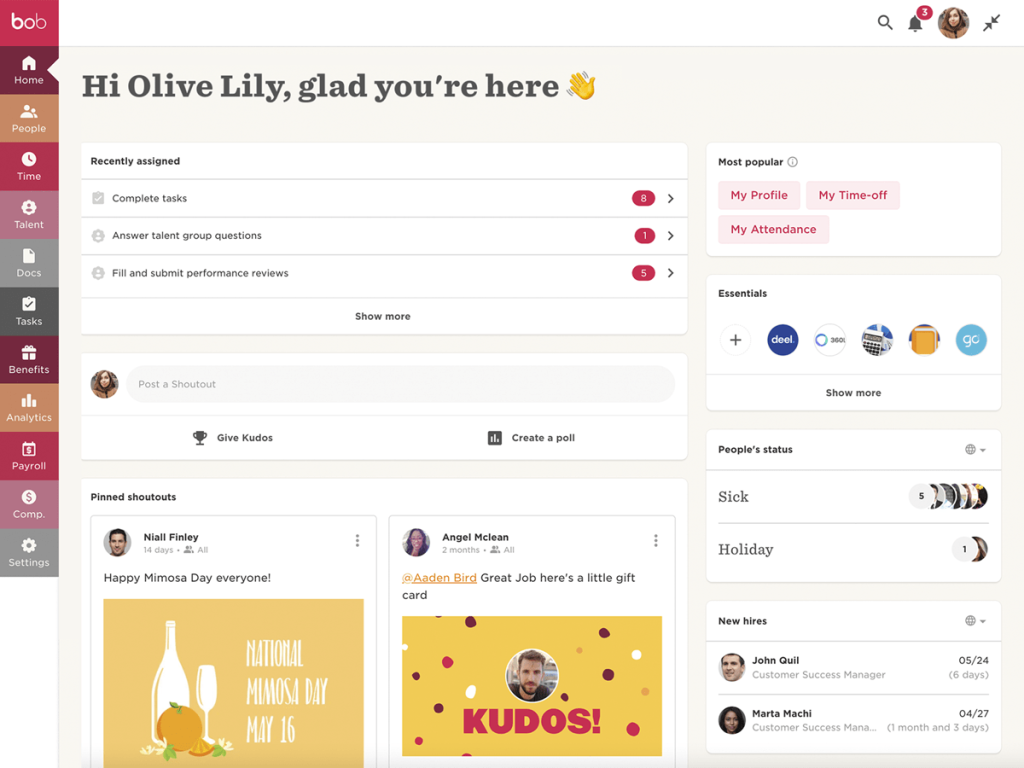
The interface is genuinely one of the most polished I have seen in this category, and adoption on her team climbed within the first month for exactly that reason alone. Shoutouts, clubs, and a social company feed sit alongside performance reviews and compensation cycles, which mattered given her team spans multiple time zones.
People analytics are unusually strong for a platform that started life as an HRIS, rivaling standalone analytics tools she had used previously at a much larger company earlier on in her career, long before this current role.
Pros:
- Genuinely high employee adoption thanks to a polished, social-feed-style interface
- People analytics rival dedicated standalone analytics tools
- Shoutouts, clubs, and social feed strengthen culture across distributed teams
- Multi-country compliance and localization built for global HR teams
- Bob AI Companion is included in the core product at no extra cost
Cons:
- Performance management module is not as deep as dedicated performance platforms
- Quote-based, modular structure makes upfront budgeting harder to plan
How Bob Compares With Small Improvements: Small Improvements is a dedicated performance tool. Bob is a full HRIS with performance built in, which suits teams that want culture, payroll, and reviews under one login rather than a standalone performance platform.
User Rating: 4.5/5 (G2)
Price: Custom Quote
10. Quantum Workplace: Best for Connecting Engagement and Performance in One Platform
Engagement surveys and performance reviews lived in two completely separate systems at a nonprofit I advised until their new HR director consolidated everything into Quantum Workplace last year. What she liked immediately was how the platform connects employee engagement, performance management, and development into one place instead of forcing her team to stitch data together manually every quarter.
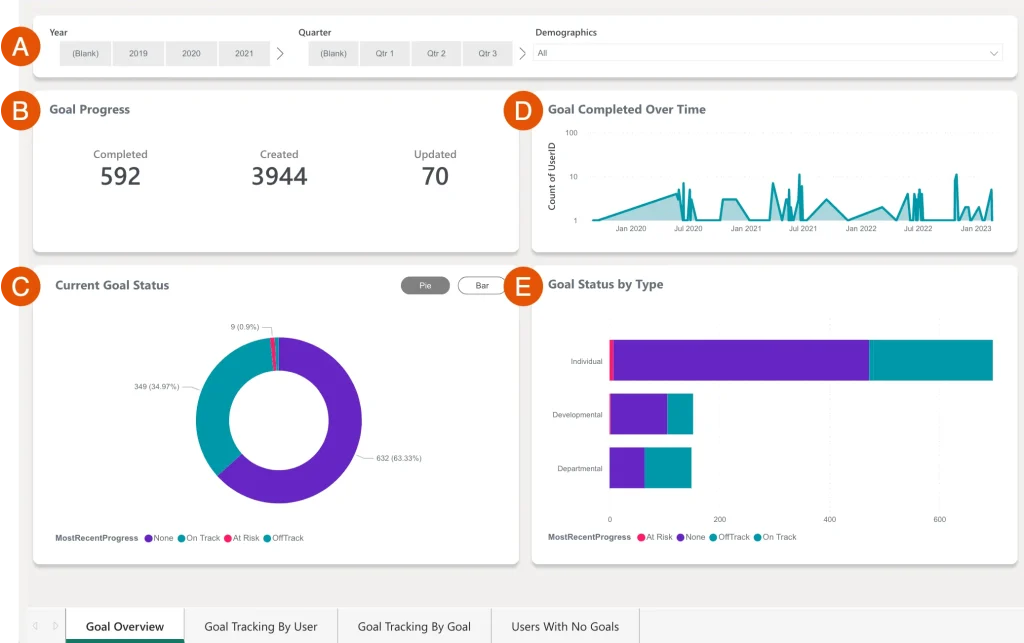
Regular check-ins, structured feedback, and consistent goal tracking turn into everyday coaching moments for managers, rather than a once-a-year scramble nobody really prepares for properly. Engagement surveys surface early warning signs of disengagement and flight risk across critical roles, which helped her flag a real retention issue two full months before it quietly became a resignation letter on her desk.
Manager dashboards and automated reporting tools replaced the spreadsheet exports her small HR team used to build by hand every single month without fail, before this switch finally happened.
Pros:
- Connects employee engagement, performance management, and development in one platform
- Engagement surveys surface early flight-risk and disengagement signals
- Manager dashboards and automated reporting replace manual spreadsheet exports
- Strong customer support track record, including industry support awards
- Integrates with ADP, Workday, BambooHR, UKG Pro, Okta, and Slack
Cons:
- Extensive feature set can feel like overkill for very small HR teams
- Survey setup and multilingual workflows take more configuration than expected
How Quantum Workplace Compares With Small Improvements: Small Improvements keeps engagement surveys fairly light. Quantum Workplace treats engagement and performance as one connected system, which suits teams that want retention risk and performance data living in the same dashboard.
User Rating: 4.3/5 (G2)
Price: Custom Quote
How I Chose These Small Improvements Alternatives
Picking tools for a list of the best small improvements alternatives is not something I take lightly. I followed a systematic approach to make sure every recommendation is practical, reliable, and worth considering for someone making a real purchasing decision.
- User Reviews / Ratings: I start by looking at real user feedback from platforms like G2. This gives me a clear picture of how teams actually experience the tool day to day, what they love, and where it falls short.
- Core Features & Functionality: I focus on what truly matters for small improvements performance management alternatives search: goal setting, review depth, feedback types, reporting, and integrations. If a tool cannot handle these well, it does not make the cut, regardless of interface polish.
- Ease of Use: I pay close attention to how intuitive the platform feels. A tool might be powerful, but if teams struggle to adopt it, it defeats the purpose. Clean interface, simple navigation, and quick onboarding are non-negotiable for me.
- Customer Support: From my experience, implementation is where many small improvements competitors fail. I evaluate how responsive and helpful the support team is, especially during setup and ongoing use, not just after problems arise.
- Value for Money: I compare pricing with what the tool actually delivers. This is not about picking the cheapest option, but about whether the features, flexibility, and performance justify the cost for your team size.
- Personal Experience / Expert Insights: Wherever possible, I rely on my own hands-on experience with these tools. I also consider insights from HR leaders and people ops teams running real review cycles, which helps me go beyond surface-level reviews.
Top 3 Small Improvements Alternatives
After comparing all ten platforms against each other, three consistently came out on top for different reasons. The right one for you depends on exactly where Small Improvements has been letting you down.
1. PeopleGoal
My top overall pick because it solves the broadest set of problems teams face when outgrowing Small Improvements. The no-code Customizable Workflows let you rebuild reviews, onboarding, and attendance around your actual process, the OKRs & SMART Goals module solves the goal-cascading friction that shows up most often in reviews, and 500+ native integrations mean you are not routing data through workarounds.
2. 15Five
The top pick for teams whose biggest complaint is a lack of continuous feedback. If you are running weekly check-ins and want manager coaching built into the same platform, 15Five handles that rhythm better than a review-first tool ever will.
3. Lattice
The right choice if connecting OKRs directly to performance reviews is your top priority. The alignment between goal progress and calibration conversations removes the guesswork that makes annual reviews feel arbitrary.
Give Your People Team a System That Actually Gets Used
Switching away from Small Improvements does not mean settling for less. It means getting a system that your managers actually open between review cycles, not just during them.
Whether you need deeper OKR cascading, continuous feedback, or a platform that scales without another migration for 18 months, there is a stronger fit among these 10 options.
If fully customizable reviews, OKRs, and employee development plans matter most, start with PeopleGoal. It’s no-code workflows adapt to how your company works, backed by 500+ integrations and a free plan to test before you commit budget.
Map your next review cycle into that free plan, then decide.
Frequently Asked Questions
Can I migrate our historical Small Improvements review data to a new platform?
Most vendors support CSV or API-based data migration, but the depth varies. Confirm before switching whether the new platform can import past review scores and goal history, not just employee profiles, so managers have context going into the first new cycle.
Which alternative works best for a fully remote or distributed team?
Bob (HiBob) and Betterworks both handle multi-country compliance and localization well. PeopleGoal's Multi-Dimensional Teams & Org Charts feature also supports complex, matrixed reporting structures common in distributed organizations.
Do any of these tools offer a free plan to test before buying?
PeopleGoal offers a free plan for smaller teams to test core functionality before committing budget. Most other platforms on this list are demo-led or offer only a time-limited free trial.
How difficult is it to run parallel review cycles during a transition period?
The safest approach is running your current cycle and a pilot cycle in the new tool simultaneously for one full review period. This confirms data accuracy and manager comfort before you fully retire the old platform.
Which platform is easiest for a small HR team with no dedicated admin?
15Five and PeopleGoal both report faster setup times and lower ongoing admin overhead compared to enterprise-oriented platforms like Betterworks or Lattice's full suite.
Do these platforms support anonymous 360 feedback?
Yes. PeopleGoal, Trakstar, and Culture Amp all support configurable anonymity settings for 360 feedback, letting you adjust visibility per review cycle depending on sensitivity.
Ready to 3x Your Teams' Performance?
Use the best performance management software to align goals, track progress, and boost employee engagement.