
I have spent years working with HR teams, and the single question I get asked more than any other is some version of this: “We know something is off with our people, but we don’t know what.” That is exactly the problem an employee engagement survey is designed to solve.
An employee engagement survey is a structured feedback tool that measures how emotionally invested, motivated, and committed your employees are to their work, their team, and your organization. It is not a satisfaction survey. A satisfied employee may show up and do the minimum. An engaged employee cares about outcomes, brings initiative, and stays because the work means something to them. The survey captures that difference, across every team and every level, in a way that gut instinct and exit interviews never can.
I have seen companies with 60 employees and Google Forms, and companies with 180 employees still running everything through Excel. Both are flying blind. The good news is that getting this right does not require a big budget or a dedicated HR department. What it does require is a clear process, the right questions, and the commitment to actually act on what you learn.
What Exactly Is an Employee Engagement Survey?
An employee engagement survey is a tool that measures the psychological connection your employees have with their work, their team, and your organization. It goes beyond simple satisfaction. It asks whether employees feel valued, heard, and motivated to contribute their best.
Think of it this way: a satisfied employee might show up every day and do their job. An engaged employee actively cares about the outcome. They go the extra mile. They stay longer. They bring ideas. The survey helps you figure out which category your people fall into and why.
For HR teams at companies with 50 to 200 employees, an engagement survey is often the most practical and cost-effective way to take the pulse of your workforce before problems become turnover.
Why Should You Measure Employee Engagement?
Here is the honest truth: most HR leaders already feel that engagement matters. But without data, it is hard to convince leadership to act or to know where to start.
The numbers make the case clearly:
- A study by Gallup in 2025 shows global employee engagement fell to 21% in 2024, matching the lowest levels seen since the pandemic began, costing the world economy an estimated $438 billion in lost productivity
- A study by Gallup in 2024 shows high employee engagement leads to a 51% drop in turnover, a 68% improvement in employee well-being, and a 23% increase in productivity
- A study by Gallup shows companies with highly engaged workforces experience a 59% reduction in turnover rates
For your organization specifically, measuring engagement helps you:
- Identify what is driving disengagement before it leads to resignations
- Give employees a voice, which itself increases trust
- Prioritize where to invest your HR time and budget
- Align teams around shared goals and organizational values
- Track whether your people programs are actually working
“You can’t improve what you don’t measure. Engagement surveys create the data foundation that turns gut instinct into strategic HR decisions.”
– Josh Bersin, Global HR Analyst and Founder, The Josh Bersin Company
What Topics Does a Good Employee Engagement Survey Cover?
A comprehensive employee engagement survey should cover 13 core topic areas. Each one captures a different dimension of how your employees experience work. Think of these as the 13 windows into your organization’s health. Skip even two or three and you are already working with incomplete data.
1. Feedback
Do employees receive regular, constructive input on their performance? This goes beyond annual reviews. People need to know how they are doing in real time. When feedback is absent or inconsistent, employees start guessing, and they usually guess wrong about how they are perceived.
Low scores here are one of the earliest warning signs of disengagement. You can explore this further in our guide on constructive feedback.
2. Opportunities for Growth
Can people see a clear path forward in your organization? Growth does not always mean promotion. It means feeling like you are learning something and moving somewhere. When employees do not see a future with you, they start looking for one elsewhere.
This topic is closely tied to employee development and is one of the strongest predictors of voluntary turnover.
3. Teamwork
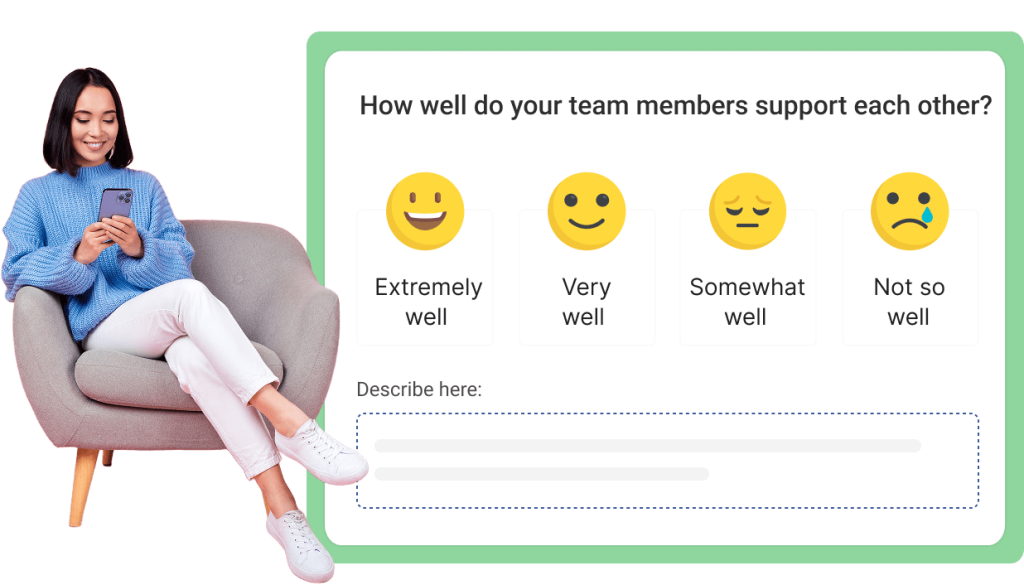
Do teams collaborate effectively and support each other? High performers in dysfunctional teams eventually stop being high performers. This area reveals whether your team culture is actually enabling people or creating friction.
Scores here often reflect the quality of your internal communication and manager behavior more than individual personality.
4. Work/Life Balance
Are workloads sustainable and boundaries respected? Burnout does not announce itself until it is already too late. This topic is your early detection signal. Consistently low scores in this area mean your best people are running on empty, and they will leave before they crash publicly.
It ties directly to employee well-being initiatives that smart organizations are already building into their culture.
5. Quality and Focus
Do employees have what they need to do their best work? This is not just about tools and software. It is about clarity of role, access to information, and freedom from unnecessary noise.
When this score drops, productivity follows shortly after.
6. Fairness
Are decisions made transparently and equitably? Perceptions of unfairness spread fast and cut deep. If one person feels a promotion decision was political or a policy is applied inconsistently, that sentiment ripples across the team within weeks.
This topic is often where your most serious cultural problems surface first.
7. Purpose and Direction
Do people understand how their work connects to the bigger picture? People who feel their work is meaningless disengage quietly but completely.
This topic measures alignment between individual contribution and organizational mission. Teams that score low here often have a communication problem at the leadership level.
8. Respect
Do employees feel valued and treated with dignity? This is foundational. Every other engagement driver sits on top of this one. If people do not feel respected, nothing else works.
Low respect scores often correlate with poor manager behavior, which is why this area deserves immediate follow-up when scores fall.
9. Remuneration
Do people feel their compensation reflects their contribution? This is not just about whether you pay enough. It is about whether employees feel the exchange is fair.
Engagement surveys surface pay dissatisfaction that people are often too cautious to raise directly with their manager.
10. Workplace and Resources
Are tools, systems, and environments set up for success? For remote and hybrid teams, this has expanded beyond the physical office.
Outdated software, slow systems, or unclear processes all chip away at engagement quietly. This area often reveals operational blockers that HR and leadership were not even aware of.
11. Performance and Accountability
Are expectations clear and goals tracked fairly? Ambiguity about what success looks like is one of the most underrated causes of disengagement. This topic connects directly to your performance management process.
Teams with strong goal-setting practices consistently score higher here. Our guide on SMART goals can help managers set clearer expectations.
12. Communication
Does information flow effectively across the organization? Poor communication is the silent killer of engagement. This topic tells you whether your people feel informed, included, and heard. Low scores here almost always correlate with low scores in trust and fairness, which brings us back to why all 13 areas need to be measured together.
13. Personal Expression
Can employees share ideas and opinions without fear? Psychological safety is the term researchers use. What it means in practice is whether your people feel safe enough to speak up, disagree, and contribute ideas without worrying about the consequences.
Organizations that score low here are usually sitting on a lot of untapped innovation and suppressed dissatisfaction. This connects closely to psychological safety as a cultural foundation.
How Many Questions Should an Employee Engagement Survey Have?
The sweet spot is 50 questions, rated on a 1 to 5 Likert scale, followed by 3 to 5 open-ended short-answer questions.
Here is why that number works:
Too few questions (under 20): You will collect surface-level data. Generic statements like “I am satisfied with my job” give you no direction on what to actually fix. You cannot distinguish between a team communication problem and a compensation problem when your survey is five questions long.
Too many questions (80+): Completion rates drop. Employees experience survey fatigue. By the time they reach question 70, they are clicking through without thinking, which corrupts your data.
The 1 to 5 Likert scale matters because it lets you measure responses both quantitatively (average scores, trend lines) and qualitatively (what the numbers reveal about specific areas). It also makes it easy to benchmark results over time and across departments.
How Do You Run an Employee Engagement Survey? (Step-by-Step)
Running an effective work engagement survey is not just about sending a form. It is a structured process with five phases:
Step 1: Define Your Survey Objectives
Before you design a single question, get clear on what you are trying to learn. Are you measuring overall engagement? Testing the impact of a recent culture initiative? Benchmarking against last year? Your objectives shape your question set.
Example objective: “Understand why retention has dropped in the engineering team over the last two quarters.”
Step 2: Design and Distribute the Survey
Build your questionnaire around the 13 core topics. Use a consistent 1 to 5 rating scale and add open-ended follow-up questions at the end. Distribute through your HR platform or survey tool, set a clear deadline, and send automated reminders, especially for employees who have not responded.
Aim for 100% participation. Even a 70% response rate can create blind spots in your data. PeopleGoal’s automated reminders and HRIS-connected distribution make this significantly easier for teams without dedicated survey administrators.
Step 3: Analyze the Results
Once the survey closes, look for patterns, not just averages. Which departments scored lowest? Where are the biggest gaps between senior leaders and individual contributors? Use filters to group results by team, role, tenure, or location.
Do not get overwhelmed by every data point. Start with your bottom three scoring areas and your biggest year-over-year drops.
Step 4: Prioritize and Build an Action Plan
You cannot fix everything at once. Prioritize based on two criteria: impact (which areas affect the most people?) and urgency (which issues are driving real harm like turnover or burnout?).
Build a time-bound plan with clear owners, milestones, and communication checkpoints. The most common mistake HR teams make is collecting data and doing nothing with it. Employees notice. And next time, they will not bother filling out the survey honestly.
Step 5: Communicate, Implement, and Remeasure
Share results with the entire organization, not just leadership. Transparency builds trust. Tell employees what you heard, what you are going to do about it, and when they can expect to see changes. Then follow through. Remeasure 6 to 12 months later to track progress.
What Are the Benefits of Running Employee Engagement Surveys?
A lot of HR teams I speak to know they should be running engagement surveys. But when it comes to getting budget sign-off or convincing a skeptical leadership team, they need more than intuition. They need to be able to articulate precisely who benefits and how. Here is the full picture broken down by stakeholder, because the ROI of a well-run employee engagement survey touches every layer of your organization.
For the Organization
The most immediate organizational benefit is visibility. An engagement survey gives leadership a real-time signal of workforce health that no financial report or headcount metric can replicate. It functions as an early warning system, surfacing retention risk, cultural drift, and operational friction before these problems become expensive.
When survey results are shared in leadership meetings, they create a shared language around people problems. Instead of vague conversations about “morale” or “culture,” you now have specific scores in specific areas that point to specific interventions. That is the difference between a leadership team that reacts and one that acts.
Engagement data also gives HR the evidence it needs to justify investment in culture programs, manager training, or system upgrades. A benchmark score in “communication” or “fairness” is far more persuasive in a budget conversation than anecdotal feedback. And when you remeasure after an intervention, you can demonstrate ROI in a way that actually lands with finance and the C-suite.
For Managers
Managers are often the last to know their team is struggling, not because they are not paying attention, but because direct reports rarely raise problems openly in a 1:1. An engagement survey removes that barrier. It gives managers department-level and team-level data that surfaces issues they might not hear any other way.
More importantly, it gives managers specific areas to work on rather than the impossible mandate to “improve engagement.” If your team scores low on “feedback,” that is actionable. If they score low on “fairness,” that points to a conversation about decision-making transparency. The survey turns a fuzzy leadership challenge into a concrete development opportunity. Our guide on one-on-one meetings can help managers turn those survey insights into meaningful conversations with their team.
For Employees
From an employee’s perspective, being asked matters. The act of running an engagement survey sends a signal that leadership cares enough to ask and, critically, that there is a process through which their experience can actually influence how things are run.
When employees see survey results communicated back to them and followed by visible action, trust compounds. They become more willing to give honest feedback in future cycles, which improves your data quality over time. The alternative, not running surveys or running them and doing nothing, erodes trust faster than almost any other HR misstep. Employees talk. If the survey felt performative, that perception will spread.
For HR Teams
For HR teams managing 50 to 200 employees, the operational benefit of a well-run engagement survey is significant. It replaces the ad-hoc, manual feedback collection that most teams rely on: the Google Forms, the Excel trackers, the Slack messages asking managers to check in with their teams informally.
Centralized survey data means you are no longer chasing down information from multiple sources and trying to stitch together a picture of workforce health from scattered inputs. You have one dataset, one dashboard, and one source of truth. That alone saves hours every survey cycle.
The deeper strategic benefit is the ability to connect engagement data with your performance review results. That connection, which PeopleGoal makes possible in a single platform, is what separates reactive HR from strategic HR. When you can see that low engagement scores in “growth” are correlating with lower performance ratings in the same team six months later, you stop treating engagement as a soft metric and start treating it as a leading indicator of business outcomes.
How Are Employee Engagement Surveys Different from Employee Satisfaction Surveys?
When I talk to HR managers who are building out their listening strategy for the first time, this question almost always comes up early. And it is a genuinely important one because the two terms get used interchangeably all the time, even though they measure fundamentally different things. Getting clarity on this distinction shapes which survey you run, when you run it, and what you do with the results.
| Employee Engagement Survey | Employee Satisfaction Survey | |
|---|---|---|
| Measures | Commitment, motivation, emotional connection | Contentment with current conditions |
| Focus | Future-oriented (will they stay and perform?) | Present-oriented (are they happy now?) |
| Depth | 50 questions, 13 topic areas | 10 to 15 questions, general sentiment |
| Actionability | High, specific drivers of engagement | Lower, general satisfaction score |
| Best used for | Annual or biannual workforce health assessment | Quick pulse checks between survey cycles |
Satisfaction surveys tell you if employees are content. Engagement surveys tell you if they are committed. You need both, but if you can only run one, run the engagement survey.
Should Your Employee Engagement Surveys Be Anonymous or Confidential?
This is the question that makes or breaks your response rate.
Anonymous surveys collect no identifiable information. Every employee gets the same generic link. Responses are completely untraceable. Anonymous surveys are most effective when trust is low, when exploring sensitive topics like harassment or ethics violations, or when your HR system is not set up to connect survey data to employee records.
Confidential surveys link responses to demographic data (department, role, tenure) through secure systems, but report results only in aggregate, typically for groups of five or more respondents. Confidential surveys enable deeper analytics, including regression analysis, key driver identification, and segmentation, turning employee voice into a strategic asset that HR teams can connect to business outcomes like retention and productivity.
Our recommendation for most HR teams: use confidential surveys for your main annual or biannual cycle. The segmented data is far more useful for action planning. Use anonymous pulse surveys for sensitive topics or new teams where trust has not yet been established.
How Do Engagement Surveys Connect to Performance Reviews?
Most HR teams treat engagement surveys and performance reviews as two completely separate processes. They live on different timelines, in different tools, and the data almost never talks to each other. That separation is one of the most common and costly blind spots in people management, because when you bring these two data sets together, the picture you get is dramatically richer than either one alone can produce.
Engagement surveys tell you how employees feel. Performance reviews tell you how employees perform. When you bring those two data sets together, you get a complete picture:
- A high performer with low engagement scores is a classic flight risk. Time for a retention conversation.
- A team with low performance and low engagement in the “resources” category likely has an operational blocker, not a talent issue.
- Department-wide low scores in “communication” point to a manager problem, and performance reviews will start reflecting it within two quarters if you do not address it.
PeopleGoal is built to connect both. You can run engagement surveys and performance reviews in the same platform, allowing you to cross-reference results without switching tools or manually merging spreadsheets. For HR teams managing 50 to 200 employees, this kind of consolidated view is the difference between reactive HR and strategic HR.
You can also explore how 360 feedback fits into this picture, as peer input combined with engagement data creates one of the most complete views of team health available to HR.
What Are Common Mistakes to Avoid With Employee Engagement Surveys?
Even well-intentioned HR teams make these mistakes:
- Surveying Without Acting: This is the fastest way to kill future participation. If employees fill out a survey and see nothing change, they stop believing in the process. Always communicate what you heard and what you are doing about it.
- Making Surveys Too Long Or Too Vague: A 100-question survey signals that leadership has not thought carefully about what they actually need to know. Keep it focused.
- Skipping Anonymity Where It Matters: In teams with low psychological safety, employees will give socially acceptable answers, not honest ones. The data you collect will be useless.
- Running Surveys Once And Calling It Done: Engagement is dynamic. It shifts with leadership changes, market conditions, and workplace policy. Measure it consistently, at least annually, with pulse checks in between.
- Treating Engagement As An Hr Project, Not A Leadership Priority: Engagement surveys are most powerful when results are shared with and owned by line managers, not just the HR team.
Start Listening: How a Regular Employee Engagement Survey Keeps Your Best People
An employee engagement survey is the most direct way to understand what is actually happening inside your organization, beyond what people say in meetings or annual reviews.
But here is what the data consistently shows: the survey itself does not move the needle. What you do with the results does.
For HR teams managing growing organizations of 50 to 200 employees, the challenge is not running a survey. It is doing it consistently, analyzing results efficiently, and connecting engagement data to the performance and development programs that drive real change.
PeopleGoal brings all of this into one platform. Run engagement surveys, performance reviews, and goal tracking in a single system so your people data works together instead of sitting in separate spreadsheets. No more manual data merging. No more switching tools. Just clear insights you can act on.
Frequently Asked Questions
How often should you run an employee engagement survey?
Most organizations run a full engagement survey annually or biannually. Many complement this with shorter pulse surveys every quarter to track specific initiatives or catch emerging issues between full survey cycles.
What is a good employee engagement survey response rate?
A response rate of 70% or above is generally considered good. Aim for 100% participation where possible. Low response rates (below 50%) can skew results and reduce the reliability of your data. Automated reminders and manager-level accountability for team participation significantly improve completion rates.
How do you ensure employees are honest in engagement surveys?
Employees are more likely to respond honestly when they trust the process. This means clearly communicating whether the survey is anonymous or confidential, sharing aggregated (not individual) results, and most importantly, demonstrating that previous survey feedback led to real changes.
How long should an employee engagement survey take to complete?
A well-designed 50-question survey with a 1 to 5 rating scale typically takes 10 to 15 minutes to complete. Open-ended questions add another 5 minutes. Keeping completion time under 20 minutes is important for maintaining focus and data quality.
What is the difference between an employee engagement survey and a pulse survey?
An employee engagement survey is a comprehensive, annual or biannual assessment covering all major aspects of the employee experience (typically 50 questions). A pulse survey is a short, frequent check-in (5 to 15 questions) focused on a specific topic or time period. Use both together for the most complete listening strategy.
What should you do after an employee engagement survey?
After the survey closes: analyze results by department and team, identify your top 3 to 5 priority areas, build a time-bound action plan with clear owners, share results transparently with the whole organization, implement changes, and remeasure at the next survey cycle to track progress.
Ready to 3x Your Teams' Performance?
Use the best performance management software to align goals, track progress, and boost employee engagement.