

If you can conduct a performance review without triggering “Panic, Excuses, or a sudden need to reschedule the meeting”, you are already ahead of several managers & HRs. Most reviews do not fail because managers are careless, but because the meeting turns into a polite guessing game where nobody says the real thing.
I have worked with HR teams and managers across fast-growing companies, reviewing thousands of performance notes, ratings, and goal plans. The pattern is almost funny: the more “formal” the review sounds, the less valuable it becomes.
Let’s fix that with a simple, practical approach you can use right away.
In this blog, you will get a better idea of:
- How to prepare for a performance review without overthinking it
- How to run the conversation so it feels fair and human
- How to follow up so improvement actually happens
By the end, you will know how to conduct a performance review that reduces anxiety, improves clarity, and drives real growth.
Why Performance Reviews Matter
Performance reviews are not just formal employee evaluations or annual review rituals. They are structured checkpoints that help a manager and employee look back with honesty and look ahead with purpose. When done well, a performance review becomes a practical part of performance management, not a dreaded meeting.
At its best, conducting a performance review helps employees stay clear on expectations and helps managers coach with confidence.

Here is what meaningful employee performance reviews make possible if you know how to conduct a performance review meeting:
- They align expectations so the employee knows what success looks like and the manager knows what to coach toward.
- They surface real achievements that might otherwise go unnoticed in the day-to-day hustle.
- They give space for constructive feedback that is specific, fair, and tied to outcomes.
- They support goal setting for the next cycle, using clear performance goals instead of vague hopes.
- They strengthen the feedback culture by making growth a shared responsibility.
This is also why the process of conducting a performance appraisal review should never feel rushed or random.
When performance reviews are skipped or treated like a checkbox, teams pay for it later. Confusion builds, small problems turn into patterns, and strong employees feel invisible. In contrast, a consistent review process helps people stay engaged because they can see their progress and feel supported.
After we know why performance reviews matter and how they drive engagement and growth, let us begin with the preparation stage, because the quality of your groundwork decides the quality of conducting a performance review.
Before the Performance Review
A great performance review is built in advance, not improvised in the meeting. When managers prepare well, the employee evaluation feels fair, specific, and focused on development. When they do not, the annual review turns into a stressful exchange based on memory, mood, or recent events.
This stage of the performance review process has one primary purpose: to enter with clarity, evidence, and a coaching mindset. That means aligning expectations, gathering a full performance picture, and helping the employee come prepared too.
This stage is the foundation of the process of conducting a performance appraisal review, and it is where most managers either build trust or lose it.
Clarify Expectations and Performance Goals So There Are No Surprises
Before evaluating performance, confirm what the employee was expected to accomplish and how success was defined. This includes job responsibilities, role standards, and earlier performance goals set during the cycle.
If expectations were unclear, the review becomes unfair because the employee is being judged against invisible rules.
What You Can Do:
- Revisit the job description and key outcomes tied to the role.
- Pull up past goal-setting notes from one-on-ones, quarterly check-ins, or OKR discussions.
- Confirm that both of you still agree on what “strong performance” looks like.
Example: If you are reviewing a customer success manager, expectations might include renewal rates, onboarding completion time, and customer satisfaction scores. If the employee believes their priority was speed, but you are judging them mainly on retention, that mismatch must be fixed before you rate performance.
Gather Performance Evaluation Data Across the Full Review Period
A performance appraisal meeting should be based on evidence, not impressions. Collect data from the entire review period so you are not over-weighting recent wins or recent stumbles.
Using multiple inputs also protects against bias and gives a more accurate view of outcomes and work habits.
What to gather:
- Output or results, such as sales numbers, project delivery metrics, or support ratings.
- Quality indicators, such as error rates, client feedback, or adherence to standards.
- Collaboration signals, such as peer feedback or cross-team observations.
- Growth signals, such as new skills learned or ownership taken.
Example: Suppose you are reviewing a content strategist. Look at the full six to twelve months of work. Review traffic and conversion changes, not just the latest blog. Pull feedback from design or SEO partners. Note improvements in planning or execution over time. This prevents recency bias, where a great or weak last month distorts the whole review.
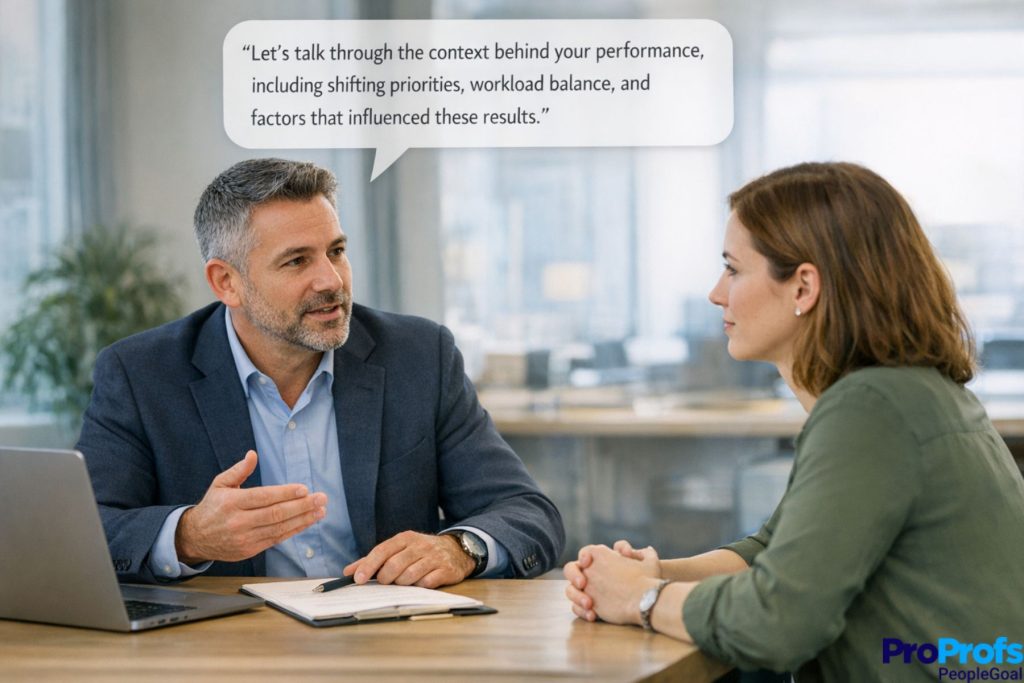
Review Patterns and Context So You See the Full Story
Numbers and outcomes matter, but they are not the entire story. Preparation also means understanding the conditions around performance.
Did priorities change mid-cycle? Was the workload uneven? Were there dependencies outside the employee’s control?
How to spot patterns:
- Track where performance was consistently strong and where it dipped.
- Notice if issues repeat in the same type of work.
- Compare performance against available resources and scope.
Example: An employee may have missed deadlines twice. If both delays happened during high-priority cross-team launches, that suggests a capacity or planning issue, not laziness. Seeing context helps you deliver constructive feedback that is accurate and useful.
Encourage Employee Self-Assessment So the Review Becomes Two-Way
Ask the employee to complete a self-assessment before the meeting. This gives you their perspective and helps you spot alignment or gaps between your view and theirs. It also makes the performance review feel collaborative instead of top-down.
What to ask them to reflect on:
- Key achievements and proud moments
- Challenges or missed goals, with reasons
- Skills they improved or want to build
- Support they need from you
- Goals they want to pursue next
Example: You may think an employee struggled with ownership. Their self-assessment may reveal they felt unsure of priorities because direction changed too often. That is valuable information. You can still address the ownership gap, but now you also fix the conditions causing it.
Notify Early and Share an Agenda to Reduce Anxiety and Improve Focus
Never ambush someone with an annual review. Schedule the meeting in advance and share a simple agenda. This gives the employee time to prepare emotionally and practically, which leads to a better performance appraisal meeting.
What a good agenda includes:
- Review of goals and outcomes from the cycle
- Discussion of strengths and impact
- Discussion of improvement areas
- Agreement on next performance goals
- Support and development plan
Example: A short note like, “We will review your goals from this cycle, discuss strengths and improvement areas, and decide 2 to 3 SMART goals for the next period,” makes the employee feel respected and ready, not cornered.
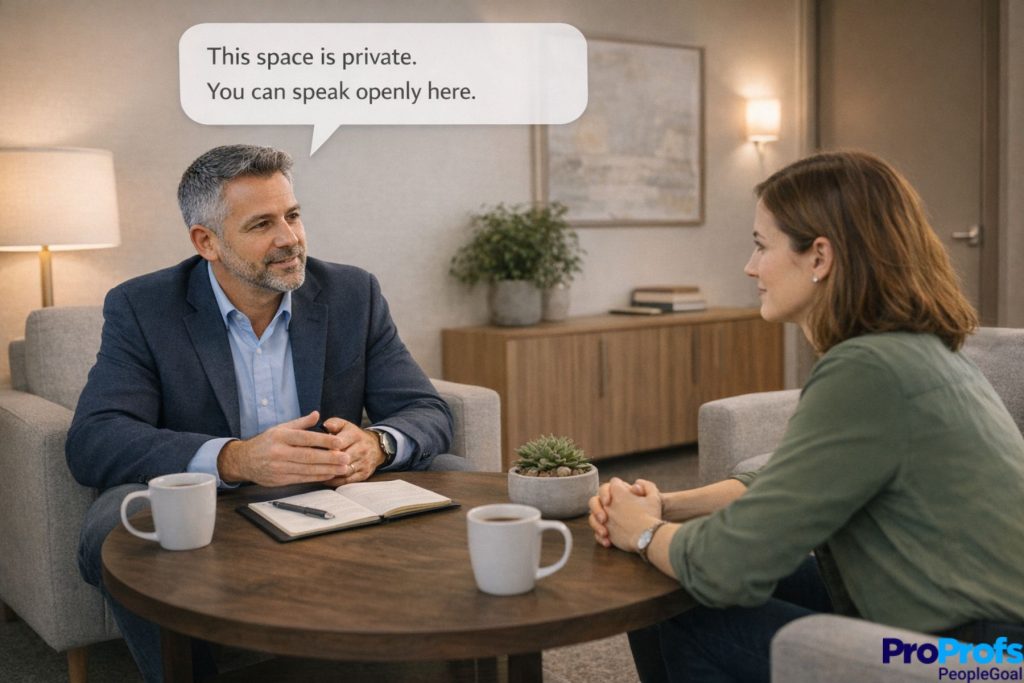
Choose a Private, Comfortable Setting That Supports Honest Dialogue
A performance evaluation needs psychological safety. The location should make it easy for the employee to speak openly without distraction or fear of being overheard. Even the best feedback can fail if the environment feels tense or exposed.
How to choose wisely:
- Pick a quiet room where you will not be interrupted.
- If remote, encourage both of you to join from private spaces.
- Avoid rushed slots between meetings.
Example: If you hold the review at a desk in a busy office or on a call with background noise, the employee may stay guarded. A calm, private setting signals that this conversation matters.
Prepare Balanced, Specific Feedback With Examples You Can Explain
Do not walk into a performance review with loose thoughts or general praise. Write down your main points in advance, and pair each point with a real example. This makes feedback easier to accept and easier to act on.
How to structure your notes:
- List 3 to 5 strengths supported by evidence.
- List 2 to 3 improvement areas supported by examples.
- Note the impact of each behavior on results, team, or clients.
- Prepare fair language that focuses on behaviors, not personality.
Example:
Instead of writing, “Good communicator,” write, “You kept stakeholders updated weekly during the onboarding rollout, which helped the support team plan ahead.”
Instead of writing, “Needs to be more organized,” write, “Two projects slipped because task ownership was unclear early on. If you define owners at kickoff, timelines will tighten.”
Balanced preparation prevents the review from tilting into either empty praise or harsh criticism.
Plan Your Flow So the Performance Review Is Structured and Calm
A scattered meeting creates confusion. A clear flow makes the review feel professional and safe. Decide the order of topics so you can guide the conversation without rushing or skipping key issues.
A simple high-trust flow:
- Welcome and purpose of the conversation
- Strengths and achievements
- Improvement areas with examples
- Employee perspective and discussion
- Future goals and SMART action items
- Support, resources, and follow-ups
Example: If you start with a sharp critique and then scramble to add praise later, the employee stays defensive. If you begin with real recognition, then move into improvement areas and close with goals, the meeting feels like development, not judgment.
After preparing thoroughly and aligning expectations, the next step is the conversation itself.
Now, let us move into how to conduct a performance review meeting in a way that feels structured, fair, and motivating.
During the Performance Review: Step By Step
A strong performance appraisal meeting follows a clear flow. It recognizes impact, addresses gaps with constructive feedback, and ends with practical performance goals and support.
Here is a process you can use for almost any employee performance review. This is the heart of conducting a good performance review, especially when the conversation feels uncomfortable.
Step 1: Open With Specific Recognition So the Employee Feels Seen and Settled
Start by calling out real achievements and strengths, backed with examples. This lowers anxiety and makes it clear that the employee evaluation is balanced.
Example: “You handled three high-priority client escalations and still delivered the onboarding checklist update on time. That reduced repeat questions for the support team.” This is more credible than generic praise because it ties effort to outcomes.
Step 2: Set a Collaborative Tone So the Review Feels Like a Two-Way Conversation
State the purpose of the meeting and invite participation early. This turns the annual review into a growth-focused discussion instead of a one-sided verdict.
Example: “I want this to be a conversation. I will share what I observed, and I want your perspective too. Then we will agree on what to focus on next.” This simple framing reduces defensiveness.
Step 3: Compare Self-Assessment With Evidence So the Review Stays Fair and Complete
Bring in the employee’s self-assessment and your performance evaluation data to build a shared picture. This helps you cover the full review period and avoid recency bias.
Example: If the employee says, “I struggled with deadlines,” you can respond with, “I saw the same pattern in two sprints, but I also saw strong execution on the client training rollout. Let us look at what changed between those projects.” Now the discussion stays grounded and balanced.
Step 4: Deliver Constructive Feedback With Clear Examples So It Is Actionable
When discussing improvement areas, focus on behaviors and results, then explain impact. Keep the language factual and forward-looking.
Example: Instead of “Your communication needs work,” say, “In two releases, status updates came late, which caused last-minute changes for QA. If updates come earlier, the team can plan and deliver with less rework.” The employee now knows exactly what to change.
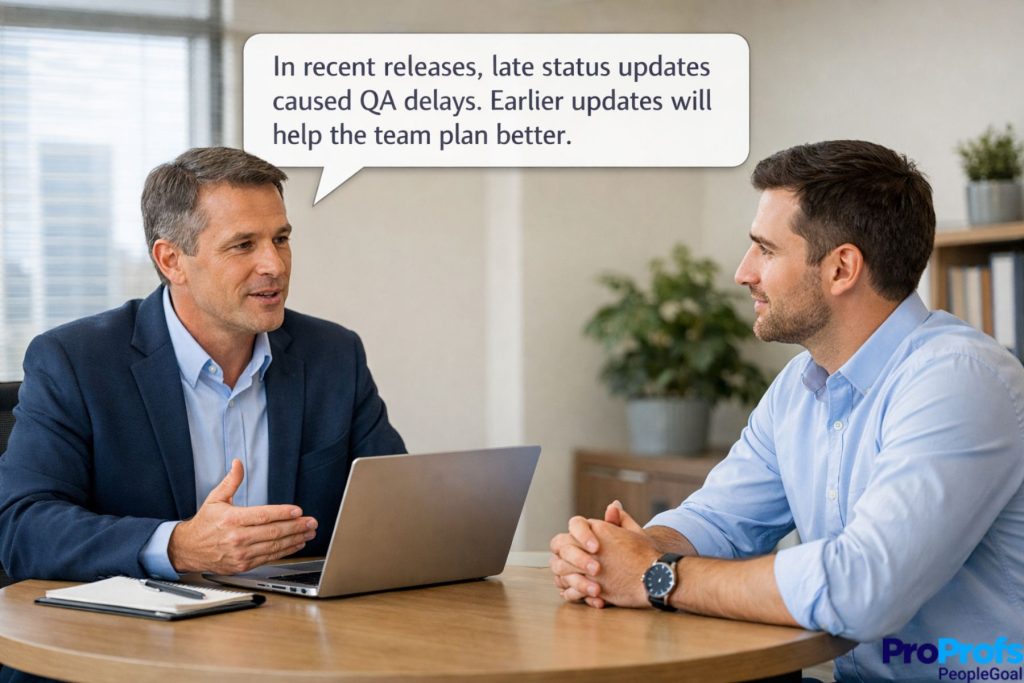
This is what a strong performance evaluation looks like, because the employee can clearly understand what needs to change.
Step 5: Problem-Solve Obstacles Together So Improvement Becomes Realistic
Ask questions, listen carefully, and look for root causes. This is where employee performance management becomes practical, because you identify what needs to change in skills, workflow, or support.
Example: If the employee explains that priorities shifted daily, you can agree on a fix like a weekly priority check-in or a clearer approval process. If the issue is a skill gap, you can agree on training or mentoring.
Step 6: Set SMART Goals and Follow-Ups So the Review Turns Into a Development Plan
End by agreeing on 2 to 3 clear performance goals, the support you will provide, and the checkpoints to track progress. Summarize aloud so there is no confusion.
Example: “By September, complete the presentation skills course. By November, lead one client demo. We will do a 20-minute check-in every two weeks to review progress and remove blockers.” This turns the performance review into employee development, not just evaluation.
This is where goal setting becomes real, because the goals are tied to timelines, support, and outcomes.
After the review conversation is complete and goals are agreed upon, the real work begins.
Let us now look at what happens after the performance review, because follow-through is a key part of the process of conducting a performance appraisal review.
After the Performance Review
The performance review does not end when the meeting does. What happens next determines whether the employee evaluation leads to growth or fades into another forgotten HR exercise. This stage of the performance review process is about reinforcement, accountability, and continuous feedback.
Strong follow-up shows employees that the review mattered, that commitments were real, and that performance management is an ongoing effort, not a once-a-year event.
This is where continuous feedback starts to matter, because employees improve faster when guidance is consistent.
Document the Discussion So Expectations Stay Clear
Soon after the meeting, document what was discussed and agreed upon. This includes strengths, improvement areas, performance goals, and support commitments. Written records reduce misunderstandings and give both manager and employee a shared reference point.
What to include in documentation:
- Key accomplishments discussed in the review
- Areas for improvement, stated clearly and factually
- Agreed performance goals and timelines
- Training, resources, or support promised
- Date of the next check-in or follow-up
Example: If you agreed that the employee will improve stakeholder communication, the document might note, “Share weekly project updates every Friday starting next month, with a progress review after six weeks.” This removes ambiguity and keeps accountability fair.
Share the Review Summary So Nothing Feels Hidden
Always share the written review or summary with the employee. A performance appraisal should never feel like private notes kept by management alone.
Why this matters:
- It reinforces transparency and trust.
- It gives the employee clarity on how they were evaluated.
- It allows them to revisit goals and feedback later.
Example: An employee preparing for a quarterly check-in can review the summary and say, “We agreed my focus would be earlier planning. Here is what I have changed so far.” That makes progress discussions easier and more objective.
Provide Ongoing Support So Goals Are Achievable
A performance review that sets goals without support creates pressure, not growth. After the meeting, follow through on the help you committed to provide.
This is also where good performance management software can help you stay organized, especially when you are managing multiple review cycles.
Support may include:
- Access to training or courses
- Coaching or mentoring
- Adjusted responsibilities or priorities
- Better tools or clearer processes
Example: If an employee needs to improve presentation skills, enrolling them in a course or pairing them with a senior presenter shows that the review was about development, not criticism.
Schedule Regular Check-Ins So Progress Does Not Stall
Do not wait until the next annual review to revisit performance goals. Schedule short, regular one-on-ones focused on progress, obstacles, and adjustments.
These one-on-one check-ins make the next review easier, because nothing feels like a surprise.
Good check-ins focus on:
- What has been working since the review
- What feels difficult or unclear
- Whether goals or timelines need adjustment
- What support is still needed
Example: A monthly 20-minute check-in can surface issues early. If an employee is struggling with a new responsibility, you can course-correct before it becomes a pattern.
Give Continuous Feedback So the Review Is Reinforced Year-Round
Performance reviews work best when supported by continuous feedback. A quick note of praise or a timely correction during the year makes the next review far less stressful.
Examples of continuous feedback:
- “Your early update this week helped the team plan better.”
- “Let us talk about how yesterday’s handoff could be clearer next time.”
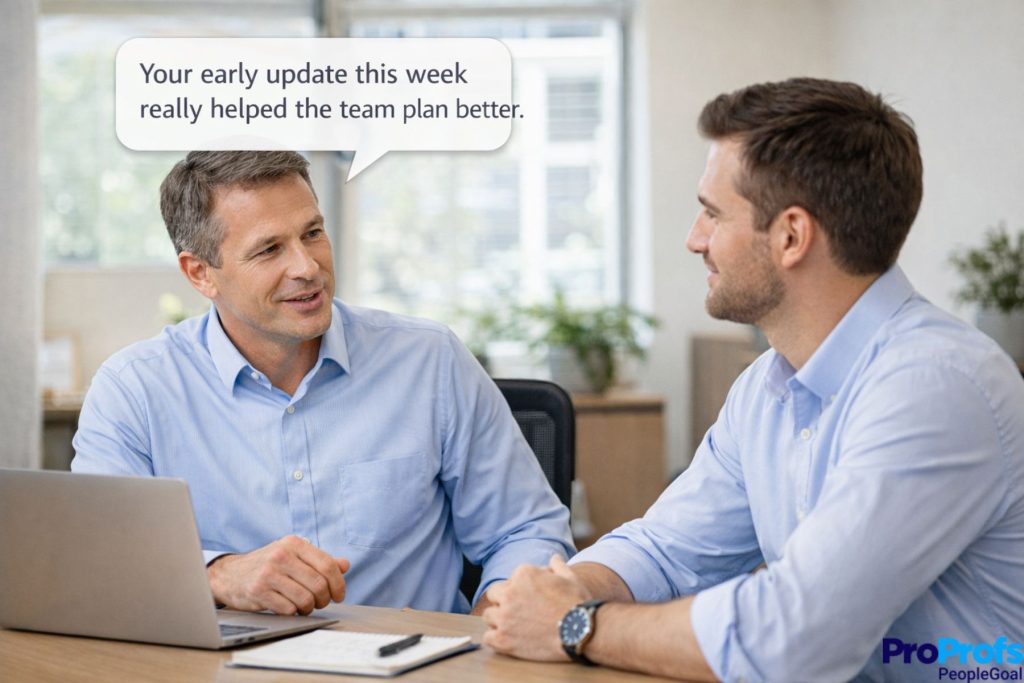
These small moments reinforce the same messages discussed in the performance appraisal meeting.
Recognize Improvement and Address Gaps Early
Pay attention to whether the review leads to change. If you see improvement, acknowledge it clearly. If progress is slow, address it early instead of waiting.
Example: If an employee improves deadline management after the review, say so in a check-in. If they do not, revisit the goal and ask what is getting in the way. This keeps performance management honest and supportive.
Now, once the review is documented and follow-ups are in motion, it is tempting to assume the hardest part of conducting a performance review is over. In my experience, this is where many performance reviews quietly lose their impact.
Before wrapping things up, it is worth pausing to look at the mistakes that can undermine even a well-intentioned performance review.
Common Pitfalls to Avoid During Performance Reviews
Even managers who care about employee development can slip into habits that weaken the performance review process.
I have seen reviews go sideways, not because someone was unfair, but because the conversation got rushed, fuzzy, or one-sided. The good news is that most of these issues are easy to spot and fix once you know what to look for.
Most of these mistakes happen when managers are still learning how to conduct a good performance review consistently. Here’s what you need to learn:
1. Letting Recent Events Decide the Whole Story
Recency bias happens when the last few weeks overshadow the entire review period. It is one of the fastest ways to make an employee evaluation feel unfair.
Here is a quick scenario that shows how this plays out. Imagine it is review day, and the employee says, “I know last month was rough, but I had a solid year.”
You check your notes and realize you were about to spend 20 minutes on the last project only.
Here is a simple way to correct course in the moment. Say, “Let us start with the full year. Then we will talk about the last month as one part of the picture.”
If you want a quick self-check, use this question.
“If I remove the last 30 days, would my rating change?” If the answer is yes, you probably need more year-round evidence.
2. Using Vague Feedback That Leaves the Employee Guessing
Words like “improve communication” or “be more proactive” sound nice, but they do not tell the employee what to do on Monday morning. Vague feedback makes performance management feel like opinion instead of guidance.
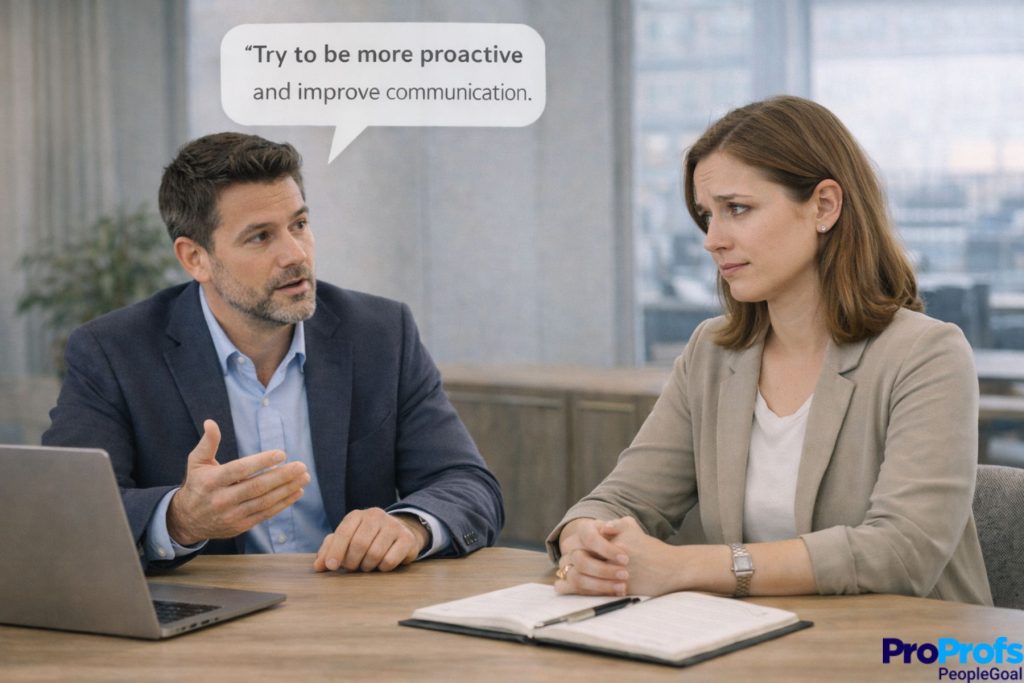
This is exactly why constructive feedback should always include examples, not labels.
Try this short exchange, and you will see the problem immediately. You say, “You need to be more proactive.” The employee asks, “Proactive how, exactly?”
If you pause and cannot answer in one sentence, the feedback needs sharpening.
Here is how to make the same point in a usable way. Try: “When a deadline looks risky, I want you to flag it two days earlier and propose one solution.”
If you want a simple test before you say something, ask yourself this.
“Can the employee act on this in the next 7 days?” If not, it is still too vague.
Here’s a quick video on how to give 360-degree feedback that actually works:
3. Focusing Only on Problems and Forgetting What Worked
Some managers walk into a review thinking, “Let us fix what is wrong.” That is useful, but if you ignore achievements, the employee leaves deflated and defensive. Recognition is not decoration. It is a key part of a strong performance appraisal meeting.
Here is a small way to make the conversation feel more balanced right away. Ask the employee: “What is one thing you did this year that you want to repeat next year?” Then add your own: “Here is one strength I want you to keep leaning into.”
Here is a clean way to structure the balance without overthinking it.
- “Here is what you did well, and here is why it mattered.”
- “Here is what needs to improve, and here is what we will do about it.”
If you want a quick clue that you leaned too negatively, watch for this. If the employee can list three mistakes from the review but cannot name one strength you praised, you missed an opportunity.
4. Skipping the Hard Topics and Hoping They Fix Themselves
This is common, especially when you like the employee or want to avoid conflict. But avoiding the issue does not protect the employee. It removes their chance to improve.
Here is what this often looks like in real time.
You are about to say, “Sometimes there are delays,” and move on.
Pause and ask yourself: “If this continues for another 3 months, will it hurt the team?” If yes, it belongs in the review.
Here is a simple way to bring it up without making it personal. Say, “I want to talk about deadlines because they affected delivery. Let us look at what happened and what needs to change.”
Keep it fair and grounded with a few simple rules.
- Stick to facts.
- Use one or two examples, not a long list.
- End with a plan.
5. Turning the Review Into a Lecture Instead of a Conversation
A review fails when the manager talks for 45 minutes, and the employee nods for 45 minutes. You lose context, the employee feels judged, and the meeting becomes something to survive instead of use.
Here is a practical way to keep the meeting two-way. Try the 60/40 rule: aim for the employee to speak around 60% of the time.
You can do that with questions like:
- “What felt hardest this cycle?”
- “Where did you feel you did your best work?”
- “What would you change if you ran this project again?”
Here is a habit that helps right after you share any major feedback. After any big feedback point, ask: “How do you see it?” and wait. If the silence feels long, that is fine. Let them think.
6. Setting Goals and Then Disappearing Until the Next Annual Review
This is where performance reviews lose credibility. Goals are agreed upon, support is promised, and then nothing happens. The employee learns that the review was a formality.
Without follow-through, the entire performance appraisal meeting loses credibility.
Here is a closing question that makes follow-through real. End the meeting with this question: “What is the first small sign we should see in the next two weeks that we are on track?” Then put a date on the calendar for a check-in.
Here are a few simple follow-through actions that work in most teams.
- A 20-minute check-in every month
- A quick mid-quarter progress review
- A shared list of goals with dates
If you want a final reality check, use this. If you cannot name the next follow-up date, the plan is not real yet.
Conduct a Performance Review That Turns Awkward Meetings Into Real Progress
A performance review does not have to feel like a tense annual review ritual. When you know how to conduct a performance review with clear expectations, real examples, and a calm, two-way tone, it starts to feel like a practical coaching session.
This is what strong performance management looks like in practice, because it connects clarity, accountability, and support.
You also leave with a shared plan, not a vague promise to “do better.”
The best reviews strike a balance between truth and support. They connect performance to impact, set SMART goals that actually fit the role, and build follow-ups into the calendar so progress does not fade. That is how performance management becomes steady, not reactive.
Once you master the process of conducting a performance appraisal review, reviews stop feeling stressful and start driving real employee development.And most importantly, you can use tools like PeopleGoal that help by organizing performance review templates, goal tracking, continuous feedback, 360-degree feedback, and one-on-one check-ins in one place, so the whole process stays consistent, trackable, and easier to run.
Ready to 3x Your Teams' Performance?
Use the best performance management software to align goals, track progress, and boost employee engagement.