
Most employees don’t fail because they lack talent. They fail because nobody clearly defined what success looks like.
That’s why searching for performance goals examples isn’t just an HR exercise. It’s damage control before another review cycle turns into vague feedback, awkward conversations, and zero real improvement.
The urgency is real. According to Gallup’s workplace research, only about 21% of employees are engaged globally, costing the world economy hundreds of billions in lost productivity. And weak goals are a big part of that story.
HR teams spend hours building review processes. Managers copy last year’s goals. Employees nod along. Nothing changes.
This guide gives you concrete performance goals for employees, organized by role, department, review scenario, and framework, so you can set goals people can actually understand, track, and achieve.
What Are Performance Goals?
Most organizations understand that goals matter. Where they struggle is the gap between “we set goals” and “our goals actually drive performance.”
That gap usually comes down to three things:
- Goals that lack any real measurement
- Goals that aren’t connected to business priorities
- Goals that get set once and never revisited
Well-written performance goals change all of that. They reduce recency bias in reviews, create accountability without micromanagement, and give employees a clear answer to “what does good actually look like in my role?”
Running short on time? Download the full Performance Goals Starter Kit below with a pre-built tracker, all 46+ goal examples, a SMART goal worksheet, manager conversation scripts, and a review cycle checklist, all in one spreadsheet.
How Do You Write Effective Performance Goals?
There are three main frameworks. Each has a different job.
| Framework | Best For | Example |
| SMART Goal | Individual performance targets | Reduce ticket resolution time from 36 to 18 hours by Q2 |
| OKR | Team or company-level alignment | Objective: Improve customer retention. KR: Reduce churn from 5% to 3% by Q3 |
| KPI Goal | Metric-based accountability | Maintain 95% forecast accuracy each quarter |
1. SMART Goals
SMART Goals are the most widely used for individual review cycles. The framework stands for Specific, Measurable, Achievable, Relevant, and Time-bound.
Weak goal: “Improve communication with the team.”
Strong SMART goal: “Deliver a written weekly status update to the team by every Friday, reducing ad-hoc status requests by 25% by the end of Q2.”
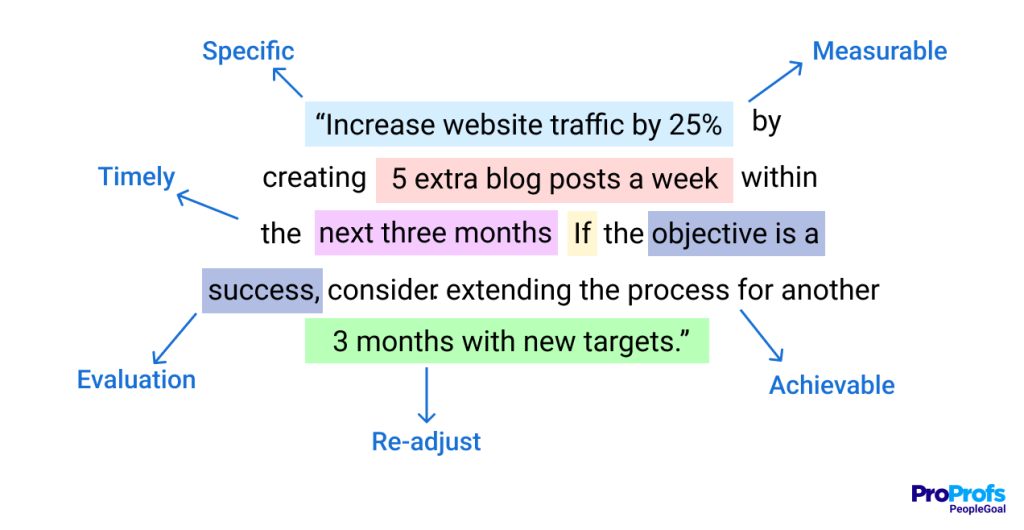
The difference isn’t ambition. It’s specificity. The first goal can’t be evaluated. The second one can.
2. OKRs
OKRs work differently. The Objective is qualitative and aspirational. The Key Results are the measurable signals that tell you whether you’re moving toward it.
Example:
- Objective: Build a customer success function that reduces churn and drives retention
- KR 1: Reduce monthly churn from 4.2% to 2.8% by end of Q3
- KR 2: Achieve an NPS of 45 or above by September
- KR 3: Complete onboarding calls with 100% of new customers within 14 days
3. KPI-Based Goals
KPI-Based Goals use the metrics a role is accountable for and turn them into concrete targets. A sales rep’s KPI might be monthly revenue. Their goal: “Achieve $85,000 in new business revenue per month in Q3, targeting mid-market SaaS accounts.”
Most organizations use all three depending on the level and context, and the right performance management software lets you run SMART, OKR, and KPI frameworks in one system.
The simple formula for writing any measurable goal:
[Action Verb] + [Specific Task or Project] + [Measurable Metric] + [Timeframe]
Examples:
- “Reduce / monthly churn rate / from 5.2% to 3.5% / by end of Q3.”
- “Complete / Advanced Excel certification / and automate two recurring reports / by Q2.”
50+ Performance Management Goals Examples
Not all performance goals work the same way across teams. A strong sales goal looks very different from a strong engineering or HR goal because every role contributes to business growth differently.
To make this easier to navigate, I’ve organized these performance goals examples by department, role, and review scenario so you can quickly adapt them to your team instead of starting from scratch.
- Performance Goals Examples by Department
- Performance Goals Examples for Managers
- Performance Goals Examples Based On Review Scenario
Performance Goals Examples by Department
This is the core section. I have organized these by department because a generic list of 50 goals helps no one. Role-specific examples you can adapt are what actually save time in a review cycle.
Sales
- Close $120,000 in new business revenue per quarter, with at least 60% sourced from outbound prospecting by Q3.
- Maintain a minimum sales pipeline coverage of 3x quota at all times, reviewed in weekly 1:1s.
- Reduce average deal cycle time from 45 to 32 days by Q4 through improved qualification and faster proposals.
- Complete 20 outreach calls per week and document outcomes in the CRM within 24 hours.
Sales goals fail when they’re outcome-only. Mixing controllable inputs (calls, pipeline coverage) with outcome targets (revenue, cycle time) gives reps clarity on what to do daily, not just what number to hit at quarter-end.
Customer Success
- Achieve a monthly NPS of 50 or above across assigned accounts, measured through quarterly surveys.
- Reduce average ticket resolution time from 36 to 18 hours by Q2 through improved triage workflows.
- Complete quarterly business reviews with 80% of key accounts before each quarter closes.
- Reduce churn in the assigned segment from 5% to 3% by starting renewal outreach 90 days before contract dates.
Customer success roles are often evaluated on “relationships,” which are notoriously hard to measure. These goals anchor that relationship work to trackable outputs.
HR and People Operations
- Launch a structured 90-day onboarding program for all new hires by Q2, targeting a satisfaction score of 4.2/5 by year-end.
- Reduce time-to-hire from 38 to 25 days by Q3 by combining AI-based resume screening with structured interview scorecards and a consistent pipeline review process.
- Complete the annual performance review cycle on schedule for 100% of employees, with manager submission rates above 95%.
- Develop and roll out a manager development program for all people managers by Q3, with completion tracked in the LMS.
HR goals are frequently written in output terms (“launch the program”) without quality measures attached. Adding a satisfaction score to onboarding or a submission rate to the review cycle turns HR deliverables into real performance data.
Marketing
- Increase organic search traffic to the blog by 35% over Q3 by publishing four SEO-optimized posts per month and building 10 quality backlinks.
- Improve email open rates from 22% to 30% by running A/B tests on subject lines across three campaigns per quarter.
- Generate 300 qualified MQLs per month through inbound channels by Q4, tracked in the CRM.
- Reduce customer acquisition cost by 15% by optimizing paid ad spend allocation across channels by Q3.
Marketing goals work best when they separate inputs from outputs. Publishing four posts per month is an input. A 35% traffic increase is the output. Tracking both means you can spot early if the strategy isn’t working.
Engineering and Product
- Reduce average bug resolution time from 72 to 48 hours by Q2 through improved triage in Jira.
- Ship two features from the roadmap each sprint with test coverage above 85% on all new code.
- Migrate three legacy manual reports to automated dashboards by Q3, saving 4 hours of weekly reporting time.
- Achieve API response under 200ms for 99% of requests by Q4 through performance optimization sprints.
Engineering goals that only measure shipping speed miss quality entirely. Including test coverage thresholds alongside delivery targets holds the team accountable for both pace and reliability.
Finance and FP&A
- Reduce monthly financial close time from 8 to 5 days by Q3 by automating three recurring reconciliation processes.
- Deliver quarterly forecasting reports with 95% variance accuracy versus actuals.
- Complete a full vendor contract audit by Q2 and identify at least $50,000 in annual cost savings.
- Automate weekly cash flow reporting, eliminating 6 hours of manual data prep per week.
Finance goals that quantify time saved, accuracy rates, and cost impact make invisible work visible during review season.
Operations
- Reduce average order fulfillment time from 3.2 to 2.0 days by Q3 through workflow redesign and supplier SLA enforcement.
- Achieve 98% warehouse inventory accuracy by Q4 through weekly cycle counts and improved intake procedures.
- Document three core operational SOPs by Q2 and train all relevant staff on updated processes.
“Improve efficiency” tells no one anything. Targeting fulfillment time to a decimal, setting a precise accuracy threshold, and naming the exact number of SOPs to document gives every stakeholder a shared definition of a good quarter.
Administrative and Executive Assistants
- Achieve 100% same-day response rate on all executive inquiries flagged as urgent, tracked via email logs.
- Reduce scheduling conflicts for the executive team by 40% by Q2 through a shared calendar review process.
- Deliver accurate meeting summaries with action items within 2 hours of each executive meeting.
Administrative roles carry some of the hardest-to-quantify work in any organization. These goals convert “being responsive and organized” into trackable performance standards that are fair to evaluate because the expectation is defined upfront.
Performance Goals Examples for Managers
Manager goals look different from individual contributor goals. They cover people development, team accountability, and process ownership, not just personal output.
31. Improve team engagement survey scores from 3.6 to 4.1 by Q4 through structured monthly 1:1s with each direct report.
32. Reduce voluntary turnover from 18% to 12% over the next 12 months through career development conversations and retention initiatives.
33. Complete mid-year reviews for all direct reports by the stated deadline, with written feedback documented for each employee.
34. Develop individual development plans for at least 80% of direct reports by Q2, identifying one growth opportunity per person.
35. Resolve team performance issues within 30 days of identification using a structured improvement process.
One thing I see managers miss: most of their goals focus on outputs, not on the people they manage. The best manager goals include both. Output goals tell you what the team delivered. People goals tell you whether the team is growing.
Performance Goals Examples Based On Review Scenario
Goals aren’t one-size-fits-all. The right goal for an annual review looks very different from a goal written for a new hire or a performance improvement plan. Here’s how to think about each situation.
Annual Review Goals
Focus on outcomes over the full year. These should reflect the biggest business priorities and the employee’s highest-value contributions.
36. Grow the assigned territory from $800K to $1.1M in annual recurring revenue by December.
37. Deliver a fully automated reporting suite replacing all manual Excel-based reports by Q4.
Quarterly Review Goals
Tighter scope, faster feedback loop. Useful for roles with high output variability or teams running OKR cycles.
38. Complete migration of three workflows from the legacy system to the new platform by end of Q2.
39. Run two customer discovery interviews per week and summarize findings in a shared research doc by Friday EOD.
Promotion-Readiness Goals
Tie directly to the behaviors and outcomes expected at the next level. Make the criteria visible before the conversation happens.
40. Own and deliver one high-visibility, cross-functional project end-to-end with documented results shared at the team all-hands.
41. Mentor one junior team member through a defined 90-day skill development plan.
PIP Goals
Must be specific, measurable, and achievable within the defined timeframe. Vague PIP goals are unfair to the employee and create legal risk for the organization.
42. Achieve 90%+ on-time task completion for 60 consecutive days, tracked in the project management tool.
43. Reduce errors in weekly financial reporting to zero for eight consecutive reporting cycles.
New Hire Goals
First 30/60/90 days. Focus on ramp, relationships, and early contributions.
44. Complete the full onboarding checklist and submit the 30-day reflection document by Day 30.
45. Schedule introductory 1:1s with all key cross-functional partners by end of Week 2.
46. Deliver the first independent project deliverable with manager sign-off by Day 60.
Remote Employee Goals
For remote and hybrid roles, performance goals should be entirely outcome-based, not activity-based.
47. Deliver all project milestones on schedule with same-day documentation in Notion.
48. Respond to all internal messages within 4 business hours during core hours.
49. Post a weekly progress update in the PM tool by EOD every Friday.
Leadership Development Goals
For senior employees who aren’t on a promotion track. Horizontal growth or development goals keep high performers engaged when the next title isn’t the right motivation.
50. Facilitate one internal knowledge-sharing session per quarter to build communication and visibility.
51. Sponsor one cross-functional initiative and document the outcomes for the team retrospective.
Weak vs. Strong Performance Goals
This is where most goal-setting breaks down. Here’s exactly what separates a goal that drives performance from one that wastes everyone’s time.
| Weak Goal | Strong Goal | Why It’s Better |
| Improve communication | Send a written project update every Friday by 3 p.m. including progress, blockers, and next steps, for the next quarter | Specific, observable, time-bound |
| Be more proactive | Identify and document two process improvement opportunities per quarter and present one recommendation to the team | Converts behavior into a trackable action |
| Improve customer service | Raise CSAT from 82% to 88% by Q3 by following up on all low-score tickets within 24 hours | Tied to a metric and a specific action |
| Get better at reporting | Reduce monthly reporting turnaround from 5 days to 2 days by automating two recurring reports by Q2 | Measures output and efficiency |
| Be a better leader | Lead one cross-functional project per quarter and share a written debrief with the team | Makes leadership behavior observable and evaluable |
| Improve team morale | Conduct structured monthly 1:1s with every direct report and improve engagement scores from 3.4 to 4.0 by Q4 | Ties an action to a measurable outcome |
How to Align Performance Goals With Company Objectives
One of the most consistent pain points I hear from HR teams: individual goals and company strategy have no visible connection. Employees set goals in January based on their job description, leadership sets company OKRs in a separate meeting, and nobody maps the two together.
Cascading goals fix this. Here’s how to do it without making it complicated:
- Start at the company level. Define three to five company-wide objectives for the year. Directional, not granular.
- Break them into team-level goals. Each team identifies what they need to achieve for the company objective to be met.
- Translate into individual goals. Each contributor sets goals that feed into one or more team-level goals.
- Make the connection visible. Every individual goal should have a clear line to a team goal and a company objective. If it doesn’t, question why it’s there.
PeopleGoal’s goal alignment feature lets teams visualize this cascade in the platform, so managers can see at a glance whether individual goals are connected to what the organization is actually trying to achieve.
How to Track Performance Goals
Goals set in January and reviewed in December aren’t goals. They’re wishes.
Here’s a simple tracking structure to keep goals active throughout the review cycle:
Performance Goal Tracking Template
| Goal | Owner | Metric | Baseline | Target | Deadline | Current Progress | Check-In Notes |
| Reduce churn | Priya S. | Churn % | 5.2% | 3.5% | Q3 end | 4.8% at Week 6 | On track, proactive outreach launched |
| Launch onboarding program | Jordan M. | CSAT score | None | 4.2/5 | Q2 end | Program built, piloting now | Delayed by 1 week, adjusting |
A few tracking rules worth following:
- Review goals in every quarterly 1:1, not just at year-end.
- Flag any goal affected by a business pivot for immediate revision.
- Give employees direct access to their own goals so they can log progress in real time.
Platforms like PeopleGoal keep goals, progress, and feedback in one place so the review conversation is based on a full cycle of data, not just the last 30 days.
5 Common Mistakes That Make Performance Goals Useless
Most goal-setting problems aren’t about effort. They’re about structure.
1. Setting Goals Once and Walking Away
Goals set in January need a review cadence. Business priorities shift, and a goal that made sense in Q1 may be irrelevant by Q3.
Fix: Schedule a 15-minute goal review as a standing item in every quarterly 1:1.
2. Writing Behavioral Goals With No Measurement
“Demonstrate stronger leadership” is feedback, not a goal.
Fix: Translate every behavioral expectation into an observable action. “Lead one cross-functional initiative per quarter and share a written debrief” is evaluable. “Be a better leader” is not.
3. Stacking Too Many Goals at Once
More than five active goals creates diffusion of focus.
Fix: Limit active goals to three to five per review period. Prioritize explicitly. If all goals are equal, none of them are.
4. Keeping Goals in a System Only HR Can See
When goals live in a spreadsheet the HR team manages, employees stop feeling ownership.
Fix: Give employees direct access to their own goals and the ability to log progress in real time.
5. Skipping Developmental Goals Entirely
Organizations that focus only on output targets and ignore growth goals consistently see higher turnover among high performers. People who are hitting their numbers but not growing will leave.
Fix: Pair every output goal with at least one developmental goal per review cycle.
Your Goals Are Only as Good as the System Behind Them
Strong performance goals do more than fill a review form. They give employees clarity, help managers coach more effectively, and connect everyday work to bigger business outcomes.
Performance goals fail when they live in documents. They work when they’re visible, reviewed, updated, and connected to feedback.
Whether you use SMART goals, OKRs, or KPI-based targets, the key is making them actionable and easy to track across the full review cycle. That’s where a platform like PeopleGoal makes a real difference. Instead of managing reviews through spreadsheets and PDFs, you can align company objectives, automate review cycles, track progress in real time, and turn 360 feedback into concrete development plans.
If your current process feels disconnected or difficult to scale, start by reviewing your existing goals and building a system employees will actually use.
Frequently Asked Questions
What are performance management goals?
Performance management goals are specific, measurable objectives that define what an employee is expected to achieve over a defined period. They form the foundation of any structured review cycle and connect individual work to team and business outcomes.
What are good performance goals for employees?
Good performance goals are specific, tied to a measurable outcome, and set within a clear timeframe. Examples include reducing customer churn by 2%, completing a certification by Q3, or improving response times by 30%. The best goals balance output targets with at least one developmental objective.
How many performance goals should an employee have?
Most frameworks recommend three to five active goals at a time. More than five dilutes focus. Goals should be reviewed quarterly and updated when business priorities shift.
What is the difference between SMART goals and OKRs?
SMART goals are role-specific individual targets designed to be specific, measurable, achievable, relevant, and time-bound. OKRs are strategic frameworks that pair an aspirational objective with measurable key results, typically used at team or company level to align priorities.
How do you write measurable performance goals?
Use the formula: Action Verb + Specific Task + Measurable Metric + Timeframe. For example, "Reduce average ticket resolution time from 36 hours to 18 hours by end of Q2." Avoid vague verbs like "improve" or "support" unless a specific, trackable outcome is attached.
What are performance goals for managers?
Manager performance goals typically cover team engagement scores, retention rates, development plan completion, and on-time review cycle delivery. Effective manager goals address both team output and people development.
When should employees set performance goals?
Goals are typically set at the start of each review cycle, most commonly at the beginning of the year or each quarter. In continuous performance management systems, goals are reviewed and updated quarterly with progress tracked in regular 1:1 check-ins.
What are performance goals examples for remote employees?
Remote employee goals should be entirely outcome-based. Examples: "Deliver all project milestones on time with documentation in Notion within 24 hours." "Respond to all internal messages within 4 business hours." "Complete weekly progress updates in the PM tool by EOD Friday."
Ready to 3x Your Teams' Performance?
Use the best performance management software to align goals, track progress, and boost employee engagement.