
Ask any manager how they feel about review season, and you will likely get a long pause. Weeks of reminders, half-remembered accomplishments, and forms that feel like a formality. The intent is good. The performance review system behind it usually is not.
That gap matters more than most teams realize. Only 21% of employees worldwide are engaged at work, according to Gallup, and managers drive about 70% of the difference in team engagement. Reviews are where those manager conversations should count most.
The right performance review software changes the experience. It keeps feedback flowing all year, ties reviews to real goals, and cuts the admin work. Below, we compare the 10 best employee review software tools, including pricing, pros, and cons.
Let’s get started.
What Is Performance Review Software?
Most performance review platforms cover four jobs: building review templates, collecting feedback from managers, peers, and employees, tracking goals between cycles, and reporting on results. Better tools add continuous check-ins, calibration, and AI help with writing feedback.
Performance Review Software vs Performance Management Software
The two terms are often used interchangeably, but they cover different scopes.
| Performance review software | Performance management software | |
| Focus | Running review cycles well | Managing performance all year |
| Core features | Templates, self and manager reviews, 360 feedback, reminders | Everything in review software plus goals, OKRs, 1:1s, development plans, engagement |
| Best for | Teams fixing a broken appraisal process | Teams building a continuous performance culture |
| Examples | Effy AI, PerformYard | PeopleGoal, Lattice, Betterworks |
In practice, most modern tools sit somewhere in between. If you are replacing a manual performance review system today, pick a tool that handles reviews well now and can grow into full performance management later.
10 Best Performance Review Software Compared
Here is how the top performance review software tools stack up on price, fit, and ratings.
| Performance Review Software | Best for | Business size | Starting price | G2 rating |
| PeopleGoal | Customizable reviews, OKRs, and development | SMB to mid-market | $4/user/month | 4.7/5 |
| Lattice | Enterprise performance and compensation | Mid-market to enterprise | $11/seat/month | 4.7/5 |
| PerformYard | Flexible review cycles | Mid-market | $5 to $10/employee/month | 4.7/5 |
| Leapsome | Modular people enablement | SMB to enterprise | Custom (per module) | 4.8/5 |
| 15Five | Continuous check-ins and 1:1s | SMB to mid-market | $11/user/month (Perform) | 4.6/5 |
| Culture Amp | People analytics and engagement | Mid-market to enterprise | Custom quote | 4.5/5 |
| Betterworks | OKR-driven enterprises | Enterprise | Custom quote | 4.4/5 |
| Effy AI | AI-powered reviews for small teams | Small business | Free (up to 5 users), then $3/seat/month | 4.8/5 |
| Keka | HR, payroll, and reviews for Indian businesses | SMB to mid-market | About $96/month (up to 100 employees) | 4.5/5 |
| BambooHR | Reviews inside a full HRIS | SMB to mid-market | Custom quote | 4.4/5 |
No two teams run reviews the same way, so the right tool depends on your size, process, and priorities. Below is a closer look at what each platform does well, where it falls short, and what it costs, so you can quickly narrow down your shortlist.
1. PeopleGoal
Best for Fully customizable performance reviews, OKRs, and employee development
PeopleGoal is the world’s most customizable performance review software built around flexibility. Instead of forcing your process into a fixed template, it lets you design review cycles that match how your teams actually work, whether that means annual appraisals, quarterly reviews, probation check-ins, or project-based evaluations.
Everything sits in one place. Managers can run 360-degree feedback with input from peers, direct reports, and self-assessments, while OKRs and SMART goals link directly to review forms. Because check-ins and feedback are captured throughout the year, managers write reviews based on a real record rather than memory, which reduces recency bias.
PeopleGoal also goes beyond appraisals. Its talent management tools cover career plans, org charts, and onboarding workflows, and an app engine with ready-made templates lets HR build custom workflows without code. An AI Coach helps managers and employees with feedback and performance questions.
Native Slack and Microsoft Teams integrations keep feedback in the flow of daily work, which helps drive higher completion rates.
Pros
- Highly customizable review templates and workflows that adapt to almost any process
- 360-degree feedback, OKRs, and development plans connected in one system
- An AI Coach that supports managers with feedback and performance questions
- Slack and Microsoft Teams integrations that boost adoption
- Automated reports that make performance trends across teams easy to spot
- Affordable starting price for a full performance management suite
Cons
- It does not support a dark mode on the web.
- No on-premise or offline version
Pricing: 14-day free trial. Paid plans start at $4/user/month.
Ratings: G2 4.7/5, Capterra 4.5/5
Case Study:
Check how PeopleGoal helped iQmetrics replace scattered forms and SharePoint with one transparent, trackable process
2. Lattice
Best for: Enterprise performance management and compensation
Lattice is a people platform that brings performance reviews, goals, engagement surveys, and compensation planning together. It is aimed at mid-market and enterprise organizations that want structured, data-heavy review processes tied directly to pay and promotion decisions.
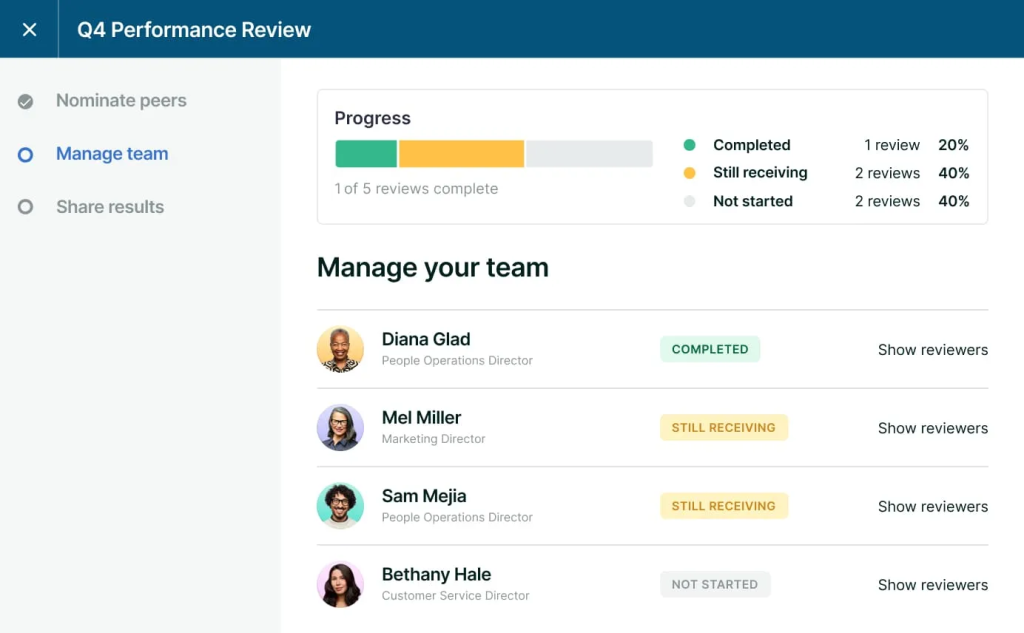
Reviews can include manager, peer, upward, and self-assessments built from custom question templates. In-product calibration helps HR keep ratings consistent across managers, and goals and OKRs feed straight into review cycles. AI features help managers draft feedback and summarize review responses, which saves time during busy cycles.
The platform is modular. Most teams start with the Talent Management bundle and later add engagement, career growth, or compensation modules as they scale. That flexibility is useful, but it also means the total cost can climb quickly once several modules are in play.
Pros
- Broad, well-integrated suite covering reviews, goals, engagement, and compensation
- Built-in calibration for fairer, more consistent ratings
- Strong analytics for spotting performance trends across departments
- Polished interface that employees generally find easy to use
Cons
- Costs add up as you add modules
- Admins face a learning curve when configuring the full suite
Pricing: Starts at $11/seat/month for Talent Management, billed annually.
Rating: G2 4.7/5
3. PerformYard
Best for: Flexible review cycles
PerformYard is built for HR teams that want full control over how reviews run. Instead of one rigid annual cycle, you can set up annual reviews, quarterly check-ins, project reviews, and probation reviews side by side, each with its own form, reviewers, and timeline.
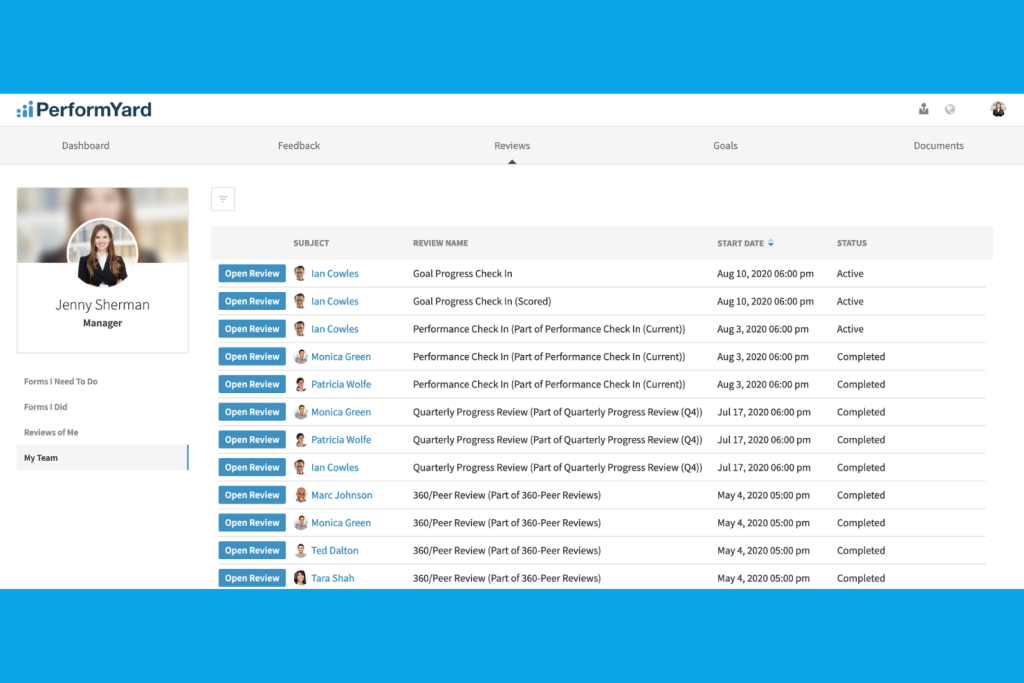
That makes it a strong fit for organizations with different processes across departments or locations. One team can run monthly check-ins while another sticks to semi-annual reviews, all inside the same system. 360 feedback, goal tracking, and ongoing check-ins are included, and reporting shows completion rates and rating trends.
PerformYard keeps the employee side simple even when the admin setup is complex. Employees see only the forms and tasks that apply to them, which helps with adoption. Its customer support team is frequently praised for hands-on help during setup.
Pros
- Highly configurable review cycles, forms, and reviewer rules
- Supports different processes for different teams in one platform
- Clean, simple experience for employees and managers
- Responsive, hands-on customer support
Cons
- Fewer engagement and learning features than all-in-one suites
- Limited third-party integrations compared with larger platforms
Pricing: Starts at about $5 to $10/employee/month, depending on plan.
Rating: G2 4.7/5
4. Leapsome
Best for: Modular people enablement
Leapsome is a people enablement platform that covers performance reviews, goals and OKRs, engagement surveys, learning, and compensation. Its standout feature is the modular model: you buy only the modules you need and add more as your people programs mature.
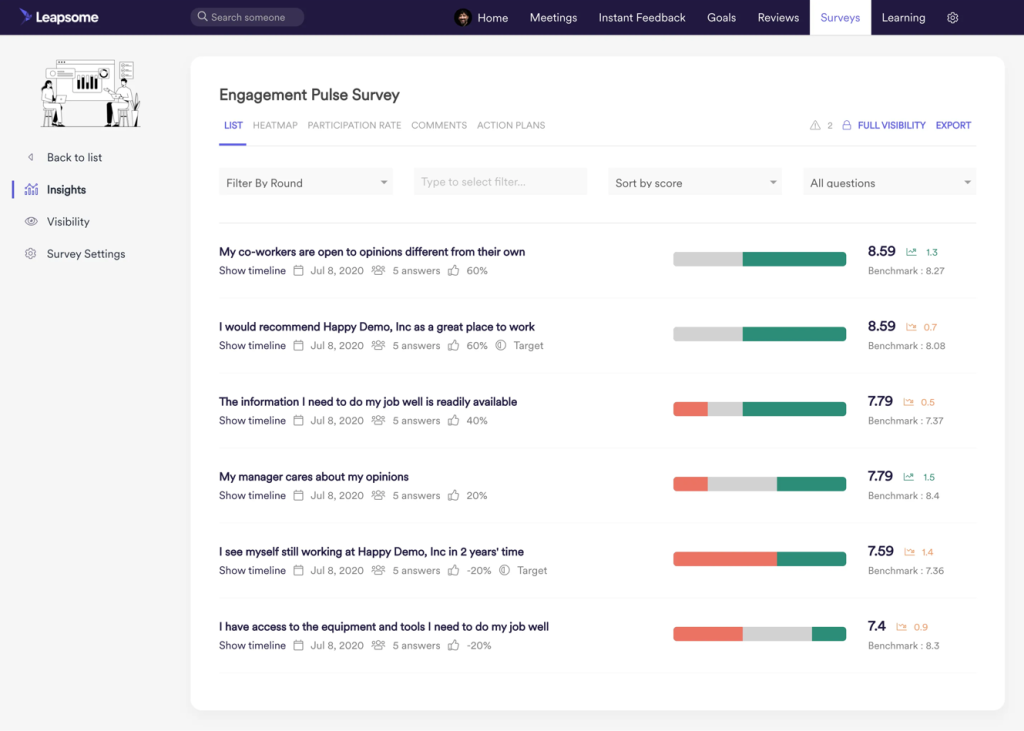
The reviews module includes best-practice question templates, review automations, and flexible visibility settings. Drag-and-drop calibration helps HR align ratings across teams, and cross-cycle analytics show how individuals and departments progress over time. Goals and OKRs connect directly to reviews, so employees see how their objectives shape their evaluation.
Leapsome suits companies that want to fix reviews today and grow into a broader people platform later without migrating tools. The trade-off is pricing transparency. There are no public prices, and combining several modules can make it as expensive as larger enterprise suites.
Pros
- Pay only for the modules you actually use
- Strong calibration and cross-cycle analytics
- Goals, reviews, and engagement data connect in one platform
- Modern, intuitive interface
Cons
- No public pricing, so a sales quote is required
- Total cost rises quickly with multiple modules
Pricing: Custom pricing based on modules and employee count.
Rating: G2 4.8/5
5. 15Five
Best for: Continuous check-ins and manager effectiveness
15Five is built around the idea that great reviews start with great weekly conversations. Employees complete short weekly check-ins covering progress, priorities, and blockers, and managers run structured 1:1s with shared agendas. By the time a review cycle opens, managers already have months of documented context to draw on.
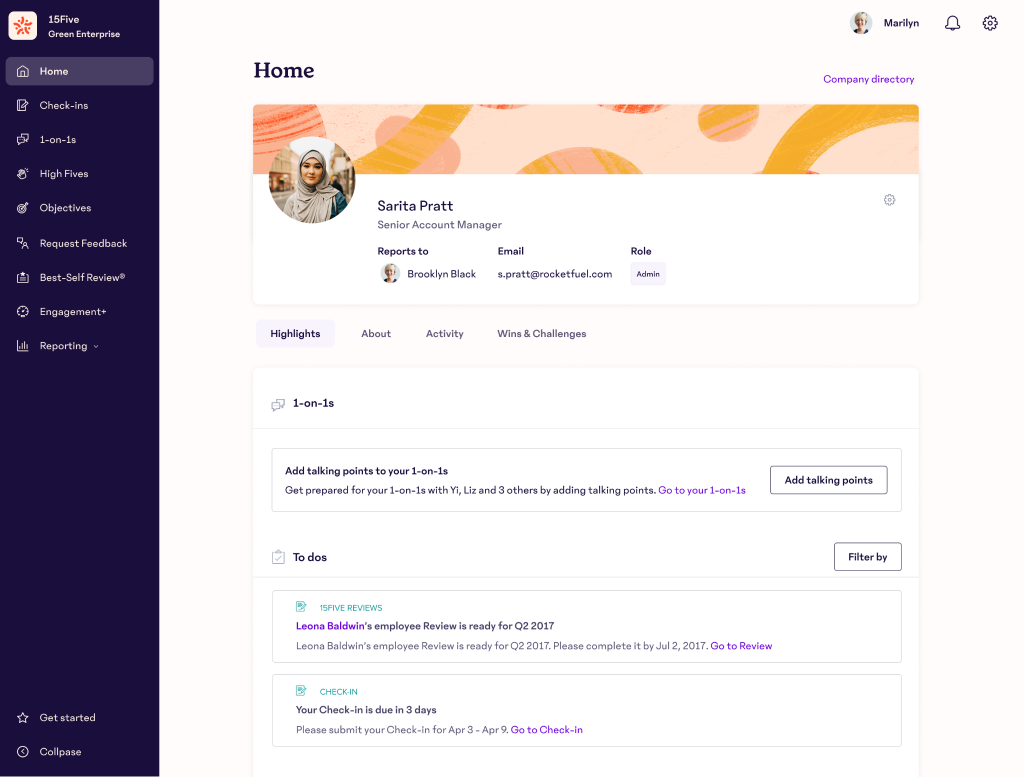
The Perform plan adds formal review cycles, 360 feedback, and OKR tracking, so check-ins, goals, and evaluations all connect. Recognition features such as high-fives help reinforce positive behavior between reviews, and AI-assisted tools help managers draft feedback and spot trends.
15Five also puts heavy emphasis on manager development. The Total Platform plan includes manager training content designed to help new and experienced managers coach their teams better. Pricing is published and per user with no minimum seats, which makes budgeting easier for growing companies.
Pros
- Weekly check-ins and 1:1s build a strong continuous feedback habit
- Review cycles, 360 feedback, and OKRs connected in one place
- Strong manager coaching and training resources
- Transparent, published per-user pricing
Cons
- No permanent free plan
- Full review features require the Perform plan or higher
Pricing: Perform plan at $11/user/month, billed annually. Engage starts at $4/user/month.
Rating: G2 4.6/5
6. Culture Amp
Best for: People analytics and engagement-led performance
Culture Amp began as an employee engagement survey platform and has grown into a full performance management suite. Its biggest strength is analytics: it connects engagement, performance, and retention data so HR can understand why performance looks the way it does, not just record ratings.
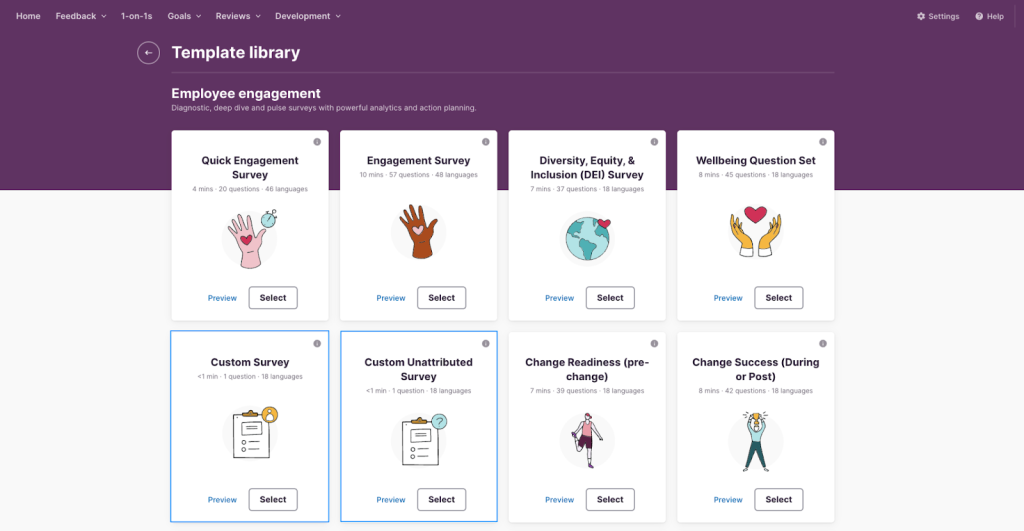
On the performance side, Culture Amp supports review cycles, 360 feedback, calibration, goals, and 1:1 conversations. AI features summarize written feedback and analyze comments, helping managers process large volumes of input quickly. Its library of research-backed survey templates covers engagement, onboarding, and exit surveys, with industry benchmarks for comparison.
This depth makes Culture Amp especially valuable for mid-market and enterprise HR teams that run regular surveys and want to link them to performance outcomes. Smaller teams may find it more than they need, and pricing is only available through a custom quote.
Pros
- Best-in-class people analytics linking engagement and performance
- Large library of research-based survey templates with benchmarks
- Calibration, 360 feedback, and goals in one suite
- AI summaries that speed up feedback analysis
Cons
- No public pricing
- Can be more than small teams need
Pricing: Custom quote based on modules and headcount.
Rating: G2 4.5/5
7. Betterworks
Best for: OKR-driven enterprises
Betterworks is designed for large organizations that want to replace traditional annual reviews with continuous, goal-driven performance management. Its core idea is that every review, check-in, and conversation should connect back to company objectives.
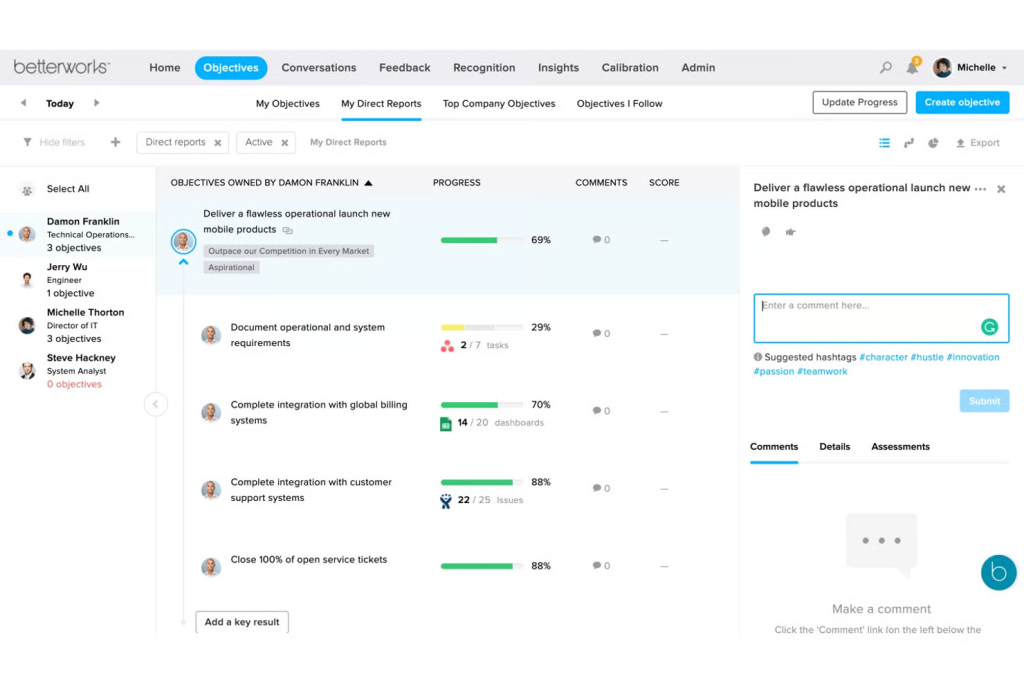
The platform’s goal-setting engine is one of the most robust on this list. Enterprises can cascade OKRs from leadership down to individual contributors, track progress in real time, and show how each person’s work contributes to company priorities. Continuous check-ins and conversations keep feedback flowing between cycles, while review cycles with calibration support fair, consistent evaluations.
Betterworks also offers enterprise-grade security, integrations with major HRIS platforms, and AI assistance for writing feedback and summaries. That depth comes with complexity, so it is best suited to organizations with dedicated HR operations teams rather than small businesses.
Pros
- Excellent goal and OKR alignment across large, complex organizations
- Continuous check-ins and conversations built into the workflow
- Enterprise-grade security and HRIS integrations
- AI support for writing feedback and summaries
Cons
- Too heavy and complex for small teams
- Pricing is only available through sales
Pricing: Custom quote.
Rating: G2 4.4/5
8. Effy AI
Best for: AI-powered reviews for small teams
Effy AI is employee review software designed for small and mid-sized businesses that want professional performance reviews without a heavy setup or a big budget. Its pitch is speed: AI helps generate review forms and summarizes responses, so managers spend minutes instead of hours on each review cycle.
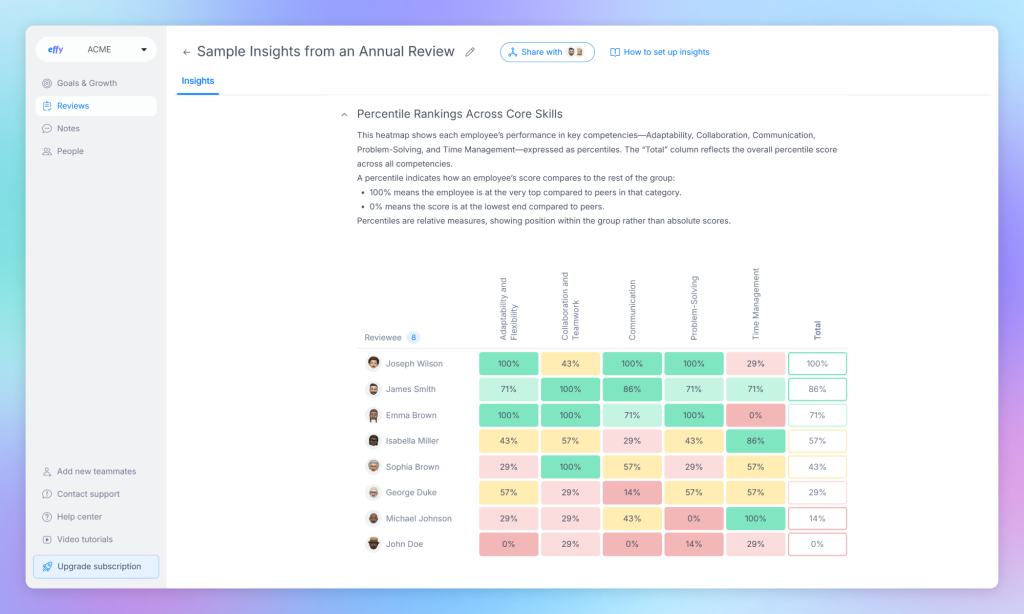
The platform supports 360 feedback with anonymous responses, which encourages more honest input from peers and direct reports. Cascading goals and progress tracking connect reviews to objectives, and visual tools such as 9-box grids and heatmaps help leaders spot high performers and development needs. A Slack integration makes it easy to invite reviewers and send reminders.
Effy AI’s pricing is one of its biggest draws. Teams of up to 5 users can use it free with no time limit, and paid plans stay affordable as you grow. The main limitation is depth: larger organizations may outgrow its analytics and customization.
Pros
- Free plan for up to 5 users, with low per-seat pricing after that
- AI-generated review forms and response summaries save time
- Anonymous 360 feedback encourages honest input
- 9-box grids and heatmaps for quick talent analysis
Cons
- AI summaries need a manager’s review for accuracy
- No dedicated mobile app
Pricing: Free for up to 5 users. Paid plans start at $3/seat/month, billed annually.
Rating: G2 4.8/5
9. Keka
Best for: HR, payroll, and performance reviews for Indian businesses
Keka is a people platform widely used by growing Indian companies, especially in IT and services. It brings payroll, attendance, leave, expenses, and performance reviews into one HRMS, with Indian statutory compliance such as PF, ESI, and TDS built into payroll.
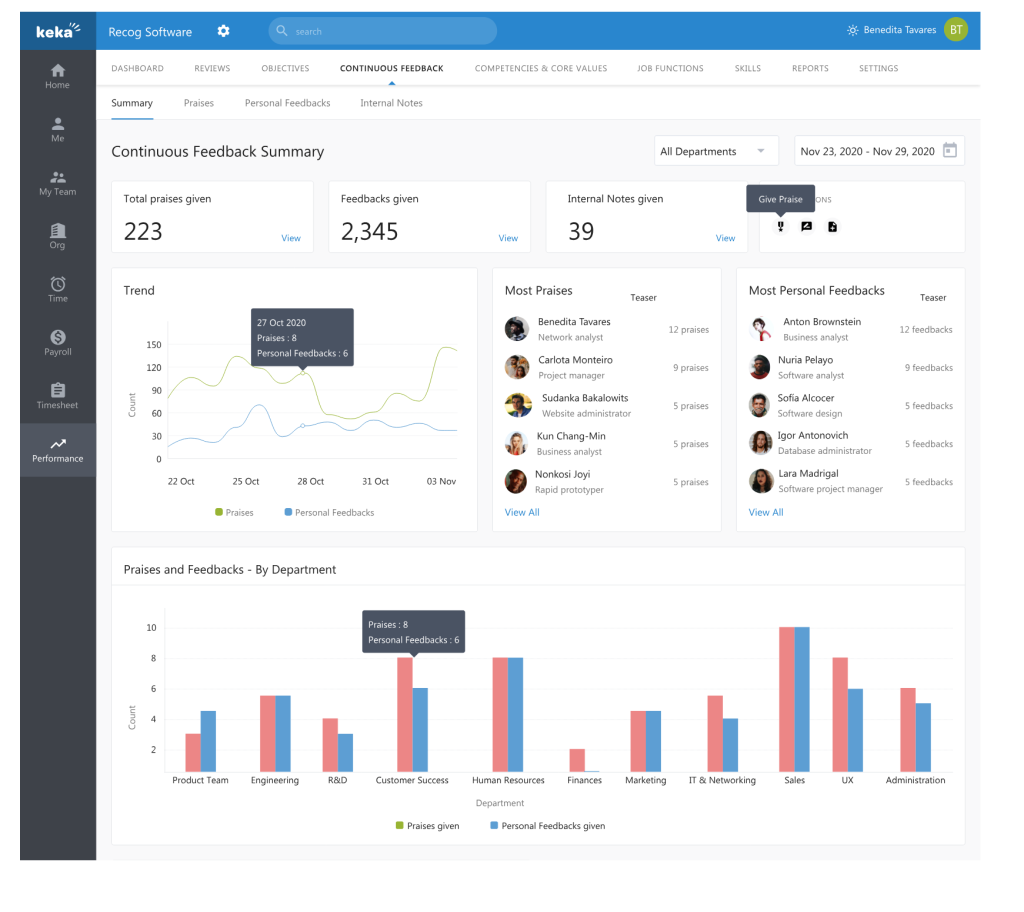
On the performance side, Keka supports review cycles with multi-rater feedback, goals and OKRs, and continuous feedback. Because reviews sit in the same system as employee records and payroll, HR can connect performance outcomes to increments and promotions without exporting data between tools. Employee self-service and a mobile app make it easy for staff to complete reviews and check their goals on the go.
Keka’s pricing is structured as flat bundles for the first 100 employees, with per-employee charges above that. Performance management sits in higher plans or is available as an add-on, so check which features are included before you buy.
Pros
- Payroll, core HR, and performance reviews in one platform
- Strong fit for Indian payroll and compliance requirements
- Clean, easy-to-use interface and mobile app
- Responsive customer support
Cons
- Performance features sit in higher plans or cost extra
- Better suited to India-based teams than global ones
Pricing: HR and payroll plans start at about $96/month for up to 100 employees. Performance management costs extra on lower plans.
Rating: G2 4.5/5
10. BambooHR
Best for: Performance reviews inside an all-in-one HRIS
BambooHR is one of the most popular HRIS platforms for small and mid-sized businesses. Its performance management module adds review cycles to a system that already handles employee records, payroll, time-off tracking, and onboarding, so HR can manage people data and reviews in one place.
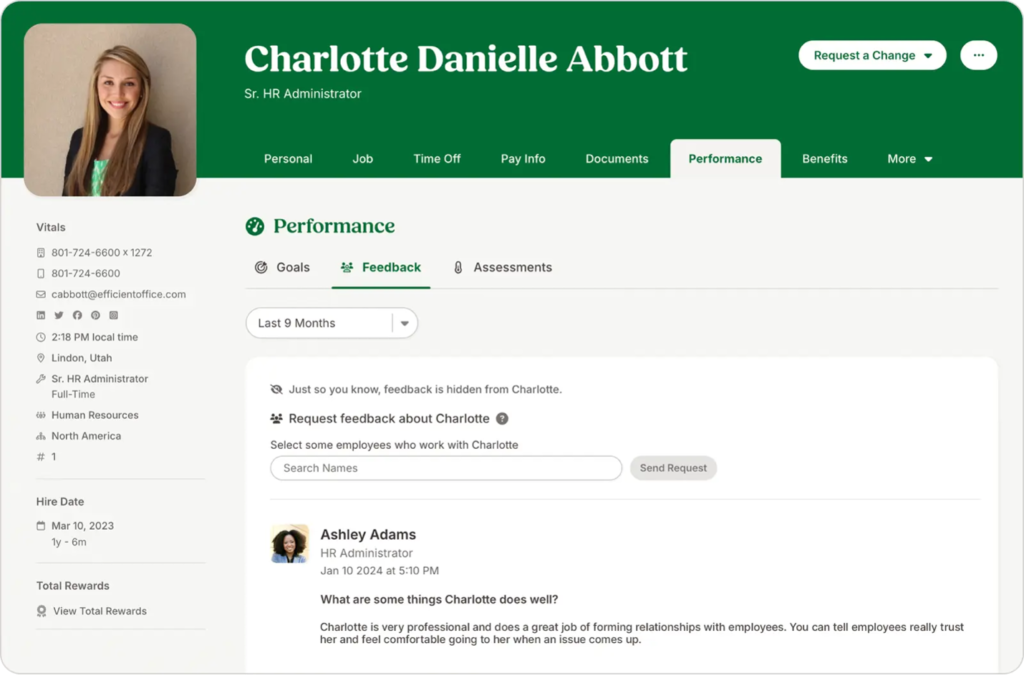
Reviews are straightforward. Employees complete self-assessments, managers add their evaluations, and automated reminders keep the cycle on schedule without constant HR follow-up. Basic goal tracking lets employees and managers set and update objectives between reviews, and it stores everything alongside each employee’s record.
BambooHR is not the deepest review tool on this list. Template customization is limited, and its 360 feedback and analytics are lighter than dedicated platforms. But for teams that want simple reviews inside the HRIS they already use, it is a practical, low-friction choice. See our list of the best HRIS software for more options.
Pros
- One system for HR data, payroll, and performance reviews
- Automated reminders keep review cycles on schedule
- Simple, user-friendly interface
- Large marketplace of integrations
Cons
- Limited customization of review templates
- Lighter 360 feedback and analytics than dedicated tools
Pricing: Custom quote. Performance management is included in higher-tier plans.
Rating: G2 4.4/5
How We Evaluated Performance Review Software
Every tool in this list was assessed through an unbiased, systematic approach designed to give you a fair and well-rounded view. Instead of relying on feature lists or marketing claims, we focused on the factors that decide whether performance review software actually works once managers and employees start using it. Here are the six criteria we used.
1. User Reviews and Ratings
We studied verified user reviews and ratings on trusted platforms such as G2 and Capterra. Real user feedback reveals what product demos often hide, including usability problems, support quality, and implementation challenges. Looking at patterns across many reviews, rather than a few standout comments, gave us a ground-level view of overall satisfaction and recurring issues.
2. Essential Features and Functionality
A performance review platform is only as useful as its core features. We examined how well each tool handles customizable review templates, 360-degree feedback, goal and OKR tracking, continuous check-ins, calibration, automated workflows, and reporting. We also looked at AI capabilities, such as drafting feedback and summarizing responses, and whether they support managers without replacing human judgment.
3. Ease of Use
Even the most powerful tool fails if managers avoid it. We assessed each platform’s design, interface, and navigation, focusing on how quickly a manager can complete a review and how easily employees can submit feedback without training. Mobile access and Slack or Microsoft Teams integrations also counted here, since they bring reviews into the tools people already use every day.
4. Customer Support
Good support makes a big difference during setup and through every review cycle. We evaluated the availability and quality of support across different phases: onboarding and configuration, day-to-day questions, and resolving technical issues. Help documentation, training resources, and response times all factored into this score.
5. Value for Money
A low price does not always mean good value. We compared each tool’s cost against its features, performance, and scalability to judge whether buyers get their money’s worth. We also checked for hidden costs, such as paid add-on modules, minimum seat counts, and implementation fees, that can raise the true cost well above the starting price.
6. Personal Experience and Expert Opinions
Finally, we combined hands-on experience with HR and performance management platforms with insights from HR leaders, people operations practitioners, and industry experts. These perspectives helped highlight what truly matters when choosing employee review software, beyond what any single review site or feature list can show.
My Top 3 Performance Review Software
Not every team needs the same tool, but some platforms consistently rise above the rest. These three stood out for getting the fundamentals right: reviews that are easy to run, feedback that actually gets used, and pricing that makes sense.
1. PeopleGoal
PeopleGoal leads the list because it fits your process instead of forcing a new one. Custom review cycles, 360 feedback, OKRs, and development plans all live in one place, and Slack and Teams integrations help adoption. At $4/user/month, it offers a full performance management suite at a price that growing teams can justify.
2. Lattice
Lattice is the go-to choice for large organizations. It connects reviews, goals, engagement, and compensation, and its built-in calibration keeps ratings fair across teams. It gets pricier as you add modules, but enterprises get real depth for the cost.
3. Effy AI
Effy AI is the easiest way for small teams to start. AI drafts review forms and summarizes responses, and anonymous 360 feedback encourages honest input. With a free plan for up to 5 users, it is a low-risk first step away from spreadsheets.
How to Choose the Right Performance Review Software
Start with your team size and your biggest review problem, then shortlist two or three tools and run a pilot.
For Small Businesses (under 50 employees)
Prioritize fast setup, ready-made templates, and low cost. A free plan or low per-seat price matters more than advanced analytics. PeopleGoal and Effy AI are strong fits.
For Mid-Market Companies (50 to 1,000 employees)
Look for customizable workflows, 360 feedback, goal tracking, and HRIS integrations. You will likely outgrow simple tools quickly. PeopleGoal, PerformYard, 15Five, and Leapsome fit well here.
For Enterprises (1,000+ employees)
Focus on calibration, compensation links, advanced analytics, security, and global support. Lattice, Culture Amp, and Betterworks are built for this scale.
For Frontline and Remote Teams
Choose tools with strong mobile apps, simple forms, and Slack or Teams integration so employees can complete reviews without a desktop.
Questions to Ask Before You Buy
- Can we configure the tool to match our current review process?
- Will managers actually use it? Can we pilot it with one team first?
- Does it integrate with our HRIS and collaboration tools?
- What will it cost at our headcount in two years, including add-on modules?
- How will we measure ROI, such as review completion rates, hours saved per cycle, and retention?
For more information, check out this detailed guide on how to choose performance review software
Common Performance Review Mistakes and How Software Fixes Them
Most performance review problems are process failures, not people failures. Here is how the right performance review system addresses each one.
| Mistake | Real-world impact | How software solves it |
| Recency bias | Reviews reflect the last few weeks, not the full period | Continuous check-ins and feedback logs create a year-round record |
| Manual admin work | HR spends weeks chasing forms and compiling feedback | Automated workflows, reminders, and reports |
| Inconsistent ratings | Scores vary widely across managers | Standard templates and calibration tools |
| Poor goal alignment | Reviews feel disconnected from real work | OKR-linked review forms |
| Single-rater bias | One manager’s view decides the outcome | 360 feedback and multi-rater input |
| Low completion rates | Reviews are rushed or never submitted | Deadline workflows and Slack or Teams nudges |
| No follow-through | Feedback is given, but nothing changes | Development plans triggered by review outcomes |
| Data silos | Review data cannot inform promotions or pay | Integrations with HRIS and compensation tools |
Software does not fix culture on its own, but it creates the conditions where fair, useful reviews become the default.
Make Performance Reviews Actually Work for Your Team
Performance reviews fail for predictable reasons: manual processes, disconnected tools, and once-a-year evaluations that miss how people actually work. The fix is a structured, continuous performance review system that managers will actually use.
When comparing the best performance review software, focus on adoption, flexibility, integrations, and how well each tool connects feedback to goals and growth.
If you want a single platform that checks all those boxes, PeopleGoal stands out. Its customizable workflows, 360-degree feedback, OKRs, and Slack and Teams integrations make it a practical choice for growing teams.
Frequently Asked Questions
What is the best performance review software?
PeopleGoal is the best overall performance review software for most growing teams, thanks to its customizable workflows, 360 feedback, and OKRs at $4/user/month. Lattice and Betterworks suit enterprises, and Effy AI suits very small teams on a budget.
What is the best performance review software for small businesses?
Small businesses should look for quick setup, ready-made templates, and low per-user pricing. PeopleGoal and Effy AI are strong choices, and Effy AI offers a free plan for up to 5 users.
Is there free employee review software?
Yes. Effy AI offers a free plan for up to 5 users. Most other tools, including PeopleGoal, offer free trials so you can test them before buying.
What is a performance review system?
A performance review system is the process and tools an organization uses to evaluate employee performance. It includes review cycles, forms, feedback sources, goals, and how results feed into decisions on pay, promotion, and development.
How much does HR performance review software cost?
Most tools cost between $3 and $16 per user per month, billed annually. Enterprise platforms often use custom quotes based on modules and headcount.
How is performance review software different from an HRIS?
Performance review software focuses on feedback, evaluations, and goals. An HRIS manages employee records, payroll, and compliance. Some HRIS tools include basic reviews, but dedicated platforms offer deeper customization and analytics.
What is the difference between 360-degree feedback and peer review?
Peer review is one part of 360-degree feedback. A 360 review also includes input from managers, direct reports, and a self-assessment, giving a more complete view of performance.
How often should we run performance reviews?
Most organizations now combine quarterly or semi-annual reviews with continuous feedback and regular check-ins. Annual-only reviews tend to suffer from recency bias.
Can performance review software help with promotion and compensation decisions?
Yes. When reviews are tied to goals and ongoing feedback, they create consistent data that supports fairer promotion and pay decisions. Many tools also let you run compensation discussions separately from development reviews.
How do I get manager buy-in for new performance review software?
Show managers the time they will save on follow-ups and form-filling, then pilot the tool with one team. Once managers see less admin work, adoption usually follows.
How do I measure if performance review software is working?
Track review completion rates, time to submit, employee satisfaction with the process, and longer-term outcomes like goal achievement and retention.
What are the benefits of performance review software?
Performance review software cuts admin work by automating forms, reminders, and reports. It makes reviews fairer by keeping a year-round record of feedback, which reduces recency bias. It also links reviews to goals, gives HR consistent data for promotion and pay decisions, and supports engagement through regular, specific feedback.
What features should HR performance review software include?
Look for customizable review templates, 360-degree feedback, goal and OKR tracking, continuous check-ins, automated reminders, calibration tools, analytics, AI help with writing feedback, HRIS, and Slack or Teams integrations, development planning, and mobile access. See how these work together inPeopleGoal's performance review software.
How much does performance review software cost?
Most performance review software costs between $3 and $16 per user per month, billed annually. Some tools offer a free plan for very small teams, many publish a fixed per-user price, and enterprise platforms usually quote based on modules and headcount. Watch for hidden costs such as add-on modules, minimum seat counts, implementation fees, and price increases at renewal.
How long does it take to implement performance review software?
Simple tools can go live in a few days, while platforms with custom workflows and integrations usually take 2 to 6 weeks. The smoothest rollouts start with a pilot team, adapt a pre-built template, connect the HRIS and Slack or Teams, and then track completion rates and feedback after the first cycle.
Ready to 3x Your Teams' Performance?
Use the best performance management software to align goals, track progress, and boost employee engagement.