
I get asked this question almost every week by HR leaders building out their people strategy: is employee experience just a fancier way of saying employee engagement? Short answer, no.
They’re related, but mixing them up is exactly why so many engagement scores stay flat no matter how many surveys a company runs.
In this guide, I’ll break down employee experience vs employee engagement in plain language, show you which one is the cause and which one is the effect, and give you a practical framework for measuring and improving both together.
If you’re researching HR tools right now, understanding this distinction will save you from buying the wrong one.
What Is Employee Experience?
Here’s why it matters for your strategy:
- Acts as the biggest lever you have, since it shapes almost every engagement outcome you’ll ever measure
- Surfaces problems early, like a clunky tool or a confusing onboarding flow, before they show up as low engagement scores
- Gives you a full journey view instead of a once-a-year snapshot
- Explains the “why” behind whatever your engagement survey results are telling you
What Is Employee Engagement?
Here’s why it matters for your strategy:
- Works as your early warning system for turnover risk
- Is the number leadership actually look at when deciding where to invest
- Tells you how people feel, even when it doesn’t tell you why they feel that way
- Serves as the KPI, while employee experience is the strategy that moves it
Employee Experience vs. Employee Engagement
I like to settle the employee engagement vs experience debate with one table. Once you see it side by side, the confusion usually disappears.
| Dimension | Employee Experience | Employee Engagement |
| What it is | The entire journey an employee has with your company, from the job posting to the exit interview | The emotional commitment, motivation, and discretionary effort an employee brings to their work |
| Time frame | Continuous and ongoing, spanning the full employee lifecycle | A snapshot, captured at a point in time and tracked over cycles |
| Role in the relationship | The input, the cause, the environment that shapes how people feel | The output, the effect, the emotional result of that environment |
| Primary metrics | Time-to-productivity, onboarding completion rate, tool adoption rate, and exit interview themes | eNPS, Happiness Index, pulse survey scores, quarterly engagement trends |
| Measurement frequency | Tracked continuously across lifecycle stages: onboarding, promotion, transfer, exit | Measured on a recurring cadence, typically weekly or monthly pulses plus a deeper quarterly survey |
| Data collection method | Journey mapping, lifecycle surveys, exit interviews, system and tool usage data | Pulse surveys, quarterly surveys, Likert-scale questions, eNPS scoring |
| Who owns it | HR, every people manager, and the tools and processes the company provides | HR and individual managers, since day-to-day engagement is shaped at the team level |
| Key levers to improve it | Onboarding design, manager quality, goal clarity, tool usability, career growth paths | Recognition, alignment to purpose, well-being support, manager check-ins |
| What weakens it | Friction: broken tools, unclear onboarding, inconsistent processes, weak culture | Disconnection: lack of recognition, unclear goals, feeling unheard, burnout |
| Business impact when strong | Lower time-to-productivity, fewer early exits, stronger employer brand | Lower turnover, higher productivity, higher discretionary effort |
How to Actually Measure and Fix Employee Experience and Engagement
Knowing the difference between experience and engagement is step one. Step two is having a system that lets you measure both and act on what you find, instead of just naming the problem. Here’s how I’d do it, using PeopleGoal to run each step, kept separate since the two need different tools.
Employee Engagement: How to Measure and Boost It
- Automate the surveys: Stop relying on one annual survey to represent an entire year of employee sentiment. PeopleGoal’s Pulse Surveys run weekly or monthly, so you’re checking in on well-being and morale in real time, not months after the fact.
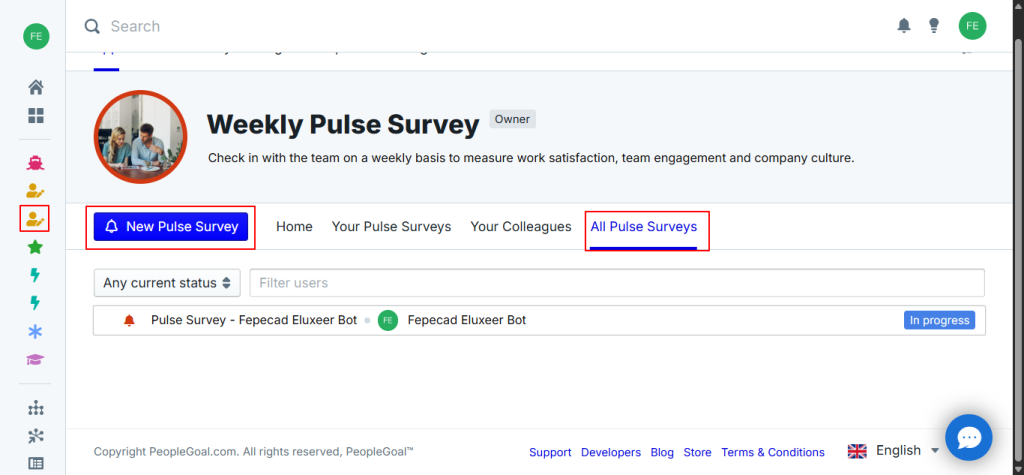
- Track more than one number: Use eNPS to measure loyalty and the Happiness Index to measure well-being, instead of squeezing every signal into a single vague engagement score. Together, they give you a clearer read on what’s actually driving how people feel.
- Build surveys that sound like you: PeopleGoal lets you create your own surveys from scratch or from templates, using Likert scales and open questions, so each survey reflects your brand voice and actually captures what matters to your teams, including well-being and diversity and inclusion.
Employee Experience: How to Measure and Improve It
- Fix onboarding before anything else: Since employee experience starts on day one, use PeopleGoal’s automated onboarding process to remove manual admin tasks and give every new hire a consistent, prepared start instead of leaving it to whichever manager has time that week.
- Centralize the records: Keep employee data, asset tracking, and time-off requests in one HRIS location instead of scattered spreadsheets, so nothing about the day-to-day experience gets lost between systems.
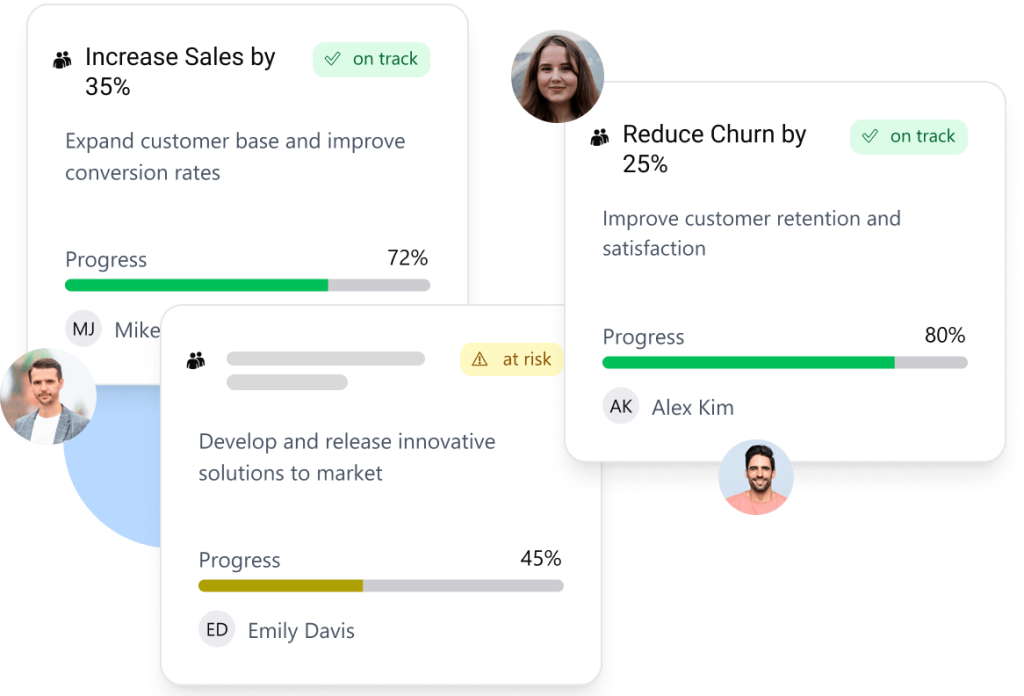
- Connect goals to daily work: Use OKRs and SMART goals inside PeopleGoal so employees can see exactly how their work ladders up to company objectives. Goal clarity is one of the clearest experience drivers of engagement, and it’s easy to lose without a system tracking it.
- Replace annual reviews with ongoing feedback: Swap the once-a-year review for regular one-on-one notes, mini-goal tracking, and 360-degree feedback from peers and managers, so people get support in the moment instead of six months later.
Bringing Both Together
Turn the data into action: PeopleGoal’s custom analytics combine survey results and performance data on one dashboard, so you can see exactly where morale is slipping and act before it turns into attrition, instead of exporting numbers from three different tools and guessing at the connection.
Bring Employee Experience and Engagement Together
If you’ve read this far, you already know that employee experience and employee engagement aren’t the same thing, and you know why treating them as one number is holding your strategy back.
The next step is making sure your goals, feedback, onboarding, and engagement data actually talk to each other instead of living in separate spreadsheets and separate tools.
That’s what PeopleGoal is built for. Get started free and see what it looks like to track employee experience and employee engagement in one connected system, or book a demo and I’ll walk you through it myself.
Frequently Asked Questions
Is employee experience just a rebrand of employee engagement?
No, though the two terms do get used interchangeably in casual conversation. Employee engagement has existed as a management concept since the 1990s, while employee experience describes the broader, ongoing journey that produces engagement as one of its outcomes. They're connected concepts, not the same concept with a new name.
Which one should I start measuring if I'm building a people strategy from scratch?
Start with employee engagement, since it gives you a fast baseline using a short pulse or quarterly survey. Then use employee experience data, like onboarding metrics and exit interview themes, to explain why that baseline looks the way it does.
How often should I run engagement surveys?
Pair frequent pulse surveys, weekly or monthly, with a deeper quarterly or annual engagement survey. Frequent pulses catch problems early. The deeper survey gives you trend data you can act on with more confidence.
Do small teams really need to track both, or is engagement enough?
Even small teams benefit from tracking both, since a handful of bad onboarding experiences or one disengaged manager can skew engagement numbers fast in a small headcount. You don't need enterprise-level tooling to start, just a consistent way to capture both.
Ready to 3x Your Teams' Performance?
Use the best performance management software to align goals, track progress, and boost employee engagement.