
The moment I start searching for types of performance appraisal methods, the confusion hits fast. There are too many options and no clear “best” answer.
And honestly, that’s because performance appraisals aren’t one-size-fits-all anymore.
What used to be a simple HR formality has become a strategic tool. Today, appraisal methods shape employee growth, leadership decisions, engagement, and even retention.
I’ve seen most frustration happen when organizations choose a method just because it’s popular, not because it aligns with their actual goal.
A rating scale might work for structured evaluations, but it falls short for development. 360 feedback can help leaders grow, but it isn’t ideal for pay decisions.
This guide isn’t about blindly adopting a trend.
It’s here to help you compare the most practical performance appraisal types and choose the method that fits your team, culture, and stage of growth, covering 10 different types of performance appraisal methods, how to choose the right method, common mistakes to avoid, running a fair process, strategic takeaways, and FAQs.
10 Types of Performance Appraisal
Performance appraisals aren’t one-size-fits-all. In my experience, some methods work best for structured annual reviews, while others are far more effective for ongoing feedback or leadership development.
Below, you’ll find the 10 most widely used types of performance appraisal systems, along with a quick comparison table to help you scan the options and shortlist what fits your organization best.
| Appraisal type | Best for | Frequency | Bias risk | Admin effort | Suitable for compensation (Yes/No) | Suitable for development (Yes/No) |
|---|---|---|---|---|---|---|
| Graphic Rating Scale | Large teams, entry-level roles, structured reviews | Annual / Biannual | High | Low | Yes | Limited |
| Management by Objectives (MBO) | Goal-driven teams, leadership roles, business targets | Quarterly / Annual | Medium | Medium | Yes | Yes |
| OKR-based Appraisals | High-growth teams, cross-functional execution | Quarterly | Medium | Medium | Sometimes | Yes |
| 360-Degree Feedback | Leadership development, collaboration-heavy roles | Annual / Biannual | Medium–High | High | No (usually) | Yes |
| Self-Appraisal | Development-focused cultures, reflective roles | Annual / Quarterly | Medium | Low | Limited | Yes |
| Peer Review | Team-based environments, shared accountability | Quarterly / Annual | High | Medium | No (usually) | Yes |
| Continuous Performance Appraisal | Fast-paced teams, ongoing coaching cultures | Ongoing (monthly check-ins) | Medium | High | Sometimes | Yes |
| BARS (Behaviorally Anchored Rating Scales) | Competency-based evaluation, structured roles | Annual / Biannual | Low–Medium | High | Yes | Yes |
| Narrative / Essay Appraisals | Senior roles, qualitative work, smaller teams | Annual | Medium–High | High | Limited | Yes |
| Project-Based Reviews | Agile teams, consulting, deliverable-driven roles | End of project / Quarterly | Medium | Medium | Sometimes | Yes |
1. Graphic Rating Scale
This is one of the most common and straightforward ways to run a performance appraisal. In most workplaces, it looks like a simple scoring sheet where managers rate employees on areas like teamwork, communication, reliability, or job knowledge, usually on a scale of 1 to 5. I often see organizations use it because it gives a quick snapshot of how someone is doing across key skills, which is why many companies still rely on it.
Best fit for: Large teams, entry-level roles, and companies starting with structured reviews.
Example: Think of a call center manager filling out a quick review form at the end of the year, rating employees from 1–5 on reliability, communication, and teamwork. It’s fast, consistent, and works well when you need to evaluate many people using the same criteria.
Pros:
- Easy to set up and explain
- Works well when you need consistency across teams
- Helps compare performance at a glance
Cons:
- Ratings can feel subjective or biased
- Doesn’t always explain the “why” behind a score
- Can miss deeper performance context
2. Management by Objectives (MBO)
Management by Objectives is a goal-focused appraisal method, and it’s especially useful when you want performance reviews to feel less like judgment and more like direction. Instead of rating someone on generic traits, managers and employees agree on clear objectives at the start of a cycle, like hitting a sales target, improving customer response time, or completing a key project.
I find this approach keeps the discussion grounded in real outcomes, so at review time, the conversation becomes much more concrete: Did we achieve what we set out to do?
Best fit for: Leadership teams, growing businesses, and departments driven by clear performance targets.
Example: A sales rep and their manager begin the quarter by agreeing on three clear goals, like closing 10 deals and improving follow-up speed. When the review comes around, the discussion is simple: what was achieved, what wasn’t, and why.
Pros:
- Keeps reviews tied to measurable outcomes
- Encourages alignment between employee and business goals
- Feels more structured and fair for managers
Cons:
- Works best only when goals are realistic and well-defined
- Can overlook soft skills or collaboration
- Not ideal for roles where success is hard to quantify
3. OKR-based Appraisals
OKR-based appraisals are best thought of as a performance review built around momentum, and I see them as especially useful for teams that want to stay focused on progress throughout the year. Instead of waiting until year-end to ask, “How did things go?”, teams regularly look at what was actually achieved against a few ambitious priorities.
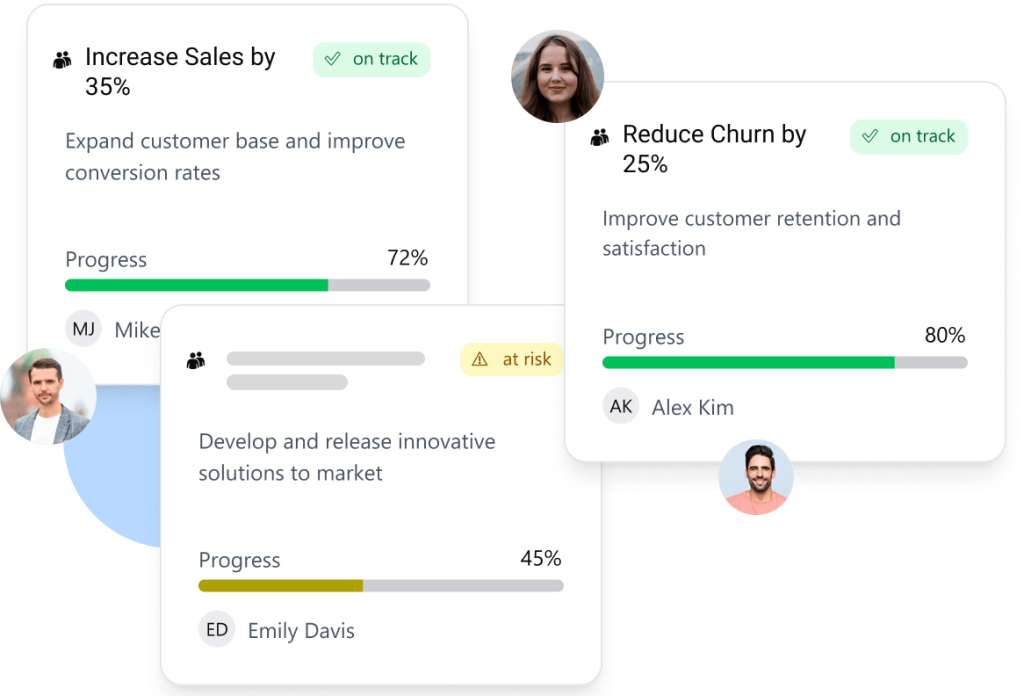
Employees are assessed based on how well they progress toward defined Objectives, supported by measurable Key Results. For CEOs, HR teams, and operations leaders, this approach makes performance discussions feel more closely aligned with business execution, not just individual effort.
Best fit for: High-growth teams, cross-functional work, and quarterly goal-driven cultures.
Example: In a fast-moving startup, teams may set an objective like “Improve onboarding experience,” with key results such as increasing activation rates by 20%. Quarterly appraisals then focus on contribution toward those outcomes.
Pros:
- Keeps everyone focused on high-impact priorities
- Makes progress visible across teams
- Supports more frequent, forward-looking reviews
Cons:
- Can become overly metric-driven if not balanced
- Needs strong goal clarity to work well
- Not ideal for roles with fewer measurable outcomes
4. 360-Degree Feedback
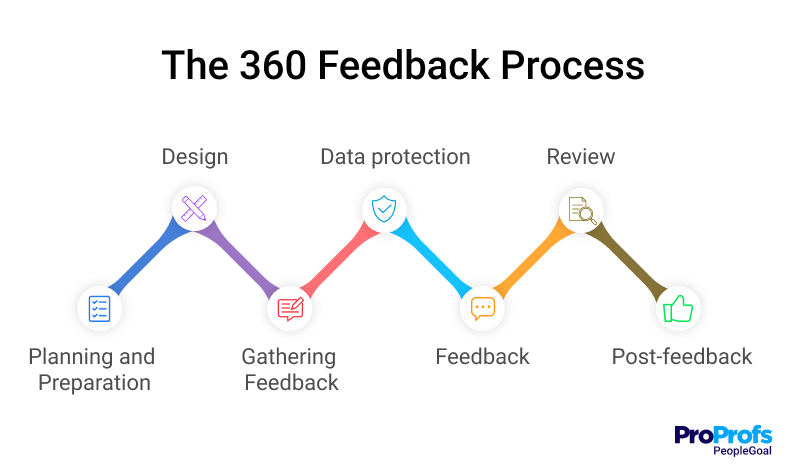
360-degree feedback is a powerful option when performance isn’t just about what someone delivers, but also how they work with others. What stands out to me about this method is the wider lens it creates. Instead of relying only on a manager’s view, employees receive input from peers, direct reports, cross-functional partners, and sometimes even clients.
For HR and talent development teams, this approach is especially useful for leadership growth, since it often surfaces blind spots that a traditional review might miss.
Best fit for: Leadership roles, mid-sized organizations, and companies focused on development over ratings.
Example: A department head may receive feedback not only from their VP, but also from team members and peers. That mix helps paint a fuller picture than a manager-only review. This can reveal patterns like strong execution but poor communication during stressful projects.
Pros:
- Offers a more well-rounded performance picture
- Helps identify leadership and collaboration gaps
- Encourages a stronger feedback culture
Cons:
- Can feel overwhelming without the right structure
- Anonymous feedback may sometimes lack context
- Requires trust and good communication to avoid politics
5. Self-Appraisal
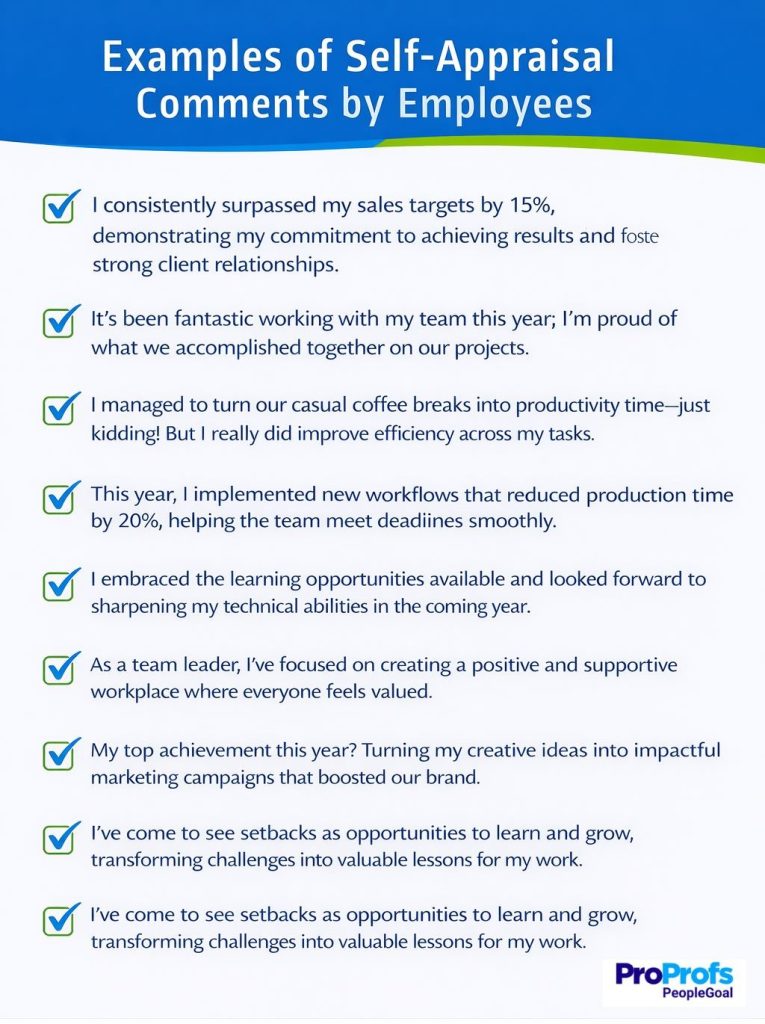
Self-appraisal brings employees into the review process as active participants, not just recipients of feedback. I’ve noticed it often shifts the tone of the conversation, because employees aren’t waiting to be evaluated; they’re actively reflecting on their own progress, challenges, wins, and areas where they want to improve.
This can make performance conversations more balanced and thoughtful, especially when employees come prepared with examples of their work.
Best fit for: Knowledge-based roles, development-focused cultures, and organizations encouraging open dialogue.
Example: A marketing specialist may write a self-review highlighting campaigns they led, skills they developed, and areas where they want more mentorship, helping the manager add context to the final evaluation.
Pros:
- Encourages ownership and self-awareness
- Helps employees share context that managers may miss
- Makes reviews feel more collaborative
Cons:
- Some employees may underrate or overrate themselves
- Can be uncomfortable without clear guidance
- Needs manager input to stay grounded
6. Peer Review
Peer review is often the missing layer in performance appraisals, especially in modern teams where managers don’t witness every collaboration firsthand. I’ve always felt this method brings out the most realistic day-to-day perspective, because coworkers notice the small things that never show up in a formal review, like who keeps projects moving, who communicates clearly, or who becomes difficult to rely on under pressure.
When peer feedback is handled thoughtfully, it adds a level of honesty and everyday context that a manager alone simply can’t capture.
Best fit for: Team-based organizations, shared ownership cultures, and fast-moving project environments.
Example: In a software team, engineers may review each other’s collaboration, code quality, and responsiveness during sprint cycles, giving managers a clearer view of day-to-day contribution.
Pros:
- Highlights teamwork and day-to-day contribution
- Gives a fuller view of performance in collaborative roles
- Helps identify strengths that managers may overlook
Cons:
- Can get biased if relationships aren’t healthy
- Requires psychological safety to work honestly
- Needs clear guidelines to stay constructive
7. Continuous Performance Appraisal
Continuous performance appraisal is less about a single formal review and more about keeping employee feedback alive throughout the year. I think it’s a strong way to make performance management feel ongoing rather than occasional. Instead of waiting for an annual cycle, managers check in regularly, track progress in smaller moments, and address issues before they grow.
This approach often feels more realistic to me because performance rarely changes overnight; it evolves week by week through coaching, goals, and ongoing conversations.
Best fit for: Fast-paced teams, growing organizations, and cultures focused on continuous improvement.
Example: A marketing manager doesn’t wait until the end of the year to bring up performance. Instead, she holds a 20-minute check-in every month to review what campaigns went well, where support is needed, and what the next goals should be. By the time annual reviews arrive, nothing feels surprising because feedback has been happening all along.
Pros:
- Prevents surprises at year-end reviews
- Supports real-time coaching and development
- Helps managers stay connected to employee progress
Cons:
- Requires consistency and time from managers
- Can feel like “always being evaluated” if handled poorly
- Needs a clear structure to avoid becoming informal and messy
8. Behaviorally Anchored Rating Scales (BARS)
BARS is a more detailed alternative to simple rating scales, and it solves one of the biggest problems I see in appraisals: vague scoring. Instead of rating someone as “good” or “average” at communication, BARS ties each score to real, observable behaviors.
Best fit for: Structured organizations, competency-based reviews, and roles with clear behavioral expectations.
Example: In a customer service role, instead of giving someone a vague “3 out of 5” for communication, BARS spells out what each score looks like. A top score might mean “handles upset customers calmly and resolves issues without escalation,” while a lower score might reflect “often needs help responding clearly under pressure.” This makes ratings much easier to understand and defend.
Pros:
- Makes ratings more specific and fair
- Reduces ambiguity in performance discussions
- Helps managers give clearer feedback
Cons:
- Takes time to build and maintain behavior examples
- Can feel too rigid for creative or evolving roles
- Requires training for consistent use
9. Narrative / Essay Appraisals
Narrative appraisals feel more like a performance conversation written down. I’ve always genuinely liked how they capture the full story behind someone’s work. Instead of checking boxes or assigning scores, managers describe an employee’s year in words, what they handled well, where they struggled, how they showed up in meetings, and what kind of growth they demonstrated.
I feel this style works especially well when performance is layered and not easily measurable, like leadership, strategy, or creative work. For HR teams, it can add richness, but it also depends heavily on the manager’s effort and clarity.
Best fit for: Smaller teams, senior roles, and development-focused review cultures.
Example: A company evaluating a senior product leader may not rely on scores at all. Instead, the manager writes a detailed review describing how the employee led a complex product launch, influenced cross-functional teams, handled tough trade-offs, and mentored junior managers. The appraisal reads more like a thoughtful performance story than a checklist.
Pros:
- Gives space for real examples and context
- Better suited for complex, non-metric roles
- Encourages thoughtful feedback instead of quick scoring
Cons:
- Difficult to standardize across departments
- Can be influenced by writing bias or vague language
- Not scalable for large organizations
10. Project-Based Reviews
Project-based reviews focus on what an employee delivered during a specific assignment, not just how they performed over an entire year. I like this method because it fits naturally in workplaces where work moves in cycles, like product launches, client engagements, consulting projects, or cross-functional initiatives.
Instead of asking, “How was their overall performance?”, I focus on what they contributed to that specific outcome. How they handled deadlines. How they collaborated. How well they executed. For operations and department leaders, it’s a practical way to evaluate real impact.
Best fit for: Agile teams, consulting firms, startups, and roles driven by deliverables.
Example: After a consulting team completes a three-month client implementation, the manager reviews each person’s contribution to that project. One employee may be recognized for strong execution and client communication, while another may receive feedback on missed deadlines or collaboration gaps. The review focuses entirely on performance during that specific engagement, not the full year.
Pros:
- Tied directly to actual work outcomes
- Useful for fast-moving, project-driven teams
- Helps capture performance in short cycles
Cons:
- Can miss long-term consistency or growth
- Success may depend on team factors, not just the individual
- Needs multiple reviews to form a full picture
How to Choose the Right Performance Appraisal Method
Choosing the right performance appraisal method doesn’t have to feel like a gamble. I always approach it as a decision process, not something you pick because it’s trending. The easiest way to avoid the “wrong system” fear is to slow down for a moment and get clear on what your organization actually needs.
Before you choose any method, it helps to step back and evaluate your workplace through a few practical lenses.
1. Team size: A method that works for 20 employees may break down at 200. Think about how scalable the process needs to be.
2. Business stage: Startups often need lightweight, fast feedback loops. Mature organizations may need more structure, consistency, and documentation.
3. Your primary goal: Be clear about what the appraisal is meant to support:
- Compensation decisions
- Employee development
- Promotion and succession readiness
- Feedback culture and engagement
4. Review frequency preference: Some organizations thrive on quarterly check-ins, while others still prefer annual cycles with mid-year touchpoints.
5. Manager capability and time: Even the best method won’t work if managers don’t have the time, training, or confidence to run it well.
Once you answer these questions, the right appraisal method usually becomes much more obvious.
Common Mistakes When Choosing a Performance Appraisal Method
Choosing a performance appraisal method sounds simple on paper, but in practice, it’s where many organizations quietly get stuck. I’ve seen even well-intentioned teams struggle when the wrong approach creates confusion, frustration, or even disengagement.
Here are a few common mistakes HR leaders and managers should watch out for, along with simple fixes.
1. Using One Method for Everything (Pay, Promotion, Feedback)
One mistake I see often is treating performance appraisals as a one-size-fits-all conversation. Teams end up using the same rating method for salary decisions, promotions, and development feedback, even though each of these requires a very different kind of discussion.
In my experience, this can leave employees unsure whether the review is meant to help them grow or judge them financially.
Fix: Separate conversations. Use structured methods for compensation decisions and development-focused methods for coaching and growth.
2. Forcing Rankings on High-Performing Teams
Stack ranking can seem like a quick way to identify top performers, but I’ve found it often creates unnecessary tension, especially in teams where most employees are already doing great work.
Instead of motivating people, forced rankings can lead to unhealthy competition and make strong contributors feel undervalued.
Fix: Avoid stack ranking unless performance gaps are truly clear. High-performing teams thrive more with feedback and development than forced competition.
3. Relying Only on Annual Reviews
When feedback happens only once a year, performance conversations start feeling disconnected from real work. I’ve noticed employees may not even remember what they did months ago, and managers struggle to give fair, specific input.
Annual-only reviews also turn feedback into a surprise rather than a support system.
Fix: Add lighter check-ins throughout the year so feedback feels timely, not like a once-a-year surprise.
4. Using Vague or Subjective Rating Criteria
Many appraisal methods fail because the criteria are unclear. In my work with teams, I’ve seen how terms like “meets expectations” or “shows initiative” can mean completely different things to different managers.
This is also where unconscious bias can quietly creep in.
Fix: Define what “good performance” actually looks like with examples, behaviors, or clear goals to reduce bias.
5. Ignoring the Manager’s Capability and Training
Even the most well-designed appraisal system depends on the person delivering it. From what I’ve observed, if managers aren’t trained to evaluate fairly or give constructive feedback, the process becomes inconsistent across teams.
Employees may walk away feeling confused, discouraged, or unsupported.
Fix: Even the best appraisal system fails without strong managers. Invest in simple training and review templates to keep evaluations consistent.
How to Run a Fair and Effective Appraisal Process
Running performance appraisals today doesn’t have to mean messy spreadsheets, long email chains, or last-minute review rushes. With modern performance management platforms, you can automate workflows, collect feedback smoothly, and keep the process consistent across teams, without adding extra admin load.
To make this more practical, let’s use PeopleGoal as an example of how online tools can simplify the entire appraisal cycle.
To make this even easier, I’ve put together a short video on how to conduct performance reviews the right way.
Step 1: Start With a Ready-to-Use Template
Instead of building everything from scratch, you can install a pre-built performance review template from the PeopleGoal App Store. It already includes default criteria, stages, and workflows, so you’re ready to launch quickly.
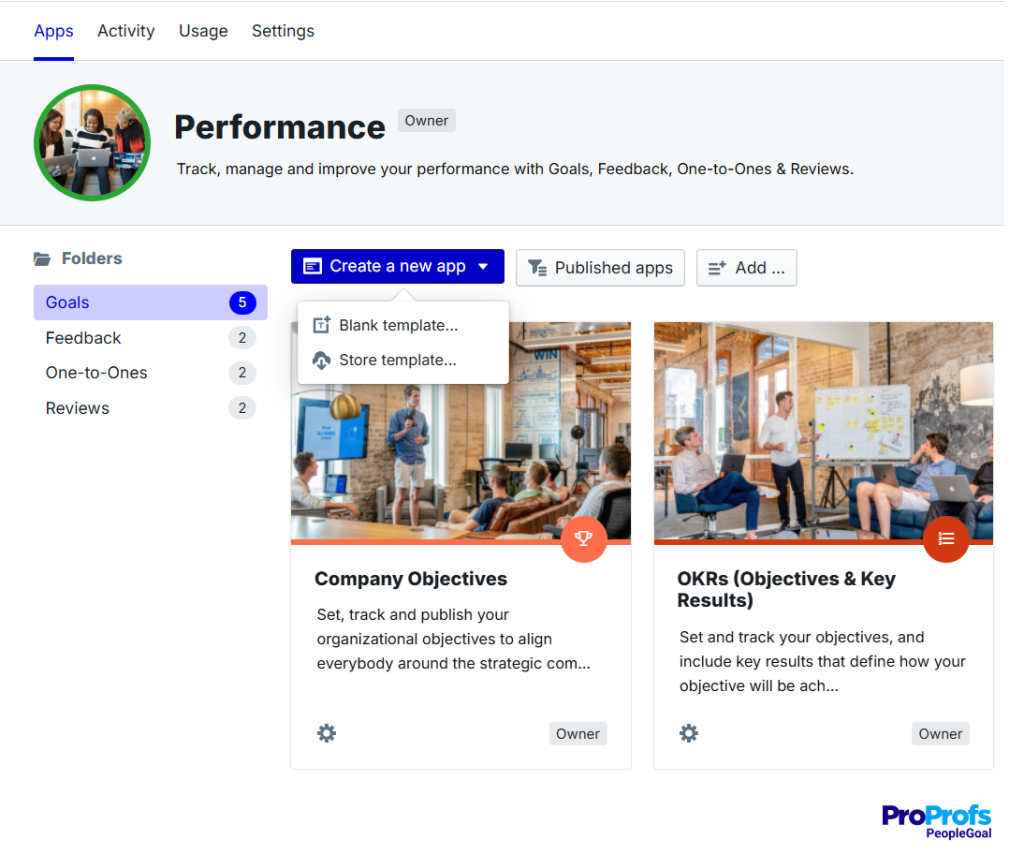
Step 2: Assign Roles and Set Visibility
Decide who’s involved in the process: employees, managers, and HR, and control who sees what at each stage. This keeps feedback structured, confidential, and clear.
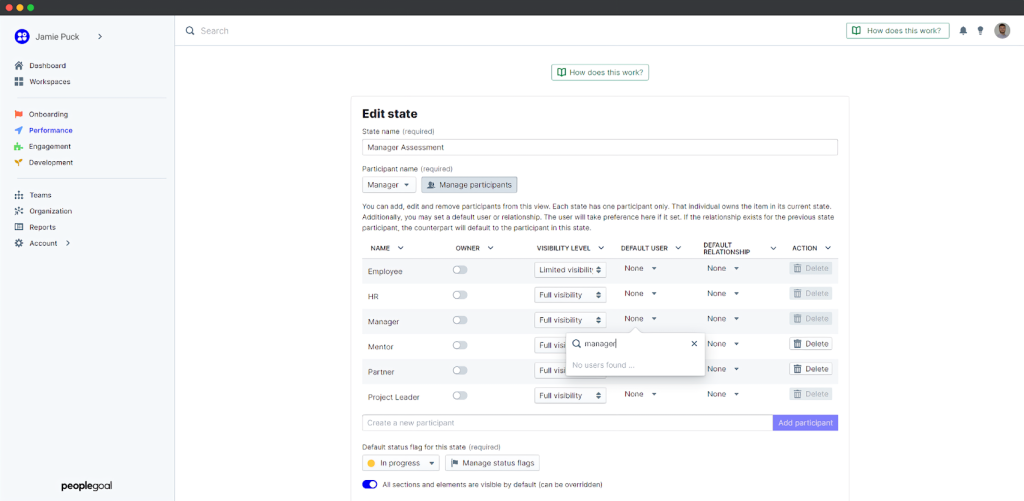
Step 3: Customize the Review Workflow
With drag-and-drop customizable workflows, you can create a smooth appraisal flow that matches your organization, like self-assessments first, then manager evaluations, followed by HR sign-off.
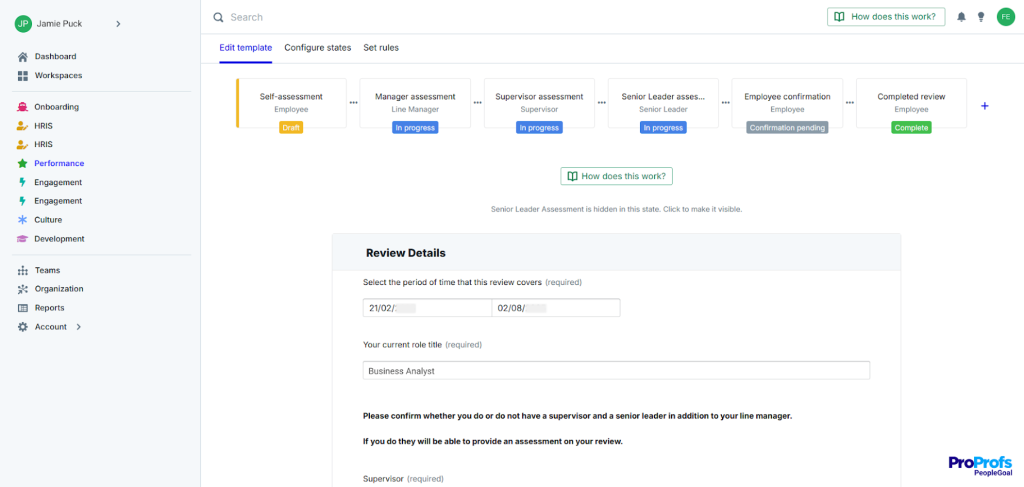
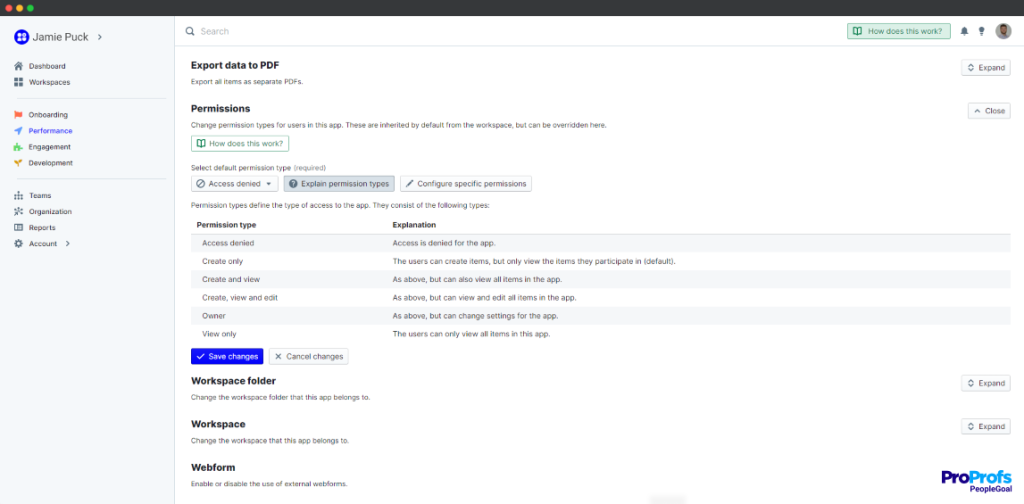
Step 4: Set Permissions and Launch at Scale
You can control who can create, view, or edit appraisals across departments. Reviews can be launched in bulk for entire teams or rolled out gradually depending on your needs.
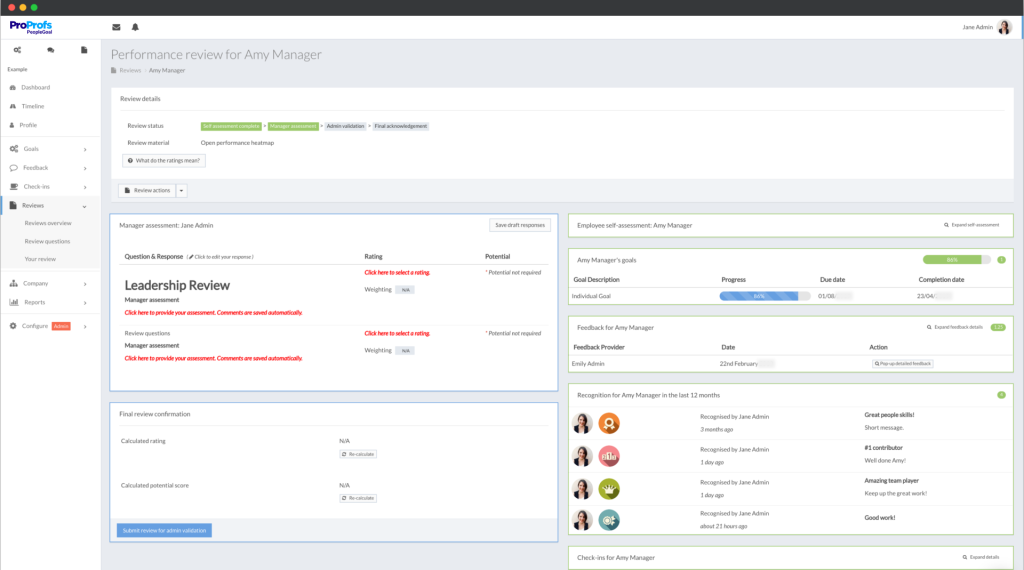
Step 5: Track Progress and Build Reports
Instead of chasing updates manually, PeopleGoal lets you monitor completion in real time and generate reports that highlight trends, performance outcomes, and development needs across the organization.
And that’s really it.
Online tools make performance appraisals easier to run, easier to manage, and far more consistent, especially as your teams grow.
If you’re evaluating platforms, it’s worth choosing one that helps you stay structured without making the process feel heavy.
Build a Stronger Performance Culture With the Right Review Method
Performance appraisals don’t have to feel complicated or stressful for HR teams or employees, and I always remind teams of one simple truth: there’s no single best type of performance appraisal that works for every organization.
What works well for a startup may not fit an enterprise, and I’ve seen how compensation-focused reviews often look very different from methods designed for development.
The right approach comes down to your goals, your culture, and how mature your performance process already is. In fact, I find most modern teams get the best results by combining methods, like goal-based reviews with continuous feedback or peer input.
At the end of the day, I don’t think strong appraisal systems are just about ratings. They’re about clarity, growth, and helping people improve over time.
If you want to run reviews more smoothly and consistently, tools like PeopleGoal can help you manage templates, workflows, and feedback in one place.
Ready to build a fairer appraisal process? I’d start with the method that fits your team best.
Frequently Asked Questions

How often should performance appraisals be done?
Most teams do best with quarterly or biannual reviews supported by regular monthly check-ins. Waiting a full year often feels too late.
Can organizations use multiple appraisal methods together?
Yes, and many do. Combining methods, like goal tracking plus peer feedback, usually creates a fairer and more complete review process.
Is 360-degree feedback better than annual reviews?
Not always. 360 feedback is great for development and leadership growth, while annual reviews are better for formal decisions like pay or promotions.
Ready to 3x Your Teams' Performance?
Use the best performance management software to align goals, track progress, and boost employee engagement.