
Most performance review cycles fail long before the actual review conversation happens.
You usually see it in December: a manager opens an annual review form for eight employees, tries to remember what happened across the year, finds a few recent examples, and realizes there is almost nothing documented from March through October.
This is not a failure of effort. This is a failure of design. And it is how most performance review cycles actually run.
According to the State of the Global Workplace Report in 2024, only 14% of employees strongly agree their reviews inspire them to improve. When you see how most cycles are built, that number stops being surprising.
A performance review cycle is supposed to connect your people to goals that matter, give managers the data to evaluate fairly, and create a year-round development engine. Most organizations have none of that. What they have is a calendar reminder and a PDF.
Here is how to build the real thing.
Who this is for:
- HR managers replacing spreadsheets and PDF review forms
- People Ops leads building their first structured performance management cycle
- Team leads and department managers doing reviews manually every year
- Founders scaling from informal to formal performance processes
- L&D professionals trying to connect development plans to actual review data
What Is a Performance Review Cycle?
Here is the distinction that matters most: a review event captures a snapshot. A review cycle captures a pattern. And patterns are what actually tell you whether someone is growing, stalling, or quietly heading for the door.
Why the structure of the cycle determines outcomes before any review conversation even begins:
- Recency bias: Without defined checkpoints during the period, managers rate employees on what happened last month rather than the full year. The cycle design is the fix, not the review form.
- Accountability gaps: When goals are never revisited between January and December, reviews become opinion-based. A cycle creates the checkpoints that turn agreement into accountability.
- Retention signal: Employees would stay longer at a company that invested in their development. A cycle that visibly connects reviews to development is how that investment shows up in practice.
- Fairness: Structured cycles with documented criteria reduce subjective grading and lower legal exposure from inconsistent standards across managers.
What Are the Stages of a Performance Management Cycle?
Understanding the stages is the easy part. Knowing where most cycles quietly fall apart between them is where this gets useful.
Stage 1: Goal Setting and Alignment
I have seen most performance management cycles fail silently. Goals get set in January, and nobody looks at them again until November.
The issue is never that employees do not care. It is that the goals were set without a clear connection to the team or company strategy. So they feel academic instead of meaningful. People complete them because they have to, not because they can see why it matters.
Good goal setting at this stage comes down to three things:
- Co-create, do not hand down: People commit to targets they helped shape. Employees who had no input in setting their goals treat them as a compliance exercise.
- Connect every goal upward: Each individual goal should map visibly to a team or company objective. When employees cannot trace the connection, goal completion rates drop and engagement goes with them.
- Make progress measurable at the halfway point: If you cannot assess where someone stands at the midpoint of the cycle, the goal is too vague to be useful.
Before finalizing any goal, I run it through one question: “If this person achieves exactly this, will it matter to the business in six months?” If the answer is unclear, I rewrite the goal before the conversation ends.
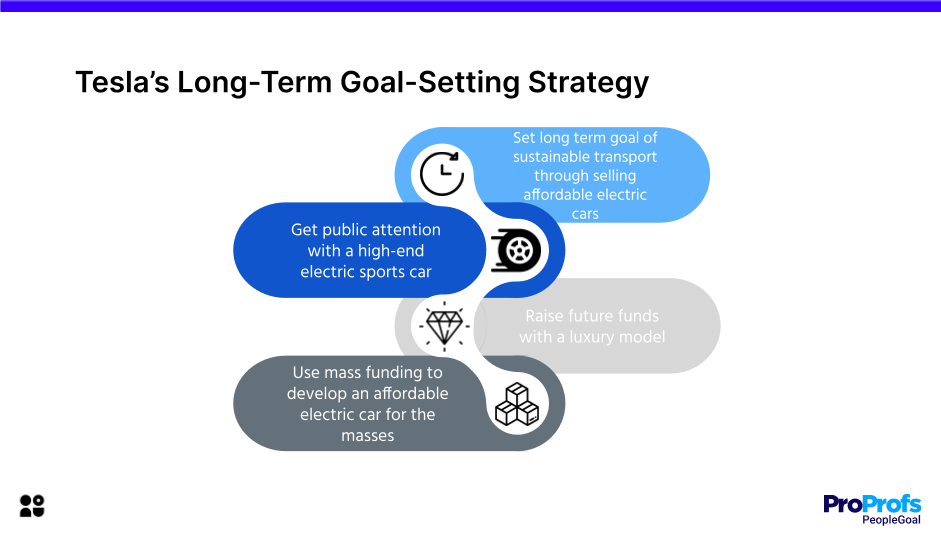
This is the exact gap PeopleGoal’s OKR framework is built to close. It cascades objectives from the company level down to each individual, so the connection between someone’s daily work and the business priority it serves is visible in real time, not reconstructed eight months later.
Watch this video to understand how it works in detail:
Stage 2: Continuous Feedback and Check-ins
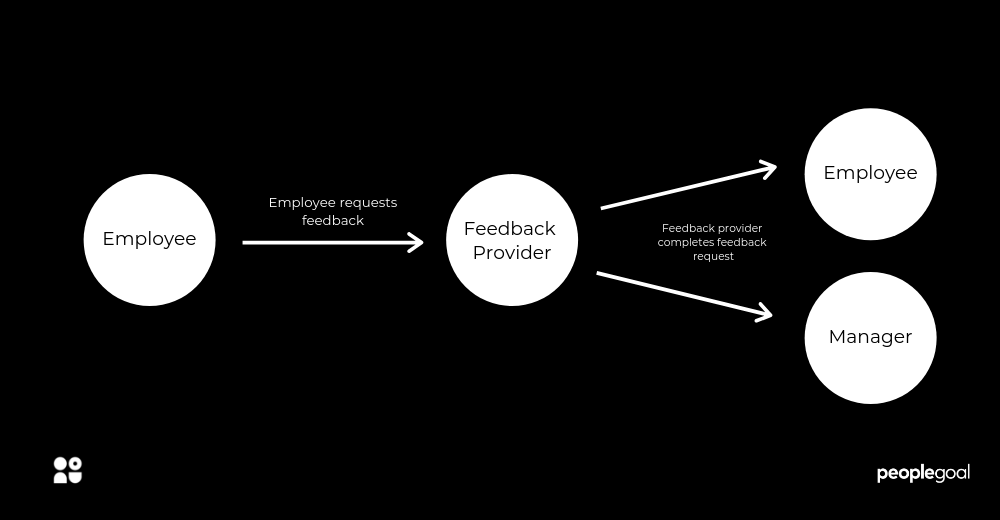
Continuous feedback is the most consistently skipped stage and the one that does the most work.
Managers who only meet employees in formal review settings are flying blind for eleven months. The formal review should summarize conversations already held. If someone is hearing critical feedback for the first time during the evaluation, something broke down in this stage months earlier.
The fix is simpler than most teams expect. It starts with a consistent one-on-one structure.
One-on-One Template (15 to 30 minutes)
Copy this into whatever tool you use. Keep a running log after every session. This becomes your documentation at review time.
| Block | Time | Questions |
| Check-in | 5 min | What is the most important thing you are working on? What is blocking you? |
| Progress | 5 to 10 min | Where do you stand on your goals? What have you completed since we last spoke? |
| Feedback | 5 min | What would help you move faster? Here is one thing I noticed this week: [fill in before the meeting] |
| Close | 2 min | What is your one priority before we speak again? |
After every session, write two to three sentences summarizing what was discussed and what the next step is. Send it to the employee or log it in your shared system. That note is your formal review documentation. It takes three minutes and saves three hours in December.
Two other habits that make this stage work:
- Ask employees to keep a running log of wins, context, and evidence as things happen. When review season arrives, their self-assessment takes minutes instead of hours.
- Give feedback close to the moment it occurred. Feedback given within 48 hours of a deliverable is specific. Feedback given four months later is a reconstruction.
Here’s a quick video of how continuous feedback works in practice:
Stage 3: The Formal Performance Evaluation
If stages one and two ran properly, this stage is synthesis, not reconstruction. The heavy lifting has already been done.
A complete formal review includes four components:
- Self-assessment from the employee
- Manager evaluation anchored to documented check-ins and goal progress
- Peer or 360-degree feedback, depending on your cycle design
- Calibration across managers before any ratings are communicated
On self-assessments: Most employees treat them as a formality. That is a missed opportunity. I always frame it for teams as their closing argument, not a box to tick.
Prompt to share before they write: “Describe one outcome from this period you are most proud of. What made it possible, and what would you do differently?”
That one reframe changes the quality of what comes back.
On 360 feedback forms: Build every question around observable behaviors, not personality traits.
| Useful | Not Useful |
| “Demonstrates accountability by communicating delays proactively” | “Is a team player” |
| “Gives clear direction when priorities shift” | “Is a good communicator” |
The difference is whether the feedback can actually inform a development action. If it cannot, it is noise.
Stage 4: Development Planning and Calibration
Reviews that end at the rating are administrative overhead. The entire cycle exists for what happens next.
Most development plans fail not because the gap was identified wrong, but because nothing bridges “identified” to “actually improved.” Here is the four-step pipeline I use to close that gap.
Step 1: Name the gap in behavioral terms, not labels.
“Needs to improve communication” is an adjective, not a gap. “Struggles to flag project delays to stakeholders before they escalate” is a gap you can act on. If you cannot describe it in one specific behavioral sentence, you are not ready to assign a learning action.
Step 2: Match the gap to the right learning format
| Gap Type | Best Learning Format |
| Lacks knowledge or frameworks | Structured course, book, or workshop |
| Knows the theory but cannot apply it | Stretch assignment with coaching |
| Has the skill but lacks confidence | Increased responsibility with manager support |
| Needs behavioral change | Coaching, feedback loops, peer accountability |
Sending someone to a generic leadership course when the real gap is feedback avoidance wastes their time and yours.
Step 3: Assign an owner and a 30-day check-in, not just a deadline.
Every development action needs three things: who owns it (the employee), who supports it (the manager), and when the first check-in happens. That check-in should be within 30 days, not at the next annual review. Without it, most plans are forgotten by week five.
Step 4: Feed it into the next cycle’s goal-setting.
When the next cycle opens, last cycle’s development action becomes an explicit input to new goals. Not “we reviewed this last year” but “here is how your development goal maps to one of your performance goals this period.” When development and performance are the same conversation, completion rates go up. When they are separate systems, development loses every time.
On calibration: Without it, two employees with identical performance can receive completely different ratings based purely on which manager they report to. The calibration session is where you catch that before it becomes a fairness problem.
Run through these four questions before the session:
- Do my ratings reflect documented evidence, not impressions?
- Am I applying the same standard I would apply to any employee in this role?
- Where I rated someone low, did I give them actionable feedback during the cycle?
- Where I rated someone high, can I name the specific behavior that drove the rating?
If you cannot answer all four confidently, you are not ready for the calibration session.
Annual vs. Quarterly vs. Continuous: Which Cycle Is Right for Your Team?
There is no universally correct frequency. What matters is whether the cycle matches your organization’s growth stage, management maturity, and operational pace.
| Cycle Type | Best Fit | Strength | Watch Out For |
| Annual | Stable organizations with strong documentation habits | Low admin overhead when well-designed | High recency bias risk; feedback arrives too late to course correct |
| Biannual | Mid-size companies with established rhythms | Balances formality with regularity | Can still feel disconnected from daily goal progress |
| Quarterly | High-growth and OKR-driven teams | Keeps goals, feedback, and evaluations tightly aligned | Requires consistent manager bandwidth; can cause fatigue if poorly designed |
| Continuous | Strong coaching cultures with documented check-ins | Most responsive to real performance trends | Needs tooling to work at scale; high manager skill dependency |
The model I see working best for most growing companies right now is a hybrid: continuous check-ins supported by quarterly goal reviews and one formal biannual or annual evaluation. The formal review does not disappear. It just stops being the only point of contact.
Why Do Employees Dislike Traditional Performance Management Cycles?
This is the question most HR content avoids because the honest answer is uncomfortable. Employees do not dislike feedback. They dislike the way most organizations deliver it.
The most repeated frustrations I see across HR communities, Reddit manager threads, and G2 reviews point to the same patterns:
- The surprise factor: Employees hear critical feedback for the first time during the annual review. By then, it is too late to change anything in the period being evaluated. That is not a performance conversation. That is a paper trail.
- Recency bias in performance reviews: Managers unconsciously weight the last 30 days over the full review period. Employees who had a strong first half and a rough Q4 get rated on Q4. Employees know this happens, and it makes the entire performance feedback cycle feel like a lottery.
- Disconnection from compensation: Employees receive a strong review and are then told there is no budget for a raise. At that point, the whole cycle feels pointless. The performance review cycle needs to be honest about what it does and does not connect to.
- Tooling nobody wants to use: Clunky HR software that requires 12 clicks to submit a self-assessment produces low-quality self-assessments. When the tool creates friction, participation drops, and the data the cycle depends on becomes unreliable.
The fix for all of these is not a new review form. It is a better-designed cycle that builds in continuous feedback, sets expectations early, and gives employees agency in their own evaluation process.
How Do You Build a Performance Review Cycle Step by Step?
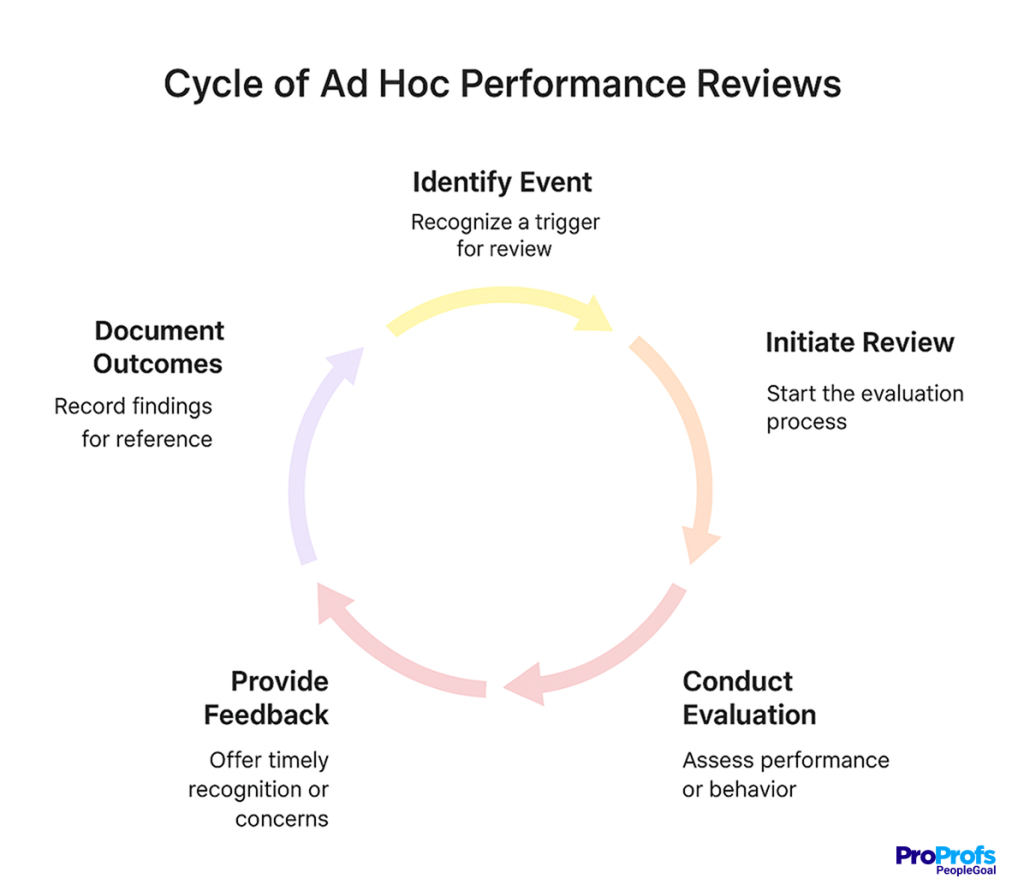
Here is the performance management cycle diagram I would follow for any organization designing or redesigning its employee performance cycle. This is not a theoretical framework. You must follow this performance review cycle diagram to close the gaps where most cycles fall apart in practice.
Step 1: Define Your Cycle Frequency and Milestone Dates
Pick a primary performance management cycle plan length and map the key dates before anything else: goal-setting window, midpoint check-in, formal review window, calibration session, and development planning deadline. Put it in a shared calendar and treat it as non-negotiable.
Step 2: Build Your Goal-Setting Framework
Decide whether you are using SMART goals, OKRs, or a hybrid. Make sure every individual goal maps visibly to a team or company-level objective. If employees cannot trace the connection, they will not feel it.
Step 3: Design Your Check-in Cadence
Decide how often one-on-ones happen, what the standard agenda looks like, and where notes live. This is the infrastructure for your formal review. Without it, you are starting from zero every cycle.
Step 4: Build Your Formal Review Structure
Include self-assessment, manager assessment, and, if relevant, 360 peer feedback. Build forms around observable behaviors and specific outcomes, not generic competency labels.
Step 5: Run Calibration Before You Communicate Ratings
Schedule manager calibration sessions before any ratings are shared. Give managers a shared rubric that defines what “meets expectations” and “exceeds expectations” look like in behavioral, documentable terms, not adjectives.
Step 6: Connect Every Review to a Development Action
Every review outcome should produce at least one concrete development action with an owner and a follow-up date. That action feeds directly into the goal-setting stage of the next cycle, so development becomes a continuous input rather than a once-a-year checkbox.
Step 7: Automate the Coordination
Reminders, approval workflows, escalations, and reporting should not live in your inbox. If you have run a review cycle manually, you already know where it breaks down: reminder emails that get ignored, approval chains that stall in someone’s inbox, and an HR team that spends two weeks of every cycle chasing status updates instead of doing anything useful with the data.
That coordination overhead is entirely automatable. PeopleGoal’s review workflows handle reminders, multi-stage approvals, 360-degree feedback collection, and real-time completion dashboards in one place, so the cycle runs without HR personally managing every handoff. The system chases the managers. You read the reports.
How Can You Use AI to Make Your Review Cycle Less Painful?
AI will not replace good management judgment. But it will eliminate a significant chunk of the documentation and synthesis work that makes review seasons painful. Here are five prompts I would use immediately:
Managers drafting review summaries: “Based on these three bullet points of this employee’s accomplishments this quarter, write a balanced performance summary that is specific, outcome-focused, and avoids vague adjectives.”
Employees writing self-assessments: “I completed these three projects this quarter. Help me frame each one using the STAR method (Situation, Task, Action, Result) in two to three sentences each.”
Synthesizing 360 feedback: “Here are five peer feedback responses about this employee. Identify two or three consistent themes, both positive and developmental, and summarize them in neutral, professional language.”
Goal-setting conversations: “Here are our company OKRs for this quarter. Suggest three individual-level goals for an employee in [role] that directly support objective two.”
Calibration prep: “These five employees have received the following ratings and justifications. Flag any ratings that appear inconsistent with the stated evidence and highlight where additional justification may be needed.”
None of these replaces the manager’s judgment. They accelerate the documentation work so managers spend more time in actual development conversations and less time staring at a blank review form.
What Makes a Performance Management Cycle Actually Effective?
Most organizations know the stages. What separates effective cycles from ceremonial ones is what happens at the handoffs between them.
Three things consistently determine whether an employee’s performance cycle changes outcomes or just generates folders nobody opens again.
1. Runs on Documentation, Not Memory
Every time I have seen a performance cycle genuinely improve, documentation habits during stages one and two were the reason.
When check-ins are documented, goal progress is logged in real time, and feedback is captured close to when it occurs, the formal review becomes a synthesis exercise rather than a reconstruction effort.
2. Separates Development Conversations From Compensation Conversations
When a performance discussion is directly tied to a salary decision, employees get defensive. They stop being honest about where they are struggling. Running these as two separate conversations changes the quality of both.
Have the development conversation first. The compensation conversation can follow, but it should not collapse into the same meeting.
3. Connects Goals to Something Bigger Than the Individual
Goal-setting that produces targets nobody can trace back to company strategy generates compliance, not commitment. When employees can see how their individual goals connect to team objectives and company priorities, both goal completion rates and engagement shift.
Performance Review Cycle Checklist for HR Teams
Before you open your next cycle, run through this. If you cannot check every item, identify the bottleneck and fix it before launch.
Before the cycle opens:
- Goals from the previous cycle have been reviewed and formally closed
- The goal-setting window is open, and employees understand the framework being used
- Manager training on rubrics and calibration standards is complete
- Check-in cadence is confirmed and in shared calendars
During the cycle:
- 360-degree feedback participants have been identified and invited
- Review forms are configured and tested before launch
- Automated reminders are active for self-assessment and manager review deadlines
- The calibration session is scheduled before the ratings are finalized
After the cycle closes:
- A development plan template is required at review submission
- Reporting dashboards are ready for HR and leadership visibility
- Development actions from this cycle feed into the next cycle’s goal-setting stage
Manager’s Checklist for the Performance Review Cycle
The HR checklist above keeps the cycle running. This one keeps your team members from being blindsided.
Before the cycle opens:
- Schedule all one-on-ones for the full review period in one sitting. Do not let them become optional.
- Share the goal-setting framework with your team before the window opens. Employees should not show up to a goal-setting conversation not knowing what format you are using.
- Review each team member’s goals from the previous cycle and close them formally before setting new ones.
- Block two hours on your calendar during the goal-setting window to co-create goals with each direct report, not hand them down.
During the cycle:
- After each one-on-one, send a two to three sentence written recap confirming what was discussed and what the next step is. This is your documentation. It takes three minutes and saves three hours at review time.
- When a team member completes a significant deliverable, send a quick note of specific feedback within 48 hours. Do not save it for the review.
- Flag any performance concern in writing as soon as it becomes a pattern, not at the end of the period. If the review is the first time they hear it, something went wrong earlier.
- Log at least one specific accomplishment per team member per month. A running note in your phone is enough. You will thank yourself in December.
Before you submit ratings:
- Re-read your check-in notes for the full period before writing a single word of the evaluation. Start with the evidence, not the impression.
- Ask yourself: “Am I rating this person on the last four weeks or the full cycle?” If you cannot answer that confidently, go back to your notes.
- For every rating of “below expectations,” confirm you gave that person feedback during the cycle they could have acted on. If you did not, the rating is not fair.
- For every rating of “exceeds expectations,” write one specific behavioral example before submitting. If you cannot, the rating will not survive calibration.
- Attend the calibration session prepared. Bring documented evidence for your outlier ratings, both high and low.
After the review conversation:
- Send a written summary of the review conversation to your team member within 24 hours. What was discussed, what was agreed, and what the development action is.
- Schedule the first check-in for the next cycle before closing the current one.
Turn Performance Reviews Into Continuous Growth Conversations
A strong performance review cycle is not really about forms, ratings, or year-end meetings. It is about creating a system where goals stay visible, feedback happens consistently, and development becomes part of everyday work instead of a once-a-year conversation. The teams that get this right usually focus less on “review season” and more on building steady habits throughout the year.
That is also where tools like PeopleGoal make a real difference. Instead of juggling spreadsheets, scattered notes, and manual follow-ups, you can manage goals, feedback, 360 reviews, calibration, and development plans in one connected workflow. It saves managers time while giving employees far more clarity and consistency.
If your current process feels reactive or overly manual, start by auditing one stage of your annual performance management cycle this quarter and build from there.
Frequently Asked Questions
What makes a performance management cycle effective?
Three things consistently determine effectiveness: documentation habits during the cycle rather than only at review time, separation of development conversations from compensation decisions, and visible alignment between individual goals and company strategy. Cycles that do all three produce better data, higher engagement, and reviews that feel fair.
Why do employees dislike traditional performance management cycles?
The most common complaints are recency bias, receiving critical feedback for the first time during the formal review, and ratings that feel disconnected from actual work. When reviews carry compensation stakes and no ongoing feedback has been given, employees experience the process as a judgment, not a conversation.
What is the difference between annual and quarterly performance review cycles?
An annual performance review cycle evaluates employees once per year and suits stable organizations with strong documentation habits. A quarterly performance review cycle runs formal checkpoints every three months, keeping goals, feedback, and development more tightly connected. Quarterly cycles significantly reduce recency bias but require more consistent manager bandwidth.
How do you avoid recency bias in a performance review cycle?
The fix is building documentation habits into the early stages of the cycle. When managers and employees maintain running notes of accomplishments, feedback, and progress throughout the period, the formal review synthesizes the full cycle rather than reconstructing the last few weeks from memory.
What is performance calibration and why does it matter?
Calibration is where managers compare and normalize ratings across their teams before communicating them to employees. Without it, one manager's "meets expectations" can be another's "exceeds expectations," creating fairness gaps and potential legal exposure. Calibration should run after manager evaluations are complete but before results are shared.
What is continuous performance management and how is it different from a traditional review cycle?
A traditional review cycle runs once or twice a year. Continuous performance management builds feedback and goal progress into the operating rhythm of the team year-round. The two are not opposites. The best approach combines continuous check-ins with structured formal review points so nothing important gets saved up or lost.
Ready to 3x Your Teams' Performance?
Use the best performance management software to align goals, track progress, and boost employee engagement.