
No manager wakes up excited to say, “We need to talk about your performance.” But sooner or later, you’ll need a clear, professional way to address what’s not working, without turning it into a stressful guessing game. That’s why you need to see performance improvement plan examples in real situations, not just textbook moments.
I really like performance improvement plans when they’re done right. A good PIP isn’t about pressure or paperwork. It’s about giving someone a fair shot with specific expectations, real support, and a path forward that everyone understands.
And honestly, when you’re writing one, you don’t need more theory. You need real wording, real structure, and PIP examples you can actually use right away.
So in this guide, I’ve included performance improvement plan examples by scenario, measurable goals you can track, ready-to-use objective statements, manager scripts for tough conversations, and a simple week-by-week checklist to keep the plan moving.
Best PIP Examples to Address Performance Issues
When I’m writing a performance improvement plan, I don’t want a blank template or vague language. I want to see how it looks in real workplace situations, with clear expectations, measurable goals, and a tone that feels fair.
That’s exactly what the examples of performance improvement plans below are meant to help with. Each one is built around a common scenario, so you can quickly find the one that fits your situation and adapt it for your own team.
Example 1: Low Productivity (Operations Role)
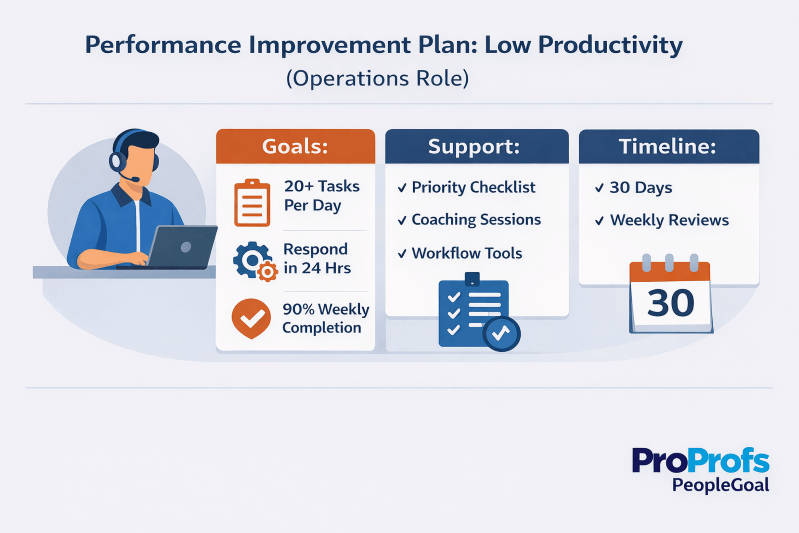
Role + Issue: Meet Jordan, an operations coordinator responsible for handling daily order processing and internal workflow requests. Over the past few weeks, Jordan has been completing tasks, but not at the pace the role demands. Work is piling up, and the team is starting to feel the slowdown.
What needs to improve: Jordan needs to manage daily operational responsibilities more consistently, stay on top of assigned workload, and avoid recurring backlogs that impact overall team efficiency.
Measurable expectations:
- Complete at least 20 orders or request processing tasks per day, with no more than 2 items rolling over to the next day.
- Respond to internal operations requests (inventory checks, scheduling updates, vendor follow-ups) within 24 business hours.
- Close 90% of weekly assigned tasks by Friday end-of-day to meet expected productivity levels.
Support provided:
- A clear daily task priority checklist so Jordan knows what to handle first.
- A couple of weekly review 30-minute coaching check-ins with the operations manager to remove roadblocks quickly.
- Access to workflow templates and automation shortcuts to reduce time spent on repetitive admin tasks.
Timeline: 30 days, with progress reviews every Friday.
Success criteria: By the end of the plan, Jordan consistently meets daily task targets, keeps work queues under control, and contributes at the pace expected in a fast-moving operations environment.
Example 2: Poor Quality of Work (Admin/Finance Role)
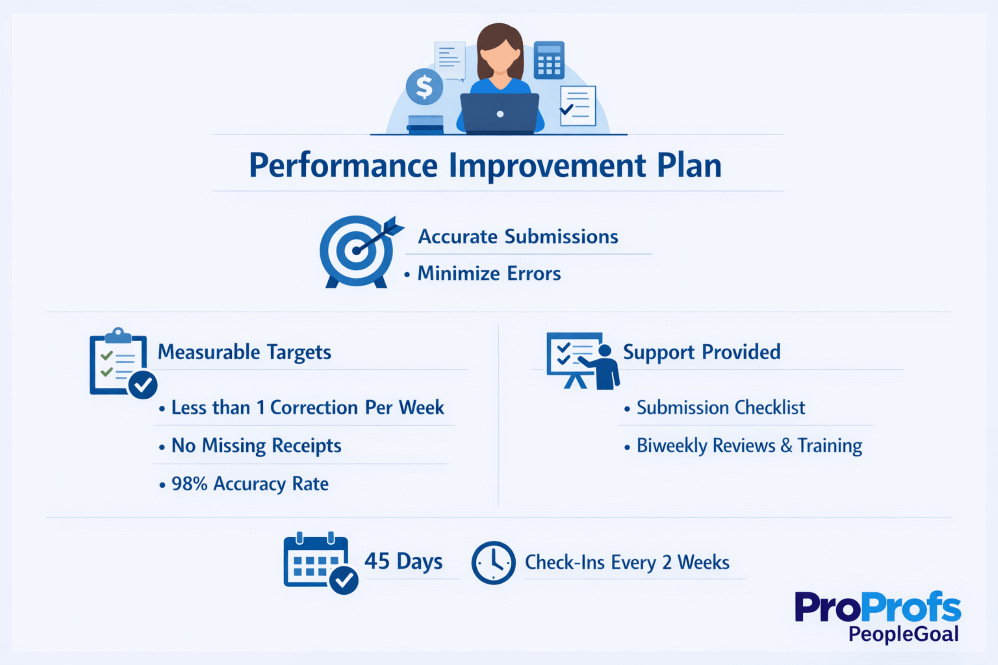
Role + Issue: Emily works as an admin finance assistant at a growing U.S. company. Her job includes tracking expenses, processing invoices, and making sure reimbursements are ready for approval. Lately, though, her submissions have been coming back with frequent fixes, like missing receipts, incorrect totals, or entries filed under the wrong cost center. Nothing is catastrophic, but the constant cleanup is slowing the team down.
What needs to improve: The goal here is simple: Emily’s work needs to be accurate the first time. Finance runs on precision, and even small errors can trigger additional rounds of performance review.
Measurable expectations:
- Keep invoice and expense submissions to one or fewer corrections per week.
- Attach the appropriate backup documentation for each reimbursement request, including no missing receipts.
- Hit a 98% accuracy rate in monthly tracking sheets, including totals, categories, and account codes.
Support provided: Emily will have a short checklist to follow before submitting anything, plus a quick biweekly review with her manager to catch patterns early. She’ll also get a refresher on internal coding and documentation standards so she doesn’t have to guess.
Timeline: 45 days, with check-ins every two weeks to review progress.
Success criteria: By the end of the plan, Emily’s reports and invoice entries should require minimal revisions, helping the finance team move faster and feel confident in the numbers being shared.
Example 3: Missed Deadlines (Project-Based Teams)
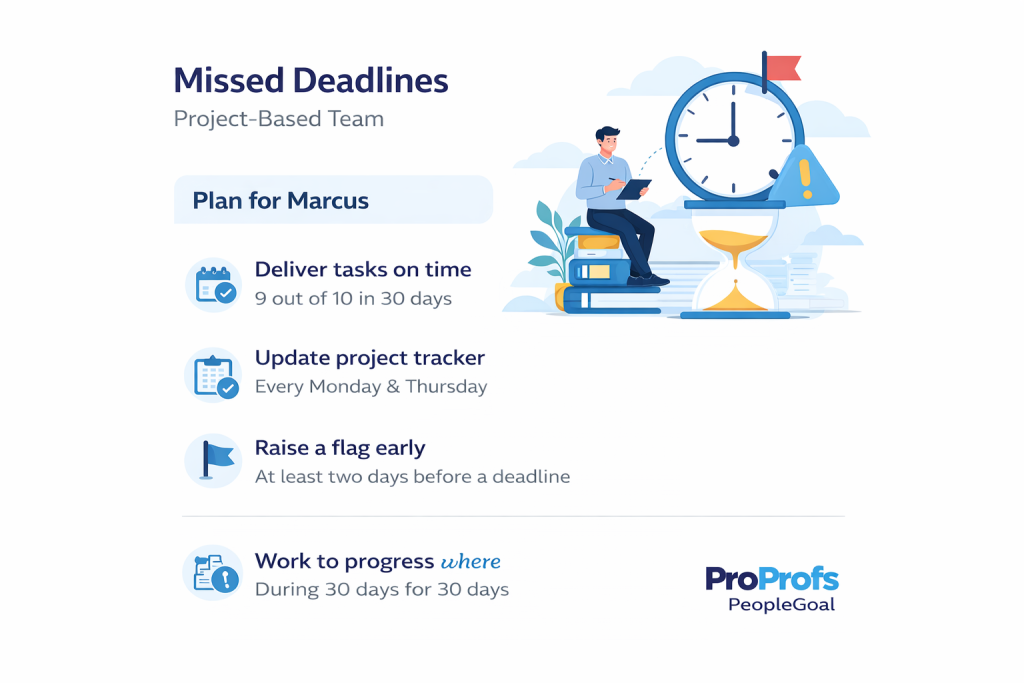
Role + Issue: Marcus works on a project team where timelines matter just as much as the work itself. He’s dependable when it comes to effort, but deliverables have started slipping. A task that was due Tuesday shows up on Thursday. A client deck gets finished right before the meeting. And over time, the team ends up making last-minute adjustments to keep things on track.
What needs to improve: The focus here isn’t speed for the sake of speed. Marcus needs a better rhythm: planning ahead, meeting commitments, and communicating early when something might fall behind.
Measurable expectations:
- Deliver assigned project tasks on time in at least 9 out of 10 cases over the next 30 days.
- Update the project tracker every Monday and Thursday so progress is visible throughout the week.
- Raise a flag when a deadline is at risk at least two business days before it hits, not after it passes.
Support provided: Marcus will work with his manager to break larger assignments into smaller checkpoints, so nothing quietly snowballs into a last-minute rush. He’ll also get a short weekly planning session to reset priorities and make sure timelines feel realistic.
Timeline: 30 days, with weekly touchpoints during active project work.
Success criteria: The plan is working if Marcus becomes a steady part of the project flow: deadlines stop being surprises, updates come consistently, and the team can rely on his work arriving when it’s needed, not after.
Example 4: Behavioral Concerns (Team Collaboration Issues)
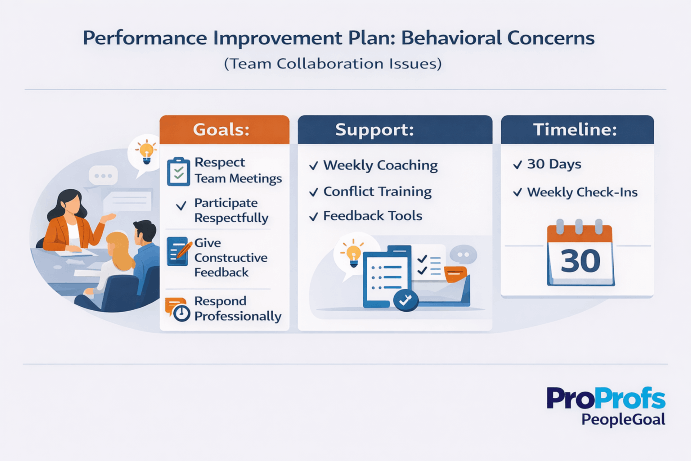
Role + Issue: Samantha is a team lead on a busy customer-facing group. She knows her work well and often delivers strong results. But lately, the way she communicates with others has become a growing concern. Meetings feel tense, feedback comes across as sharp, and teammates have started hesitating before looping her into discussions.
What needs to improve: This isn’t about changing Samantha’s personality. It’s about ensuring her communication style supports collaboration rather than unintentionally shutting it down. The team needs a work environment where people can share ideas, raise issues, and solve problems without friction.
Measurable expectations:
- Participate in team meetings without interrupting or dismissing others, with zero reported incidents of disruptive behavior over the next 30 days.
- Provide feedback in a constructive format (issue + suggestion + next step) in at least 90% of peer interactions, as observed by the manager.
- Respond to internal messages and requests professionally within one business day, even during high-pressure situations.
Support provided: Samantha will have weekly coaching conversations focused on communication and conflict management. She’ll also be given a few practical tools, like feedback templates and de-escalation techniques, to make tough conversations easier in the moment.
Timeline: 30 days, with weekly check-ins and a midpoint feedback review from key collaborators.
Success criteria: Progress looks like a noticeable shift in team dynamics: smoother interactions, fewer tensions in meetings, and coworkers feeling comfortable collaborating with Samantha again.
Example 5: Attendance & Reliability Issues
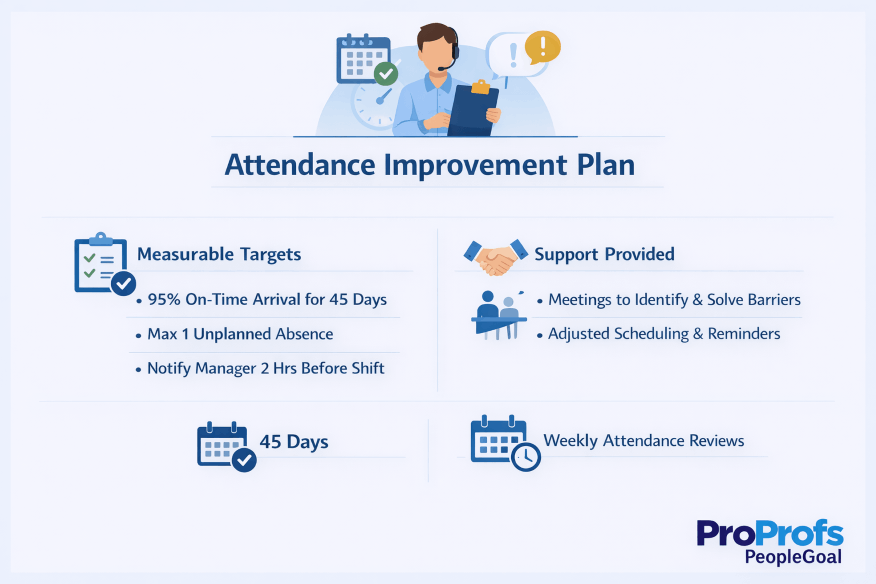
Role + Issue: Derrick works as a support associate on a team that depends heavily on consistent coverage. Recently, his attendance has become unpredictable. Late arrivals, unplanned absences, and last-minute call-outs have made scheduling more difficult and left teammates scrambling to fill gaps.
What needs to improve: The issue isn’t just about being present. Reliability is part of the job. Derrick needs to show up consistently, follow the scheduling expectations, and communicate early if something is genuinely unavoidable.
Measurable expectations:
- Arrive on time for scheduled shifts at least 95% of workdays over the next 45 days.
- Limit unplanned absences to no more than one occurrence during the performance improvement period, unless covered by approved leave.
- Notify the manager of any emergency absence at least two hours before shift start, whenever possible.
Support provided: Derrick’s manager will meet with him to understand whether there are underlying barriers (transportation, health, scheduling conflicts) and help create a realistic plan. Adjusted scheduling options and reminders will also be discussed to support consistency.
Timeline: 45 days, with attendance reviewed weekly.
Success criteria: The plan is successful if Derrick becomes a dependable part of the schedule again, with steady attendance, timely communication, and no ongoing disruption to team coverage.
Example 6: Probation Period Improvement Plan (New Hire)
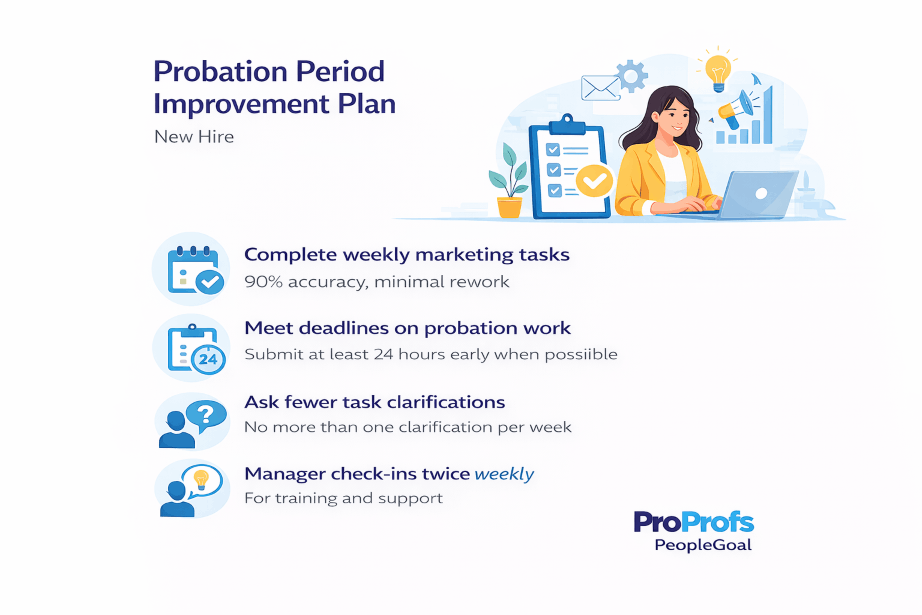
Role + Issue: Nina joined the company six weeks ago as a new marketing coordinator. She’s enthusiastic and clearly trying, but her probation period has revealed a few gaps. Key tasks take longer than expected, instructions often need to be repeated, and early deliverables have missed the mark on accuracy and follow-through.
What needs to improve: This plan is meant to help Nina ramp up successfully, not catch her off guard. She needs greater consistency in executing core responsibilities and in demonstrating steady progress toward full role expectations.
Measurable expectations:
- Complete assigned weekly marketing tasks (content uploads, campaign updates, reporting) with 90% accuracy and minimal rework.
- Meet all deadlines for probation deliverables over the next month, with work submitted at least 24 hours before due time when possible.
- Demonstrate independence by requiring clarification on no more than one task per week after initial training is provided.
Support provided: Nina will receive a structured onboarding checklist and two weekly check-ins with her manager to address questions early and reinforce priorities. Additional training resources and PIP examples of completed work will also be shared to reduce guesswork.
Timeline: 30 days, aligned with the end of her probation review window.
Success criteria: The plan is working if Nina shows clear improvement in accuracy, confidence, and follow-through, allowing the team to confirm she’s ready to continue beyond probation in the role.
Example 7: Sales Performance PIP (Quota + Activity Metrics)
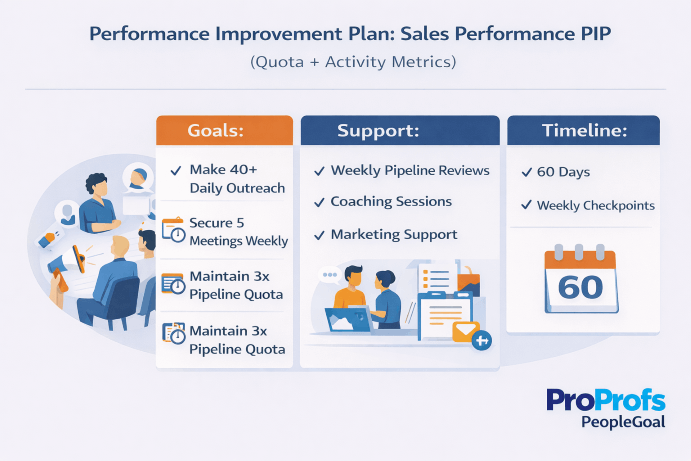
Role + Issue: Jason is an account executive responsible for bringing in new business each quarter. Over the last two months, his pipeline has thinned out, outreach activity has dropped, and quota attainment is trending well below target. The concern isn’t just the missed number, it’s the lack of consistent sales motion behind it.
What needs to improve: Jason needs to rebuild a steady sales cadence by strengthening prospecting, improving pipeline coverage, and ensuring more predictable follow-through on deals in progress.
Measurable expectations:
- Complete at least 40 outbound touches per day (calls, emails, LinkedIn outreach) to maintain consistent top-of-funnel activity.
- Schedule at least 5 qualified discovery meetings per week with new prospects.
- Maintain pipeline coverage at least 3x the monthly quota, with weekly updates in the CRM and accurate next steps.
Support provided: Jason will work closely with the sales manager on weekly pipeline reviews, objection-handling coaching, and deal strategy. Marketing will also provide refreshed lead lists and messaging support to help increase response rates.
Timeline: 60 days, with weekly performance checkpoints.
Success criteria: Success looks like momentum returning: increased activity, a stronger pipeline, and measurable progress toward quota, with consistent habits that can be sustained beyond the improvement period.
Example 8: Manager/Leader Improvement Plan (Soft Skills → Measurable)
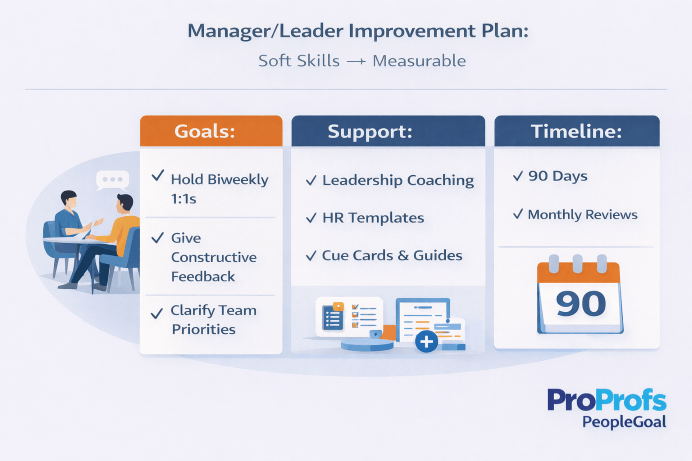
Role + Issue: Carlos is a department manager with a strong track record in execution. Projects get delivered, goals get met. But feedback from his team suggests something is missing on the leadership side. Employees feel unclear on priorities, one-on-ones are inconsistent, and coaching tends to happen only when something goes wrong.
What needs to improve: This plan focuses on strengthening Carlos’s day-to-day leadership habits, not his technical performance. The expectation is that he creates clarity, supports team growth, and shows up as a consistent people leader rather than just a task owner.
Measurable expectations:
- Hold bi-weekly one-on-one meetings with each direct report and document clear action items.
- Provide at least two pieces of constructive feedback per employee per month, not limited to performance problems.
- Improve team clarity by sharing weekly priorities every Monday, with progress check-ins by Friday.
Support provided: Carlos will receive leadership coaching focused on communication, delegation, and employee development. HR will also provide simple one-on-one templates and conversation guides to structure and repeat feedback.
Timeline: 90 days, with monthly leadership reviews and mid-plan employee pulse feedback.
Success criteria: The plan is successful if Carlos becomes more consistent and intentional as a manager, with improved team engagement, clearer communication, and employees reporting stronger support and direction.
How to Make Each PIP Clear and Measurable
A performance improvement plan only works when it stops sounding like “do better” and starts sounding like “here’s what success looks like.”
If you’re writing a PIP, these measurable performance metrics make the difference between a confusing document and a clear roadmap:
- Productivity targets: Complete 20 tasks per day with no more than 2 rollovers
- Quality improvement: Reduce weekly corrections from 6 to 1 or fewer
- Deadline reliability: Deliver 90% of project work on or before the due date
- Attendance consistency: Arrive on time 95% of scheduled shifts over 45 days
- Response expectations: Reply to internal requests within 24 business hours
- Documentation accuracy: Submit 100% of reimbursement forms with correct receipts attached
- Pipeline activity (Sales): Maintain 3x quota coverage with weekly CRM updates
- Behavioral progress: Zero reported incidents of disruptive communication in meetings
- Feedback and leadership habits: Hold biweekly one-on-ones with every direct report
- Collaboration improvement: Increase peer feedback scores from “needs improvement” to “meets expectations” within 60 days
The best part? Once you use metrics like these, everyone knows what the employee is working toward, and the manager knows exactly what to track.
Ready-to-Use PIP Template
A Performance Improvement Plan works best when it is clear, structured, and supportive, not vague or punitive. This template is designed for enterprise environments where documentation, fairness, and measurable progress matter.
Use this as a formal framework to define expectations, track improvement, and ensure the employee knows exactly where they stand throughout the plan.
1. Employee Information
This section captures the official employee and plan details. It ensures the PIP is tied to the correct role, reporting manager, and HR contact. Here are the inclusions:
Employee Name:
Employee ID:
Job Title:
Department:
Manager Name:
HR Representative:
Plan Start Date:
The Plan Duration: (30 / 60 / 90 days)
Plan End Date:
2. Purpose of This Plan
Here, you explain why the PIP is being initiated and what the organization intends to achieve. This sets the tone as a structured opportunity for improvement.
This Performance Improvement Plan is initiated to formally address identified performance gaps. The purpose is to:
- Clearly define performance deficiencies
- Establish measurable expectations
- Provide structured support and coaching
- Document progress and outcomes
- Offer the employee a fair opportunity to improve
3. Performance Concerns
This is where you document the specific performance issues using objective examples. Avoid vague language and focus only on observable behaviors and outcomes.
Provide objective, behavior-based observations. Avoid personal language.
Concern Area 1:
- Description:
- Impact on Team/Business:
- Evidence or Examples:
The Concern Area 2:
- Description:
- Impact on Team/Business:
- Evidence or Examples:
Concern Area 3:
- Description:
- Impact on Team/Business:
- Evidence or Examples:
4. Performance Expectations and Standards
This section defines what acceptable performance looks like going forward. The employee should be able to read this and know exactly what “success” means.
Clearly outline what acceptable performance looks like.
Expectation 1:
Performance Standard:
Measurement Criteria:
Expectation 2:
Performance Standard:
Measurement Criteria:
Expectation 3:
Performance Standard:
Measurement Criteria:
All expectations must be:
- Specific
- Measurable
- Time-bound
- Aligned with role responsibilities
5. Improvement Goals and Milestones
Breaking improvement into phases makes the plan feel manageable. Instead of waiting until the final week, progress is tracked through clear checkpoints.
Break down the plan into structured checkpoints.
Phase 1: Initial Adjustment (Weeks 1–2)
This phase focuses on immediate corrections and baseline clarity, like:
- Target behaviors to demonstrate
- Required output levels
- Communication expectations
Phase 2: Consistency Building (Weeks 3–4)
Here, the goal is sustained improvement using:
- Sustained performance metrics
- Reduction in error rate
- Improved collaboration indicators
Phase 3: Stabilization and Review (Final Weeks)
This phase confirms whether the employee can meet expectations independently. It includes:
- Independent performance without excessive oversight
- Achievement of all defined standards
- Demonstrated behavioral improvement
6. Support and Resources Provided
A strong PIP includes support, not just demands. This section documents what the organization will provide to help the employee succeed.
The organization commits to supporting the employee through:
- Weekly structured 1:1 meetings
- Coaching or mentoring sessions
- Process clarification
- Role expectations alignment
- Skills training (if applicable)
- Adjusted workload (if necessary)
7. Monitoring and Documentation
This section explains how progress will be tracked and recorded. It ensures transparency and creates a clear written record of improvement discussions.
Progress will be monitored through:
- Weekly documented check-ins
- Performance metric tracking
- Quality reviews
- Peer or stakeholder feedback (if relevant)
All discussions will be documented and retained in HR records.
8. Employee Responsibilities
Improvement requires active ownership. This section outlines what the employee should do consistently during the plan.
The employee is expected to:
- Actively participate in weekly check-ins
- Demonstrate measurable effort toward improvement
- Communicate blockers promptly
- Meet outlined performance standards
- Take ownership of agreed actions
9. Midpoint Review Summary (To Be Completed During Plan)
This checkpoint helps ensure the plan stays realistic. It allows adjustments before the final evaluation if progress is partial or barriers remain. Here’s a checklist:
- Date:
- Progress Summary:
- Areas Improved:
- Areas Still Requiring Attention:
- Plan Adjustments (if any):
10. Final Evaluation
At the end of the plan, this section captures the outcome clearly. It ensures closure, fairness, and documentation of the final decision.
At the conclusion of the PIP, one of the following outcomes will be determined:
- Performance expectations met. Employee returns to standard performance status.
- Partial improvement observed. Plan extended with revised goals.
- Expectations not met. Further action required, up to and including reassignment or termination.
Final Summary Comments:
11. Acknowledgment
This final step confirms that the employee received and reviewed the PIP. It protects both the organization and the employee by ensuring the process is formally recorded.
Employee Acknowledgment
I acknowledge that this Performance Improvement Plan has been reviewed with me. My signature confirms receipt, not necessarily agreement.
Employee Signature: ____________________ Date: ______
Manager Signature: _____________________ Date: ______
HR Representative Signature: ____________ Date: ______
When To Use A PIP
A performance improvement plan should never be your first move. It’s not meant to scare someone into working harder. It’s meant to create clarity when performance has slipped, and the employee needs a fair, structured chance to reset.
The right time to use a PIP is when the problem is consistent, specific, and still fixable with support.
Use a PIP when:
- The employee is repeatedly missing deadlines or core responsibilities
- Feedback has already been given, but improvement hasn’t happened
- Expectations are clear, but execution is still falling short
- The role requires immediate reliability, and performance gaps are affecting others
- The employee seems capable, but needs structure, coaching, or accountability
- You want a documented, fair process before making bigger decisions
A good PIP is not about punishment. It’s about giving someone a clear path back to success, with both sides knowing exactly what needs to change.
How to Monitor Progress During a PIP
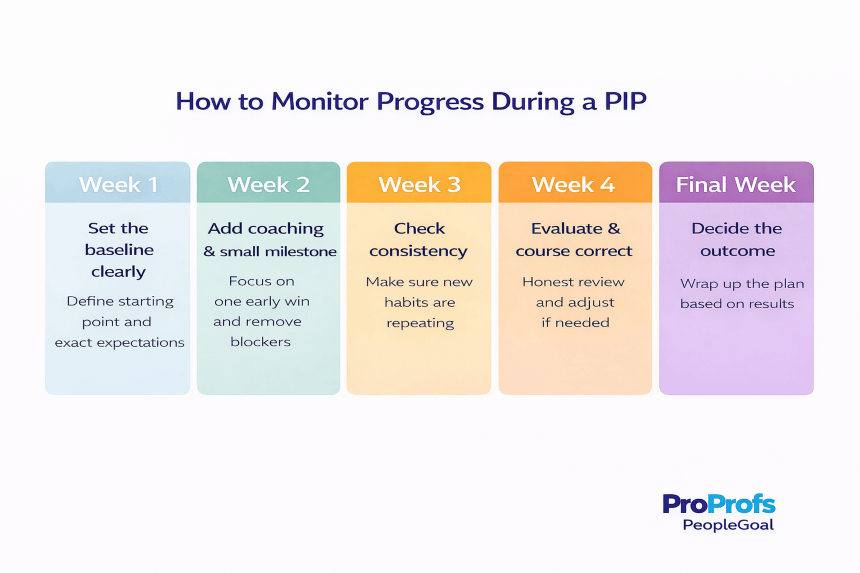
One of the easiest ways a performance improvement plan fails is when it becomes a document that sits in a folder…while everyone waits until the final deadline.
What I’ve found works better is treating the PIP like a short, structured rhythm. You don’t need daily pressure, but you do need clear checkpoints, so progress is visible early.
To make this feel more real, let’s walk through a simple example of PIP.
Meet Jordan, an operations coordinator who’s been falling behind on daily workload and missing key internal deadlines. The PIP is set for 30 days, and here’s how I’d track it week by week.
Week 1: Set the Baseline Clearly
In the first week, I sit down with Jordan and make sure nothing is fuzzy. We look at what’s happening right now, like tasks rolling over every day, delayed vendor follow-ups, and incomplete updates in the system.
This is where I’ll say: “Let’s get specific about what needs to change, and what success actually looks like.”
For Jordan’s role, that might mean agreeing on clear weekly expectations, such as:
- Vendor emails are responded to within one business day
- Purchase requests logged and updated by the end of the day
- Daily operations tracker kept accurate with no missing entries
- Internal teams receive status updates without needing reminders
By the end of Week 1, Jordan and I both have a clear starting point, including the exact expectations for daily output and turnaround time.
Week 2: Add Coaching and the First Small Milestone
Once the plan is in motion, I don’t wait until the end of the month to check progress.
In Week 2, Jordan and I focus on one early win.
Maybe it’s something simple like: “This week, let’s make sure all priority requests are closed within 24 hours.”
This is also where I remove friction. If Jordan is falling behind because tasks aren’t being prioritized properly, we introduce a simple structure, like a daily queue review or a clear system for urgent vs routine requests.
Improvement doesn’t need to be perfect yet, but it should be visible.
Week 3: Check Consistency, Not Just Effort
Week 3 is where reality kicks in.
Jordan might have had a strong Week 2, but now I’m watching for repeat patterns. Are deadlines still being met when the week gets busy? Or are tasks slipping back into last-minute catch-up?
At this stage, I look closely at things like:
- Are tracker updates still happening daily without reminders?
- Are internal teams still chasing status updates?
- Is the backlog shrinking or quietly rebuilding?
This is usually when I’ll ask: “What’s still getting in the way when things pile up?”
The goal here is consistency, not a temporary spike in effort.
Week 4: Mid-Plan Evaluation and Course Correction
By Week 4, I pause and take a more honest look.
Jordan may be improving, but maybe accuracy is still an issue. Or maybe tasks are getting completed, but only after heavy manager follow-ups.
This is where I decide whether the plan needs adjustment, such as:
- Tighter turnaround metrics for recurring tasks
- Additional process training on operations tools
- More structured midweek check-ins
- Clearer prioritization rules for high-impact requests
Week 4 is less about pressure and more about making sure progress is sustainable, not fragile.
Final Week: Decide the Outcome With Transparency
The last week shouldn’t feel sudden or dramatic. By this point, the direction is usually obvious.
I sit down with Jordan and review the goals side by side:
- Did daily productivity stabilize?
- Are deadlines being met without constant follow-up?
- Has the backlog stopped building?
Then we close the plan with one of three outcomes:
- Improvement achieved, and Jordan returns to normal performance expectations
- The plan is extended with revised goals if progress is partial
- Next steps are discussed if expectations were not met
A PIP works best when it feels like a guided process rather than a waiting period. When you track it week by week like this, you stay fair, consistent, and clear, and the employee always knows where they stand.
Improve Performance Outcomes With Smarter PIP Planning
A performance improvement plan doesn’t have to feel like a cold HR formality. When I approach it with clear expectations, measurable goals, and real support, it becomes a practical reset rather than just a warning.
The examples of performance improvement plans for employees in this guide show that the best PIPs are specific, fair, and focused on progress, whether it’s productivity, collaboration, reliability, or leadership growth.
What matters most is consistency: tracking improvement week by week, keeping communication open, and ensuring success is visible to both the employee and the manager.
If you’re managing multiple plans or want a smoother way to document goals, check-ins, and follow-ups, PeopleGoal can make the process far easier. It helps you run structured performance plans without spreadsheets or scattered notes.
Ready to create a PIP that actually drives improvement? Start with one of these examples of performance improvement plans for employees and take the next step.
Ready to 3x Your Teams' Performance?
Use the best performance management software to align goals, track progress, and boost employee engagement.