If performance management is the engine of your people strategy, compensation is the fuel. Most organizations treat them like separate systems anyway, and then act surprised when employees feel whiplash: “I got great feedback all year… so why did my raise look like that?”
Here’s the uncomfortable truth: when performance and pay aren’t integrated, you don’t just get confusion. You get distrust, attrition, and managers making awkward promises they can’t keep.
In this guide, I’ll walk through:
- How to connect performance signals to pay decisions without wrecking morale
- What “Total Rewards” actually looks like in practice (beyond posters and platitudes)
- How to build Pay for Performance and AI-supported systems that stay fair and defensible
Let’s get started:
Why Performance and Compensation Management Matters
According to various studies, organizations that have integrated compensation and performance management systems see a 30% increase in employee engagement.
That helps a lot, right?
But there are other reasons why performance and compensation integration matter a great deal.
Let’s start with the synergy, because “integration” can sound like a systems project when it’s really a trust project.
Performance and compensation work best as a strategic portfolio: one system clarifies what “good” looks like and helps people improve; the other reinforces what the organization values by rewarding outcomes and behaviors.
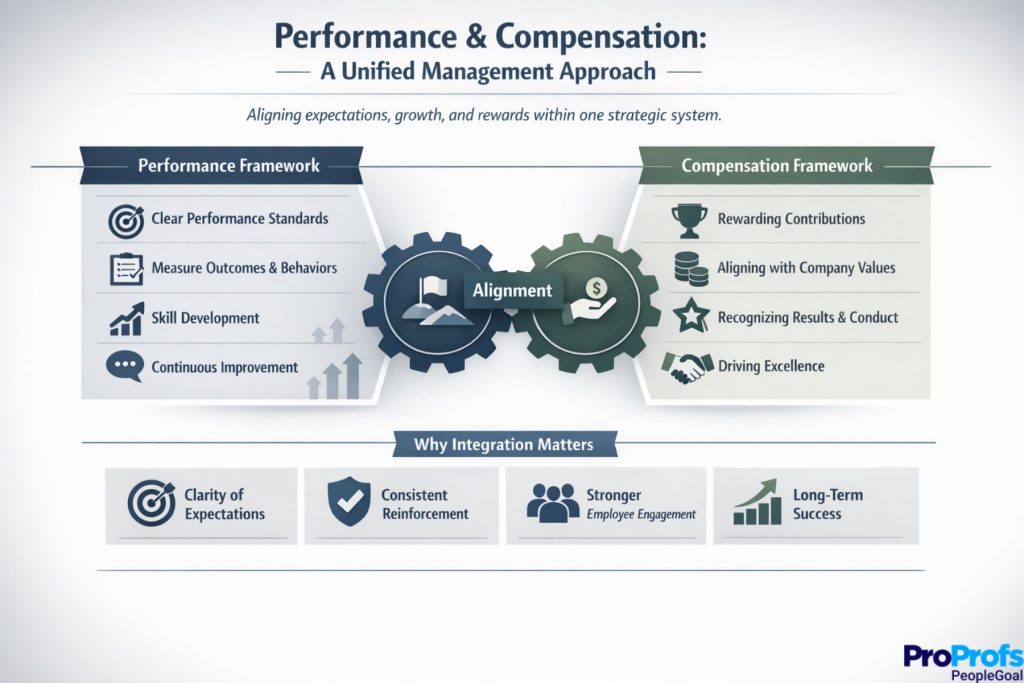
When they’re aligned, you can attract the right talent, develop them faster, and retain them longer. When they’re misaligned, you accidentally incentivize the wrong stuff and lose your best people to “somewhere that feels clearer.”
1. Make Performance and Pay Tell The Same Story
Performance management answers what we are trying to achieve, how we are measuring progress, what capabilities we need more of, and what support or coaching will help.
Compensation management answers:
- What do we reward?
- How do we stay competitive in the market?
- How do we maintain internal equity?
- How do we motivate without creating perverse incentives?
The “synergy” happens when the output of performance management becomes the input to compensation decisions in a way that employees can understand. Not with a mysterious formula. With logic.
A simple way to frame performance and compensation management is this:
- Performance management builds alignment and growth throughout the year.
- Compensation management reinforces priorities and outcomes at key decision points.
- Integration means the story employees hear in 1:1s matches the story their paycheck tells.
If your managers spend all year coaching collaboration, and then year-end bonuses reward individual heroics, you’ve just taught your organization to ignore coaching.
By the way, here is a quick video I recorded to help you get a better idea about performance management:
What Is Employee Performance Management? Discover What Top Teams Do Differently | PeopleGoal
2. Build Pay That Keeps Up With Changing Work
Traditional pay structures were built for stability: job families, pay grades, annual increments, and (sometimes) a promotion ladder that looked suspiciously like “wait your turn.”
But the modern workforce is messy in the best way:
- Skills change quickly.
- Roles evolve mid-year.
- Teams form and dissolve.
- Work happens across functions, locations, and time zones.
That’s why organizations are moving away from purely static salary structures toward dynamic, proactive human capital planning. The goal isn’t to make pay chaotic. It’s to make it responsive, grounded in skills, impact, and business needs.
This is where strategic human resource management comes in: workforce planning, capability mapping, succession readiness, internal mobility, and pay structures that support real strategic shifts (like digital transformation or customer expansion).
Here’s what usually goes wrong:
HR modernizes performance management into continuous feedback, but compensation remains trapped in a once-a-year spreadsheet ritual. Employees experience that as “nice conversations, no follow-through.”
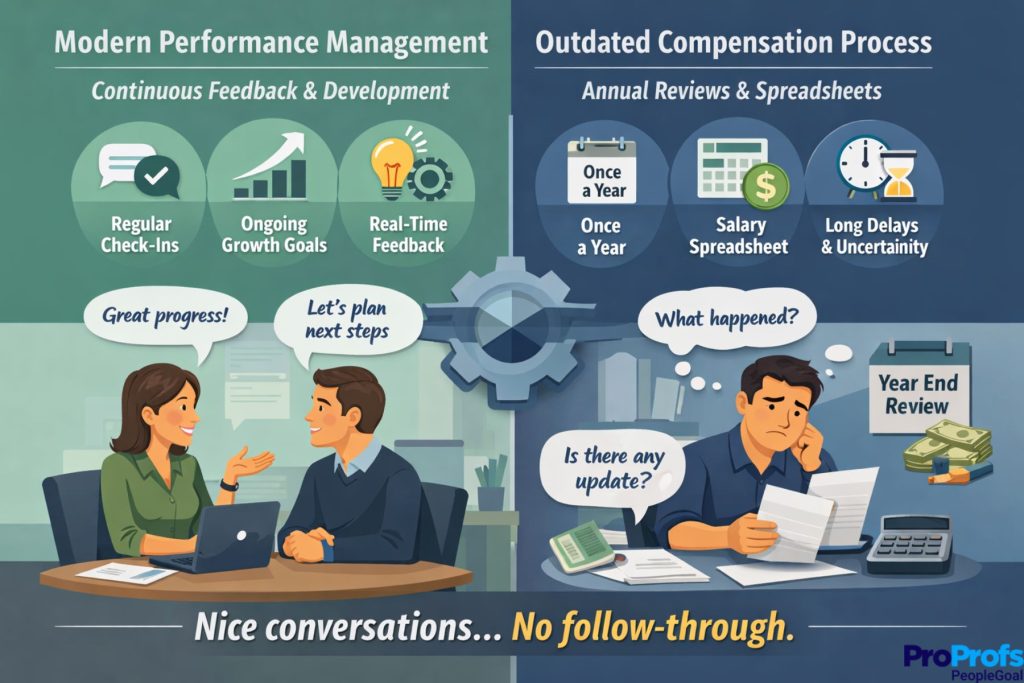
The fix is not “make raises happen monthly.” The fix is to ensure the annual cycle is supported by credible performance reports collected throughout the year.
3. Reward The Capabilities That Drive Strategy
When performance and pay are integrated, the organization can do something powerful: align employee competencies with organizational strategy.
That sounds lofty, but it’s very practical. If your strategy is customer retention, you need to reward:
- Account health improvements,
- Cross-functional responsiveness,
- Customer empathy,
- Renewal discipline,
- Product feedback loops.
If your pay system rewards only new logos, guess what you’ll get? A leaky bucket and a sales culture that treats existing customers like yesterday’s news.
Integrated performance and compensation management does three big things for business performance:
- It increases signal quality. You get clearer data on who is contributing, how, and where performance blockers live.
- It improves allocation. You invest raises, bonuses, and development budgets where they drive the most impact.
- It makes execution faster. People don’t waste time decoding contradictions; they can focus on the work.
Okay, so integration matters. But a lot of confusion starts earlier, with a basic misunderstanding of what “performance management” actually is.
Let’s untangle that next, because this is where many systems quietly sabotage themselves.
Performance Management vs. Performance Appraisal: Understanding The Evolution
These terms get used interchangeably, and it’s one of the reasons employees dread “performance season.” They think every feedback conversation is a stealth appraisal.
But performance management and performance appraisal are not the same thing. One is a continuous process. The other is a formal event.
Keep People Aligned With Real-Time Coaching
Continuous performance management is a proactive, ongoing system of goal-setting, coaching, feedback, and development. It’s designed to keep work aligned in real time, especially when priorities shift.
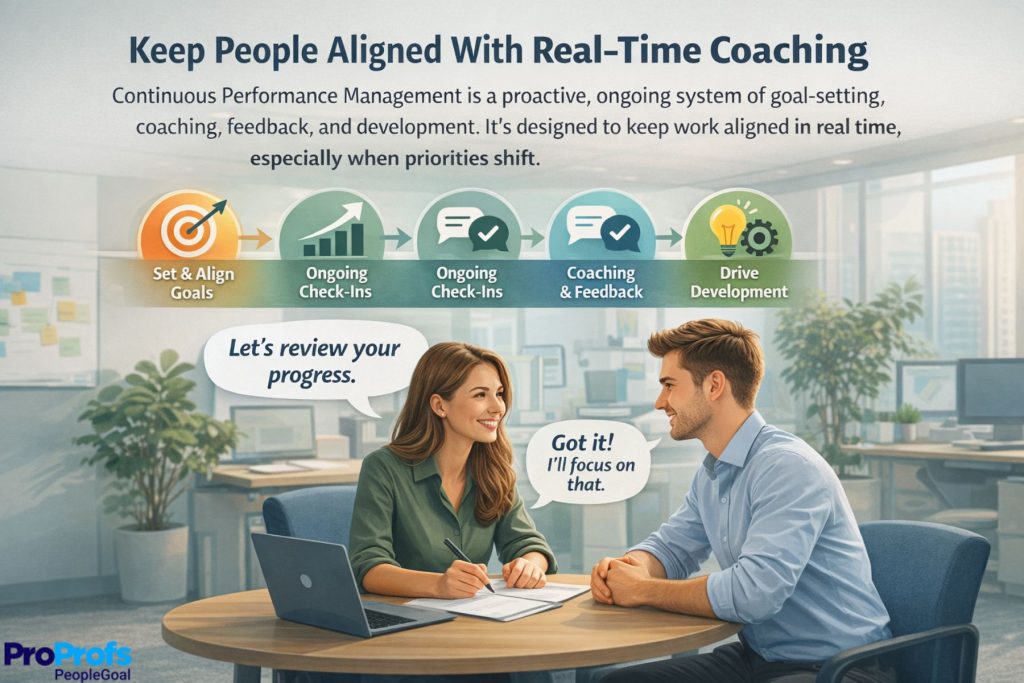
In a well-run continuous model, employees don’t wait 11 months to learn they’re off track. They get clarity on expectations, regular check-ins, real coaching, timely course correction, and recognition when it matters.
This model is also a mental health upgrade. It reduces the anxiety of “surprise verdicts” because the feedback is already happening.
In practice, continuous performance management often includes:
- Monthly or biweekly manager check-ins,
- Lightweight goal reviews,
- Project retrospectives,
- Peer feedback in context,
- Skill development plans tied to actual work.
And it’s not “always-on surveillance.” It’s “always-on alignment.”
Use Formal Reviews Without The Drama
A performance appraisal is typically a formal, periodic evaluation, annual or quarterly, used for administrative decisions like pay raises (merit), bonuses, promotions, performance improvement plans, and sometimes role changes or exits.
Appraisals can be useful. The problem is when the appraisal becomes the only performance conversation all year.
Then the appraisal carries too much weight and too little context. Employees feel judged by a snapshot. Managers scramble to remember what happened nine months ago. And biases creep in because humans are terrible at remembering evenly.
This is why people talk about performance appraisal vs management, because the intent is different:
- Management is about growth and alignment.
- Appraisal is about evaluation and decisions.
Both can coexist, but they need clear boundaries.
Combine Check-Ins and Appraisals For Better Accuracy
Most organizations land on a hybrid approach, and honestly, that’s usually the most practical.
In a hybrid model:
- Continuous performance management runs throughout the year.
- Formal appraisals serve as structured checkpoints.
The appraisal becomes less of a dramatic courtroom scene and more like a documented summary of what has already been discussed.
Why this reduces anxiety: because employees aren’t walking into a review blind. They’ve seen the feedback, tracked progress, and had chances to adjust.
A good hybrid system makes it easy to answer:
- What were the goals?
- What evidence shows progress?
- What impact did the employee deliver?
- What behaviors supported the culture?
- What capabilities should be developed next?
Here’s what usually goes wrong:
Organizations adopt “continuous feedback,” but managers don’t actually do the check-ins. Then year-end ratings become even more frustrating because now there’s no evidence trail.
A practical fix is to make check-ins lightweight and structured:
- A quick goals review,
- One “what’s working,”
- One “what needs to change,”
- One development focus,
- And a documented note.
That documentation becomes your defense against bias and your foundation for pay decisions.
Now that we’ve separated performance management from appraisals, we can talk about compensation without defaulting to “pay equals rating.”
Because the best compensation strategies are bigger than salary, and employees experience them as a package.
The Total Rewards Model: A Holistic View Of Compensation
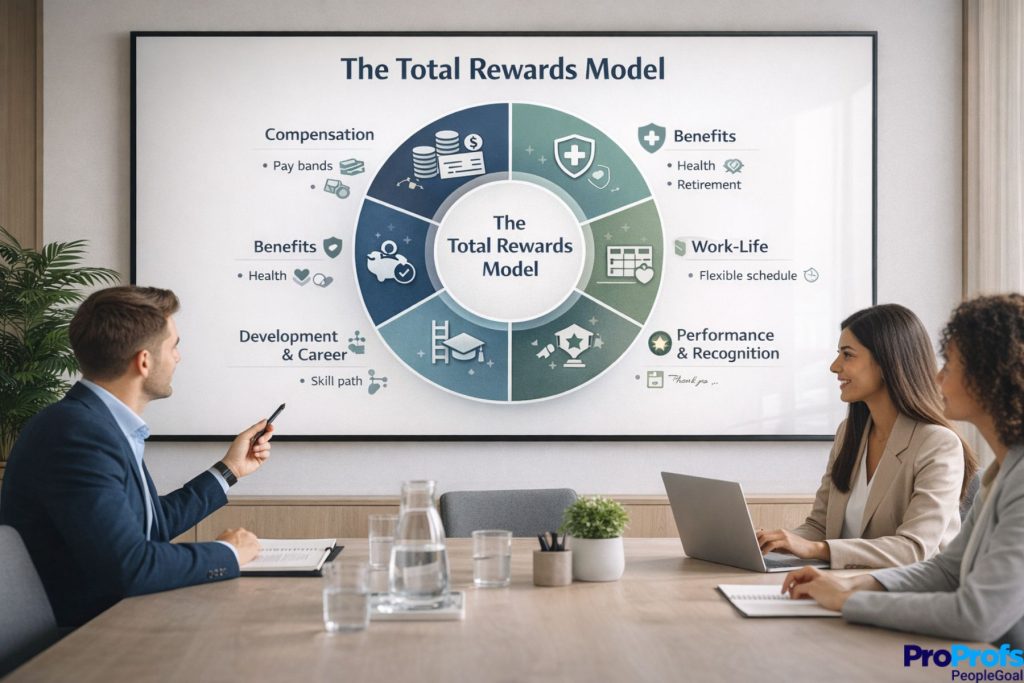
If your compensation strategy begins and ends with salary, you’re playing a very expensive and very exhausting game of whack-a-mole.
Salary matters. But people don’t stay at companies purely because of salary, especially once they’re paid “enough.” They stay (or leave) based on the full experience: growth, respect, flexibility, fairness, and whether the organization keeps its promises.
This is where Total Rewards Strategy becomes the grown-up version of compensation.
Design Total Rewards People Actually Feel
Most Total Rewards frameworks include five core elements:
- Compensation: base pay, incentives, bonuses, equity (where applicable).
- Benefits: health coverage, retirement, paid leave, insurance, etc.
- Well-being: mental health support, workload sustainability, safety, flexibility.
- Career Development: learning, coaching, internal mobility, progression paths.
- Recognition: appreciation, awards, feedback loops, status, visibility.
You don’t need to be world-class in every category. But you do need to be intentional, because employees feel gaps sharply.
For example:
If your pay is strong but your workload is unreasonable, you’re not “high-paying.” You’re “paying hazard rates.” People burn out and leave.
If your benefits are great but career development is vague, you become a comfortable waiting room, not a growth destination.
Make The Employee Value Proposition Clear and Credible
The Employee Value Proposition (or People Value Proposition) is the deal, whether you write it down or not:
“What you give us” versus “what you get from us.”
Employees give time, effort, creativity, emotional labor, and (in many roles) personal energy that doesn’t cleanly fit into a job description.
In return, they want financial security, meaningful work, autonomy and flexibility, growth and opportunity, recognition, and fairness and dignity.
A strong total rewards approach makes that exchange explicit and consistent. It helps managers explain decisions without hand-waving. It also reduces the pressure on salary to solve everything.
A realistic example:
- A mid-level engineer might accept a slightly lower base salary for faster progression, strong mentorship, and flexible work.
- A working parent might prioritize benefits, predictable schedules, and manager support over a higher bonus.
- A high-performing salesperson might prioritize variable upside and clear commission rules over a marginal base increase.
Total Rewards is how you design for different needs without turning compensation into chaos.
Balance Market Pay With Internal Equity
This is the part that gets spicy, because it’s where fairness debates live.
To build a credible compensation system, you need:
- External competitiveness: pay is aligned with market reality for similar roles/skills.
- Internal consistency: pay is equitable within your organization for comparable impact and scope.
External consistency helps you attract and retain. Internal consistency helps you avoid resentment and legal risk.
Here’s what usually goes wrong:
Companies chase market rates but don’t clean up internal inequities. So they hire new people at higher pay while long-tenured performers fall behind. That creates a quiet morale crisis, and suddenly “loyalty” becomes a punchline.
A practical approach is to regularly review:
- Compa-ratios (pay vs band midpoint),
- Pay gaps by gender/ethnicity (where legally allowed to analyze),
- Pay compression (new hires vs experienced staff),
- High performer placement within bands.
Integration with performance matters here: if your internal equity adjustments ignore performance entirely, top talent may feel punished. If your adjustments over-focus on performance while ignoring historical inequities, you’ll perpetuate unfairness. The best systems balance both.
Total Rewards gives us the full compensation picture. Now let’s zoom in on the part that gets the most attention, and the most controversy: paying more for performance.
A Pay-for-performance Model can work beautifully, or it can torch your culture if you design it poorly.
Implementing Pay For Performance (P4P) Models
Pay for Performance is one of those ideas that sounds obviously correct until you meet reality. Here’s something that will offer you a better idea:
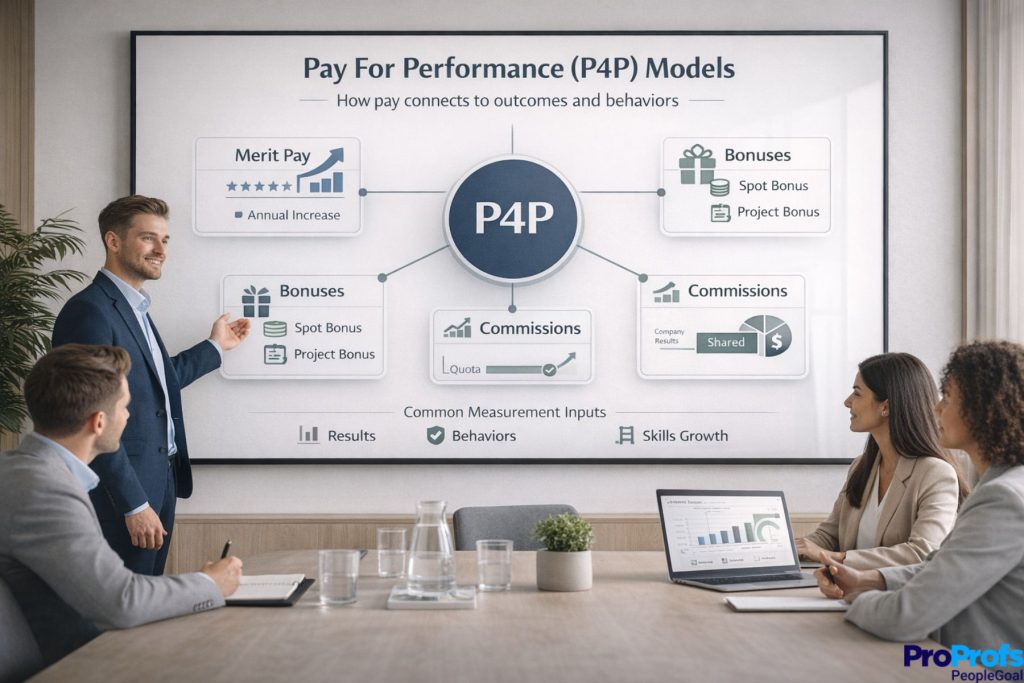
In theory: reward high performance, motivate effort, improve results.
In practice: define performance wrong, measure it poorly, and you’ve just incentivized gaming and politics.
The goal of a Pay for Performance Model isn’t to “pay people like machines.” It’s to connect rewards to outcomes and contributions in a way that’s measurable, fair, and aligned with strategy.
1. Define Pay For Performance So It Motivates Instead Of Backfiring
A pay-for-performance approach adds rewards to base salary when employees meet specific, measurable metrics. Rewards might be permanent (merit increases) or variable (bonuses, commissions, profit sharing).
It works best when goals are clear, measurement is credible, managers can coach toward outcomes, and the organization trusts the system.
P4P collapses when performance is ambiguous, political, or dependent on factors employees can’t control.
2. Choose The Right Pay Levers For Different Roles
Each structure solves a different problem. Many organizations use a mix.
Pay for Performance Structures at a Glance
| P4P Structure | What It Changes | Best For | Risk If Designed Poorly |
|---|---|---|---|
| Merit-Based Pay | Permanent base salary increase | Stable roles with sustained performance and skill depth | Small differences feel meaningless; bias in ratings compounds long-term pay gaps |
| Performance Bonus | One-time cash payout | Time-bound goals tied to business cycles | Feels like a lottery if employees lack control over outcomes |
| Variable / Incentive Pay | Flexible, output-based earnings (e.g., commissions) | Roles with measurable output and revenue impact | Encourages short-termism or gaming metrics |
| Profit Sharing | Shared company-level payout | Reinforcing collective ownership and business literacy | Frustration if financial results lack transparency |
a. Merit-Based Pay: Permanent Base Increases
Merit pay is a permanent increase to base salary based on sustained performance over time.
It’s best for roles where:
- Performance is consistent,
- Impact compounds,
- Skills deepen,
- And you want retention through predictable growth.
Merit-based raises can reinforce long-term excellence, if you avoid the trap of tiny differences that feel insulting (“You’re a top performer, enjoy your extra 0.8%!”).
A strong merit system needs:
- Clear performance standards,
- Review calibration across managers,
- And guardrails against bias.
b. Performance Bonuses: One-Time Payments
Performance bonuses are one-time cash payments for hitting specific annual or quarterly targets.
They’re useful when:
- You want motivation without permanently increasing fixed costs,
- Goals are time-bound,
- Performance is closely tied to business cycles.
Bonuses should be tied to goals that employees can influence. If a bonus depends on “company profitability” but employees have no line of sight into cost decisions, it can feel like a lottery.
c. Variable/Incentive Pay: Flexible Rewards
Variable pay includes:
- Commissions (common in sales),
- Spot bonuses,
- Project completion incentives,
- Non-monetary perks (experiences, extra PTO, development budgets).
This structure fits roles with measurable output and high volatility in performance outcomes.
A classic long-tailed scenario is “implementing a pay-for-performance model for sales teams.”
Sales is where variable pay shines, because revenue and pipeline activity can be tracked and connected to compensation in near real time.
But sales incentives can also create short-term thinking, discounting, and poor handoffs, unless you include quality signals like retention, customer satisfaction, deal health, and compliance.
d. Profit Sharing: Distributing Collective Upside
Profit sharing distributes a portion of the company’s success across the workforce.
This can be powerful for:
- Building a “we win together” culture,
- Reinforcing business literacy,
- Reducing internal competition.
It works best when the company is transparent about how profits are created and when employees believe leadership is managing responsibly.
Profit sharing often pairs well with individual bonuses: one reinforces team success, the other reinforces role-specific contribution.
3. Prevent Gaming, Metric Fixation, and Toxic Competition
Two big risks show up again and again: metric fixation and internal competition.
Metric fixation is when people optimize the number instead of the outcome. You’ve seen it:
- Customer support closes tickets fast, and customer satisfaction tanks.
- Sales hit targets by discounting aggressively, hurting margin.
- Developers ship more “features,” and product quality declines.
The fix is not to abandon metrics. It’s to use balanced metrics and qualitative review.
A practical way to prevent gaming is to design goals with:
- A primary outcome metric (what you want),
- A quality guardrail (what you refuse to sacrifice),
- And a values/behavior check (how you expect it to be done).
You can keep this simple. For example, a support team metric set might include:
- Resolution time (outcome),
- Customer satisfaction (quality),
- Peer feedback on collaboration (behavior).
Unhealthy competition happens when reward structures feel like a zero-sum tournament. If employees believe only a few people can “win,” they stop helping each other.
A strong P4P system uses:
- Transparent criteria,
- Calibration across teams,
- And recognition for collaborative contributions that don’t always show up in raw KPIs.
Most pay-for-performance systems still rely on human judgment.
But today, performance signals increasingly come from dashboards, platforms, and automated tracking tools.
When data becomes the backbone of evaluation, AI and algorithmic systems inevitably shape compensation decisions.
That shift changes both speed and risk.
Algorithmic Management & AI in Performance and Compensation Management

AI in HR isn’t just about chatbots and drafting job descriptions. In many organizations, “algorithmic management” is already shaping:
- Task allocation,
- Performance monitoring,
- Productivity signals,
- Commission calculations,
- And even promotion shortlists.
The upside: speed, consistency, fewer manual errors.
The downside: employees feel like they’re being judged by a machine they can’t question.
Use Automation To Reduce Admin Without Losing Trust
Automated platforms can ingest data from project tools, CRMs, customer support systems, and collaboration platforms to create performance signals.
For compensation, this can mean automated commission calculations, standardized bonus eligibility based on tracked outcomes, quicker identification of pay anomalies, and compensation modeling for budgeting.
When the rules are clear, automation reduces favoritism and math mistakes. That directly supports fairness, especially in high-volume environments like sales, support, or operations.
But “objective data” is not automatically “fair data.”
Make Algorithms Explainable and Contestable
Employees tolerate tough evaluations better when they understand:
- What’s being measured,
- How it’s being measured,
- What they can do to improve,
- And how disputes are handled.
Algorithmic systems often fail at this because they’re treated like proprietary magic.
Algorithmic accountability matters. If you can’t explain why someone received a certain performance flag or pay outcome, trust erodes fast.
Practical transparency doesn’t require revealing every technical detail. It requires a clear explanation of the inputs (what data is used), the logic (how it influences outcomes), the safeguards (bias checks, audits), and the recourse (how to appeal errors).
If you’re using AI-assisted insights, employees should know whether it’s advisory (“this helps managers spot trends”) or determinative (“this decides bonuses”).
Protect The Human Work Metrics Miss
Some of the most valuable contributions in modern work are hard to quantify, including creativity, mentoring, conflict resolution, cross-team coordination, and psychological safety building.
If your system relies only on measurable outputs, you unintentionally punish the people doing the glue work, often your best managers, senior ICs, and culture carriers.
The fix is to integrate qualitative signals responsibly:
- Structured peer feedback,
- Documented examples of impact,
- Manager narrative with evidence,
- Project retrospectives,
- 360-degree feedback (used carefully).
A note on 360-degree feedback: it can be excellent for development, but risky as a direct pay determinant unless your process is mature. People can weaponize it, and popularity contests are very real.
A good principle:
Use AI and analytics to surface questions, not to replace judgment.
The more structured and data-driven your system becomes, the higher the stakes. Performance and compensation decisions influence pay, promotions, and exits. If the process is unclear or inconsistent, the risk is not just morale. It is legal and reputational.
That is why defensibility matters.
Because if your process isn’t fair and documented, it’s not just broken; it’s risky.
Legal and Ethical Best Practices For Implementation
This section matters whether you’re a 50-person startup or a 50,000-person enterprise. The bigger you get, the more formal your processes need to be, but the fundamentals stay the same: clarity, job relevance, consistency, and recourse.
1. Set SMART Goals That Hold Up Under Scrutiny
SMART goals are a classic for a reason. They reduce ambiguity, and ambiguity is where bias thrives.
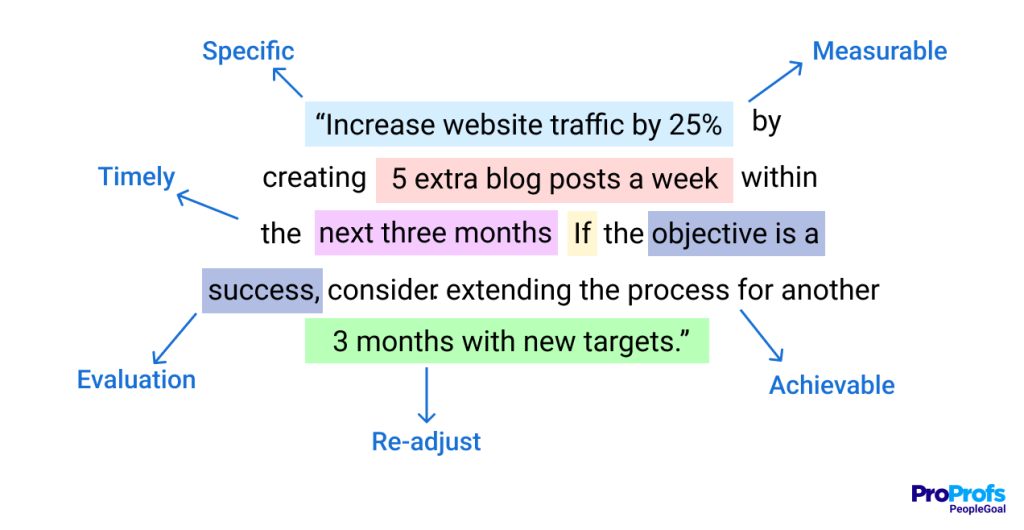
But “SMART” doesn’t mean “tiny.” You can set ambitious goals as long as they’re clear and attainable with reasonable support.
A non-SMART goal:
“Be more strategic.”
A SMART-leaning version:
“By June 30, deliver a quarterly plan for customer retention that includes three prioritized initiatives, success metrics, and an execution timeline agreed with Sales and Support.”
The long-tailed keyword “benefits of continuous feedback in the workplace” shows up here in a real way: continuous feedback makes SMART goals alive. You don’t set them in January and rediscover them in December like an old yogurt in the fridge.
2. Evaluate Based On The Job, Not The Person
This is the fairness backbone: performance evaluations should be based on actual job requirements and observable behaviors, not personality judgments.
A job-analysis-based evaluation asks:
- What does success look like in this role?
- What outputs and behaviors demonstrate success?
- What competencies matter most?
It avoids vague, biased language like:
- “Not executive presence,”
- “Not a culture fit,”
- “Too quiet,”
- “Not leadership material.”
Those phrases are bias magnets unless they’re tied to specific job behaviors.
Instead, focus only on clearly defined, job-related evidence such as:
- “In stakeholder meetings, decisions weren’t documented, leading to rework.”
- “Customer escalations increased due to delayed response times.”
- “Project handoffs lacked clear requirements, creating delivery risks.”
This approach also improves coaching. Employees can’t fix “vibes.” They can fix behaviors.
3. Train Raters and Build A Real Appeals Path
Even the best-designed system fails if managers aren’t trained.
Rater training should cover how to use the framework, document evidence, avoid common biases (recency, halo/horns, similarity bias), and provide actionable feedback.
And you need an appeal process. Not because you expect constant disputes, but because recourse increases trust.
When someone asks the long-tailed question “legal considerations for performance evaluation systems,” this is a major piece of the answer: a documented, consistent process with job-related criteria and a fair mechanism to challenge errors is more defensible and more ethical.
A basic appeal process can be:
- Employee reviews the written evaluation and submits concerns in writing.
- Manager responds with evidence and clarifications.
- A neutral reviewer (HR or a calibration panel) assesses whether the evaluation followed the process and used appropriate evidence.
- Outcomes are documented, including any adjustments.
This doesn’t mean every complaint leads to a change. It means employees aren’t trapped in “manager said so.”
We’ve covered the system design. Now let’s make it practical: what does it actually look like to link performance management to compensation without making everyone miserable?
Here’s a grounded approach you can use as a working blueprint.
How To Link Performance and Compensation Management Without Breaking Trust
This is the heart of performance and compensation management: connecting two sensitive systems in a way that feels coherent.
This is also where the phrasing matters. Many teams are actively looking for stronger compensation management and employee performance alignment, and the “how” comes down to separating conversations, defining evidence, and making decisions explainable.
Here’s the process you can follow:
Step 1: Separate Development Conversations From Pay Conversations
Employees won’t be honest about learning gaps if every conversation feels like it will affect their paycheck.
You can still connect the systems, just don’t blend every discussion into compensation stakes.
A practical model:
- Regular check-ins focus on goals, support, and development.
- Formal review cycles summarize performance with evidence.
- Compensation discussions happen with clear criteria and context.
Step 2: Define Performance In Two Dimensions
Most organizations need two dimensions to avoid rewarding the wrong thing:
- Results (what): outcomes, targets, deliverables.
- Behaviors (how): collaboration, quality, values, leadership.
If you reward only results, you get brilliant jerks and short-term hacks.
If you reward only behaviors, you risk “nice but ineffective.”
Many organizations use a simple matrix:
| Dimension | What You’re Looking For | Evidence Examples |
|---|---|---|
| Results | Outcomes delivered | KPIs, project completion, impact metrics |
| Behaviors | How work is done | Peer feedback, examples of collaboration, customer feedback |
This approach also supports organizational justice. People understand why someone who “hit numbers” might not be rewarded the same way if they created collateral damage.
Step 3: Use Calibration To Reduce Bias
Calibration is where leaders compare performance decisions across teams to ensure consistency.
Without calibration:
- One manager rates everyone high,
- Another rates everyone low,
- And compensation becomes a manager’s lottery.
With calibration:
- You normalize standards,
- Challenge weak evidence,
- And reduce favoritism.
Calibration isn’t about forcing a curve. It’s about aligning expectations.
This is one of the most practical bridges between performance appraisal and compensation management, because it improves consistency and strengthens the evidence behind pay decisions.
Step 4: Build Simple Rules For Compensation Outcomes
Employees don’t need an algebra equation. They need understandable rules.
For example:
- Merit increases are based on sustained performance and role scope.
- Bonuses are tied to goal achievement and business outcomes.
- Equity adjustments address pay fairness and compression issues.
- Promotions require demonstrated role-ready behaviors, not tenure.
When people ask “how to link performance management to compensation,” what they really want is this: a system where the logic is visible and the outcomes feel earned.
This is also where performance management and compensation strategies should be written down clearly enough that a new manager can apply them without inventing their own rules.
Step 5: Audit, Learn, And Adjust
Comp systems are never “done.” You need to review outcomes:
- Are certain teams consistently paid less?
- Are underrepresented groups clustered in lower ratings?
- Are managers documenting evidence consistently?
- Are high performers actually being retained?
If you’re using AI-driven signals, add audits such as input data checks, bias testing, and error correction protocols.
Trust is built through repetition: “We review the system, we fix issues, we communicate changes.”
This also strengthens performance evaluation and compensation management by ensuring decisions stay consistent and defensible over time.
Now, let’s land this in the real world: if you remember nothing else, remember that performance and compensation are basically your organization’s credibility system.
When they match, people lean in. When they don’t, people quietly update their resumes.
Make The Story Match The Paycheck
performance and compensation management isn’t about making pay “more mathematical.” It’s about making the employee experience more coherent.
When performance management is continuous, evidence-based, and development-oriented, people know where they stand and how to grow. When compensation is aligned to strategy, equity, and real contribution, people trust the system, even when outcomes aren’t perfect.
If you’re building or improving your integrated approach, start small:
- Tighten goal clarity,
- Document evidence throughout the year,
- Calibrate manager decisions,
- And make the compensation logic explainable.
That’s how you create a system that drives growth without sacrificing fairness.
And if you’re using a performance management platform like PeopleGoal to support goal tracking, feedback, and structured reviews, the integration conversation gets much easier, because you’re no longer trying to reconstruct the year from memory at compensation time.
Frequently Asked Questions
How do you integrate performance management tools with payroll systems?
Define what must reach payroll, typically bonuses, commissions, one-time awards, effective dates, and approvals. Confirm your HRIS as the source of employee data, then choose a reliable sync or export method. Add validation steps so payroll can verify amounts, and keep an audit trail for disputes and compliance.
How can small businesses implement effective pay-for-performance models?
Keep it simple and affordable. Pick one or two role-relevant outcomes, add a quality guardrail to prevent gaming, and review progress often so there are no surprises. Many small businesses start with modest bonuses or variable pay first, creating upside without permanently increasing fixed salary costs.
What are the benefits of using cloud-based performance and compensation management systems?
Cloud systems reduce spreadsheet chaos and make cycles more consistent. They centralize goals, feedback, reviews, and approvals, so evidence is easy to find when pay decisions happen. Leaders gain visibility into completion and coaching gaps, and HR gets cleaner reporting and audit trails across teams.
What are the best practices for linking individual performance to variable compensation?
Use a small set of measurable outcomes employees can influence, plus a quality or values safeguard to prevent bad trade-offs. Keep payout rules easy to explain, calibrate across managers for consistency, and document evidence throughout the cycle. Make the dispute process clear so payouts feel fair.
What are the 5 C’s of performance management?
A practical “5 C’s” view is clarity, cadence, coaching, consistency, and consequences. People know what success looks like, check-ins happen routinely, managers coach in the moment, standards are applied evenly, and outcomes follow through with recognition or correction. If one breaks, trust in reviews and pay decisions drops.
Where can HR teams find demos of compensation management solutions?
Vendor sites typically offer recorded walkthroughs, live demo requests, and trial access. Bring a real use case, such as a merit cycle with calibration or a bonus allocation workflow, and ask them to run it end to end. If they can’t mirror approvals, reporting, and permissions, treat that as a red flag.
Ready to 3x Your Teams' Performance?
Use the best performance management software to align goals, track progress, and boost employee engagement.