
If you can’t clearly explain why someone was promoted, you don’t have a performance system; you have opinions.
I’ve seen beautifully designed review templates fall apart the moment real conversations begin. The issue usually isn’t a lack of forms. It’s vague expectations, inconsistent feedback, and performance data buried in private notes instead of shared systems.
When leaders search “how to track employee performance,” they’re often trying to fix something deeper: subjective promotions, avoided conversations, unclear standards, and early attrition because no one has defined what good looks like.
Performance tracking should reduce uncertainty, not create anxiety.
In this guide, I’ll show you:
- How to track performance and feedback without micromanaging
- How to structure the first 180 days with measurable milestones
- How to use data to support fair, strategic decisions
Let’s start with the foundation.
Why Is Tracking Employee Performance Essential?
Tracking employee performance provides organizations with a reliable framework for measuring contributions, identifying development needs, and aligning individual effort with business goals.
This process is often referred to as employee performance tracking systems, performance measurement frameworks, or structured performance evaluation processes within modern organizations.
Without structured tracking, organizations drift. Expectations change without being communicated. Managers rely on memory. Employees receive feedback too late to adjust. High performers quietly disengage when their effort goes unnoticed.
Gallup reports that employees who receive regular feedback are 3.6 times more likely to be engaged at work. Engagement correlates strongly with productivity, retention, and profitability. That statistic alone shows that performance tracking is not administrative overhead. It is a business driver.
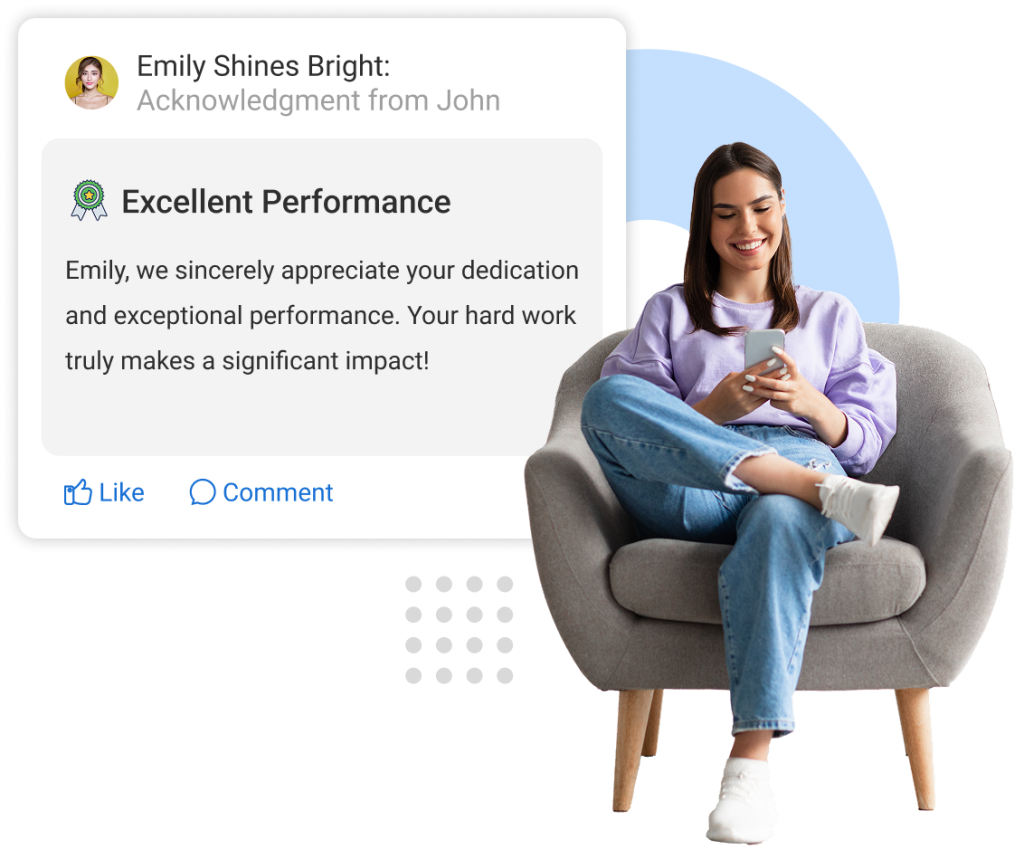
When organizations implement effective performance tracking, they achieve several important outcomes:
- They align daily tasks with strategic priorities so employees understand how their work contributes to broader goals.
- They reduce bias in performance evaluations by documenting evidence consistently.
- They improve retention by identifying and addressing performance gaps early.
- They increase accountability by defining measurable standards for success.
- They strengthen leadership credibility by making decisions transparent and data-informed.
Performance tracking, when structured properly, builds trust. Employees know what is expected. Managers know what to evaluate. Leadership decisions become defensible and fair.
Now that we understand why performance tracking matters, we can address the question most organizations are asking.
What Is the Best Way to Track Employee Performance in Modern Organizations?
The best way to track employee performance is to combine clear goal setting, structured behavioral evaluation, continuous feedback documentation, and regular data review within a centralized system that ensures consistency.
Modern workplaces are hybrid, distributed, and fast-moving. Informal tracking no longer works at scale. Strong performance systems are intentional and repeatable.
Organizations require a structured employee performance tracking system that combines measurement methods, documentation standards, and repeatable evaluation processes.
1. Establish Clear, Measurable Goals That Direct Daily Effort Toward Business Priorities
Performance begins with clarity. Employees cannot meet expectations that have never been clearly defined.
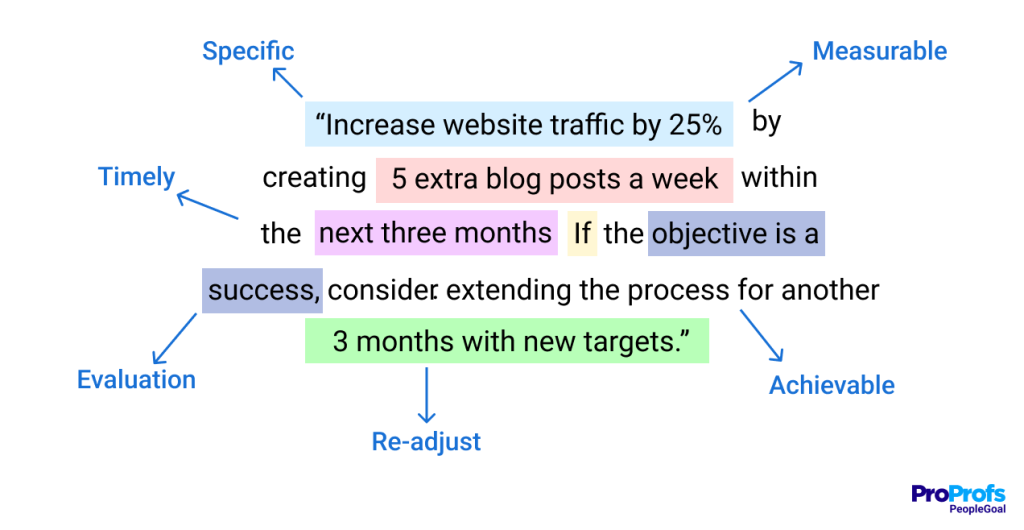
Every employee should have a limited number of well-defined goals, typically three to five per quarter. Each goal should include:
- A clearly described outcome that leaves no room for interpretation.
- A measurable indicator that defines how progress will be evaluated.
- A timeline that creates accountability.
- A visible link to department and company objectives.
For example:
- Increase quarterly sales revenue by 15 percent compared to the previous quarter.
- Reduce average ticket resolution time from 36 hours to 18 hours within three months.
- Complete implementation of a new onboarding workflow before the end of Q3.
- Improve customer satisfaction rating from 4.3 to 4.7 within six months.
Clear goals eliminate ambiguity. When expectations are documented and shared, managers do not need to micromanage because the standards are already defined.
Here is what that looks like in practice.
Example: What Structured Performance Tracking Looks Like in Practice
Take a customer success manager as an example. At the start of the quarter, the manager and employee agree on four measurable goals: maintain a gross renewal rate of 92 percent, improve onboarding completion from 78 percent to 88 percent, keep customer satisfaction above 4.5, and reduce average first-response time from 10 hours to 6 hours.
They also define behavioral expectations such as proactive communication, consistent follow-up, and strong cross-functional collaboration with support and sales.
During the quarter, progress is reviewed in biweekly one-on-ones and documented in a shared system. The manager records evidence such as renewal outcomes, customer comments, onboarding data, and examples of how the employee handled escalations or coordinated with other teams.
At the end of the quarter, the review is based on visible results and documented behaviors rather than memory or opinion. The employee may have exceeded the renewal target, met the customer satisfaction goal, missed the response-time target slightly, and still demonstrated strong collaboration throughout. That creates a much more balanced and fair performance discussion.
This is what effective performance tracking should look like in practice: clear goals, defined behaviors, regular documentation, and a final evaluation based on evidence rather than assumptions.
2. Define Behavioral Standards That Protect Culture and Reinforce Company Values
Results matter. But how results are achieved matters just as much.
Organizations should define a structured competency framework that outlines expected behaviors at each level. These competencies may include collaboration, communication, accountability, initiative, adaptability, and leadership presence.
Instead of vague language, behavioral standards should include detailed descriptions. For example, collaboration may involve actively sharing updates with stakeholders, offering assistance during high-pressure periods, and participating constructively in problem-solving sessions.
Defining behaviors ensures that high output does not excuse poor conduct. Sustainable performance requires alignment between results and values.
3. Implement Continuous Feedback Cycles That Replace Annual Surprises With Ongoing Improvement
Annual reviews often create anxiety because they attempt to summarize an entire year in one conversation. Continuous feedback reduces that pressure.
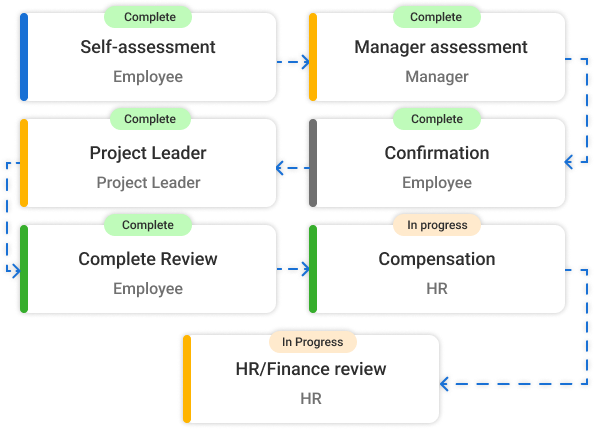
Organizations should implement structured feedback rhythms such as:
- Monthly one-on-one meetings focused on progress and support.
- Quarterly formal reviews that evaluate both goals and behaviors.
- Mid-cycle check-ins that provide course correction.
- Self-assessment opportunities that encourage reflection and accountability.
After each conversation, managers should document key discussion points, agreed action steps, and performance highlights. Documentation ensures accuracy and prevents recency bias.
Continuous tracking turns performance management into a development system rather than a compliance exercise.
Organizations that want to refine this process further should establish structured performance review frameworks that define evaluation criteria, documentation standards, and review timelines in detail. A comprehensive guide to conducting effective performance reviews can help managers build this foundation consistently across teams.
The CLEAR Performance Tracking Framework
To simplify performance tracking and create a scalable performance evaluation framework, organizations can follow a five-part system called the CLEAR framework. This model ensures performance management remains consistent, measurable, and fair.
C – Clarity of Goals
Define three to five measurable outcomes per quarter. Each goal must include a metric, timeline, and connection to company priorities.
L – Linked Behaviors
Document the competencies that define how work should be completed, such as collaboration, accountability, and communication standards.
E – Evidence Documentation
Record feedback conversations, examples of performance, and progress updates after every review cycle to reduce bias and memory distortion.
A – Accountability Rhythm
Establish structured check-ins, including monthly one-on-ones and quarterly formal reviews.
R – Review and Analytics
Analyze performance trends quarterly to identify high performers, development needs, and promotion readiness.
When organizations apply this framework consistently, performance tracking becomes predictable rather than reactive.
The difference becomes even clearer when you see how it works in practice.
Example: How One Manager Uses the CLEAR Framework in a Real Quarter
Instead of treating CLEAR as a theoretical model, it helps to see how a manager actually uses it during a live review cycle.
Take a team lead managing five customer support specialists. At the start of the quarter, each employee is assigned three measurable goals: reduce average resolution time, maintain a customer satisfaction score above 4.5, and complete internal training milestones tied to product updates.
The manager also defines behavioral expectations upfront, such as clear ticket documentation, proactive escalation of complex issues, and collaboration with engineering on recurring bugs.
Every two weeks, the manager runs structured one-on-ones and updates a shared performance document. Instead of writing general comments, they log specific evidence like:
- “Resolved 42 tickets this week with an average response time of 5.8 hours (target: under 6 hours).”
- “Escalated billing issue early, preventing repeat tickets across 3 accounts.”
- “Missed documentation step on two tickets; improvement needed in process consistency.”
By the end of the quarter, the review takes less time because the performance story is already documented. One employee exceeded all targets but needed improvement in documentation discipline. Another met targets consistently and demonstrated strong collaboration, making them a better candidate for promotion despite slightly lower output.
The framework works because it turns performance into a series of small, recorded moments rather than a single high-pressure evaluation.
At-a-Glance: How to Track Employee Performance
| Component | What It Includes | Why It Matters |
|---|---|---|
| Goal Setting | 3 to 5 measurable objectives per quarter | Eliminates ambiguity |
| Behavioral Standards | Defined competencies tied to company values | Protects culture |
| Feedback Rhythm | Monthly check-ins and quarterly reviews | Prevents annual surprises |
| Documentation | Written summaries of progress and development areas | Reduces bias |
| Data Review | Quarterly performance trend analysis | Supports strategic decisions |
How to Track Employee Performance & Feedback With Structure & Fairness
Tracking employee performance and feedback requires discipline. Without a consistent process, even strong intentions produce uneven results.
1. Align Individual Objectives With Organizational Strategy to Create Meaningful Line of Sight
Performance tracking must begin with alignment between the company strategy and individual responsibility.
Organizations should clearly communicate annual and quarterly objectives. Department leaders should translate those objectives into team-level priorities. Managers should then collaborate with employees to define individual goals that directly support those priorities.
This structured alignment ensures that employees see purpose in their daily tasks. It also prevents misalignment where employees focus on activities that do not advance strategic goals.
When alignment is visible, performance tracking becomes a shared responsibility rather than a top-down exercise.
2. Document Performance Conversations Thoroughly to Improve Accuracy and Protect Fairness
Performance discussions must be documented consistently to ensure fairness.
After each one-on-one meeting or review session, managers should record the following. The quality of this documentation matters more than most managers realize:
- Progress toward specific goals.
- Concrete examples of strengths demonstrated.
- Clearly defined areas for improvement.
- Agreed on next steps with timelines.
Example: What Strong Performance Documentation Actually Looks Like
Most managers believe they are documenting performance, but the difference between weak and strong documentation is what determines whether reviews feel fair or subjective.
Here is a simple comparison:
Weak documentation (what most managers write):
“Doing well overall, needs to communicate more.”
Strong documentation (what effective managers write):
“Delivered onboarding project on time and met all quality benchmarks. Missed two stakeholder updates during the rollout phase, which caused minor confusion across teams. Agreed to send a structured weekly update every Friday for the next 30 days to improve visibility.”
The difference is specificity. Strong documentation includes:
- What actually happened
- What evidence supports it
- What the impact was
- What happens next
Managers can use a simple structure after every check-in:
Performance Note Formula:
- Progress made since last check-in
- Specific evidence or example
- Gap or improvement area (if any)
- Agreed next step with timeline
When this level of detail is maintained consistently, performance reviews become faster, more accurate, and significantly easier to defend.
This documentation reduces the influence of memory distortion. It also provides a reliable record if performance concerns escalate or promotion opportunities arise.
Fair performance systems are built on written evidence.
3. Integrate Structured Multi-Source Feedback to Expand Perspective and Increase Credibility
Employees interact with more than one supervisor. Performance evaluation should reflect that reality.
Structured multi-source feedback can include input from peers, cross-functional partners, and direct reports. To maintain fairness, organizations should use standardized feedback forms tied to defined competencies rather than open-ended opinion requests.
Structured multi-source feedback strengthens evaluations by:
- Capturing collaboration effectiveness.
- Highlighting leadership influence.
- Identifying blind spots.
- Validating strengths observed by managers.
Structured 360-degree feedback systems ensure that multi-source input remains fair and competency-based rather than opinion-driven. A practical 360-degree feedback guide can help organizations standardize peer and cross-functional evaluations.
Keep Track of Employee Performance Without Micromanaging Daily Work
One of the most common concerns managers express is how to keep track of employee performance without creating an environment of surveillance.
The answer lies in shifting focus from activity monitoring to outcome measurement.
Prioritize Outcome-Based Measurement to Strengthen Accountability and Trust
Outcome-based tracking focuses on deliverables and impact rather than minute-by-minute activity.
Managers should clearly define expected milestones and deadlines, then evaluate performance based on:
- Completion of agreed projects.
- Quality benchmarks were established at the outset.
- Timeliness relative to defined timelines.
- Satisfaction of clients or internal stakeholders.
When employees understand expectations and are evaluated on results, they gain autonomy. Trust increases because accountability is transparent.
Use Transparent Performance Dashboards to Provide Visibility Without Intrusion
Centralized dashboards give both managers and employees real-time visibility into progress.
A strong dashboard should display:
- Active goals and percentage completion.
- Key performance indicators relevant to the role.
- Historical performance summaries.
- Development milestones and training progress.
This transparency reduces the need for frequent status requests. Employees can self-monitor progress, and managers can intervene only when necessary.
Platforms such as PeopleGoal centralize these dashboards so both managers and employees can view real-time goal progress and documented feedback in one place.
The best way to track employee performance is to create systems that empower rather than restrict.
Structured Performance Tracking vs Informal Performance Management
| Structured Tracking | Informal Tracking |
|---|---|
| Goals are documented and measurable | Expectations shift without clarity |
| Feedback is recorded consistently | Feedback relies on memory |
| Promotion decisions reference documented evidence | Decisions depend on manager’s opinion |
| Performance data is centralized | Notes are scattered across emails and files |
| Employees understand the success criteria | Employees guess what matters |
Organizations that rely on informal systems often experience inconsistent evaluations and avoidable turnover. Structured tracking replaces opinion with evidence.
Over time, inconsistent evaluation processes weaken leadership credibility, increase promotion disputes, and create disengagement among high-performing employees.
Inconsistent performance systems also introduce financial exposure by increasing the cost of regrettable attrition, distorting compensation calibration, and undermining revenue continuity when top contributors disengage or exit.
How to Track Employee Performance in the First 180 Days
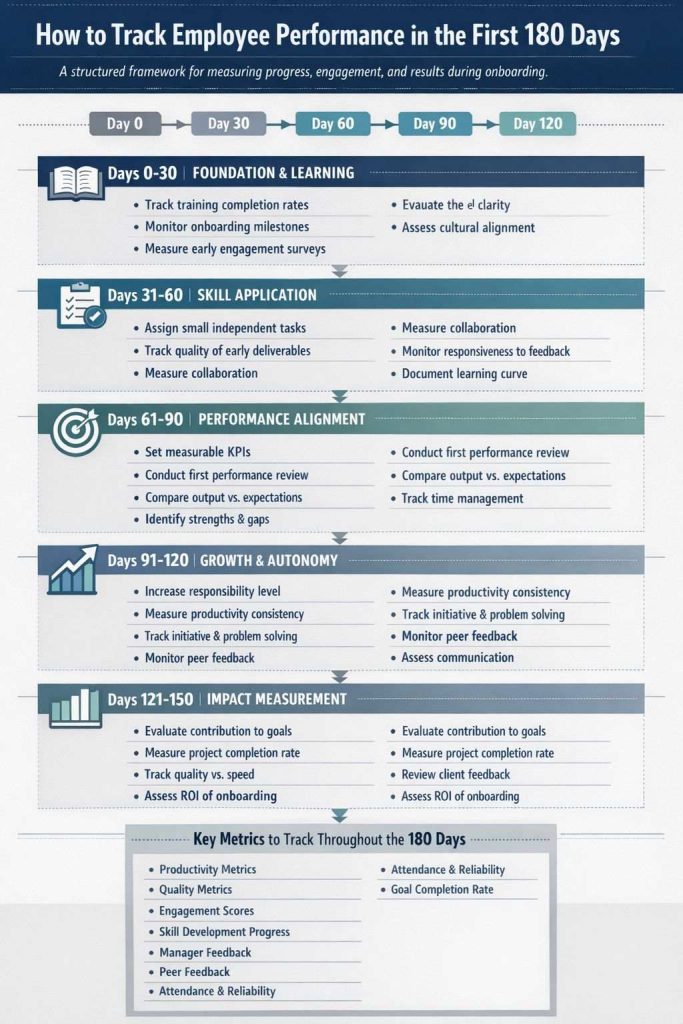
The first six months of employment are critical for long-term success. Expectations must be structured differently during this period.
According to SHRM research, employees who experience structured onboarding are 58 percent more likely to remain with the organization after three years. Early performance clarity improves retention significantly.
Design Structured 30-60-90 Day Milestones to Accelerate Learning and Build Confidence
During the first 30 days, tracking should focus on integration and foundational knowledge. Managers should measure onboarding completion, training progress, system familiarity, and understanding of role expectations.
Between 60 and 90 days, the evaluation should expand to include early independent deliverables, adherence to processes, and collaboration effectiveness. Feedback during this period should be detailed and specific.
Between 90 and 180 days, organizations should gradually introduce measurable performance targets aligned with full job expectations. Accountability increases steadily rather than abruptly.
Structured milestones prevent overwhelm while encouraging progress, but only if managers actively use them during performance conversations.
30-60-90-180 Milestones at a Glance
| Time Frame | Focus Area | What to Measure |
|---|---|---|
| First 30 Days | Integration and learning | Onboarding completion, system familiarity, training progress |
| 60 Days | Guided contribution | Early deliverables, collaboration, process adherence |
| 90 Days | Independent execution | Ownership of assigned projects, quality benchmarks |
| 180 Days | Full accountability | Achievement of measurable performance targets aligned with role expectations |
Structured milestones reduce overwhelm and create steady performance acceleration.
How Managers Should Use This 180-Day Plan in Practice
Most onboarding plans fail not because the milestones are wrong, but because managers do not actively use them during check-ins.
A 30-60-90-180 framework only works when it becomes part of regular performance conversations.
In practice, managers should use each milestone as a reference point during check-ins. Instead of asking general questions like “How are things going?”, they should anchor the discussion to the current stage.
For example:
- At 30 days, the conversation should focus on learning progress, system familiarity, and clarity of role expectations
- At 60 days, managers should review early contributions and identify where the employee still needs guidance
- At 90 days, the focus should shift to ownership, quality of execution, and consistency
- By 180 days, the discussion should mirror a standard performance review, including measurable outcomes and behavioral expectations
The key difference is that performance is evaluated relative to the stage, not against full-role expectations too early.
Managers should also document each of these milestone conversations with specific examples. This creates a clear progression narrative and avoids vague conclusions like “ramping well” or “still adjusting.”
When used this way, the 180-day plan becomes a tracking tool, not just an onboarding checklist.
Deliver Frequent Coaching Conversations to Correct Course Early and Reinforce Development
New employees require shorter feedback cycles.
Managers should schedule check-ins every two to four weeks during the first three months. Each conversation should clarify expectations, reinforce strengths, and address improvement areas with specific examples.
Documenting these discussions ensures alignment and prevents confusion.
Tracking employee performance in the first 180 days is about building competence and confidence simultaneously.
How Can I Use Data to Track Employee Performance Effectively?
Data is one of the most powerful tools in performance management when applied responsibly.
Effective performance measurement methods rely on clearly defined indicators, consistent reporting standards, and transparent documentation practices.
1. Measure Objective Results to Establish a Reliable Performance Baseline
Objective data points provide clarity and reduce subjectivity. Depending on the role, these metrics may include:
- Revenue generated within a defined time frame.
- Project completion rates and adherence to deadlines.
- Quality indicators, such as error reduction percentages.
- Customer satisfaction ratings and retention rates.
- Attendance and punctuality consistency.
These measures create a factual foundation for performance discussions.
2. Combine Quantitative Data With Contextual Qualitative Insight to Capture Full Impact
Numbers tell part of the story. Context completes it.
Managers should also consider:
- Peer feedback describing collaboration quality.
- Client testimonials reflecting service impact.
- Employee self-assessments that reveal reflection and accountability.
- Observations about leadership presence and communication effectiveness.
Balanced evaluation ensures fairness and depth.
3. Analyze Performance Trends Over Time to Support Strategic Workforce Decisions
Quarterly and annual data reviews should focus on identifying patterns rather than isolated results.
Trend analysis allows organizations to:
- Identify high-potential employees for leadership development.
- Detect recurring performance challenges.
- Evaluate training effectiveness.
- Support succession planning with evidence.
When reviewed consistently, performance data becomes more than an evaluation tool. It becomes a strategic workforce planning instrument that informs compensation decisions, leadership development investments, and long-term organizational design.
Example: How Structured Performance Tracking Reduced Promotion Disputes
A 50-person SaaS company implemented quarterly goal dashboards aligned with department objectives. Each employee had four measurable goals and defined behavioral competencies tied to promotion criteria.
Managers documented monthly feedback conversations and used a standardized performance scorecard during quarterly reviews. After two review cycles, leadership reported a 40 percent reduction in promotion disputes.
Employee engagement scores also improved during the same period, as clarity around advancement criteria increased trust in leadership decisions. Employees understood the criteria for advancement because performance evidence was visible and consistent.
The shift did not require more meetings. It required clearer expectations and disciplined documentation.
Quarterly Performance Scorecard
Below is a simplified example of how organizations can track both results and behaviors.
| Category | Metric | Target | Actual | Evaluation |
|---|---|---|---|---|
| Revenue | Quarterly sales growth | 15% increase | 17% | Exceeded |
| Customer Satisfaction | CSAT rating | 4.5+ | 4.6 | Met |
| Efficiency | Project deadline adherence | 95% on-time | 92% | Needs Improvement |
| Collaboration | Peer feedback rating | 4.0+ | 4.3 | Strong |
Combining quantitative and qualitative indicators creates balanced evaluations.
How to Build a Sustainable Performance Tracking System
A sustainable system requires clarity, rhythm, and accountability.
These principles apply equally to organizations with 20 employees and enterprises with 2,000. While the scale of documentation and reporting may increase, the underlying structure of goal clarity, behavioral standards, and documented review cycles remains consistent across company size.
Building a sustainable system is less about adding more forms and more about making performance expectations visible, repeatable, and fair. The organizations that do this well tend to follow the same core steps.
1. Define a Performance Philosophy Before Choosing Tools or Templates
A sustainable system starts with one basic question: what is performance tracking actually for in this organization?
Some companies use it mainly for evaluation. Others use it to support growth, promotion readiness, coaching, or succession planning. If leaders are not aligned on this point, the process becomes confusing very quickly.
For example, one manager may treat check-ins as coaching conversations, while another uses them to build a case for rating employees. That inconsistency creates distrust.
A clear performance philosophy should answer:
- What does good performance means
- How results and behaviors will be evaluated
- How often should feedback happen
- How performance data will be used in decisions
Takeaway: If the purpose of performance tracking is unclear, the process will feel inconsistent no matter how good the forms are.
2. Standardize Goal Setting So Employees Are Measured Against Comparable Expectations
Sustainable systems need consistency. That does not mean every department uses identical goals, but it does mean goals should follow the same structure.
A sales team may track revenue growth, while a customer support team tracks resolution time and satisfaction scores. The goals will differ, but both teams should still define clear metrics, timelines, and expected outcomes.
For example, “improve client communication” is too vague to track fairly. “Send weekly client status updates every Friday and maintain a CSAT score above 4.5” is much easier to evaluate.
Standardization reduces ambiguity and makes performance conversations easier across teams.
Takeaway: Different roles can have different goals, but every goal should still be specific, measurable, and time-bound.
3. Create a Check-In Rhythm That Managers Can Realistically Maintain
Most performance systems fail because they ask for consistency but rely on the manager’s memory.
A sustainable rhythm should be simple enough to maintain even during busy periods. For many organizations, that means monthly one-on-ones, quarterly formal reviews, and lighter mid-cycle progress check-ins.
For example, a manager with eight direct reports may not be able to write long narrative assessments every two weeks. But they can maintain a short monthly note with progress, blockers, feedback, and next steps.
The point is not to create more admin. The point is to prevent performance tracking from disappearing until review season.
Takeaway: The best check-in rhythm is the one managers will actually follow consistently.
4. Keep Goals, Feedback, and Evidence in One Shared System
Performance tracking breaks down when goals live in one document, feedback in a private notebook, and review notes in email threads.
Managers need one place to record progress over time. Employees also need visibility into what is being tracked so expectations do not become one-sided or opaque.
For example, if an employee misses a quarterly target but has consistently documented obstacles, peer praise, and evidence of improvement, that context should be visible during the final review. Without a shared record, nuance gets lost.
A centralized system also makes it easier to spot patterns across teams rather than treating every review as an isolated event.
Takeaway: If performance evidence is scattered, decisions will rely on memory instead of documentation.
5. Review Performance Data Quarterly, Not Just Annually
A sustainable system should help leaders spot trends, not just produce ratings.
Quarterly reviews allow organizations to identify recurring performance issues, flag high-potential employees, and see whether development efforts are working. They also make it easier to catch inconsistent standards between managers.
For example, if one manager rates nearly every employee as high-performing while another rates conservatively across the board, that pattern should be reviewed before promotion or compensation decisions are made.
Quarterly pattern review creates a more disciplined and fair system over time.
Takeaway: Performance tracking becomes strategic when leaders review patterns, not just individual cases.
6. Train Managers to Document and Discuss Performance Well
Even the best system will fail if managers do not know how to give useful feedback.
Managers need training on how to set expectations, write specific documentation, address underperformance early, and separate observable evidence from personal opinion.
For example, “not leadership material” is subjective and unhelpful. “Handled client escalations well but has not yet demonstrated ownership in cross-functional planning” is much clearer and easier to act on.
Training also reduces one of the biggest risks in performance management: uneven manager quality.
Takeaway: Performance systems do not fail only because of bad design. They also fail because managers are left to interpret them on their own.
What Makes the System Sustainable Over Time?
The system becomes sustainable when it is simple enough to repeat, clear enough to trust, and structured enough to support decisions. That usually means fewer forms, better documentation habits, and more discipline around expectations.
A practical way to test whether the system is sustainable is to ask:
- Can managers explain the standards clearly?
- Can employees see what they are being measured against?
- Can leaders defend promotion or performance decisions with evidence?
- Can the process still work during a busy quarter?
If the answer to those questions is yes, the system is probably strong enough to last.
This step-by-step structure ensures that performance tracking becomes embedded in daily operations rather than treated as an annual event.
Track Employee Performance to Ensure Consistent Outcomes
Tracking employee performance is not about enforcing control. It is about creating clarity, fairness, and growth.
When expectations are defined clearly, feedback is delivered consistently, and performance data is documented thoughtfully, performance management becomes a strategic advantage. Employees understand how they contribute. Managers evaluate with confidence. Leaders make informed decisions based on evidence.
A structured platform such as PeopleGoal supports this process by centralizing goal tracking, standardizing performance review templates, enabling continuous feedback workflows, and providing analytics dashboards that reveal performance trends over time.
Features such as customizable review cycles, competency frameworks, onboarding milestone tracking, and structured feedback forms allow organizations to implement discipline without sacrificing flexibility.
Frequently Asked Questions

How to track employee performance and feedback effectively?
Track employee performance and feedback by aligning goals with company priorities, conducting structured one-on-one meetings, documenting feedback after each session, and incorporating peer or cross-functional input where appropriate. Consistency and written records are essential to reduce bias and improve fairness.
How to keep track of employee performance without micromanaging?
Focus on measurable outcomes rather than daily activity monitoring. Define clear milestones and deadlines, provide visibility through shared dashboards, and review progress during scheduled check-ins. This approach maintains accountability while preserving employee autonomy and trust.
How to track employee performance in the first 180 days?
Use structured 30-60-90 day milestones that emphasize onboarding completion, skill development, early deliverables, and gradual accountability. Frequent coaching conversations and documented feedback during this period significantly improve retention and performance ramp-up.
How can I use data to track employee performance fairly?
Use objective metrics such as revenue, quality indicators, and customer feedback alongside qualitative insights from peers and managers. Review performance trends over time rather than relying on isolated results. Balanced interpretation of data strengthens fairness in evaluations and promotion decisions.
Does tracking employee performance improve engagement?
Yes. Research from Gallup shows employees who receive regular feedback are significantly more engaged. Structured performance tracking clarifies expectations, recognizes achievements, and provides development guidance, all of which contribute to higher motivation and retention.
What tools help organizations track employee performance?
Organizations often use performance management platforms to centralize goal tracking, feedback documentation, review cycles, and analytics. Tools like PeopleGoal support customizable workflows, competency frameworks, onboarding milestones, and performance dashboards that scale as teams grow.
Ready to 3x Your Teams' Performance?
Use the best performance management software to align goals, track progress, and boost employee engagement.