
Spreadsheets, paper forms, and half-remembered conversations, this is still how most companies handle performance management in 2026. Not because HR teams do not care, but because nobody ever gave them a better system to work with.
AI in performance management is changing that completely. I have spent years in the HR tech space talking to hundreds of HR leaders, people managers, and CHROs, and the frustration is always the same: review cycles that drain weeks of productivity, feedback that does not reflect what actually happened, and managers who dread the process as much as the employees sitting across from them.
In this guide, I have reviewed the 10 best AI performance management tools available in 2026 so you can stop managing performance in spreadsheets and start actually improving it. Whether you are setting up your first formal review cycle or replacing a tool that has outgrown your needs, there is something here for every team size and budget.
What Is AI in Performance Management?
AI in performance management means using machine learning, natural language processing, and intelligent automation to collect, synthesize, and act on employee performance data continuously, not just once a year.
Instead of a manager spending 3–6 hours per employee reconstructing a year from memory, AI-powered tools pull together check-in notes, goal progress, peer feedback, and engagement signals into a structured, bias-reduced picture. The manager’s job becomes reviewing and contextualizing not starting from scratch.
Key capabilities AI brings to performance management:
- Automated review draft generation from year-round data
- AI summarization of open-ended survey and feedback responses
- Real-time OKR and goal tracking with automated flags
- 360-degree feedback synthesis across multiple raters
- Predictive insights on disengagement and attrition risk
- Bias detection in review language and ratings
- Personalized coaching nudges for managers and employees
According to a study by McKinsey & Company in 2024, companies that focus on their people’s performance are 4.2 times more likely to outperform their peers, realizing an average 30% higher revenue growth and experiencing attrition five percentage points lower.
10 Best AI Performance Management Tools
After reviewing dozens of platforms, here are the 10 best AI performance management tools that actually deliver on their promises whether you are running your first review cycle or looking to upgrade from a tool that no longer fits.
| Tool | Best For | Pricing |
|---|---|---|
| PeopleGoal | Employee Performance & Improving Engagement | FREE 14-day trial. Paid starts at $4/user/month |
| Lattice | HRIS in Large Enterprises | Custom pricing |
| 15Five | Enterprise Performance Reviews System | Starts at $9/user/month |
| Culture Amp | Building Organizational Culture | Custom pricing |
| Betterworks | Structured Check-Ins | Custom pricing |
| PerformYard | Flexible Review Workflows | Starts at $5/user/month |
| Leapsome | Personalized Learning Paths | Starts at $8/user/month |
| Engagedly | Combining Performance Management With Engagement Tools | Custom pricing |
| Effy AI | AI-Based 360 Feedback Software | Starts at $3.60/user/month |
| Teamflect | Teams Living Inside Microsoft Teams | Starts at $5/user/month |
1. PeopleGoal – Best for Boosting Employee Performance & Improving Engagement
I currently use PeopleGoal with a team, and the thing that stands out most is the no-code workflow builder. I was able to set up our entire performance review cycle with self-assessments, manager reviews, 360-degree peer nominations, and HR sign-off without touching a single line of code.
What I didn’t expect was how much the automation features would change the way we run reviews. Reminders go out automatically, review cycles trigger on schedule, and the platform routes each step to the right person without anyone having to chase it manually. The engagement surveys, pulse checks, and Cheer Wall recognition feed into our ongoing performance narrative rather than sitting in a separate silo.
For a first-time buyer or a company moving away from manual processes, and that describes most of our customers, PeopleGoal offers the best balance of depth, flexibility, and price in this entire category.
Pros:
- No-code workflow builder for fully customizable review cycles
- 360-degree feedback with flexible anonymity settings and external reviewer access (no login required)
- Automated insights and summaries across reviews and engagement surveys
- Native integrations with BambooHR, Workday, ADP, Slack, MS Teams, and more
Cons:
- No downloadable or on-premise version
- The dark user interface option is not available
Pricing:
FREE 14-day trial. Paid starts at $4/user/month.
2. Lattice – Best for HRIS in Large Enterprises
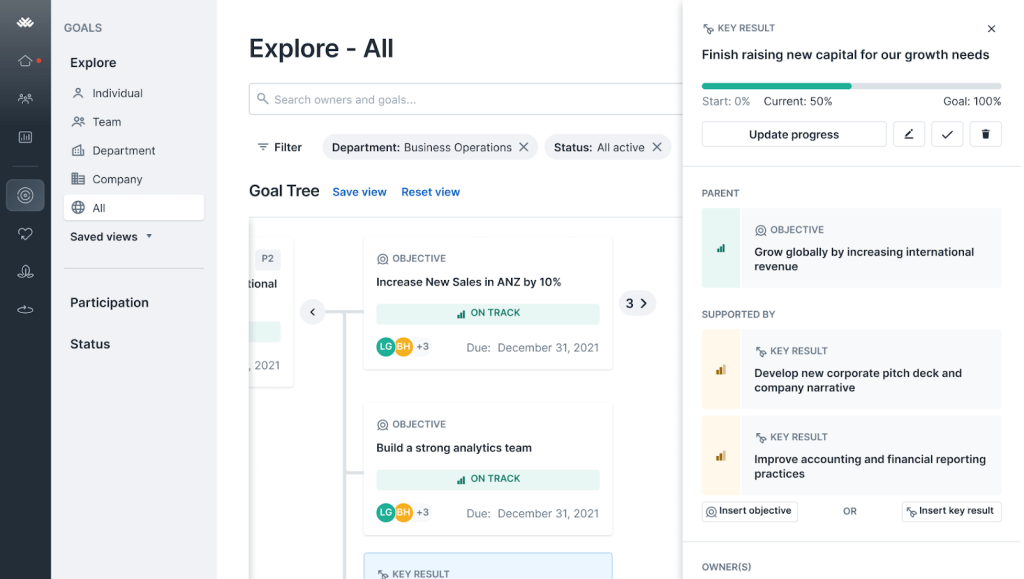
A friend of mine who heads up People Operations at a 300-person SaaS company switched to Lattice two years ago and hasn’t looked back. What she told me most stuck: “It’s not just that reviews are easier. It’s that our calibration sessions actually have data to work from now.” Lattice’s analytics dashboards give HR teams and managers real visibility into performance trends, rating distributions, and engagement signals across the organization.
The AI capabilities in Lattice surface performance insights from check-in data, flag trends in engagement, and help managers prepare for 1:1 conversations with context from past interactions. The modular structure means you can start with performance reviews and add compensation management or HRIS features as you grow.
That said, Lattice’s modular pricing model means costs can climb as you unlock more capabilities — it’s a strong fit for growth-stage companies with budget to match, but can price out smaller teams.
Pros:
- Highly mature performance and compensation management in a single platform
- Strong calibration tools and rating analytics for large review cycles
- Flexible 1:1 workflows with documentation and AI-assisted talking points
- Robust integration ecosystem with major HRIS and HRMS platforms
Cons:
- Modular pricing increases cost significantly as features are added
- Implementation requires more resources and time than lighter alternatives
Pricing:
Starts at $11/user/month.
3. 15Five – Best for Enterprise Performance Reviews System
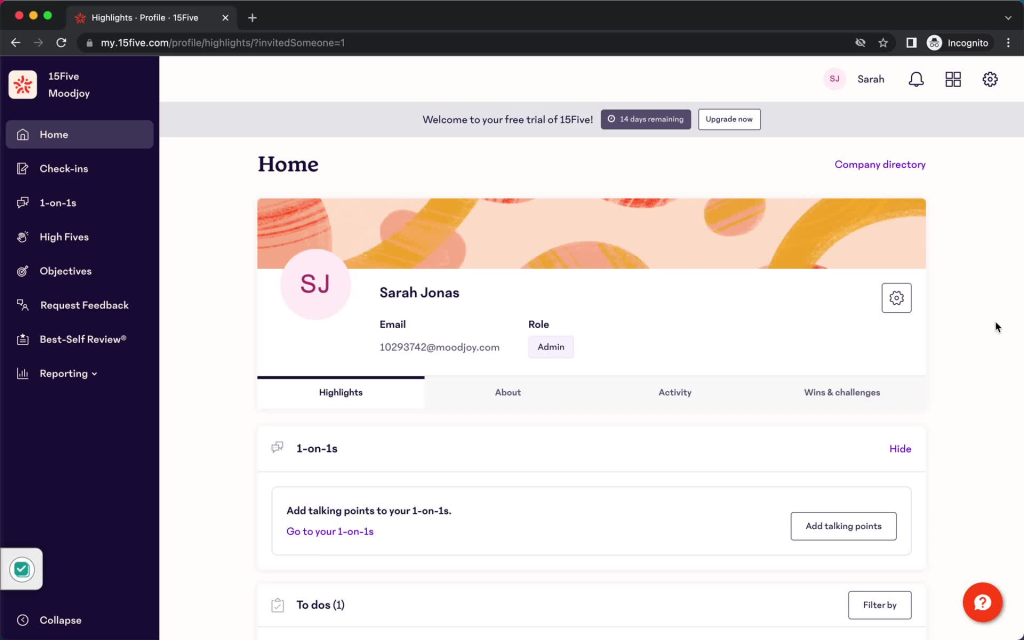
I used 15Five for about 18 months at a previous company, back when our biggest challenge was that managers had no structured way to stay connected with their direct reports between formal reviews. The weekly check-in system forced a cadence that our team badly needed, and the AI features helped surface sentiment trends from those check-ins so HR could spot disengagement signals before they became resignation letters.
The AI analyzes check-in responses, highlights employees who may be struggling, and generates engagement reports that feed directly into our performance narrative. For teams that want performance management to feel less like an annual event and more like an ongoing conversation, 15Five delivers consistently.
The only friction we experienced was check-in fatigue; some employees started treating the weekly questions as a box-ticking exercise rather than a genuine reflection. That said, the manager coaching tools and OKR tracking more than made up for it.
Pros:
- AI-powered check-in analysis that surfaces morale, engagement, and obstacle trends
- Manager effectiveness tools, including coaching prompts and leadership insights
- Strong OKR and goal alignment features with real-time tracking
- Clean, modern interface with a low learning curve for managers and employees
Cons:
- Weekly check-in cadence can cause fatigue if not well managed
- Less suitable for complex multi-structure review cycles across many departments
Pricing:
Starts at $9/user/month.
4. Culture Amp – Best for Building Organizational Culture
Culture Amp was founded by organizational psychologists, and it shows. The platform is the most research-backed tool in this list, built for companies that want employee engagement data to drive real business decisions, not just look good in a board deck.
A colleague at a mid-size consulting firm introduced me to Culture Amp when her company was trying to figure out why attrition had spiked two quarters in a row. What the platform surfaced through its engagement analytics helped them identify a specific manager layer that was driving the exit risk, something their annual survey had completely missed.
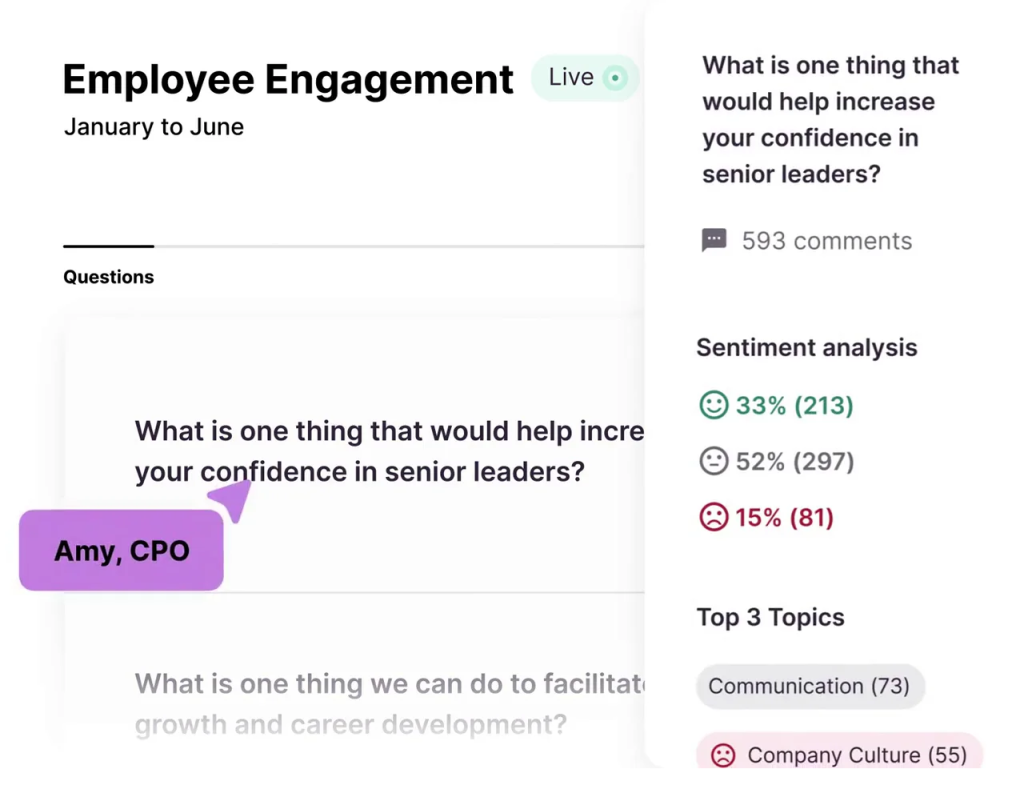
The AI features in Culture Amp help HR teams interpret open-ended feedback at scale, summarize text responses, and recommend focus areas based on engagement drivers like recognition, manager effectiveness, and career growth. Its performance review features have grown significantly, though performance remains a secondary strength to its market-leading engagement capabilities.
Pros:
- Industry-leading engagement survey design backed by organizational psychology research
- AI-assisted text analysis for open-ended survey responses at scale
- Benchmarking tools that compare your engagement data to industry norms
- Strong manager-level analytics with actionable recommendations
Cons:
- Performance management is not the core strength — better as a complement to a dedicated review tool
- Deep reporting capabilities require time and HR expertise to use fully
Pricing:
Custom pricing (contact vendor).
5. Betterworks – Best for Structured Check-Ins
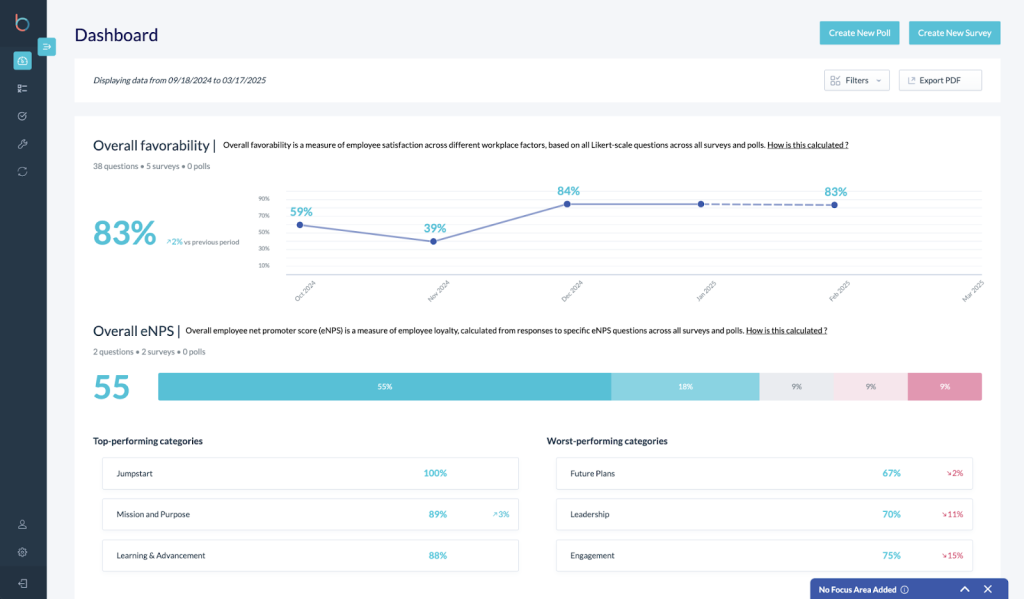
Image source: Betterworks
Betterworks is purpose-built for enterprise organizations that need performance management tightly connected to strategic goal alignment. If your company has complex cross-functional OKR structures and needs performance data to inform workforce planning, Betterworks is in a category of its own.
I had a chance to see Betterworks in action at a 2,500-person company that was struggling to connect individual performance to company strategy. The OKR cascading system made it visible in real time, how a software engineer’s quarterly goals connected to the product team’s OKRs which connected to the company’s revenue targets. That kind of clarity is rare.
The generative AI features in Betterworks are specifically designed to relieve managers — compiling historical check-in data into annual review drafts, generating AI-driven conversation prompts tailored to each employee’s goals and feedback history, and recommending SMART goal adjustments when targets appear misaligned.
Pros:
- Sophisticated OKR cascading from company level down to individual contributor
- AI generates review drafts from monthly check-in data, saving hours per review cycle
- Manager coaching prompts tailored to individual employee context
- Strong calibration tools for enterprise-wide consistency
Cons:
- Implementation is complex and typically requires professional services support
- Feature breadth can be overwhelming for companies without a mature HR function
Pricing:
Custom pricing.
6. PerformYard – Best for Flexible Review Workflows
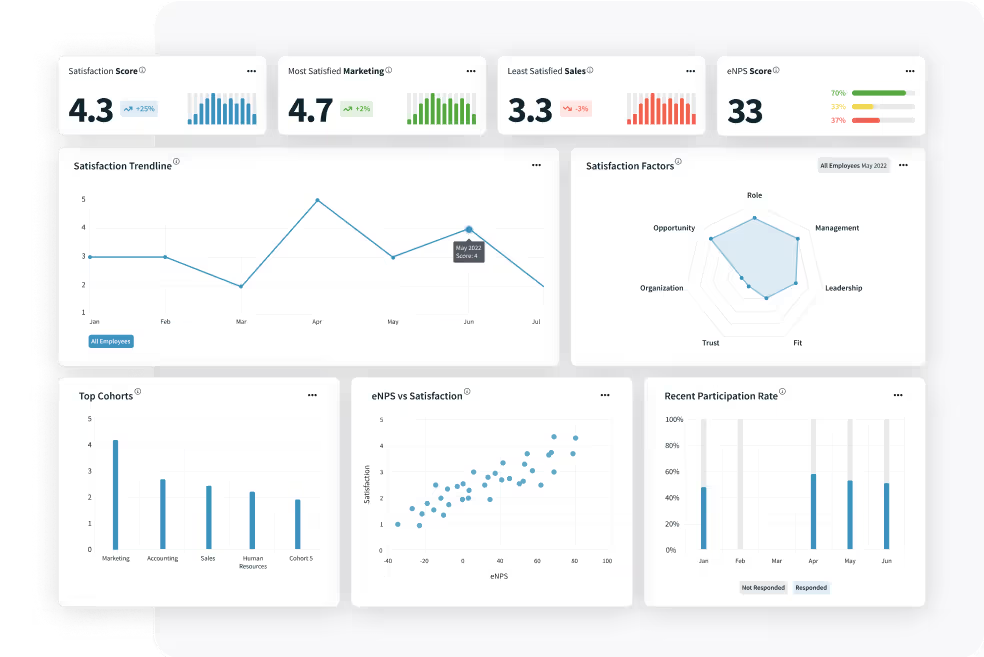
PerformYard is one of the most flexible performance management platforms for companies with non-standard review needs, think multiple review types, seasonal workers, custom approval chains, and department-specific forms all running in the same system.
A former colleague of mine at a construction company used PerformYard specifically because it allowed them to run completely different review forms and cadences for field workers, office staff, and management all within the same platform. Most tools either flatten everyone into the same workflow or require expensive customization. PerformYard handled it cleanly out of the box.
The platform supports 360-degree feedback, goal tracking, and detailed reporting with data export. The AI capabilities focus primarily on automating administrative workflows nudges, reminders, and scheduling rather than deep generative review assistance. It’s a strong choice for companies whose priority is workflow control over AI-first features.
Pros:
- Supports multiple simultaneous review cycles without administrative complexity
- Clean reporting with Excel/CSV export and good HR visibility
- Responsive customer support with strong onboarding resources
- HRIS integrations with BambooHR, ADP, and others
Cons:
- Interface can feel dated compared to newer UI-focused competitors
- The goal module is functional, but not as deep as dedicated OKR platforms
Pricing:
Starts at $5/user/month.
7. Leapsome – Best for Personalized Learning Paths
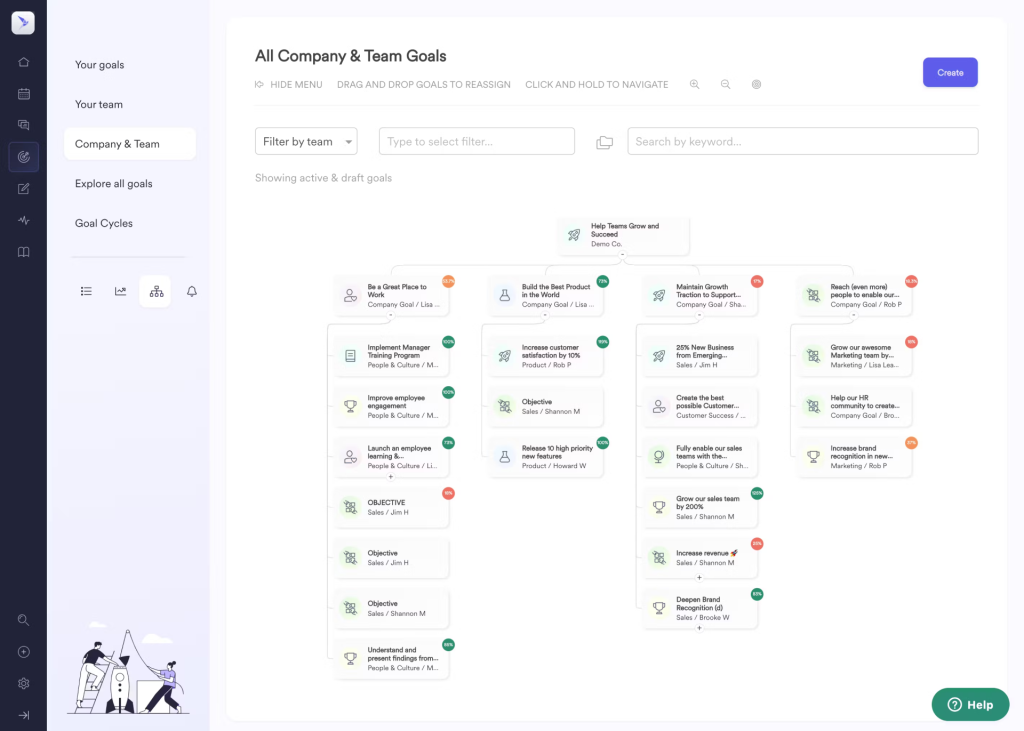
Leapsome is one of the only platforms that genuinely integrates performance reviews, OKRs, feedback, pulse surveys, and learning and development into a single connected system. If you want employee development to flow naturally from the feedback they receive, Leapsome is the strongest choice in this list.
When I ran a performance review cycle at a fast-scaling technology company, the biggest frustration was that feedback would identify skill gaps and then… nothing would happen. There was no connection between “you need to improve in X” and any actual development resources. Leapsome closed that loop for a company I worked with afterward — after a review surfaced leadership development gaps, the platform automatically surfaced relevant learning modules and connected them to the employee’s development plan.
The AI features generate personalized coaching suggestions based on 360-degree feedback, prompt managers and employees to give real-time feedback on an ongoing basis, and surface engagement analytics across the organization.
Pros:
- Tightly connected performance reviews, OKRs, feedback, and learning in one platform
- AI-generated coaching suggestions and development recommendations based on review data
- Strong continuous feedback features with automated prompts and nudges
- Excellent analytics for identifying competency gaps across teams and departments
Cons:
- Setup and configuration require meaningful HR time investment upfront
- Learning module may be redundant if you already use a dedicated LMS
Pricing:
Starts at $8/user/month.
8. Engagedly – Best for Combining Performance Management With Engagement Tools
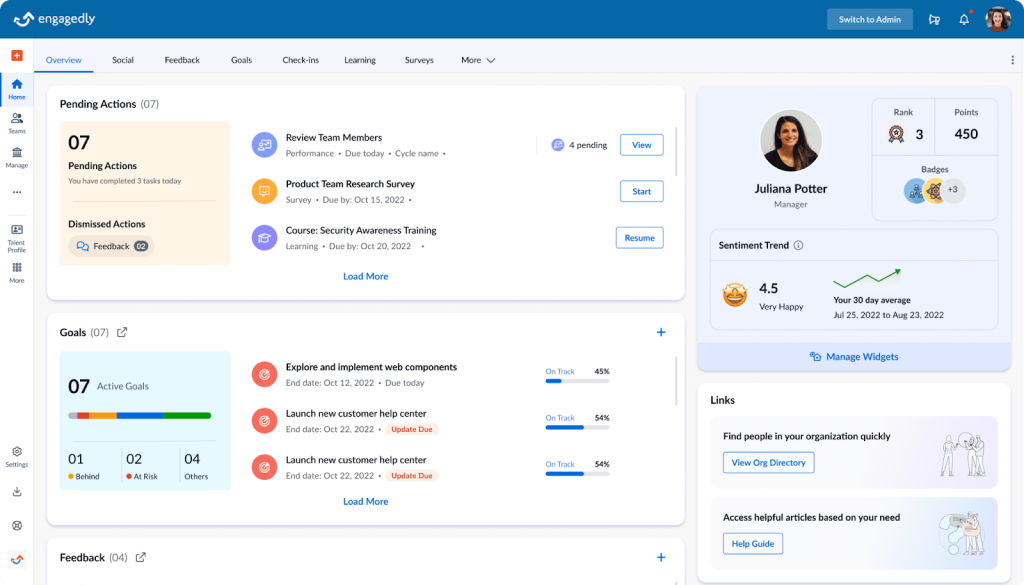
Image source: Engagedly
Engagedly combines performance management, employee engagement, and learning into a single platform with a distinctly gamified approach of badges, recognition, points, and leaderboards alongside 360 feedback, OKRs, and pulse surveys.
A friend who runs HR at a 200-person SaaS startup chose Engagedly specifically because their workforce was young, engagement was a constant struggle, and the gamification layer made participation feel less like compliance. The recognition badges, peer nominations, and points system drove genuine engagement with the feedback process, something they’d never managed with a traditional platform.
The AI features in Engagedly power continuous performance management with real-time feedback suggestions, goal recommendations, and engagement analytics. It’s particularly strong for organizations that want performance and culture management to feel like one unified experience rather than two separate HR programs.
Pros:
- Unique gamification features (badges, points, leaderboards) drive employee participation
- All-in-one platform combining performance, engagement, and learning management
- AI-powered goal recommendations and feedback suggestions
- Solid integration with major HRIS platforms and communication tools
Cons:
- Gamification elements may not fit every company culture
- UI can feel busy or complex for first-time users
Pricing:
Custom pricing.
9. Effy AI – Best for AI-Based 360 Feedback Software
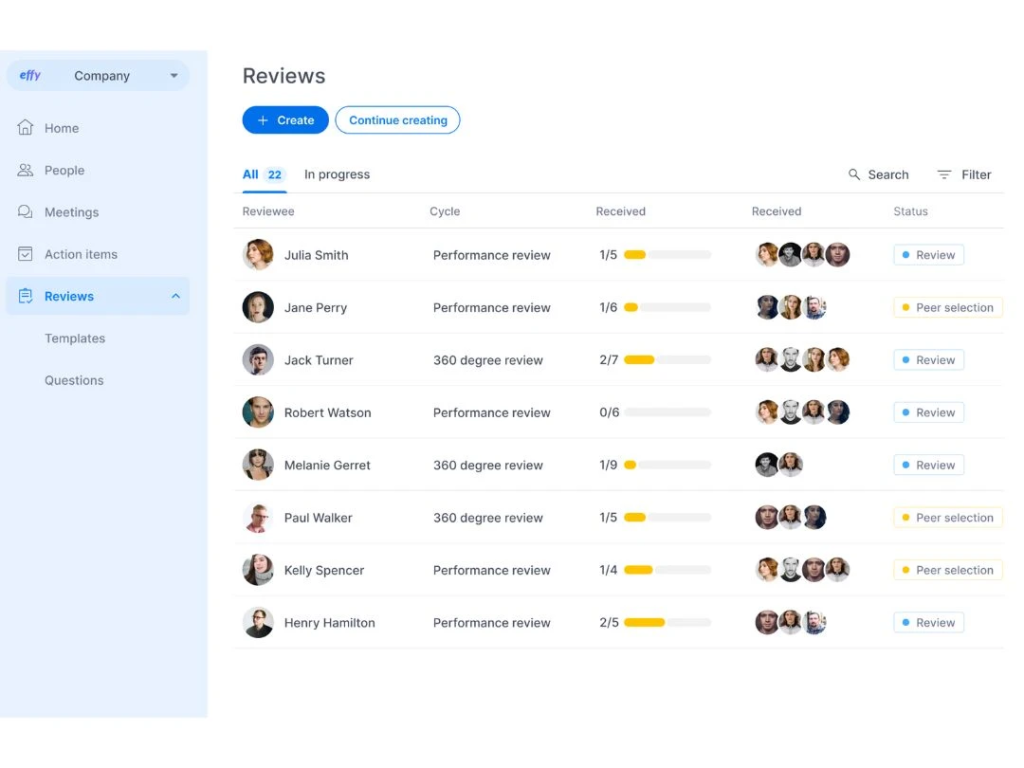
Image source: Techjockey
Effy AI is a purpose-built AI performance review tool focused on making 360-degree feedback fast, structured, and AI-summarized at the lowest price point in this list. It’s a strong option for small teams running their first 360 review who need simplicity over depth.
A colleague of mine at a 25-person startup tried Effy AI after spending an entire weekend trying to run a 360 review process in SurveyMonkey and nearly losing their mind managing data, following up with reviewers, and manually building reports. Effy AI handled all of it automatically: reviewer assignments, automated reminders, anonymous collection, and AI-generated individual reports that surfaced key themes and coaching suggestions.
It’s not the deepest platform in this list; there’s no full performance review cycle, advanced OKR tracking, or engagement survey module. But for teams whose primary need is AI-assisted 360-degree feedback that works fast and produces professional reports, it delivers excellent value for the price.
Pros:
- AI automatically generates individual performance report summaries from 360 responses
- Clean, simple interface with very low setup time — most teams launch in hours
- Automated reviewer reminders and anonymous feedback collection
- Strong value for money for small teams running occasional 360 reviews
Cons:
- Limited to 360 and performance reviews, lacks full OKR, engagement, or learning modules
- Not designed for complex multi-department review cycles or enterprise scale
Pricing:
Starts at $3.60/user/month.
10. Teamflect – Best for Teams Living Inside Microsoft Teams
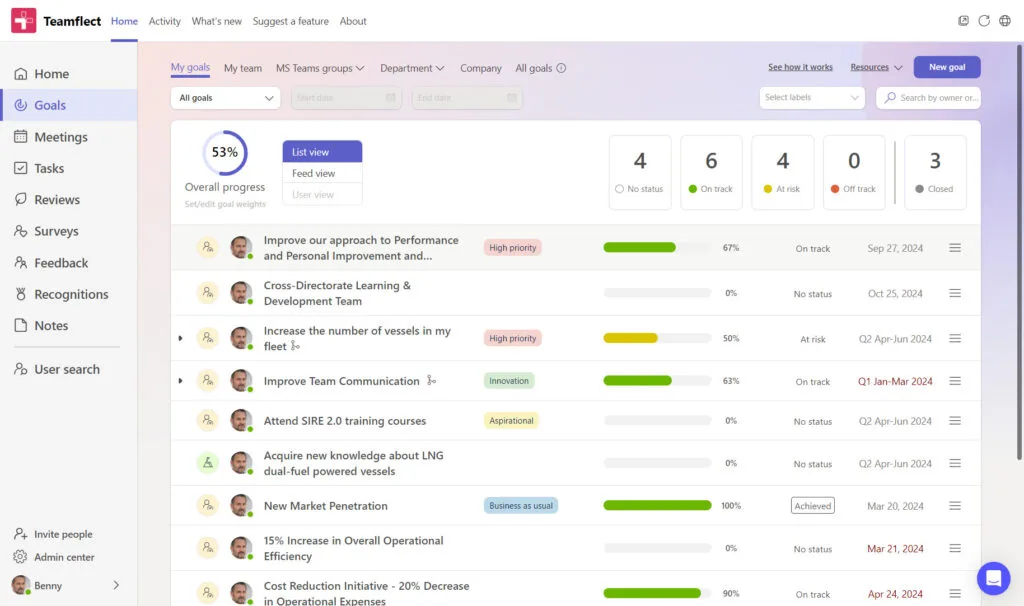
Image source: Teamflect
Teamflect is built entirely inside Microsoft Teams with reviews, 1:1s, OKRs, recognition, and feedback all happen directly in the Teams interface. For organizations already deep in the Microsoft 365 ecosystem, this eliminates the “yet another tool” problem entirely.
I came across Teamflect when helping a 150-person healthcare company that had tried and failed with three different performance tools — all because nobody would log in to a separate platform. Their workforce was 100% in Microsoft Teams every day. Once they moved to Teamflect, adoption hit 90%+ within the first month because the workflow lived where people already worked.
The AI features generate review summaries, suggest SMART goals based on team objectives, and surface coaching recommendations all inside Teams. The tradeoff is that Teamflect is more limited outside the Microsoft ecosystem, and deep customization is less flexible than standalone platforms.
Pros:
- AI-generated review summaries and SMART goal recommendations inside Teams
- Clean, familiar interface that drives exceptional adoption rates
- Strong 1:1 meeting management with agenda templates and action item tracking
- Accessible pricing with solid feature depth for Microsoft-centric organizations
Cons:
- Customization of review forms and workflows is less flexible than standalone tools
- Not designed for organizations with complex multi-HRIS environments
Pricing:
Starts at $5/user/month.
My Top 3 Picks for the Best AI Performance Management Tools
After going through all 10 tools in detail, these three consistently stood out across the criteria that matter most to real HR teams: ease of use, AI depth, customization, and value for money.
1. PeopleGoal
If I had to recommend one tool to an HR team formalizing their review process for the first time, it would be PeopleGoal. The no-code workflow builder means you are not dependent on IT to set anything up. The 360-degree feedback system is genuinely flexible, and the pricing per user makes it accessible for teams of almost any size.
2. Lattice
Lattice is the right choice for teams that have outgrown simpler solutions. The dashboards are excellent, the calibration tools make review cycles far more consistent across departments, and the overall experience feels polished. For mid-size to large teams that are serious about building a data-driven performance culture, it delivers.
3. 15Five
15Five approaches performance management from a completely different angle. Rather than starting with the annual review and working backwards, it starts with the weekly conversation and builds forward. If your biggest challenge is that managers and employees are simply not talking enough between review cycles, 15Five solves that problem better than almost anything else on this list.
How I Evaluated These AI Performance Management Tools
Every tool in this list was assessed using a consistent, unbiased framework built around what real HR teams, people managers, and business owners actually need from an AI performance management platform. Here is what I looked at:
- User Reviews and Ratings: I looked at real user feedback from trusted review platforms like G2, Capterra, and GetApp to understand how these tools perform in day-to-day use, not just in a sales demo. Ratings, recurring complaints, and praise from verified users all played a role in shaping my final assessments.
- AI Features and Core Functionality: I evaluated how deeply AI is actually built into each platform, covering capabilities like review draft generation, 360-degree feedback synthesis, goal tracking automation, engagement survey analysis, and coaching recommendations. Tools that use AI as a genuine workflow feature ranked higher in my list than those that treat it as a marketing add-on.
- Ease of Use and Adoption: In my experience, a performance management tool only works if your managers and employees actually use it. I assessed each platform’s interface, setup process, and learning curve, paying particular attention to how suitable it is for teams running their first formal review cycle with little to no HR tech experience.
- Customization and Flexibility: Every organization I have worked with runs performance differently. I looked at how much each tool lets you customize review forms, workflows, approval chains, goal structures, and feedback cycles, without needing a developer or a dedicated IT team to make it work.
- Integrations and Compatibility: I checked how well each tool connects with the systems HR teams already use, including HRIS platforms as well as communication tools like Slack and Microsoft Teams. Seamless integrations reduce manual work and increase adoption across the organization.
- Value for Money: I compared pricing against the depth of features offered at each tier. This was especially important to me for SMBs and first-time buyers who need a capable platform without paying for features they will never use.
Why Are HR Teams Adopting AI Performance Management Tools Right Now?
The shift toward AI in performance management isn’t just a trend; it’s a response to a process that has been broken for years. Here’s what’s driving HR teams to finally make the move.
1. The Traditional Review Process Is Broken
Most companies running on annual reviews face the same set of predictable failures: recency bias (reviews reflect only the last few weeks of work), generic feedback that employees can tell wasn’t personally written, and an administrative burden that makes managers dread review season.
According to a study by Gallup, 59% of managers and employees see little value in their current performance management process, and the cost of that broken process can run between $2.4 million and $35 million per year for a company with 10,000 employees. AI-powered platforms fix this by capturing performance signals continuously throughout the year, so review time becomes a synthesis exercise, not a memory test.
2. Most Companies Are Starting From Scratch, Not Upgrading
Here’s something the enterprise-focused blogs won’t tell you: the majority of companies buying AI performance management tools in 2026 are not switching from Workday or SAP. They’re escaping Excel files, fillable PDFs, and Google Docs.
They’ve never had a formal review process, and they’re implementing one for the very first time. If that sounds like your organization, you’re in good company, and these tools were built for you.
3. Managers Are Already Using AI
JPMorgan Chase now permits managers to use an internal AI chatbot to help compose performance write-ups, with the bank’s own guidance noting it should be a “starting point” and not a substitute for human judgment. But for most companies, there’s no policy in place — and managers are using ChatGPT on their own, pasting sensitive employee data into public large language models.
According to a study by Gartner in 2024, 87% of employees already believe algorithms could give them fairer feedback than their managers, which means the pressure to adopt AI responsibly is coming from both sides. The smarter, safer approach is purpose-built AI performance management software that keeps employee data secure, compliant with GDPR, and inside your organization’s systems.
How Does AI Performance Management Software Actually Work? (Step-by-Step)
If you have ever wondered what actually happens behind the scenes when an AI performance management tool is running, here is a simple breakdown.
Step 1: Continuous Data Capture – Building a Year-Round Record Instead of Relying on Memory
The system collects everything throughout the year, not just when a review is due. Check-in notes, goal updates, peer feedback, recognition shoutouts, and survey responses all get logged automatically. By the time review season arrives, there is already a full picture of each employee waiting for you, instead of a blank page and a foggy memory.
For example, if a software engineer closed three major bugs in Q1, received a peer shoutout in Q2, and flagged a blocker in their August check-in, all of that is already documented and timestamped without anyone having to remember it.
Step 2: Signal Synthesis – Turning Raw Data Into Patterns That Actually Mean Something
Once the data is collected, the AI gets to work analyzing it. It looks for patterns across all that information and surfaces the themes that matter most, like an employee’s top strengths, areas where they keep running into the same challenges, and whether their engagement levels have been trending up or down. This is the step where raw data turns into something actually useful.
For example, if an employee’s check-ins consistently mention being blocked by cross-team dependencies, the system flags that as a recurring obstacle, not a one-off complaint. That context is exactly what a manager needs to have a meaningful development conversation.
Step 3: Review Draft Generation – Giving Managers a Head Start Instead of a Blank Page
When the review cycle opens, instead of staring at an empty form, the manager gets a structured draft already waiting for them. That draft is built entirely from documented evidence collected throughout the year. No guesswork, no trying to remember what happened eight months ago.
The AI has done the heavy lifting, so the manager can focus on adding the context and nuance that only a human can bring. For example, instead of a manager spending two hours writing a review from scratch, they open a draft that already outlines the employee’s key contributions, goal progress, and areas for growth and spend 20 minutes refining it.
Step 4: Manager Refinement – The Human Step That Makes the Review Real
This is the most important step, and it is entirely human. The manager reads through the AI-generated draft, adds their own observations, adjusts the tone, and makes the final call on everything.
Think of the AI as a really good first draft, and the manager as the editor who makes it real. The AI is the assistant. The manager is always the author. For example, the draft might note that an employee met their sales targets, but the manager adds context that the employee did so while onboarding two new team members simultaneously, something the data alone would never capture.
Step 5: Calibration and Reporting – Making Sure Ratings Are Fair Across the Whole Organization
Once individual reviews are done, HR teams use dashboards and analytics to look at the bigger picture. Are ratings consistent across departments? Are certain managers grading significantly higher or lower than others? Are there outliers that need a second look?
This calibration step makes the whole process fairer and more transparent, and the data can be exported for leadership reports without anyone having to manually pull numbers from a spreadsheet.
For example, if one department head consistently rates their entire team as “exceeds expectations” while the company average sits much lower, the calibration dashboard flags that discrepancy for HR to review before ratings are finalized.
Step 6: Coaching Recommendations – Turning the Review Into a Starting Point, Not an Ending Point
The process does not stop at the review. For employees, the AI surfaces personalized development suggestions based on their feedback, recommends SMART goals for the next cycle, and points them toward learning resources that are actually relevant to where they want to grow.
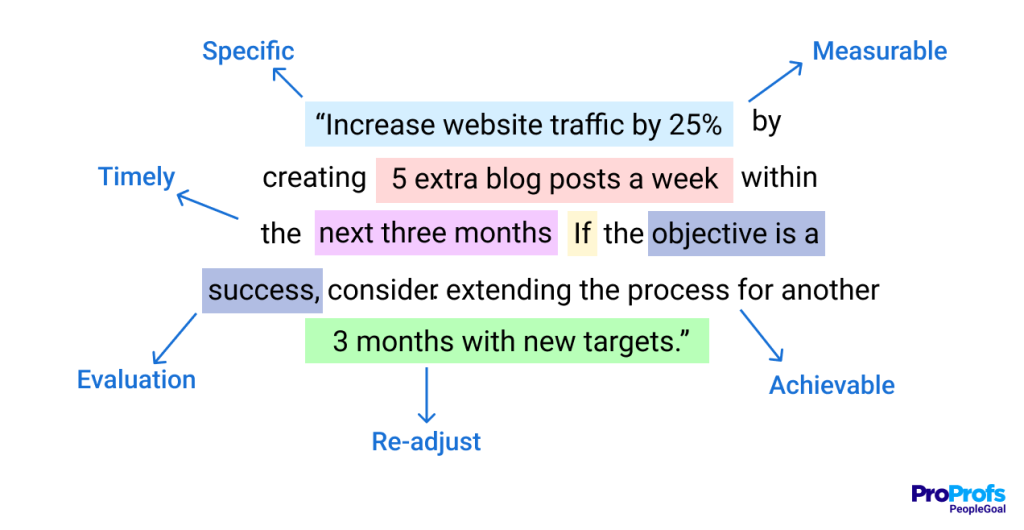
This is where performance management stops being a once-a-year event and starts feeling like ongoing support.
For example, if a product manager’s 360 feedback consistently highlights that they struggle to communicate upward, the system might recommend a specific communication course, suggest a SMART goal around executive presentations, and schedule a follow-up check-in in 60 days to track progress.
Important: AI should always support, never replace, human judgment in performance decisions. Promotions, pay changes, and terminations must always remain in human hands.
What Are the Real Benefits of AI in Performance Management?
Beyond saving time, AI in performance management solves problems that traditional review processes have failed to fix for decades. Here is what changes when you make the switch.
Benefit 1: Eliminating Recency Bias
The most documented failure of traditional performance reviews is recency bias. Managers disproportionately weigh what happened in the last 4 to 6 weeks over an employee’s performance across the full year.
AI tools that capture check-ins, feedback, and goal progress continuously produce reviews grounded in a 12-month picture, not a 3-week one.
Benefit 2: Saving Time at Scale
According to a study by Gartner in 2024, 87% of employees believe algorithms could give fairer feedback than their managers, and a big reason for that is simply that AI never forgets. For managers, AI-assisted review drafting reduces a task that typically takes 3 to 6 hours per employee down to a focused refinement session of minutes.
At an organization with 100 managers, even a 2-hour saving per review translates to 200 hours of reclaimed productivity per cycle.
Benefit 3: Reducing Bias and Improving Fairness
AI systems analyze performance data based on documented evidence rather than subjective impressions. When configured correctly, they can flag rating patterns that suggest inconsistency across demographic groups, a capability that manual review processes simply cannot replicate at scale.
Benefit 4: Connecting Performance to Development
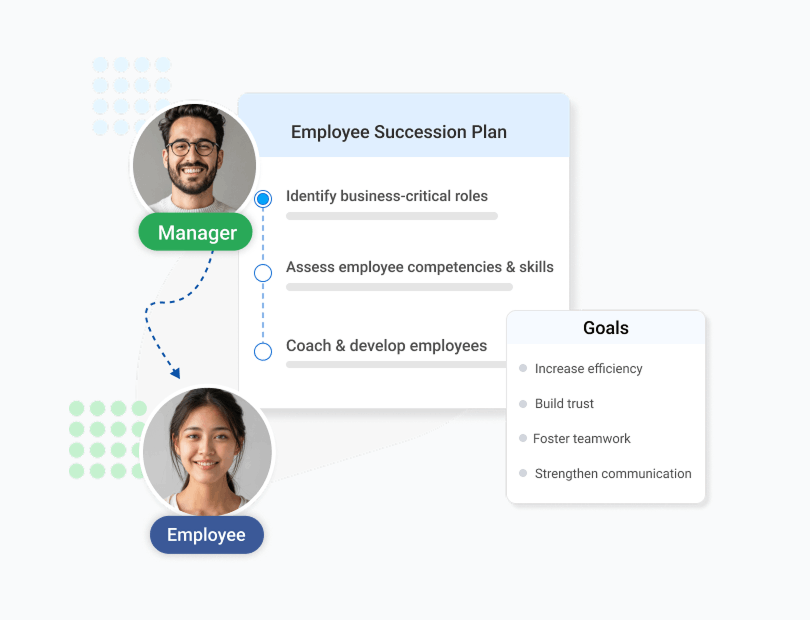
The best AI performance management tools do not just evaluate past performance. They generate forward-facing recommendations. When 360 feedback highlights a specific skill gap, AI can immediately surface relevant learning resources, suggest development goals, and schedule follow-up coaching conversations.
Benefit 5: Scaling Without Adding HR Headcount
For growing companies, the biggest pain point is that performance management workload scales with headcount but HR teams do not.
AI performance management software automates reminders, generates reports, synthesizes feedback, and surfaces insights so a two-person HR team can manage 500-person review cycles with confidence.
AI Performance Management vs. Traditional Performance Management — What’s the Difference?
If you are still on the fence about making the switch, this side-by-side comparison makes it pretty clear what you are leaving on the table.
| Factor | Traditional Performance Management | AI Performance Management |
|---|---|---|
| Review frequency | Annual or biannual | Continuous + structured cycles |
| Data sources | Manager memory + notes | Year-round check-ins, goals, feedback |
| Bias risk | High (recency, halo effect) | Reduced through documented evidence |
| Time to complete reviews | 3–6 hours per employee | Minutes with AI-drafted summaries |
| Feedback quality | Subjective, inconsistent | Structured, evidence-based, coached |
| Scalability | Degrades with headcount growth | Scales without proportional HR effort |
| Reporting | Manual exports, limited visibility | Real-time dashboards, automated reports |
| Employee experience | Annual surprise | Ongoing, transparent, developmental |
Start Managing Performance the Way Your People Actually Deserve
If there’s one thing that’s become clear from both the research and real buyer conversations, it’s this: AI in performance management isn’t about replacing the human side of feedback — it’s about giving managers the data, structure, and time to make that human side better.
Most teams buying in 2026 aren’t choosing between “AI-powered” and “traditional.” They’re choosing between doing performance management well or continuing to manage it badly in Excel. The tools in this list represent the best options at every price point and company size.
If you’re starting from scratch or finally formalizing your first real review cycle, start with PeopleGoal. A lot of teams in a similar position — moving away from spreadsheets, running their first formal review cycle, trying to get 360 feedback off the ground — have found it to be a practical starting point that grows with them.
The right AI performance management tool is the one your managers will actually use — and your employees will actually trust.
Frequently Asked Questions
Is AI in performance management safe to use?
Yes, when using purpose-built platforms with SOC 2 and GDPR compliance. The key risk is using public LLMs like ChatGPT for reviews. This exposes confidential employee data. Purpose-built AI performance management tools keep data secure inside your organization's systems.
Can AI performance management tools reduce bias in reviews?
AI can reduce certain types of bias by basing reviews on documented, year-round evidence rather than manager memory or recent impressions. However, AI can also encode historical biases from training data — regular audits and human oversight remain essential.
What is the difference between AI performance management software and traditional HR software?
Traditional HR software stores and schedules performance reviews. AI performance management software actively captures data continuously, synthesizes it into insights, drafts review language, flags at-risk employees, and generates personalized coaching recommendations turning performance management from an annual event into an ongoing process.
What AI performance management tools are best for small businesses?
For small businesses, PeopleGoal ($4/user/month) and Effy AI ($3.60/user/month) offer the strongest combination of AI features and affordability. PeopleGoal is the better choice for companies that need a full performance cycle with 360 feedback, OKRs, and engagement surveys in one platform.
How much does AI performance management software cost?
Most AI performance management tools start between $3–$9/user/month for SMBs. Enterprise platforms like Lattice, Culture Amp, and Betterworks use custom pricing. For a 100-person team, expect to budget $4,800–$10,800/year for a mid-tier platform with full AI capabilities.
Can AI write performance reviews on its own?
AI can generate draft performance reviews from documented data but it should never produce final, unreviewed content. The manager must always review, contextualize, and take responsibility for what is communicated to the employee. AI is the assistant; the manager is the author.
What is the best AI tool for 360-degree feedback?
PeopleGoal is consistently rated among the best for 360-degree feedback, offering customizable multi-rater workflows, anonymous feedback collection, AI-powered synthesis, and flexible reporting. Leapsome and Effy AI are strong alternatives depending on budget and depth requirements.
How do I implement AI in performance management for the first time?
Start by auditing your current process, whether it's paper, PDFs, or spreadsheets. Select a platform aligned to your company's size and workflow needs. Begin with a small pilot (one team or one review cycle), gather feedback, then roll out organization-wide. Most platforms like PeopleGoal can be configured and launched within 1–4 weeks.
Does AI performance management work for remote and hybrid teams?
Yes. AI performance management tools are particularly valuable for distributed teams where managers have less day-to-day visibility. Continuous check-ins, asynchronous feedback, pulse surveys, and AI-summarized performance data help managers stay connected to remote employees without adding meeting overhead.
What are the legal risks of using AI in performance management?
Using AI in employment decisions without proper disclosure, auditing, or human oversight can create legal exposure particularly related to discrimination, privacy, and labor law compliance. Always work with legal counsel when deploying AI-informed performance systems, and ensure your platform is GDPR-compliant with transparent model documentation.
Ready to 3x Your Teams' Performance?
Use the best performance management software to align goals, track progress, and boost employee engagement.