

Most performance goals don’t fail because people don’t care. They fail because they quietly turn into documents no one uses.
I’ve seen it happen often. Goals get written at the start of the year, saved, and forgotten until review season. Then everyone is just trying to recall what they meant.
According to Gallup in 2026, only 20% of employees strongly agree that their manager helps set clear work priorities. That’s the real problem.
It’s not that teams don’t value goals. They just don’t know how to make them useful in everyday work.
That gap between setting goals and actually using them is where things break.
In this guide, I’ll show you what effective performance goals look like, with real performance goals examples, simple frameworks, and ways to connect them to outcomes that matter.
What Are Employee Performance Goals and Why Do They Matter?
Performance goals aren’t a formality. When they’re built right, they do five things at once:
- Clarity over chaos: Employees know exactly what’s expected and how success will be measured, which cuts out the ambiguity that kills accountability.
- Alignment from top to bottom: Company objectives cascade from leadership down to individual contributors, so every goal connects to a business outcome.
- A fair review foundation: Goals give managers something concrete to evaluate, not just impressions or recency bias during performance reviews.
- Development with direction: When goals include a growth component, employees have a roadmap for skill development that serves both their career and the business.
- Motivation through ownership: Co-created, visible goals increase engagement because people invest more in targets they helped shape.
The SMART Framework: How to Write Goals That Hold Up
Before I give you the employee performance goals examples, you need the framework behind them. Because a list of goals without structure is just a wishlist.
The SMART framework is the most widely used methodology for writing performance goals, and for good reason. It turns vague intentions into measurable commitments.
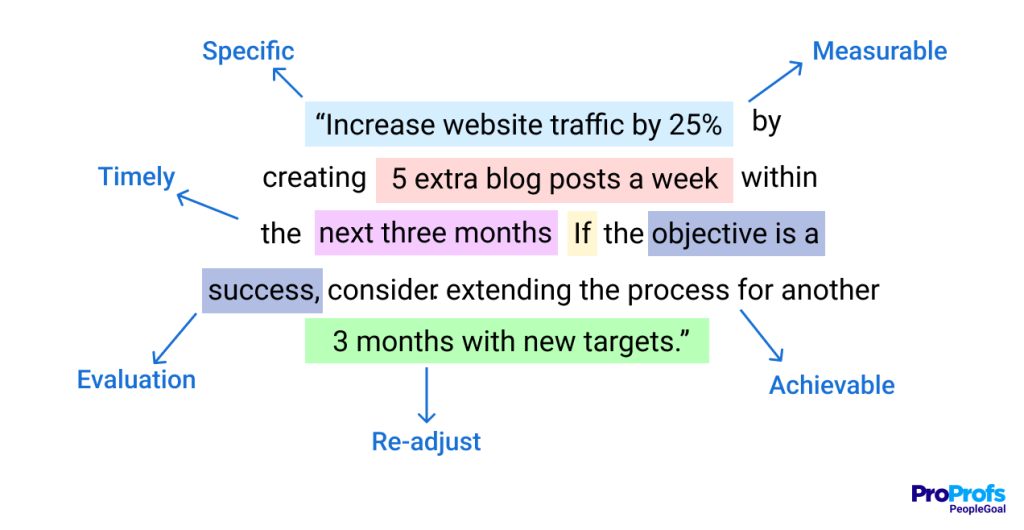
S: Specific – The goal names a clear outcome, not a general direction. “Improve communication” is not specific. “Complete a presentation skills course and deliver one cross-functional update per month.”
M: Measurable – There is a number, percentage, or observable output attached. You need to be able to answer: how will we know this was achieved?
A: Achievable – The goal stretches the employee without being unrealistic. A goal that feels impossible destroys motivation faster than having no goal at all.
R: Relevant – The goal connects to the employee’s role, their team’s priorities, and the company’s direction. Goals that feel irrelevant get deprioritized immediately.
T: Time-bound – There’s a deadline, a review checkpoint, or a defined cycle. “By the end of Q3” is a time-bound constraint. “Eventually” is not.
Here’s a simple before-and-after that shows the difference:
Weak goal: Improve customer satisfaction.
SMART goal: Increase our NPS score from 42 to 55 by the end of Q3 by implementing a post-resolution follow-up process and tracking feedback weekly.
The second version is something a manager and employee can both point to, track, and evaluate honestly. That’s what you’re building toward.
50 Best Employee Performance Goals Examples by Role and Category
Let me break down the examples of performance goals the way I think about them: by role and by category. Use these as starting points, not copy-paste answers.
Every goal should be adapted to the person’s specific context. I’ve also organized employee productivity goals, leadership targets, and development objectives as separate categories so you can go straight to what’s relevant for your team.
- Productivity and Output Goals (Employee Productivity Goals)
- Leadership and Management Goals
- Collaboration and Communication Goals
- Professional Development Goals
- Sales Goals
- Customer Service Goals
- HR and People Operations Goals
- Engineering and Technical Goals
- Finance and FP&A Goals
- AI and Digital Fluency Goals
Productivity and Output Goals (Employee Productivity Goals)
If you’re not sure where to start with goal-setting, start here. These are the goals that show up most often in performance reviews because they’re tied directly to output, timelines, and measurable results, which makes them the easiest to write and the hardest to argue with during evaluation.

1. Reduce average ticket resolution time from 3 days to 1.5 days by Q2 by implementing a first-response checklist and priority triage system.
2. Complete at least 95% of assigned project milestones on time over the next two quarters by improving personal planning with weekly task reviews.
3. Increase personal output by 20% this quarter by identifying and eliminating two recurring time sinks through a documented time audit.
4. Process and close 30% more client accounts per month by standardizing the proposal workflow and removing approval bottlenecks.
5. Deliver monthly reports 2 business days earlier than the current average by building an automated data pull from existing dashboards.
Leadership and Management Goals
Leadership goals are where a lot of managers struggle, not because they don’t know what good leadership looks like, but because they’ve never had to put a number on it.
The employee performance goals examples below give you a way to make influence, coaching, and decision-making trackable without turning them into a checklist.
6. Conduct structured one-on-one meetings with each direct report bi-weekly, and document two action items per session to improve consistency of coaching conversations by Q3.
7. Increase team engagement scores by 10 points on the next pulse survey by implementing a recognition practice and addressing the top two friction points raised in the last survey.
8. Develop one high-potential team member for a senior role by creating an individual development plan and reviewing it monthly for the next six months.
9. Lead at least two cross-functional initiatives in the next quarter to expand influence outside the immediate team and improve collaboration with product and marketing.
10. Reduce manager-to-decision time on routine approvals by 40% by documenting a clear authority matrix and training the team to act within it.
Collaboration and Communication Goals
“Be a better communicator” is one of the most written and least useful goals I’ve seen. The fix is not to avoid this category but to attach a behavior to every intention. Here’s how collaboration and communication goals look when they actually have teeth.
11. Contribute at least three substantive comments or updates per week in project channels to improve async visibility and reduce status meetings.
12. Present a summary of the team’s quarterly wins to senior leadership once per quarter to build stakeholder visibility and practice executive communication.
13. Co-create a team working agreement with direct reports and review it at the end of every quarter to address any friction that has emerged.
14. Reduce recurring meeting time by 25% over the next two months by auditing the current meeting cadence and replacing 3 standing meetings with structured async updates.
15. Improve cross-departmental response speed to under 4 hours during business hours by agreeing on communication SLAs with adjacent teams.
Professional Development Goals
These are the goals that matter most to the employee but get cut first when managers run out of time during review prep. Build them in from the start. When individual growth connects to a business need, employee development goals stop being a nice-to-have and start being a retention strategy.
16. Complete a relevant certification or course in the next 90 days, and apply at least one new skill to a current project with documented outcomes.
17. Read two industry-relevant books or reports per quarter and share a one-page summary with the team to build a shared knowledge base.
18. Attend at least one external conference or networking event this half and bring back three actionable takeaways presented to the broader team.
19. Shadow a senior colleague in a different function once per month for a quarter to develop cross-functional understanding and expand career perspective.
20. Complete PeopleGoal’s Skill Development framework with your manager this quarter and define three competency-building milestones tied to your growth roadmap.
Sales Goals
Sales teams already live and die by numbers, but there’s a difference between a quota and a goal. A quota tells you the outcome. A goal tells you the outcome, the method, and the timeline.
These employee performance goals examples show what that looks like when applied to the full sales motion, from prospecting through to close.
21. Close 12 new accounts this quarter with an average deal size of $8,000+ by improving discovery call structure and focusing pipeline on qualified mid-market segments.
22. Increase outbound prospecting activity from 20 to 35 meaningful touches per week by blocking two daily prospecting hours and using a structured outreach cadence.
23. Improve proposal-to-close rate from 22% to 30% by end of Q3 through better objection handling and introducing a competitive positioning document.
24. Generate $180,000 in pipeline this quarter from net-new accounts by targeting two new verticals identified in the last strategic planning session.
25. Reduce average sales cycle from 45 days to 32 days by implementing a structured follow-up process and tracking deal stage progression weekly.
Customer Service Goals
Customer service goals need to balance speed, quality, and knowledge, and when any one of those is missing from the goal, the others suffer. The examples below give you targets across all three dimensions, so your team is improving the full customer experience, not just one metric in isolation.
26. Achieve a customer satisfaction (CSAT) score of 90% or above for the next two quarters by improving first-contact resolution and collecting post-interaction feedback.
27. Reduce escalations to Tier 2 support by 30% in Q2 by identifying the top five recurring issue types and building a self-service resolution guide for the team.
28. Complete product knowledge certification within 60 days and demonstrate applied understanding by resolving complex queries without escalation in at least 80% of cases.
29. Decrease average handle time from 9 minutes to 6.5 minutes by Q3 by building a personal response template library for the 20 most common customer queries.
30. Maintain a first-response time of under 2 hours for all priority tickets, tracked weekly and reviewed in monthly performance check-ins.
HR and People Operations Goals
HR teams often set goals for everyone else while their own objectives get buried in administrative work.
These employee performance goals examples are built specifically for People Ops professionals who need to show measurable impact on hiring, onboarding, retention, and the performance processes they’re responsible for running.
31. Reduce time-to-hire for open roles from 42 days to 28 days by Q3 by pre-screening candidates faster and improving the hiring manager briefing process.
32. Improve 90-day new hire retention by 15% by redesigning the onboarding checklist and assigning a buddy for every new employee’s first month.
33. Increase completion rate of quarterly performance reviews from 65% to 90% by automating reminders and simplifying the review form structure.
34. Launch a company-wide pulse survey by the end of Q1 and deliver a leadership summary within 5 business days of close, with at least three recommended actions.
35. Build and roll out a standardized goal-setting process across all departments by Q2, including templates, manager training, and integration with PeopleGoal’s OKR tracking workflow.
Engineering and Technical Goals
Engineering goals work best when they cover both the technical output and the team contribution, not just the code.
These work performance goals examples span quality, performance, learning, and knowledge sharing, so your engineers have goals that reflect what strong technical performance actually looks like in practice.
36. Reduce production bug rate by 20% over the next two sprints by adding integration tests for all new features and reviewing pull requests within 24 hours.
37. Complete the AWS Solutions Architect certification by the end of Q2 and apply at least one architectural improvement to a current system.
38. Refactor the top three highest-complexity modules identified in the last code review, reducing the average complexity score by 30% within the quarter.
39. Lead one architecture discussion or tech talk per month for the next quarter to build a culture of knowledge sharing across the engineering team.
40. Improve API response time for the core product endpoints from 800ms to under 300ms by the end of Q3 through profiling, caching, and query optimization.
Finance and FP&A Goals
Finance goals are where precision matters more than volume. One well-defined goal focused on forecast accuracy or close-cycle efficiency can have a greater organizational impact than five vague objectives focused on “supporting leadership decisions.”
These work performance goals examples give you the specificity that Finance roles deserve.
41. Reduce the monthly close time from 8 days to 5 business days by Q3 by automating three manual reconciliation steps and standardizing data sources.
42. Build a rolling 12-month cash flow forecast model by the end of Q1 and review it monthly with the CFO and CEO to improve financial visibility.
43. Improve budget variance accuracy to within 5% for all departments by redesigning the budget submission process and adding a mid-quarter reforecast checkpoint.
44. Deliver one competitor financial benchmarking report per quarter to give leadership visibility into market positioning and spending trends.
45. Automate the monthly P&L reporting process by integrating data pulls from three source systems, reducing manual effort by at least 4 hours per month.
AI and Digital Fluency Goals
AI and digital fluency goals are becoming increasingly important as teams are expected to improve efficiency, adapt to new technologies, and streamline repetitive work without sacrificing quality.
These work performance goals examples focus on practical AI adoption, workflow optimization, and measurable productivity improvements across modern roles.
46. Complete an AI-assisted workflow training program by Q2 and reduce time spent on one recurring task by 20% through a documented before-and-after process comparison.
47. Identify and automate one manual reporting or administrative process per quarter using AI or workflow automation tools, reducing monthly effort by at least 3 hours.
48. Evaluate and pilot two AI tools relevant to the team’s workflow by the end of Q3 and present a documented recommendation with expected efficiency gains, risks, and implementation requirements.
49. Reduce repetitive documentation or communication work by 25% over the next quarter by using AI-assisted drafting, summarization, or meeting note tools while maintaining quality standards.
50. Complete one advanced course or certification related to AI, automation, or digital productivity tools this half and apply at least one learned skill to improve an existing team workflow.
How Do You Align Employee Performance Goals With Company Objectives?
Here’s something that most goal lists miss entirely: individual employee performance objectives don’t exist in a vacuum. If your team is setting goals without knowing what the company is trying to achieve this year, you’re optimizing in the wrong direction.
Cascading goals is the process of connecting company-level objectives all the way down to individual employee performance objectives. Here’s how it works in practice.
Step 1: Define Company-Level OKRs
Leadership sets 3 to 5 strategic objectives for the year or quarter. These are the outcomes the business needs to hit.
Step 2: Translate Into Team Objectives
Each department identifies how they contribute to those company-level objectives. The finance team’s goal of reducing operating costs connects to the company’s profitability objective. The customer success team’s retention goal connects to the company’s revenue growth objective.
Step 3: Set Individual Goals That Roll Up
Each employee’s goals are built to support their team’s objectives. The individual sales rep’s quota goal connects to the team’s revenue target, which connects to the company’s growth objective.
Step 4: Make Alignment Visible
This is where most organizations fail. Goals are set in silos, filed in different documents, and never connected visually.
In PeopleGoal’s OKR software, you can cascade goals from the company level down to the department and individual, with a live dashboard that shows every employee exactly how their work connects to the bigger picture. No more guessing, no more disconnected spreadsheets.
Step 5: Review and Update Quarterly
Goals that made sense in January may be irrelevant by April if business priorities shift. Build in a structured quarterly review, so goals stay connected to what actually matters right now.
How Do You Track Workplace Performance Goals Without Losing Your Mind?
Setting goals is the easy part. Tracking them consistently is where most managers give up and revert to Excel, which results in the same problems they had before.
Here’s what functional goal tracking actually requires:
1. Measurable Checkpoints, Not Just End-of-Year Reviews
Every goal needs at least one mid-point check-in built in. Without it, you find out too late that someone is off-track, and there’s nothing left to do but document it for the review.
A single source of truth. When goals live in three different places, tracking becomes a coordination problem, not a performance problem. Everyone should be looking at the same dashboard.
2. Automated Reminders That Replace Manual Chasing
If your goal tracking system requires a manager to send follow-up emails to collect updates, you’ll get inconsistent data.
PeopleGoal’s OKR software sends automated weekly check-in nudges integrated with Slack and Microsoft Teams, so updates happen inside the tools your team is already using.
3. Status Visibility at a Glance
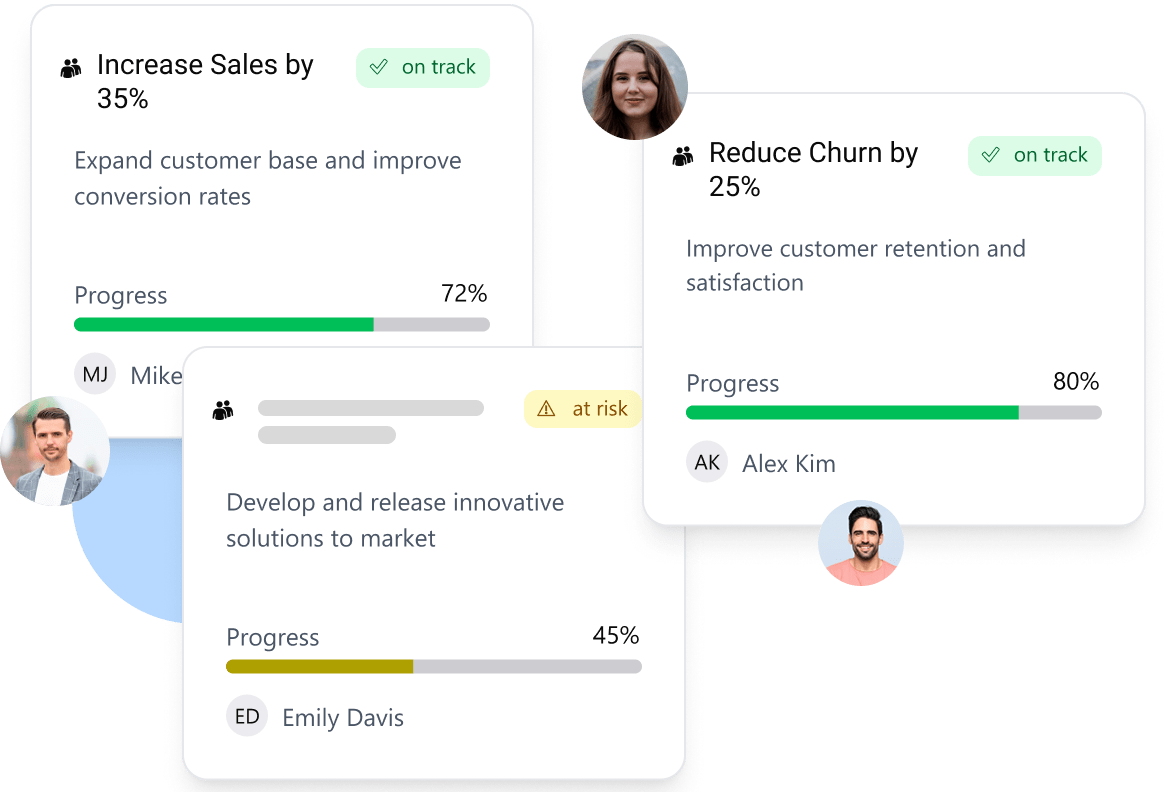
Managers should be able to see in under 60 seconds which goals are on track, which are at risk, and which need an immediate conversation.
PeopleGoal’s live dashboards give you exactly that, with real-time department and org-wide reports filtered by person, team, or review cycle.
4. Connection to Performance Reviews
This is the piece that closes the loop. Goals tracked through the year should feed directly into the review conversation, not require a separate data gathering exercise. When goal data, feedback, and review forms exist in one system, managers spend their review time on meaningful coaching, not administrative catch-up.
Weak Goal vs. Strong Goal: Real Rewrites
Let me show you exactly what separates a goal that produces accountability from one that produces paperwork.
| Weak Goal | Strong Goal |
| Improve team communication | Hold bi-weekly team syncs and reduce status meetings by 30% through documented async updates by end of Q2 |
| Be more productive | Increase project output by 25% this quarter by blocking two 90-minute deep work sessions per day and auditing weekly time usage |
| Develop leadership skills | Mentor two junior team members with bi-monthly 1:1s and document their progress toward one defined skill goal each |
| Better customer relationships | Increase account NPS from 38 to 52 by Q3 through monthly business reviews and a post-resolution follow-up protocol |
| Improve technical knowledge | Complete AWS certification by end of Q2 and apply one architectural improvement to a live system with documented results |
| Be a better collaborator | Contribute to at least two cross-functional projects this half and document outcomes in a shared team knowledge base |
The pattern here is simple: weak goals describe intentions. Strong goals define outcomes, timelines, and methods. If you can’t answer “how will we know this was achieved?”, the goal isn’t ready yet.
How Do You Turn Soft Skills Into Measurable Performance Goals?
One of the biggest challenges in performance management is quantifying soft skills. “Be a better communicator” tells you nothing. Here’s how to make soft skill goals actually measurable.
- Accountability: Document all project mistakes within 24 hours with a written root cause analysis and one preventive action to avoid recurrence, tracked monthly.
- Problem-solving: Resolve at least 80% of team-level blockers independently without escalating to the manager, reviewed during monthly one-on-ones for the next quarter.
- Adaptability: Successfully lead one project that involve a significant scope change mid-delivery, completing on time with documented learnings shared with the team.
- Emotional intelligence: Collect structured 360-degree feedback from three peers at mid-year with a focus on collaboration and active listening, and discuss results with a manager within two weeks.
- Ownership and initiative: Identify one recurring process inefficiency per quarter, propose a solution, and implement it with measurable results before the end of the following quarter.
The key to soft skill goals is tying the behavior to an observable action and attaching a feedback mechanism.
PeopleGoal’s 360 Feedback software is built exactly for this: you can benchmark competencies like communication, leadership, and collaboration with weighted scores across multiple raters, so soft skill development becomes part of the formal record.
How Can You Set Sustainable Performance Goals That Actually Last?
High performance is not just about output. Organizations that ignore well-being in their goal-setting end up with high performers burning out and leaving. Here are performance goals for employees examples that build sustainable performance into your culture.
- Establish a team working agreement that includes defined response time windows outside core hours, reviewed and renewed each quarter.
- Use all scheduled PTO within the calendar year, tracked by HR and flagged if usage falls below 80% by mid-year.
- Reduce after-hours Slack and email activity by 20% over Q2, tracked through communication analytics and reviewed in monthly one-on-ones.
- Participate in at least one team wellness initiative per quarter, whether mental health programming, ERG involvement, or structured peer support.
- Managers set a goal to complete skip-level conversations with each of their team members once per quarter to surface workload and engagement issues early.
These goals signal to employees that performance is not just about output, and that the organization cares about how results are achieved, not just whether they are.
Ready to Build a Goal System That Lasts?
If you’ve made it this far, you have everything you need to write goals that are specific, measurable, connected to business outcomes, and actually useful in a performance review conversation.
The missing piece for most teams isn’t knowledge of how to write goals. It’s a system that keeps those goals alive between January and December.
PeopleGoal gives you OKR and SMART goal tracking, cascading alignment from company to individual, automated check-ins, 360 feedback, real-time dashboards, and review workflows, all in one platform that integrates with the tools your team already uses.
So, replace your goal-tracking spreadsheets with a system that actually drives performance.
Frequently Asked Questions
What are the benefits of setting employee performance goals?
Structured employee performance goals improve clarity, accountability, and alignment across the organization. Research by Locke and Latham shows that specific and challenging goals consistently produce higher performance than vague or general ones. Practically, they give employees direction, give managers an objective evaluation framework, reduce bias in performance reviews, accelerate professional development, and connect individual work to business outcomes. Organizations with strong goal-setting systems also see measurable improvements in engagement and retention.
Why should managers define clear performance goals for employees?
Managers who define clear employee performance objectives remove the ambiguity that consistently drives disengagement and turnover. When employees know exactly what they are working toward and how it connects to the team's priorities, they focus better, make faster decisions, and feel more ownership over their results. Clear goals also protect managers during review time: when expectations were explicit from the start, feedback conversations are grounded in agreed-upon outcomes rather than perceived effort or personality.
How many performance goals should an employee have?
Three to five well-defined goals per review cycle tend to outperform long lists of minor targets. When employees have too many goals, focus dilutes and accountability drops. For quarterly cycles, two to three focused goals is often enough. Annual reviews can support four to five, especially when one or two include a longer-term development or career growth component. Quality and specificity matter far more than quantity.
How do you write performance goals for employees in hard-to-measure roles?
Focus on outputs and behaviors rather than activity. Even roles without clear numerical KPIs, like executive assistants, creative directors, or L&D specialists, produce observable results: projects delivered on time, stakeholder satisfaction scores, process improvements implemented, or quality of deliverables assessed through peer review. Competency-based goals with 360 feedback are particularly effective here, as they turn behavioral targets into trackable data points across multiple raters.
How do you handle performance goals when priorities change mid-year?
Goals should be treated as living documents, not annual commitments fixed in stone. Build a formal quarterly review checkpoint where goals can be updated, paused, or replaced if the business context has shifted. Document the change and the reason so year-end reviews reflect what was actually achievable, not a target set before a major strategic pivot or market change. Organizations using PeopleGoal can update goal status, add notes, and adjust timelines directly within the platform so the record stays accurate in real time.
Ready to 3x Your Teams' Performance?
Use the best performance management software to align goals, track progress, and boost employee engagement.