Talent development strategies are structured methods organizations use to build employee skills, leadership readiness, and internal mobility in line with business goals. The most effective strategies include skills-based development, 360-degree feedback, OKR alignment, individual development plans, succession planning, and continuous performance coaching. When managed well, these strategies improve retention, promotion readiness, and workforce performance.
“We are putting effort into development, but it does not feel structured. It does not feel measurable.”
I hear this more often than I should. Smart HR leaders. Ambitious companies. Real investment in people. Yet growth still feels inconsistent and hard to track. The issue is not commitment. It is the design. When talent development lives across spreadsheets, forms, and annual review documents, it becomes fragmented and invisible.
Gallup reports that only 21% of employees believe their performance metrics are within their control. That tells us something important. People are working hard, but they cannot clearly see how effort connects to progress.
Over time, this creates a divide. Some organizations build integrated, continuous development systems. Others run isolated programs that never compound. In this blog, I break down the strategies, frameworks, operating model, and tools needed to build a talent development system that actually delivers results.
What Is Talent Development, and Why Does It Matter?
Talent development is the deliberate process of expanding employee capabilities, aligning individual growth to organizational goals, and building the internal bench strength needed to lead the business forward.
Its strategies are structured, data-backed approaches that help organizations identify employee strengths, close skill gaps, align individual growth with business goals, and build leadership pipelines, all in a continuous, measurable system rather than a once-a-year event.
Here is why it matters now more than ever:
- Skill half-life is shrinking. Technical skills are becoming obsolete every 18–24 months due to AI and automation.
- Internal hiring beats external. Internal promotions are faster, cheaper, and produce higher engagement than external hires.
- Transparency drives retention. Employees stay when they can see a clear, documented path for their future in the organization.
- The “training trap” is real. Companies that develop talent without a structured retention strategy risk building skills only to lose the person to a competitor.
What Are the Best Talent Development Strategies?
The best talent development strategies are not isolated initiatives. They are structured, data-driven systems that connect skill building, performance management, and business goals into one continuous process.
Below are the proven strategies that help organizations build leadership pipelines, close skill gaps, and turn employee growth into measurable business impact.
| Strategy | Primary Focus | Business Impact |
|---|---|---|
| Skills-Based Development | Build capabilities over roles | Closes skill gaps, improves agility |
| 360-Degree Feedback | Leadership and behavioral insights | Identifies high-potentials, reduces blind spots |
| Cascading OKRs | Align growth with business goals | Makes development measurable and relevant |
| Individual Development Plans (IDPs) | Structured employee growth | Improves execution and career progression |
| High-Potential Identification | Leadership pipeline building | Reduces bias, strengthens succession |
| Continuous Performance Development | Ongoing feedback and coaching | Improves engagement and retention |
| Succession Planning | Future leadership readiness | Minimizes disruption, ensures continuity |
| Modern Learning Modalities (70-20-10) | Practical, real-world learning | Accelerates skill development |
| Talent Development ROI Tracking | Measure business impact | Secures executive buy-in and budget |
| Integrated Development Platform | System and workflow alignment | Reduces admin, improves visibility |
1. Build a Skills-Based Development Foundation (Not a Job Title Hierarchy)
Here is something I wish someone had told me earlier: the moment you stop organizing development around job titles and start organizing it around skills, everything changes.
The old model organized development around job titles. The new model organizes it around skills and competencies.
Skills-based development means:
- Defining the specific capabilities required at each level of the organization
- Assessing employees against those capabilities (not just their job description)
- Creating development paths that are fluid — employees can grow sideways, diagonally, and upward
When I work with HR teams on this, the implementation always comes down to three practical steps:
- Create a competency framework for each function (leadership, technical, interpersonal)
- Use skill assessments at the start of every development cycle
- Allow employees to self-identify skill goals, then validate with manager input
PeopleGoal’s development module lets you build custom competency frameworks and link them directly to performance cycles, so skills gaps surface automatically, not during an annual review scramble.
2. Deploy 360-Degree Feedback as a Leadership Development Engine
I have reviewed a lot of development tools over the years. If I had to pick one strategy that shows up consistently in the highest-performing HR teams I have seen, it is structured 360-degree feedback — no contest.
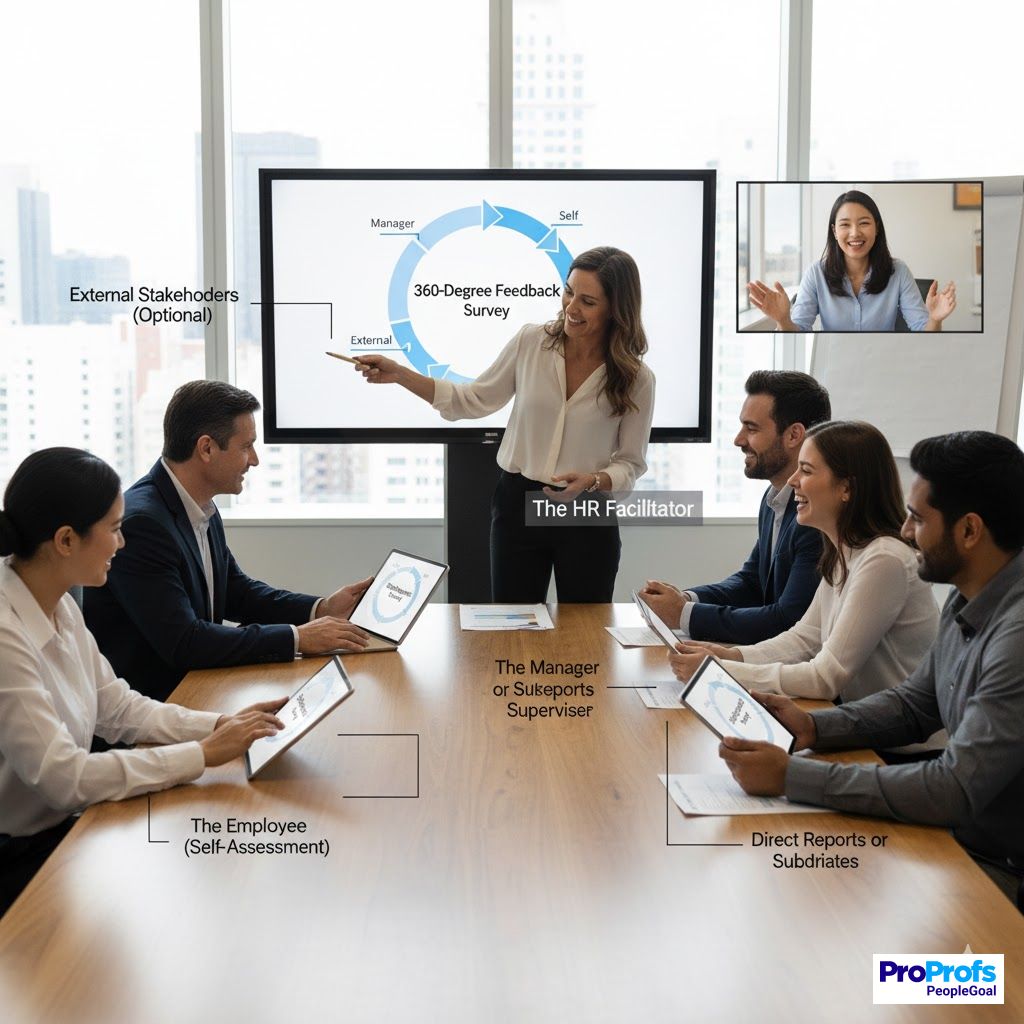
Anonymous, multi-rater feedback does three things no other tool can:
- It surfaces blind spots that self-assessments and manager reviews miss
- It creates a data-rich baseline for Individual Development Plans
- It builds a culture of feedback that normalizes growth conversations
Here are the use cases I run into most frequently:
- Identifying the top 25% of high-potential employees for leadership tracks
- Elevating director-level leadership before a senior promotion
- Creating baseline assessments for new managers within their first 90 days
- Building cultural alignment post-acquisition by establishing shared behavioral standards
360 Feedback Implementation Checklist:
- Define the competencies being evaluated (leadership, communication, execution, etc.)
- Select evaluators: direct manager, peers, direct reports (and self)
- Automate evaluator assignment and reminder workflows
- Ensure anonymity for all non-manager responses
- Schedule debrief conversations within 2 weeks of results
- Link 360 insights directly to IDP action items
PeopleGoal supports multi-manager, multi-rater 360 workflows with automated evaluator selection and reminder sequences, so HR isn’t chasing responses through Slack.
3. Cascade OKRs to Connect Individual Growth to Company Goals
Cascading OKRs improve talent development by linking employee skill growth to team and company goals. This makes development measurable, business-relevant, and easier to prioritize.
It looks like activity, but it does not move the business. I have seen well-intentioned programs fall apart for exactly this reason.
The most effective development strategies I have seen link individual growth plans directly to team and company OKRs. When an employee’s skill development directly contributes to a Q3 company objective, development stops being a “nice to have” and becomes operationally essential.
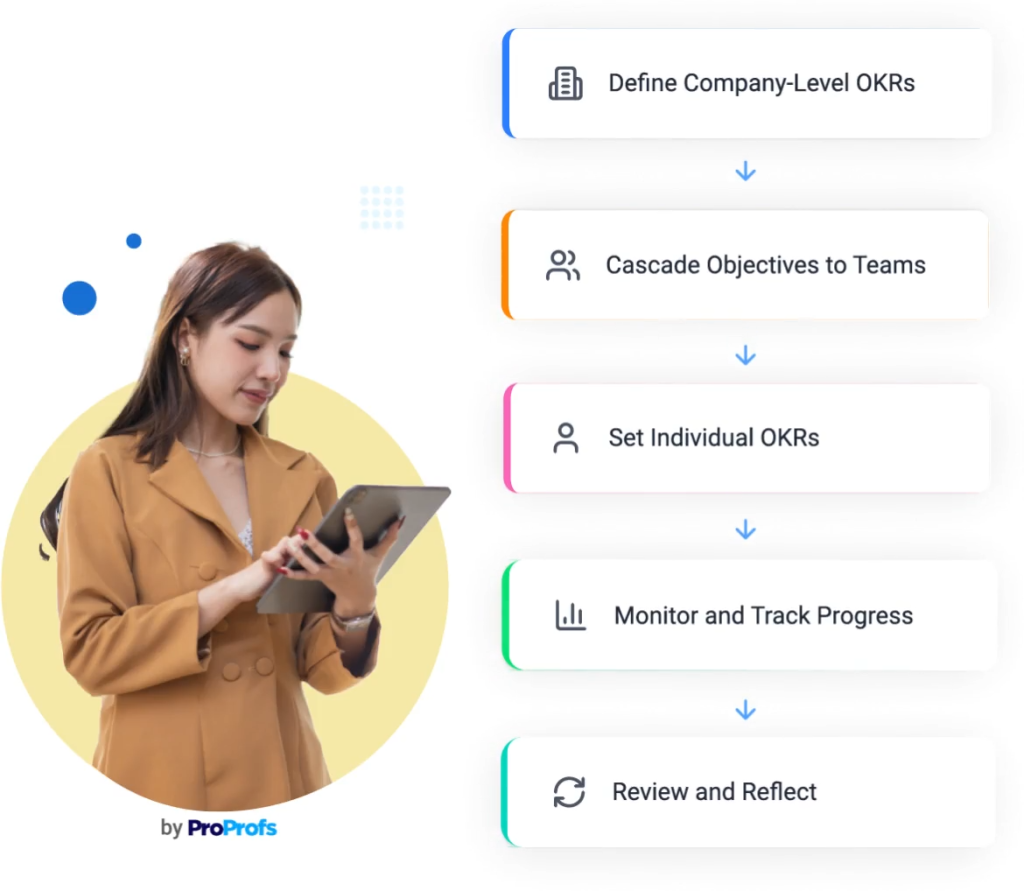
How to cascade OKRs for development:
| Level | OKR Example | Linked Development Goal |
|---|---|---|
| Company | Expand enterprise sales by 40% | Sales team completes negotiation training |
| Team | Improve NPS by 15 points | CS team builds active listening and escalation skills |
| Individual | Own 3 strategic accounts | Account manager completes executive communication course |
Once the cascade is in place, here is what you actually need to be watching:
- Goal completion rates by quarter
- Alignment scores (are individual goals tied to team goals?)
- Check-in frequency (weekly is optimal; monthly is the floor)
- Progress visibility across teams
The biggest mistake I see? Goals are set in January and reviewed in December. Quarterly OKRs with monthly check-ins are non-negotiable in a continuous development model.
4. Create Individual Development Plans That Actually Get Used
I will be honest: most IDPs I have come across are a waste of everyone’s time. Not because people do not care, but because they are written as documents rather than workflows. They sit in a shared Google Drive folder untouched for 11 months, and nobody is surprised when nothing changes.
An effective IDP is not a PDF. It is a living plan with:
- Specific skills to develop (not generic “improve communication”)
- Milestones and timelines (30/60/90-day checkpoints)
- Resources assigned (mentor, course, stretch project)
- Manager accountability built in (scheduled review touchpoints)
- Connection to promotion criteria or compensation review
IDP Template Structure:
| Employee Name:
Role and Level:Review Period: Current Strengths (from 360/assessment data): Priority Development Areas (max 3): 1. [Skill] → [Action] → [Timeline] → [Resource] 90-Day Milestones:Manager Check-in Schedule:Promotion Readiness Indicators: |
PeopleGoal’s development planning tools allow managers and employees to co-create IDPs within the platform, with automated check-in reminders and progress tracking built directly into the workflow.
5. Build a High-Potential Identification Program (Not Just Gut Feel)
This is one of the most common conversations I have with People leaders: “We think we know who our high-potentials are, but we have no objective process to confirm it.” I hear it constantly and I get it.
The instinct is often right. The problem is that instinct alone does not scale, and it absolutely creates bias you probably cannot see.
Gut feel creates bias. Structured identification creates a leadership pipeline.
The nine-box grid approach: The nine-box talent matrix popularized by McKinsey, plots employees on two axes: current performance (low to high) and future potential (low to high). This creates 9 talent segments that inform development investment decisions.
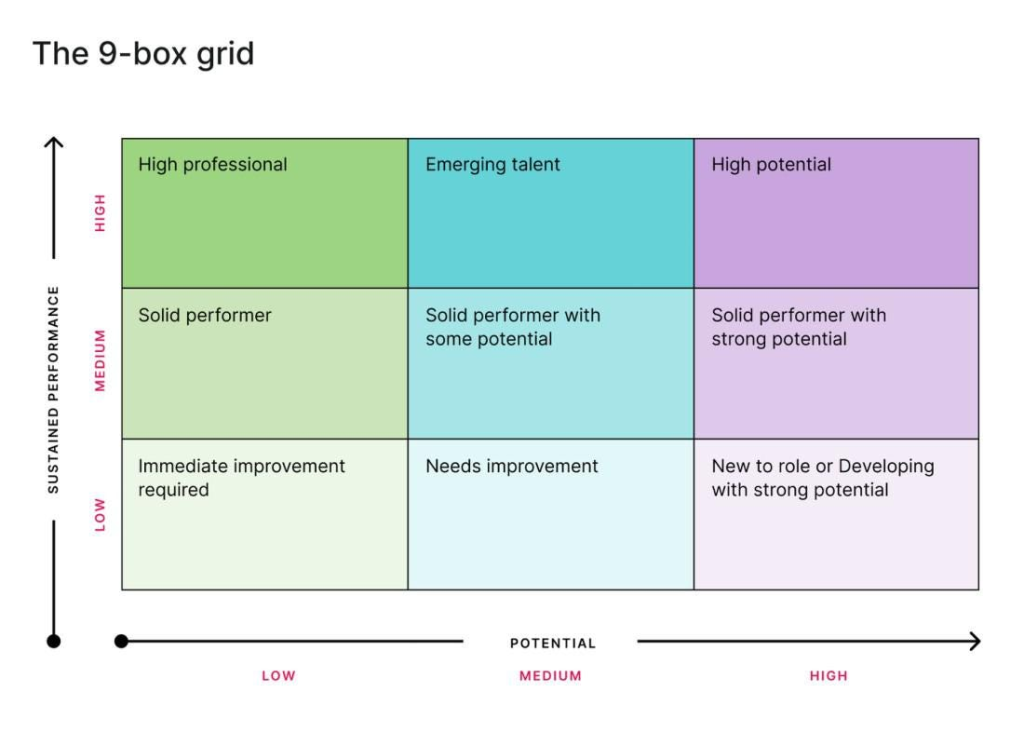
- Top right (high performance, high potential): Leadership pipeline candidates — invest heavily
- Middle band: Solid performers — develop for lateral growth and retention
- Bottom left: Low performance, low potential — address performance, not development
Before you run your first calibration session, make sure you have covered these basics:
- Use data from 360 feedback, goal completion, and performance reviews — not just manager opinion
- Calibrate across multiple managers in a committee session (reduces individual bias)
- Define “potential” explicitly: does it mean leadership aspiration, learning agility, or role expansion?
- Review and update the nine-box at least twice per year
Once high-potentials are identified, build explicit development tracks: executive mentoring, stretch assignments, cross-functional projects, and succession planning conversations.
6. Move From Annual Reviews to Continuous Performance Development
It’s simple: the annual review is not development. It is documentation. And there is a big difference.
Real development happens in the moments between reviews — in weekly one-on-ones, in real-time feedback after a high-stakes presentation, in the coaching conversation that happens the day an employee misses a target.
The shift I advocate:
| Old Model | New Model |
|---|---|
| Annual performance review | Monthly development check-ins |
| Year-end ratings | Continuous performance data |
| Manager-only feedback | Multi-directional feedback |
| Static goal setting | Quarterly OKR cycles |
| Development as HR event | Development as management habit |
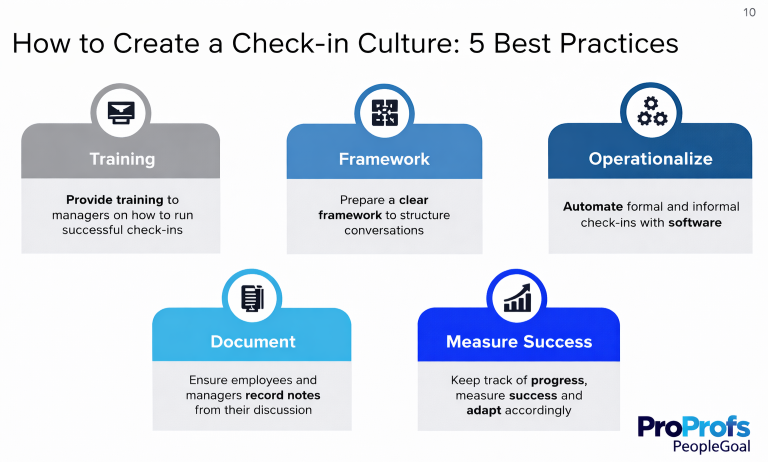
In practice, this is what a continuous development rhythm actually looks like week to week:
- Weekly 15-minute manager check-ins (not status updates — growth conversations)
- Monthly goal progress reviews with documented notes
- Quarterly 360 feedback cycles for leadership roles
- Real-time recognition tied to specific behaviors and competencies
7. Design a Succession Planning Framework Before You Need It
Most organizations I talk to start thinking about succession the moment someone hands in their notice. By then, you are already behind by six to twelve months. I have seen it derail quarters, destabilize teams, and push good people out the door while leadership scrambles.
Succession planning is a development strategy, not an emergency response. When built properly, it creates:
- Clear promotion criteria that employees can see and work toward
- Leadership pipeline depth at every level (not just executive succession)
- Reduced organizational disruption during leadership transitions
- A culture where high performers see a future inside the company
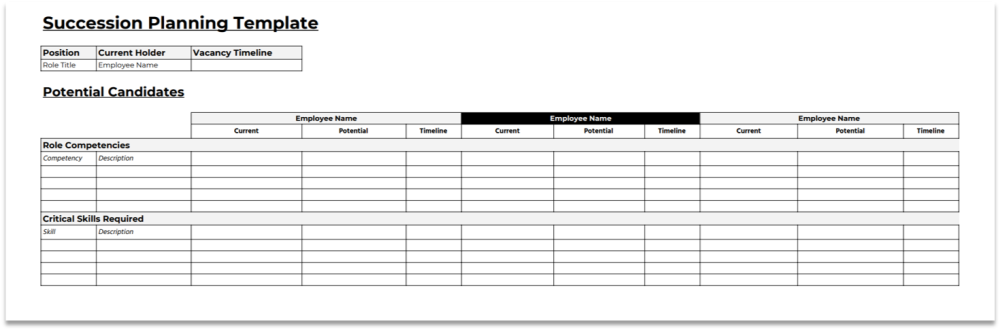
Succession Planning Framework:
Step 1: Identify critical roles (roles where a vacancy would create operational risk)
Step 2: Assess readiness for each role
- Ready now: Could step in within 30–60 days
- Ready in 1 year: Identified, needs specific development
- Ready in 2–3 years: High-potential, needs leadership track
Step 3: Build development plans for each successor. Connect their IDP directly to the competencies required for the target role.
Step 4: Use promotion readiness indicators. Traffic-light KPI systems (red/amber/green) give both employees and leadership visibility into where each candidate stands.
Step 5: Review quarterly. Succession plans must be live documents, not annual presentations.
8. Use Learning Modalities That Match How Adults Actually Learn
One of the biggest mistakes I see in talent development is this: organizations invest heavily in training, but very little of it actually sticks. Not because employees don’t want to learn, but because the way learning is delivered doesn’t match how adults develop skills in real-world environments.
Adults don’t learn effectively through long courses or passive content alone. They learn by doing, by solving real problems, and by getting feedback in the flow of work.
This shift in how you think about learning is what separates programs that look good on paper from those that actually change behavior.
The 70-20-10 development model remains the most validated framework:
- 70% from on-the-job experience (stretch assignments, new projects, cross-functional work)
- 20% from social learning (mentoring, peer coaching, feedback conversations)
- 10% from formal learning (courses, workshops, certifications)
Most organizations invert this. They spend 80% of their L&D budget on formal training (courses, conferences) and almost nothing on structured on-the-job or social learning.
When I think about what actually moves the needle for high-potentials, these are the interventions I come back to again and again:
- Stretch assignments: Give high-potentials projects slightly beyond their current capability
- Peer coaching circles: Small groups of peers with complementary skills exchange challenges and feedback
- Mentorship programs: Pair high-potentials with senior leaders for 6–12 month relationships
- Microlearning modules: Short, targeted learning (under 10 minutes) delivered in the flow of work
- After-action reviews: Structured debrief conversations after major projects or milestones
Pro Tip: One-on-one coaching and peer-to-peer learning produce better development outcomes than passive video content or mandatory compliance courses.
9. Measure Talent Development ROI (And Talk to the C-Suite in Their Language)
If I had a dollar for every time I heard an HR leader say “we know development matters but we can’t get budget for it” I would fund the program myself. The problem is almost never the executive team’s willingness. It is that the business case is being made in the wrong language.
Executives speak in revenue, margin, and cost. “Employee development improved engagement” does not move budgets. These metrics do:
The KPIs that get executive buy-in:
| Metric | What It Measures | Why It Matters |
|---|---|---|
| Internal Promotion Rate | % of open roles filled internally | Validates pipeline depth |
| Time-to-Competency | How fast new hires or promoted employees reach full productivity | Measures development efficiency |
| High-Performer Retention Rate | % of top quartile retained year-over-year | Quantifies cost avoidance (replacing a senior hire costs 1.5–2x salary) |
| Promotion Velocity | Average time between promotions for high-potentials | Signals leadership pipeline health |
| 360 Score Improvement | Change in competency ratings between cycles | Proves development is working |
| Development Plan Completion Rate | % of IDPs with documented progress | Measures execution, not just intent |
Here is the exact framing I use when making the ROI case to a CFO:
If your average senior manager salary is $120,000 and the replacement cost is 1.5x that ($180,000), retaining 5 high performers through structured development saves $900,000 in recruitment costs alone before factoring in productivity loss and institutional knowledge.
That is the number you bring to the CFO.
10. Replace Manual, Fragmented Tools With an Integrated Development Platform
Every strategy I have laid out above will stall if you try to run it across six tools that do not talk to each other. I have watched great talent programs collapse under their own admin weight and it is almost always the same story:
- Excel spreadsheets for goal tracking
- Google Forms for 360-degree feedback
- PDFs for development plans
- Power BI dashboards disconnected from your HR data
- Slack messages for manager check-ins
The result is what I hear constantly: too much admin work, zero unified view of performance and development, and reports that take days to compile.
An integrated performance management and development platform solves this by:
- Centralizing all development data (360 results, goal progress, IDP status, check-in notes)
- Automating workflows (evaluator assignment, check-in reminders, review cycle triggers)
- Creating real-time reporting (who has an IDP, who is on track, who is at risk of leaving)
- Integrating with existing tools (Workday, BambooHR, ADP, Slack)
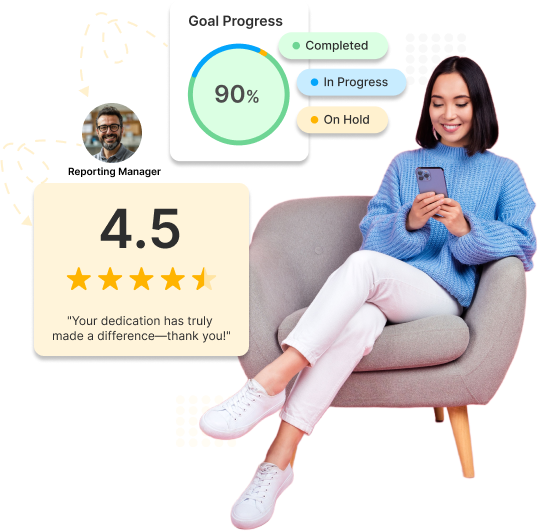
PeopleGoal is built specifically for this. The platform supports custom 360 workflows, cascading OKRs, development planning, talent matrices, and manager dashboards — all in one place. You do not replace your HRIS; you connect to it. Here’s what this looks like in practice.
Now that you are aware of all the strategies, you must be wondering, “How do you choose the best talent development strategies for your organization?” That’s why I have created this talent development strategy selection guide:
| If Your Organization Is… | Your Primary Challenge | Start With This Strategy | Why This Works |
|---|---|---|---|
| Scaling from 100–500 employees | Inconsistent performance and unclear expectations | Skills-Based Development Foundation | Creates structure before chaos scales |
| Growing quickly across regions | Leadership gaps and uneven management quality | 360-Degree Feedback + Leadership IDPs | Surfaces blind spots and builds management consistency |
| Mature company with low mobility | High-performer attrition | Succession Planning + Nine-Box Calibration | Creates visible growth paths and internal mobility |
| Revenue-driven organization | Development not tied to business outcomes | Cascading OKRs | Connects skill growth directly to company targets |
| HR team overwhelmed by admin | Fragmented tools and manual reporting | Integrated Development Platform | Centralizes data and reduces operational friction |
| Budget-constrained mid-sized business | Need measurable ROI | ROI Tracking + Internal Promotion Metrics | Makes development defensible at the executive level |
| Industry facing rapid skill shifts (Tech, AI, Manufacturing) | Skill obsolescence risk | Skills Framework + Continuous Learning Model (70-20-10) | Keeps capabilities aligned with future demand |
| Large enterprise with succession risk | Critical role dependency | Formal Succession Framework | Protects against leadership disruption |
What Are the Key Benefits of Talent Development Strategies?
When executed properly, talent development strategies do not just improve HR processes. They create measurable business outcomes across performance, retention, and workforce planning.
Here is why talent development is beneficial:
- Stronger leadership pipeline: Internal candidates are ready to step into senior roles, reducing disruption and eliminating last-minute scrambling when someone exits.
- Higher retention of top performers: High-potentials who see a clear, documented growth path are far more likely to stay. Lack of visibility is often what pushes them out.
- Faster time-to-competency: New hires and promoted employees reach full productivity 50% faster when development is structured and tracked.
- Lower recruitment costs: Internal promotions avoid the 1.5–2x annual salary replacement cost typically associated with external hiring.
- Better workforce planning: Skills data and succession maps provide 12–36 month visibility into capability gaps before they become urgent problems.
- Improved engagement scores: Employees who feel invested in and supported consistently show higher engagement, as Gallup research consistently shows year after year.
- Stronger learning and development integration: Development plans linked directly to learning resources ensure training spend is targeted and aligned with real skill gaps
- Reduced manager administrative burden: Automated workflows replace spreadsheets, manual follow-ups, and scattered documentation, freeing managers to focus on coaching instead of coordination.
What Are the Implementation Challenges of Talent Development Strategies?
Let me be clear. Developing a talent management strategy is not conceptually difficult. Most of the frameworks in this guide are well understood. The real challenge is execution inside a live organization with limited time, competing priorities, and human resistance.
Here are the most common roadblocks I see, and how to handle them.
1. Managers Often Resist Talent Development Because They See It as Extra Work
Managers often see development as an added responsibility rather than part of their core role. When positioned as an HR requirement, it gets deprioritized.
Fix: Frame development as a time-saver. Show how structured check-ins reduce year-end review stress and improve team performance.
2. Teams Experience Change Fatigue From Past Initiatives That Didn’t Stick
Employees and managers can become skeptical when previous programs faded after launch, making them less likely to engage with new initiatives.
Fix: Start with a focused 90-day pilot tied to a real business metric. Prove impact before scaling.
3. Tool Fragmentation Makes It Difficult to Track and Manage Development
Disconnected systems create reporting chaos and prevent a unified view of employee performance and growth.
Fix: Implement a development layer that integrates with your HR stack and centralizes feedback, goals, and IDPs.
4. Lack of Executive Buy-In Limits the Impact of Development Programs
When talent development is framed as an HR activity instead of a business driver, it becomes vulnerable to budget cuts.
Fix: Translate programs into cost savings, promotion velocity, and productivity gains.
5. Workforce Planning Blind Spots Lead to Reactive Hiring Instead of Development
When development is not aligned with future capability needs, organizations end up hiring reactively instead of building internal talent.
Fix: Align succession planning and talent matrices with 12–36 month business forecasts.
From Framework to Execution: Making Development Work
Talent development is no longer a nice HR initiative. It is a business strategy. The strongest organizations build skills, leadership pipelines, and succession depth in a structured, measurable way.
They move beyond annual reviews and treat development as a continuous system powered by 360 feedback, cascading OKRs, living IDPs, and clear promotion pathways. They also measure what matters, from internal promotion rates to retention of high performers, so development conversations translate into real business outcomes.
The biggest shift is operational. Strategy only works when execution is simple, centralized, and visible. That is where integrated platforms like PeopleGoal help connect performance, feedback, goals, and development into one scalable system.
If you are rethinking how your organization grows its people, start by assessing where your current process feels fragmented and where visibility is missing. That is usually where the real opportunity lies.
Frequently Asked Questions
Should talent development focus only on high-potential employees?
High-potentials absolutely need structured acceleration, but development shouldn’t stop there. If you only invest in the top 10–20%, you risk disengaging solid performers who make up the backbone of your business. A strong strategy develops everyone while giving extra structure and visibility to future leaders.
How do you prioritize development when budgets are limited?
Start where the business impact is highest. Focus on roles tied directly to revenue, customer retention, or operational continuity. Then look 12–36 months ahead. What skills will you need that you don’t have today? Invest there first. Development should follow strategy, not trends.
How do you ensure managers actually execute development plans?
Development fails when it lives only in HR documents. Managers need clear expectations, scheduled check-ins, and visible accountability. Tie development conversations to performance KPIs and make IDP reviews part of the manager’s own evaluation. What gets measured gets managed.
What competencies should every leadership development program include?
At a minimum, focus on communication, strategic thinking, decision-making, coaching ability, emotional intelligence, and execution. These competencies consistently separate managers from leaders. The exact mix may vary by industry, but these fundamentals apply almost everywhere.
How do you prevent bias in talent development decisions?
Bias creeps in when one manager controls the narrative. Use multi-rater feedback, standardized competency frameworks, and cross-team calibration sessions. When performance data, 360 insights, and peer input all contribute, decisions become far more objective and defensible.
How often should competency frameworks be updated?
Review them annually to ensure they still reflect business priorities. Then plan for a deeper refresh every 2–3 years, especially if technology, market demands, or strategy shifts significantly. Competencies should evolve with your business.
How do you align talent development with workforce planning?
Start by mapping where the business is headed, like new markets, automation initiatives, leadership expansion. Then connect succession planning and skill gap analysis directly to those future needs. Development should prepare you for the roles you’ll need tomorrow, not just improve today’s performance.
What role does employee self-assessment play in development?
Self-assessments build ownership and awareness. They encourage employees to reflect on their strengths and growth areas. But they shouldn’t stand alone. Pair them with 360-degree feedback or manager input to balance perception with reality and avoid blind spots.
How do you scale talent development globally across regions?
Standardize the competencies, review cycles, and IDP templates so everyone speaks the same language. Then allow flexibility in how regions execute locally. A centralized system ensures consistent data and benchmarking while respecting cultural differences.
What is the difference between talent development and talent management?
Talent management and development strategy are two different concepts. Talent management practices cover the entire employee lifecycle, from hiring to retention. Talent development specifically focuses on building the capabilities of the people you already have.
Who should own talent development in an organization?
Ownership should be shared. HR or L&D designs the framework, managers execute development conversations, and employees take responsibility for their growth plans. When one group carries it alone, accountability weakens, and execution suffers.
Ready to 3x Your Teams' Performance?
Use the best performance management software to align goals, track progress, and boost employee engagement.