
Most mid-year performance reviews don’t fail because managers don’t care. They fail because six months of performance gets condensed into a single conversation built on memory, scattered notes, and incomplete context.
The result is feedback that feels vague, employees who leave unsure where they stand, and little improvement afterward. The impact is significant.
According to Gallup’s State of the Global Workplace 2026 report, global employee engagement fell to 20% in 2025, its lowest level since 2020, highlighting the need for better manager-employee conversations and stronger performance practices.
The good news is that effective mid-year reviews don’t require a complicated process. They require a clear framework, meaningful feedback, and actionable follow-through.
Whether you’re managing a team of five or fifty, in this guide, I will show you how to run mid-year performance reviews that create alignment, support employee growth, and improve results in the second half of the year.
What Is a Mid-Year Performance Review?
This distinction matters. A mid-year review is not a mini-annual review. It’s a course-correction tool. Done right, it gives you and your team a six-month runway to fix problems, recognize momentum, and align on what matters most going into year-end.
Here’s why it matters:
- Prevents year-end surprises: Employees who receive consistent mid-year feedback are far less likely to be blindsided by a low year-end rating
- Catches goal drift early: Business priorities shift. A mid-year review lets you formally acknowledge that and reset expectations before they become a source of conflict
- Creates a feedback record: Documentation from mid-year reviews gives you data when it’s time to make promotion, compensation, or succession decisions
- Identifies who needs what: High performers, developing employees, and those at risk all need different support. Mid-year reviews give you the information to differentiate your approach
- Increases employee engagement: Employees who feel their manager is genuinely invested in their growth are significantly more likely to stay and perform
How Is a Mid-Year Review Different From an Annual Review?
This is one of the most common questions I get from managers, and it’s worth answering clearly before you design your process.
| Basis | Mid-Year Review | Annual Review |
| Primary purpose | Course correction and recalibration | Evaluation and compensation decisions |
| Tone | Coaching and forward-looking | Summative and backward-looking |
| Ratings | Optional, informal | Formal and tied to outcomes |
| Outcome | Updated goals, development plan | Final rating, comp decision |
| Length | 30-60 minutes | 60-90 minutes |
| Frequency | Once mid-year | Once annually |
What Should Be Included in a Mid-Year Performance Review?
There are six components every solid mid-year review should cover. I’ll walk through each one with enough detail that you can build this into your process directly.
1. Goal Progress Review
What to cover: Go through every SMART goal, OKR, or KPI set at the start of the year. For each one, ask: Is it on track, at risk, or off track? What’s the evidence?
Don’t just ask “how are your goals going?” That gets you vague answers. Come in with the actual numbers. If an employee was supposed to close 20 accounts by mid-year and they’ve closed 11, that’s the starting point for a real conversation.
What to do with off-track goals: Three options. Recommit with a revised plan, adjust the target if business context has genuinely changed, or deprioritize it entirely if it’s no longer relevant. All three are valid. What’s not valid is leaving it ambiguous.
Sample questions to ask:
- Which goals are you most proud of your progress on, and what drove that?
- Which goals are you behind on, and what’s the main obstacle?
- Have any of your goals become less relevant given how the business has shifted?
- What would you need from me or the organization to get back on track?
With PeopleGoal’s OKR and SMART Goal Tracking, goals set at the start of a cycle stay live and visible throughout the period. Managers see real-time progress. Employees update their status without chasing HR for forms.
Here’s a quick video to understand this better:
2. Competency and Behavior Assessment
What to cover: Goals tell you what someone has achieved. Competencies tell you how they did it. Both matter for a complete performance picture.
Here’s how you conduct this assessment:
- Pick four to six competencies relevant to the role: communication, collaboration, problem-solving, ownership, quality of work, and leadership (for managers).
- Rate each one informally or use a simple scale. The point is to move beyond tasks and outputs into the behaviors that drive long-term performance.
Common mistake: Many managers skip this because it feels subjective. But leaving it out means your review only tells half the story. An employee can hit their numbers while leaving a trail of damaged relationships behind them. Competency assessment catches that.
Standardizing competency ratings across your team is harder than it looks without a shared system. One manager’s “meets expectations” on communication is another manager’s “developing.”
When you’re making promotion or compensation decisions across teams, that inconsistency creates real problems. A shared platform like PeopleGoal’s 360 Feedback Software helps.
It collects structured input from managers, peers, direct reports, and external stakeholders in one place. It supports anonymous response collection, automated evaluator selection, and weighted scoring so multi-rater feedback produces patterns, not noise.
Sample rating framework for competency scoring:
| Level | Description |
| Exceeds expectations | Consistently demonstrates this competency at a level above what’s expected for the role |
| Meets expectations | Demonstrates this competency reliably and at the expected level for the role |
| Developing | Shows early signs of this competency but needs continued coaching and development |
| Below expectations | Has not yet demonstrated this competency at the required level; intervention needed |
3. Self-Assessment Review
What to cover: Before the meeting, ask employees to complete a self-assessment. Then use the meeting to compare perspectives. Where you agree, reinforce. Where you disagree, have the conversation. The mid-year performance review examples below give employees a starting point so they’re not staring at a blank form.
Self-assessments matter for two reasons.
- First, they force employees to articulate their own performance in terms of impact, not just activity.
- Second, they give you a signal of how someone perceives their own standing.
A high performer who underrates themselves needs one kind of conversation. An underperformer who overrates themselves needs a very different one.
Employee self-assessment questions (give these out one week before the meeting):
- What are your two or three biggest accomplishments in the first half of this year? What was the measurable impact?
- Which of your goals are on track? What contributed to that?
- Which goals are off track? What obstacles are you facing?
- What competency or skill do you feel you’ve grown in the most?
- Where do you feel you need more support, coaching, or development?
- What do you want to focus on in the second half of the year?
- Is there anything I should know about your work experience that hasn’t come up in our 1-on-1s?
One practical note: Collecting these via a structured form rather than email means you can read manager observations and employee responses side by side before the meeting. That comparison is where the most useful conversations come from.
PeopleGoal’s customizable review workflows let you build self-assessment forms directly into the review cycle so both perspectives land in one place automatically.
4. Feedback Delivery (Both Directions)
What to cover: The manager shares specific, evidence-based feedback on performance. The employee also shares feedback on management, team dynamics, and organizational support. This is a two-way conversation.
The single biggest complaint from employees in communities is surprise critiques. Feedback that shows up for the first time in a formal review tells the employee one of two things: either their manager wasn’t paying attention all year, or they were holding information back. Neither builds trust.
The formula for giving non-vague feedback:
Don’t say: “You need to communicate better.”
Say: “In the last three team meetings, I noticed you didn’t push back when the timeline was unrealistic. Going forward, I want you to flag scope concerns in the meeting itself, not after. Here’s why that matters to the team…”
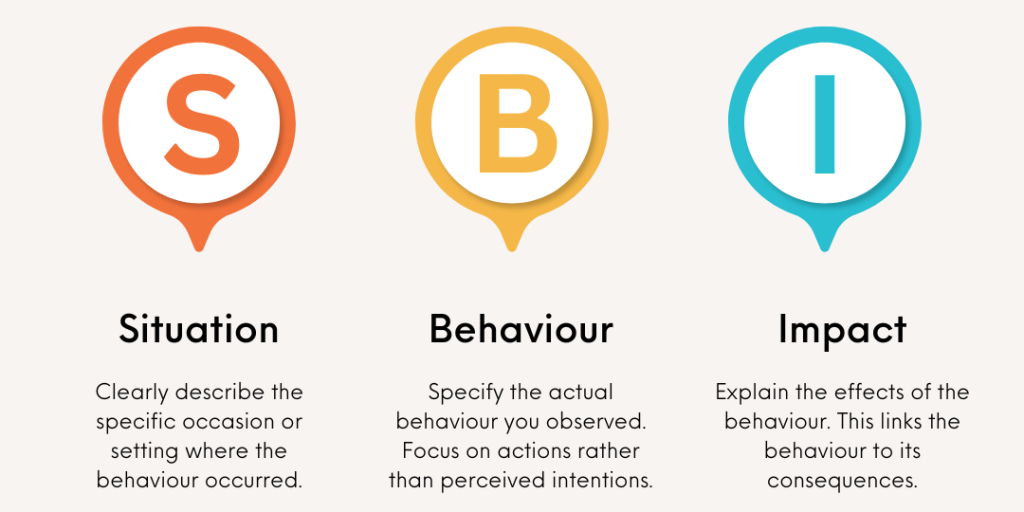
Situation + behavior + impact + expected change. That’s the structure. Every piece of developmental feedback should follow it.
Phrases to avoid (and what to say instead):
| Vague Feedback | Actionable Alternative |
| “Think more strategically” | “Before our next planning meeting, I want you to draft three options, not just one recommendation” |
| “Be more proactive” | “When you spot a blocker in a project, flag it to me that same day, don’t wait for our weekly check-in” |
| “Improve your communication” | “Send a brief status update every Friday so stakeholders aren’t coming to me with questions that should go to you” |
| “Take more ownership” | “When a deliverable is at risk, I expect you to come to me with a proposed solution, not just the problem” |
5. Development Planning
What to cover: Every mid-year review should produce at least one clear development action. This is the part most managers skip because it takes time. It’s also the part employees remember most.
A development plan doesn’t have to be complex. It needs three things: a growth area, a specific action to build it, and a timeline. That’s it.
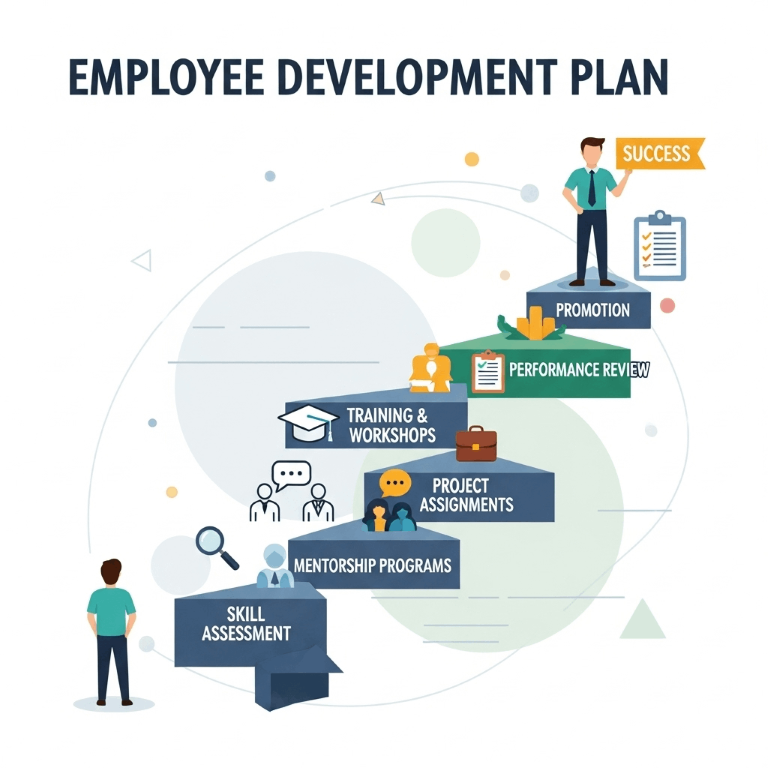
Example development plan format:
| Growth Area | Specific Action | Owner | Timeline |
| Presentation skills | Lead the monthly business review in Q3 | Employee | August 15 |
| Cross-functional collaboration | Join one product sync per sprint | Employee | Ongoing |
| Strategic thinking | Complete one structured problem-solving workshop | Manager to source, employee to complete | September 30 |
The more specific the action, the more likely it gets done. “Work on your stakeholder management” is not a plan. “Schedule a 30-minute monthly check-in with the head of marketing starting next month” is a plan.
6. Second-Half Goal Setting and Alignment
What to cover: Adjust, confirm, or add goals for the rest of the year. Make sure each one is specific, measurable, and genuinely aligned with team and business priorities.
This is also where you want to plant seeds for year-end conversations.
- If someone is tracking toward a promotion, say so clearly.
- If someone needs to demonstrate improvement in a specific area to receive a strong year-end rating, they should leave this meeting knowing exactly what that means.
Ambiguity here is expensive. Employees who don’t know what “success” looks like for the rest of the year will either assume they’re fine or assume the worst. Neither helps you nor them.
How to Run Your Mid-Year Review Process
Most managers I talk to are running their review process across three or four different tools. Self-assessments in Google Forms. Goal data in a spreadsheet. Feedback notes in email.
Development plans in a shared doc nobody updates. It works until it doesn’t, and it usually stops working right when you need it most, during an actual review cycle.
Here’s how to consolidate the entire mid-year review process in PeopleGoal, from setup to follow-through.
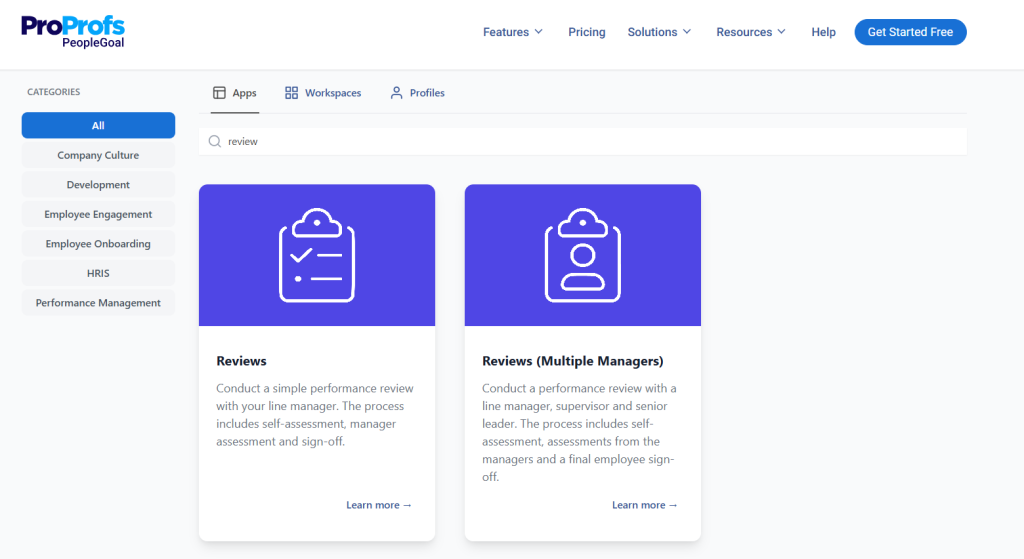
Step 1: Install the Reviews App Template
Go to your PeopleGoal dashboard, click “Create a new app,” and browse the App Store templates. Add the review app to your workspace. You’re starting with a proven structure, not building from scratch. This alone saves the two to three weeks most HR teams spend designing review forms before a cycle even begins.
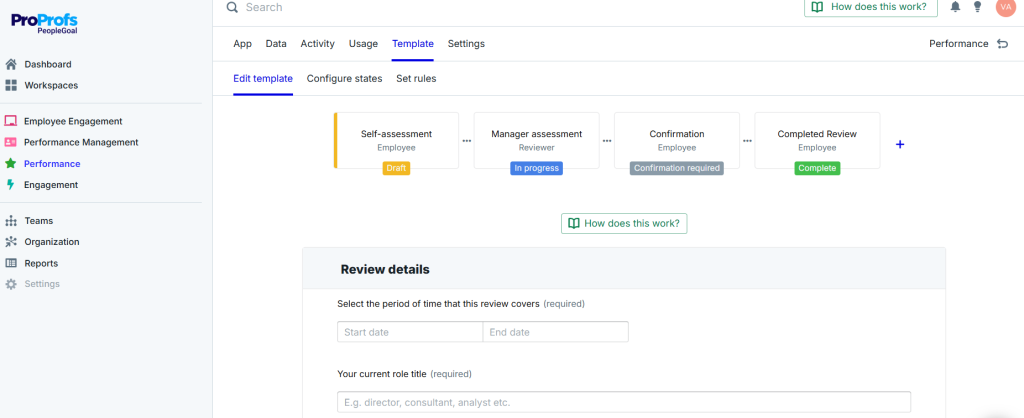
Step 2: Customize Your Review Template
Navigate to Template, then Edit Template. Define the stages your review process actually needs: self-assessment, line manager review, supervisor sign-off, and senior leader input if your org requires it. Add form fields that match your evaluation criteria.
Text fields for qualitative feedback, numerical ratings for competencies, and multi-select for goal status. You’re not locked into a generic format.
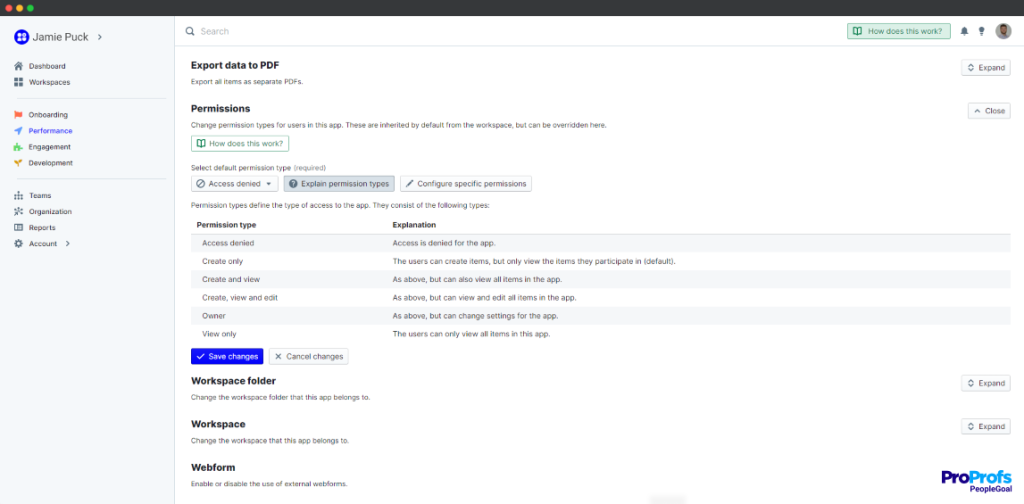
Step 3: Configure Permissions and Visibility
Under Settings and Permissions, set who accesses the app, who provides input at each stage, and what each reviewer can see. If you’re collecting peer or direct report feedback, this is where you protect anonymity. Getting this right before launch prevents a lot of awkward situations later.
Step 4: Launch the Review Cycle
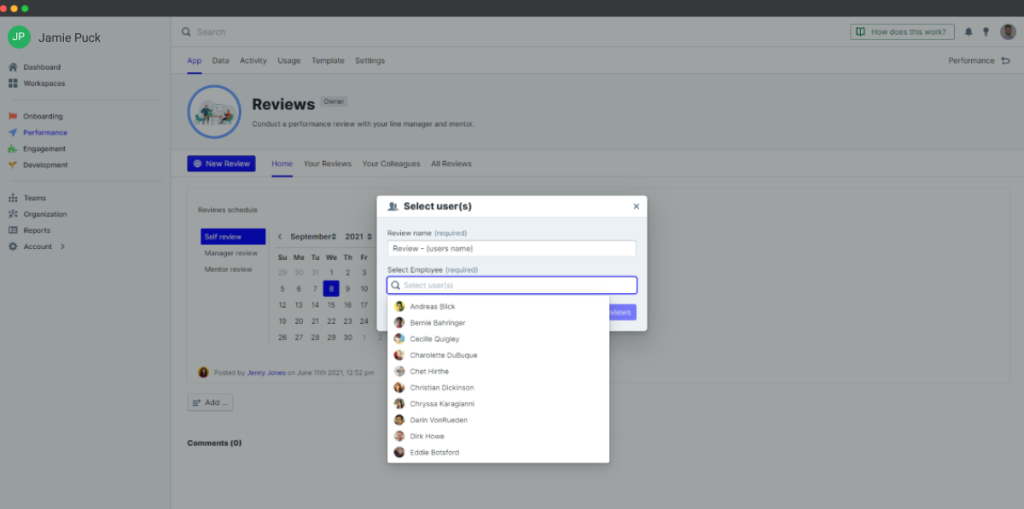
From the App Home, click New Review, select the employees or teams you’re reviewing, and initiate the cycle. You can run reviews for individuals and entire cohorts at the same time. Everyone gets notified. Everyone knows what they need to complete and by when.
Step 5: Automate Recurring Cycles
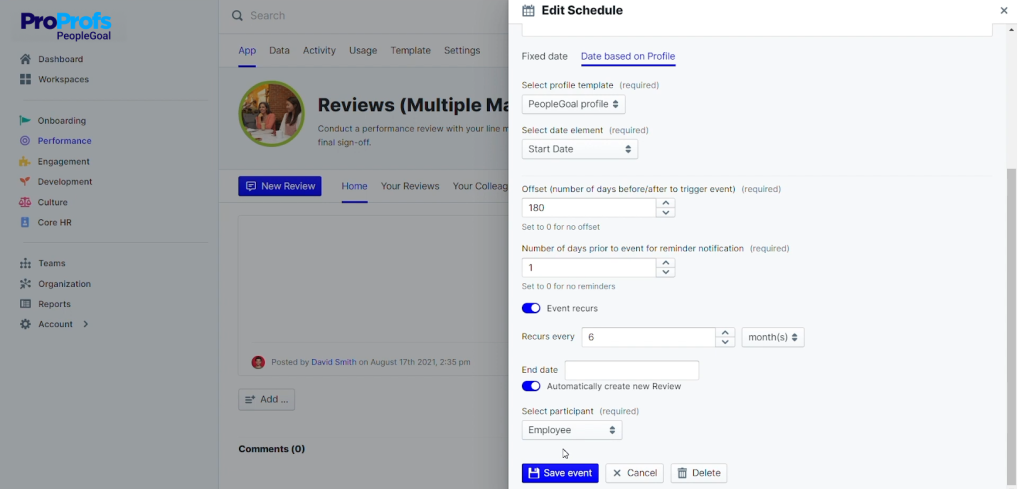
Use the Schedule feature to trigger reviews automatically. Set them to launch 180 days after a hire date, recur every six months, or align to your specific calendar period. The system sends reminders. HR tracks completion in the dashboard instead of manually chasing people down. This is the step that turns a one-time review effort into a repeatable process your organization actually sticks to.
Mid-Year Performance Review Comments and Phrases for Managers
One of the most time-consuming parts of running reviews is writing the actual feedback. These mid-year performance review examples are organized by performance level and category, so you can adapt them directly instead of starting from scratch. Follow the SBI Framework for clarity here:
1. For High Performers
- On achievement: “You exceeded your Q1 and Q2 targets consistently. The work you did on [specific project] directly contributed to [specific outcome]. That’s the standard we want to scale.”
- On leadership: “You’ve taken clear ownership of your workstream without waiting to be asked. Other team members are starting to look to you for direction, which is exactly what we need from someone at your level.”
- On development: “You’re ready for a larger scope. For the second half of the year, I want to stretch you into [specific responsibility]. This will be the evidence we need for the promotion conversation at year-end.”
2. For Mid-Level Performers (Solid Contributors)
- On achievement: “You’ve delivered consistently on your core responsibilities. The next step is not just meeting goals but influencing how the team approaches similar problems. Let’s talk about what that looks like.”
- On development: “Your technical work is solid. Where I want to see you grow in H2 is in how you communicate your work to stakeholders outside our immediate team. That visibility matters for what comes next.”
3. For Underperformers
- On performance gaps: “Your results in [specific area] are below what we agreed to at the start of the year. I want to be direct with you because I’d rather course-correct now than revisit this at year-end. Here’s what I need to see change.”
- On support: “I don’t want to just tell you what’s not working. I want to understand what’s getting in your way. Let’s build a plan together for the next 90 days with clear checkpoints so we’re both accountable.”
Documentation note:
- For any underperformer, document the specific feedback shared, the agreed-upon actions, and the timeline for follow-up. Do this in writing and share it with the employee after the meeting. This protects both of you and creates clarity.
- If you want mid-year performance review samples you can copy into your own forms, the phrases above are structured to work as standalone written feedback entries, not just talking points. Paste them into your review system, adjust the specifics, and you have a documented record that’s both clear and defensible.
Mid-Year Performance Review Template (60-Minute Meeting Agenda)
Here’s a meeting agenda you can use or adapt. Share it with the employee 48 hours before the meeting so they can prepare.
- Pre-meeting (employee): Complete self-assessment and submit 48 hours before.
- Pre-meeting (manager): Review employee’s self-assessment, pull goal data, prepare specific feedback examples.
| Time | Agenda Item |
| 0-5 min | Set the tone: “This is a two-way conversation. I want to hear your perspective first on most things.” |
| 5-20 min | Employee shares: highlights, progress, obstacles |
| 20-35 min | Manager shares: observations, specific feedback, alignment gaps |
| 35-45 min | Discussion: goal adjustments, recalibration, second-half priorities |
| 45-55 min | Development plan: one to two specific growth actions |
| 55-60 min | Next steps: confirm what’s documented, next check-in date |
One rule I always follow: No new critiques in a formal review that haven’t been raised in a 1-on-1. If it’s important enough to put in writing, it was important enough to say earlier. Use mid-year reviews to reinforce and formalize feedback, not to introduce it for the first time.
How to Handle Underperformance During a Mid-Year Review
This is the conversation most managers dread. Here’s how I suggest you to structure it so it’s productive instead of damaging.
1. Be Direct, Not Harsh
The goal of an underperformance conversation is not to put someone on notice. It’s to give them the clearest possible picture of where they stand and what they need to do about it. Softening the message to the point where the employee leaves thinking they’re fine is a disservice to them.
“I want to be honest with you because I think you deserve a clear picture. Here’s what I’m seeing, here’s the impact, and here’s what I need to see change in the next 90 days.”
2. Use Data, Not Impressions
Bring specific examples. Dates, deliverables, outcomes. “In March, the campaign launch was delayed two weeks because…” is more credible and less personal than “you seem to struggle with deadlines.”
Most community research consistently shows that employees distrust feedback that feels like opinion. Data changes that dynamic.
3. Separate Feedback From Compensation
If you want an honest development conversation, don’t tie it directly to salary in the same meeting. Employees who are worried about their comp become defensive. Defensive employees can’t absorb coaching. Schedule compensation discussions separately, even if they’re related.
4. Create a 90-Day Recovery Plan
For any employee with a performance gap, the mid-year review should produce a 90-day plan with:
- Two to three specific behavioral or output changes are required
- Clear metrics for what “meeting expectations” looks like
- Bi-weekly check-ins to track progress
- A clear statement of what will happen at year-end if the plan is met or not met
This is not a PIP. It’s a structured support plan. Frame it that way.
How to Review Goals That Are Off Track
Off-track goals are not automatically a performance issue. Before drawing conclusions, ask these three diagnostic questions:
- Was the goal realistic to begin with?
If business conditions changed significantly after goal-setting, the goal may need to be adjusted rather than marked as a failure. - Is the employee aware that the goal is off track?
You’d be surprised how often employees don’t have clear visibility into their own progress numbers. Data transparency matters. - What’s the root cause?
Capability gap, motivation issue, resource constraint, or external dependency? Each requires a different intervention.
Once you’ve diagnosed the root cause, you have four options:
- Recommit: The goal is still valid and achievable. Agree on a revised action plan.
- Adjust the target: External factors changed. Formally update the goal with documentation.
- Deprioritize: The goal is no longer strategically relevant. Remove it and replace it with something current.
- Escalate support: The employee needs resources, training, or unblocking before progress is possible.
How to Conduct Mid-Year Review for Remote and Hybrid Teams
Managing reviews across distributed teams adds logistical complexity. Here’s what changes and what doesn’t.
What changes:
- Documentation becomes even more critical because you can’t rely on informal hallway observations
- Self-assessments carry more weight because remote employees often have less visibility into how their manager perceives their work
- You need structured check-in data (weekly updates, project trackers, async feedback) to make up for the loss of in-person observation
This is where having a system like PeopleGoal that logs goal updates, feedback exchanges, and check-in notes in one place becomes less of a nice-to-have and more of a necessity.
Without it, you’re reconstructing six months of remote performance from memory and scattered messages, which is exactly how recency bias creeps in and how employees feel unseen.
What stays the same:
- The core framework above applies exactly the same way
- The expectation of no surprises is even more important for remote employees who may feel more vulnerable about their standing
- Development planning should be just as deliberate, with specific online learning resources, stretch assignments, and virtual cross-functional projects as options
Practical adjustments for remote reviews:
- Send the self-assessment form and agenda at least five business days before, not 48 hours
- Use video, not just audio, for the review conversation
- Follow up with a written summary within 24 hours, since remote employees don’t have the context of shared physical space to anchor the conversation
- Check in at the 30-day mark after the review to make sure action items are progressing
Mid-Year Performance Review Template for Managers
Four weeks before:
- [ ] Confirm review dates with all direct reports
- [ ] Send self-assessment forms to employees
- [ ] Pull goal progress data from your tracking system
- [ ] Review your notes and documentation from the past six months
Two weeks before:
- [ ] Collect and read all self-assessments
- [ ] Identify areas of alignment and disagreement between your observations and the employee’s
- [ ] Draft specific feedback with examples for each employee
- [ ] Prepare goal adjustments or second-half priorities
One week before:
- [ ] Share meeting agenda with each employee
- [ ] Block 30 minutes after each meeting to document notes and follow-up actions
During the meeting:
- [ ] Start with the employee’s perspective
- [ ] Cover all six components (goal progress, competencies, self-assessment review, feedback, development, second-half goals)
- [ ] Confirm all agreed-upon actions before ending the meeting
Within 48 hours after:
- [ ] Send a written summary of feedback and agreed-upon actions to the employee
- [ ] Update goal tracking system with any changes
- [ ] Schedule 30-day follow-up check-in
Ongoing:
- [ ] Reference review outcomes in every 1-on-1 between now and year-end
- [ ] Document progress against the development plan monthly
- [ ] Don’t wait for year-end to share feedback that emerges in H2
Turn Your Mid-Year Reviews Into a Performance System That Compounds Over Time
A mid-year performance review is only valuable if it leads to action. The best reviews don’t focus on judging the first six months. They focus on improving the next six.
By reviewing goal progress, discussing strengths and challenges, delivering clear feedback, and creating development plans, managers can help employees finish the year stronger than they started it. Consistency matters just as much as the conversation itself.
For organizations looking to make this process scalable and consistent, PeopleGoal helps bring goal tracking, performance reviews, 360-degree feedback, development planning, and progress reporting into one structured workflow, making it easier for managers to run meaningful reviews without relying on spreadsheets, emails, or disconnected tools.
Ready for your next review cycle? Start by reviewing your current process, identifying gaps, and implementing a framework that turns mid-year conversations into measurable performance improvements.
Frequently Asked Questions
Should mid-year reviews include a formal rating?
Mid-year reviews don't require a formal rating the way annual reviews do. An informal rating or a simple three-level scale (on track, developing, needs improvement) is usually enough. The goal at mid-year is to communicate clearly about standing and direction, not to assign a final score. If your organization does include ratings, make sure they're shared with context and explanation, not just as a number.
How long should a mid-year performance review meeting be?
Sixty minutes is the right target for most direct report relationships. That's enough time to cover goal progress, give and receive feedback, discuss development, and set second-half priorities without rushing. For more complex situations, like an underperformance conversation or a promotion discussion, plan for 75 to 90 minutes.
How do you give a mid-year review to a high performer without it feeling pointless?
The risk with high performers is that the review becomes a praise session with no substance. Treat it as a promotion and growth conversation instead. Discuss what the next level looks like, what evidence they still need to build, and what stretch assignments or visibility opportunities you can create for H2. High performers disengage when they feel like their ceiling isn't being raised.
What's the best way to document a mid-year review?
Send a written summary to the employee within 48 hours of the meeting. Include: key feedback points, goal status updates, agreed-upon changes, development actions with owners and timelines, and the date of the next check-in. Keep it in a shared system both of you can access, not just in your own notes.
How do you handle an employee who disagrees with the feedback in their mid-year review?
Let them respond. Give them space in the meeting to share their perspective and listen to understand, not just to respond. If their evidence changes your view, say so. If it doesn't, acknowledge the disagreement clearly and explain your reasoning. Document that the employee had an opportunity to share their perspective. Disagreement handled well builds trust. Disagreement dismissed damages it permanently.
Is it okay to change someone's goals at the mid-year review?
Yes, and in many cases it's the right thing to do. If business priorities have shifted significantly, keeping employees accountable to goals that are no longer relevant is demoralizing and counterproductive. Document the change formally, note the reason, and make sure the new goals are as specific and measurable as the originals.
How do you conduct a mid-year review for someone who is on a performance improvement plan?
Treat the mid-year review as a formal check-in against the PIP milestones, not a separate process. Review each PIP goal specifically: is it being met, partially met, or not met? Be explicit about where they stand and what the path forward looks like. These conversations require more preparation and more documentation than standard reviews.
What questions should managers ask during a mid-year review?
Ask goal-focused questions such as: Which goals are progressing well? Which are behind, and why? Have priorities changed? What support would help? Also discuss strengths, skill development, and growth areas. Focus on evidence and specific examples rather than broad questions like "How's it going?"
How should employees prepare for a mid-year review?
Complete a self-assessment before the meeting and reflect on key achievements, measurable results, goal progress, challenges, and skill growth. Be ready to discuss where support is needed and frame accomplishments in terms of business impact rather than completed tasks to encourage a more productive conversation.
What happens after a mid-year performance review?
After the review, managers should document feedback, update goals, assign development actions, and confirm timelines. Schedule a follow-up check-in within 30 days and revisit progress during regular 1-on-1 meetings. Consistent follow-up ensures feedback leads to meaningful improvement instead of being forgotten until year-end.
Ready to 3x Your Teams' Performance?
Use the best performance management software to align goals, track progress, and boost employee engagement.