After years of sitting across the table during countless annual evaluations, I’ve come to realize one universal truth: performance review strengths are often the hardest to articulate.
Managers tend to breeze through weaknesses but freeze when it’s time to celebrate what employees do best. I’ve seen brilliant performers undersold simply because their strengths weren’t clearly defined enough to guide their growth.
In this guide, I’ll share proven frameworks and examples of performance review strengths and weaknesses based on my 10+ years of coaching leadership, ensuring your reviews empower your team, not intimidate them.
Why Focusing on Performance Review Strengths Matters?
Most managers dread employee performance reviews because they often turn into fault-finding sessions. Focusing on strengths for performance review can completely change that narrative — from criticism to growth.
Here’s why it matters:
1. Boosts Employee Confidence: Recognizing strengths helps employees feel valued and appreciated, encouraging them to maintain and improve their performance.
2. Drives Engagement & Motivation: Strength-based feedback energizes employees and inspires them to take ownership of their roles.
3. Enhances Team Productivity: Leveraging individual strengths allows teams to collaborate more efficiently and deliver higher-quality results.
4. Reduces Turnover: When people feel their strengths are recognized, they’re more likely to stay loyal to the company.
5. Improves Leadership Effectiveness: Managers who focus on strengths build more trust and credibility with their teams.
6. Creates a Growth-Focused Culture: Shifting the emphasis from weaknesses to potential fosters continuous learning and development across the organization.
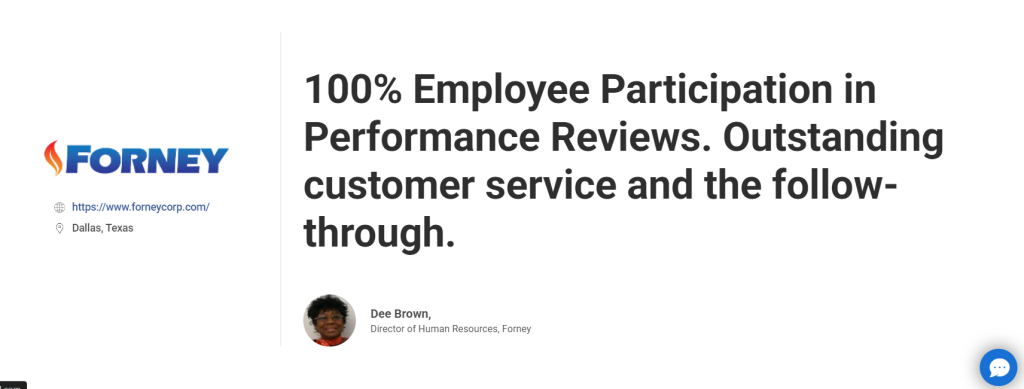
Let me show you a real-life case study example of how Forney, a leader in combustion equipment, enabled a 100% employee participation in performance reviews with performance management software:
How to Identify Employee Strengths for Performance Review
Spotting an employee’s strengths goes beyond looking at who delivers results; it’s about understanding what drives those results.
By combining data, observation, and feedback, managers can create a clear and unbiased picture of individual capabilities. Here’s how to identify employee strengths effectively:
1. Observe Behavior & Outcomes
Pay close attention to how employees handle their daily responsibilities. Do they take initiative, solve problems creatively, or support team members naturally?
Observing behavior in real-life scenarios reveals soft skills, such as adaptability, leadership, and collaboration, that metrics can’t capture.
2. Use Performance Data
Go beyond gut feeling by analyzing KPIs, project outcomes, and goal completion rates. Consistent high performance in specific areas often signals core strengths, such as analytical thinking, organization, or technical expertise.
3. Ask for Peer Feedback
Colleagues often witness different aspects of an employee’s work. Continuous peer feedback can uncover hidden strengths, such as being a go-to problem solver or a calm influence during crises — that may not always be visible to managers.
4. Encourage Self-Assessment
Invite employees to evaluate their own performance and identify what they believe are their greatest strengths.
This exercise promotes self-awareness and opens up an honest two-way conversation during the performance review.
5. Leverage 360-Degree Reviews
Gathering feedback from supervisors, peers, and clients provides a well-rounded perspective. This method minimizes bias and highlights strengths that consistently stand out across multiple relationships and work contexts.
6. Track Patterns Over Time
Strengths are not one-time achievements; they’re recurring behaviors. Look for patterns across quarters or projects, for example, who consistently meet deadlines, mentor others, or deliver creative solutions.
7. Use Tools & Analytics
Leverage employee performance management software to track individual contributions, monitor productivity, and visualize performance data & reports.
Such tools help translate daily efforts into measurable insights, making strength identification more objective and data-driven.
Common Strengths for Performance Review + Example Phrases
Let’s break down each common strength with clear descriptions and specific performance review phrases you can directly use in employee evaluations.
1. Communication Skills
Strong communicators express ideas clearly, listen actively, and tailor their message to the specific audience they’re addressing. They prevent misunderstandings and ensure smooth collaboration across teams.
Example: “Consistently communicates project expectations and ensures everyone is aligned, reducing misunderstandings across the team.”
2. Problem-Solving Abilities
Effective problem solvers break down issues, analyze root causes, and propose practical, data-driven solutions. They navigate uncertainty with calmness and make meaningful contributions during brainstorming sessions or crisis situations.
Example: “Regularly identifies process gaps and proposes practical solutions that improve workflow efficiency.”
3. Team Collaboration
Collaborative employees contribute positively to team dynamics, share knowledge openly, and prioritize collective success over individual wins. They help build a supportive, high-trust environment.
Example: “Actively collaborates with cross-functional teams and offers help proactively during high-pressure periods.”
4. Leadership & Ownership
Employees with strong leadership skills take initiative, guide their teammates, and remain accountable for their outcomes. Even without a managerial title, they influence others through reliability, clarity, and strong decision-making.
Example: “Leads projects with confidence and ensures deliverables are met, even when timelines are tight.”
5. Adaptability
Adaptable employees stay productive in changing environments, quickly learn new tools or skills, and remain solution-oriented despite shifting priorities. They help teams stay agile and future-ready.
Example: “Adapts to new tools and processes quickly, often helping others get up to speed during transitions.”
6. Time Management
Strong time managers prioritize effectively, maintain steady progress, and consistently meet deadlines. They balance multiple responsibilities without compromising quality or requiring constant follow-up.
Example: “Consistently completes tasks ahead of schedule while managing several concurrent projects.”
7. Attention to Detail
Detail-oriented employees ensure accuracy, catch issues early, and contribute to higher-quality outputs. Their careful review reduces rework, improves employee performance, and strengthens the team’s credibility.
Example: “Produces error-free reports and catches inconsistencies during reviews that prevent costly revisions.”
8. Customer Focus
Customer-focused employees understand user needs deeply, solve issues quickly, and maintain a service-first mindset. They help strengthen long-term relationships and improve overall satisfaction.
Example: “Regularly receives positive feedback from clients due to quick responses and personalized support.”
9. Technical Expertise
Technically skilled employees apply specialized knowledge to solve problems, improve systems, and support teammates. They stay updated on industry trends and serve as reliable subject matter experts.
Example: “Demonstrates deep knowledge of the product and quickly resolves complex technical issues.”
Potential Performance Review Challenges & Fixes
Even a well-structured review process has its pitfalls. Here are common performance review challenges and how to address each one constructively.
1. Inconsistent Communication
This occurs when an employee occasionally delays sharing updates or assumes others have the same context, resulting in misunderstandings or duplicated work. This inconsistency is usually unintentional and stems from workload or uncertainty.
Example Phrase: “John sometimes waits too long to share updates on interdependent tasks, causing the design team to duplicate efforts.”
How to Address: Encourage short but regular status updates, clarify preferred communication channels, and set expectations for response times to keep everyone aligned.
2. Difficulty Prioritizing Tasks
This happens when an employee struggles to balance urgent versus essential tasks, resulting in missed deadlines or wasted time on low-priority work. This usually occurs when goals are unclear or multiple priorities conflict.
Example Phrase: “Sarah needs coaching on balancing competing priorities; she sometimes overspends time on minor tasks while essential deadlines approach.”
How to Address: Use structured prioritization frameworks, help break larger tasks into steps, and review weekly priorities together to build consistency.
3. Limited Collaboration in Team Settings
This happens when an employee prefers working independently or feels unsure about contributing during group discussions. This may reduce team cohesion and limit the group’s ability to generate ideas.
Example Phrase: “While individual performance is strong, Michael needs to improve collaboration by proactively offering insights during team planning sessions.”
How to Address: Encourage active participation in team sessions by assigning small collaborative tasks first and creating a safe environment for sharing ideas.
4. Resistance to Change
This occurs when an employee feels uncomfortable or performs poorly due to sudden changes in processes, tools, or expectations. This often reflects a desire for stability and clear instruction, not an unwillingness to adapt.
Example Phrase: “We observed a slight dip in output when we switched CRMs; Jane could improve by proactively seeking clarity and embracing new tools sooner.”
How to Address: Provide context behind new initiatives, offer hands-on support or training, and introduce changes gradually with clear milestones.
5. Needs Improvement in Time Management
This occurs when an employee underestimates task duration or undertakes unplanned work, resulting in delays or last-minute rush efforts. This is typically due to unclear planning methods or difficulty delegating/saying no.
Example Phrase: “Alex often underestimates project timeframes, resulting in last-minute pressure; establishing a detailed weekly plan would help manage this.”
How to Address: Use time-tracking tools, set realistic deadlines together, and help create weekly schedules that account for buffer time.
6. Attention to Detail Issues
This occurs when an employee occasionally overlooks minor details or makes minor errors, especially when multitasking or working under pressure. This shows inconsistent focus rather than a lack of ability on routine tasks.
Example Phrase: “While his concepts are excellent, Ben occasionally requires rework because minor errors slip through, especially on quick, repetitive tasks.”
How to Address: Encourage the use of checklists, peer reviews, or slowing down during critical reviews, and reinforce the value of quality over speed.
7. Reluctance to Take Initiative
This happens when an employee waits for explicit direction instead of proactively identifying issues, solutions, or opportunities for improvement. This may limit their growth and is often linked to fear of overstepping or a lack of confidence.
Example Phrase: “Maria consistently meets expectations but should aim to take more initiative, offering solutions or identifying inefficiencies before being asked.”
How to Address: Set clear expectations around proactive behavior, recognize initiative publicly, and provide reassurance that ideas and ownership are welcomed.
How to Discuss Performance Gaps Effectively: Step-by-Step Guide
Discussing performance gaps is one of the most challenging aspects of any review, but when done well, it fosters trust, clarity, and long-term improvement.
Here’s how to approach these conversations constructively and professionally:
1. Prepare with Facts, Not Feelings
Your conversation must be grounded in objective data. The very first step is to gather specific examples, data, and outcomes related to the performance gap. This prevents the discussion from sounding personal or emotional.
Action: Gather specific data (metrics, dates, outcomes).
- Example: Instead of saying, “You’re often slow,” say, “On the Q3 report, the accuracy rating was 88%, falling below the team standard of 95%.”
2. Lead with Empathy & Curiosity
Start the conversation by first asking the employee for their perspective. Often, performance gaps have underlying, external causes, such as workload, unclear expectations, or inadequate resources. Leading with curiosity fosters trust and helps uncover the root issue.
Action: Ask the employee what challenges they faced.
- Example: “Before we discuss the Q3 report, can you share what challenges you faced with data verification last quarter?”
3. Be Clear, Direct, & Respectful
Once the floor is set, state the performance gap in simple, unambiguous language. Clarity creates direction; ambiguity creates confusion. Be direct about the issue while maintaining a tone of professional respect.
Action: State the gap simply and clearly.
- Example: “The specific gap we need to address is the failure to complete client calls by the established 3 PM cutoff time.”
4. Focus on Behaviors, Not Identity
Ensure you address what happened (actions, patterns, results), not who the employee is (their character or identity). This ensures the discussion feels fair, objective, and actionable.
Action: Address actions and results, not personal traits.
- Example: Focus on, “Your actions of submitting deliverables past the final deadline need to change,” instead of, “You are unreliable.”
5. Show the Impact of the Gap
Employees are motivated when they understand the significance of the change. Explain how the specific issue affects the team, project timelines, or the customer experience. This context improves understanding and accountability.
Action: Link the behavior to the organizational consequence.
- Example: “The delay in your code review blocked the QA team for two full days, pushing our entire launch date back by one week.”
6. Co-create an Improvement Plan
This is a collaborative effort. Outline the next steps together, including specific goals, timelines, the type of support to be provided, and regular check-in points. Collaboration significantly increases accountability and buy-in.
Action: Outline goals, support, and check-in points together.
- Example: “Let’s set a goal: All client communication templates must be error-free. We’ll meet every Friday for the next month to review progress.”
7. End on a Note of Confidence & Support
Conclude the conversation by reinforcing your belief in their ability to improve and confirming the specific resources or coaching you’ll provide. People are more committed to change when they feel supported and confident in their ability to succeed.
Action: Affirm their potential and confirm resources.
- Example: “I know you can master this. I’ve scheduled the mandatory training, and I’m here to support you every step of the way.”
Tools to Streamline the Review Process
Modern performance reviews are far more effective when supported by the right technology.
Here’s how modern employee performance management software can simplify, standardize, and strengthen the entire evaluation cycle.
- Automatically gathers data from goals, tasks, peer feedback, project timelines, and daily outputs to build a clear picture of each employee’s strengths.
- Visual dashboards highlight trends, including consistent top skills, areas for improvement, and performance patterns over time.
- Strengths can be categorized, tagged, and compared to role expectations, making it easier for managers to give specific, fact-based feedback.
- Centralized records eliminate guesswork, ensuring no achievements are overlooked during the review cycle.
- Heatmaps, scorecards, and competency tracking enable managers to identify high performers, potential skill gaps, and opportunities for mentoring.
Benefits of Using Automation for Fair & Data-Driven Reviews
Automation transforms performance reviews from subjective, stressful meetings into objective, data-backed discussions. Here’s why:
- Reduces bias by relying on measurable performance indicators instead of memory or subjective impressions.
- Saves time with automated reminders, scheduled evaluations, progress tracking, and instant report generation.
- Ensures consistency across departments with standardized review templates, scoring systems, and evaluation criteria.
- Provides transparency to employees by showing how ratings were reached and which data points contributed.
- Helps leaders make better decisions around promotions, rewards, employee development plans, and workforce planning based on reliable, real-time insights.
Improve Engagement & Results With Performance Review Strengths
Recognizing and documenting performance review strengths is one of the most effective ways to boost engagement, productivity, and morale. When reviews highlight what employees do well, conversations become more constructive, motivating, and forward-focused.
A strengths-centered approach helps teams build on existing capabilities while creating clearer growth paths. And with tools like PeopleGoal, you can streamline this process through structured goals, real-time feedback, competency tracking, and automated insights, ensuring fair, consistent, and data-driven evaluations.
By focusing on strengths and using the right tools, performance reviews become a meaningful driver of employee development rather than a once-a-year formality.
Ready to 3x Your Teams' Performance?
Use the best performance management software to align goals, track progress, and boost employee engagement.