
Choosing the right employee performance review rating scale can make or break your performance management process. A good rating scale provides clarity and consistency, while a bad one can frustrate managers and employees alike.
In this blog, we’ll explore how to select a performance rating scale that truly works for your organization – one that fits your culture, supports fair evaluations, and actually helps your team grow. We’ll also look at common rating scale types, pitfalls to avoid, and best practices to ensure your performance review scoring drives positive outcomes.
Whether you’re an HR manager designing an annual performance review rating scale or a team leader seeking a better way to evaluate your people, these tips will guide you to a solution that feels fair and effective. Let’s dive in!
What Is a Performance Review Rating Scale (and Why It Matters)?
A performance review rating scale is a simple way to evaluate performance using numbers or labels like 1–5, Exceeds Expectations, or Needs Improvement. You use it to rate things like goal achievement, skills, and on-the-job behavior. The idea is to keep reviews consistent, so everyone is measured using the same standards.
Why does this matter to you? Because rating scales turn feedback into clear, measurable data. They help you make fair decisions around raises, promotions, and development.
They also reduce bias by setting clear expectations, so your employees know exactly what “good performance” looks like and how to improve. In short, a well-defined rating scale keeps performance reviews fair, focused, and easier for everyone involved.
The Problem With Rating Scales (and How to Avoid Common Pitfalls)
Performance rating scales can backfire if they’re not handled carefully. Here are the most common issues you should watch out for and how to avoid them:
- They can feel unfair or inconsistent
Different managers often interpret ratings differently. Without clear definitions and calibration, similar performance can get very different scores. - Bias and subjectivity creep in
Some managers rate too generously, others too strictly. Unconscious bias and recency bias can also influence ratings more than actual performance. - Poorly defined scales create confusion
Vague labels or unclear number scales make it hard to understand what each rating really means, leading to inflated or inaccurate scores. - Too much focus on the number
When ratings aren’t supported by clear feedback, employees fixate on the score instead of learning how to improve. - Negative impact on morale
Annual ratings can lower engagement if feedback only shows up once a year instead of through regular conversations.
If you define your rating scale clearly, train managers, calibrate results, and pair ratings with ongoing feedback, you can avoid these pitfalls and make rating scales work for you, not against you.
Common Types of Performance Review Rating Scales (With Examples)
There’s no perfect scale. I usually pick the scale based on three things:
- What we’re measuring: results, behaviors, or both
- How confident managers are at rating: more confidence means more granularity
- How much fairness we need to defend: clearer definitions beat “gut feel” every time
1) Five-Point Scale (1–5)
This is popular because it’s familiar and flexible. It works best when each number has a clear meaning and people know what “3” looks like in real life.
Example 1: Overall performance (role-based)
Use case: Annual review for any role.
Scale
- 1. Unsatisfactory: Misses most key expectations. Needs immediate improvement plan.
- 2. Needs Improvement: Meets some expectations, but gaps impact results or team.
- 3. Meets Expectations: Solid, reliable performance. Consistently delivers what the role requires.
- 4. Exceeds Expectations: Often goes beyond role needs. Strong quality and ownership.
- 5. Outstanding: Consistently exceptional impact. Raises the bar for others.
How it’s used (sample rating)
- Employee: Riya, Customer Support Specialist
- Summary: “Resolved tickets on time, maintained quality, and improved one macro that reduced average handling time.”
- Final rating: 4 (Exceeds Expectations)
Example 2: Competency rating (Communication)
Use case: Rate specific skills alongside results.
Scale
- 1: Messages are unclear. Misses context. Causes rework.
- 2: Sometimes clear, sometimes confusing. Needs frequent follow-ups.
- 3: Clear in most situations. Shares context and next steps.
- 4: Clear, concise, and proactive. Adapts to audience well.
- 5: Sets the standard. Influences across teams. Handles tough conversations smoothly.
How it’s used (sample rating)
- Employee: Aditya, Project Manager
- Evidence: “Runs crisp standups, sends recap notes with owners, handled a scope conflict calmly.”
- Communication rating: 5
2) Three-Point Scale (Below, Meets, Exceeds)
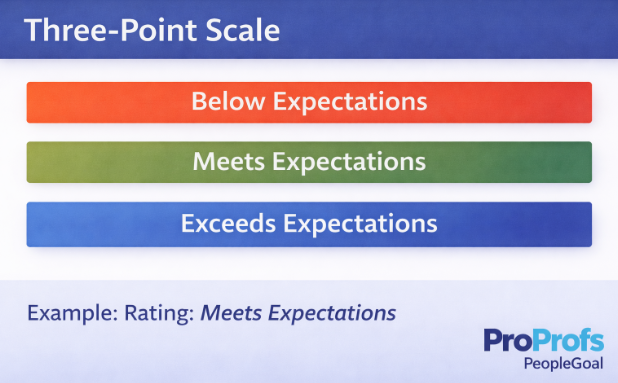
This forces clarity and reduces “rating math.” It’s great for small teams or when you want fewer debates. The trade-off is less nuance.
Example 1: Role expectations (simple and fast)
Scale
- Below Expectations: Frequent misses. Needs coaching and tighter checkpoints.
- Meets Expectations: Consistent delivery. Quality and pace match the role.
- Exceeds Expectations: Regularly outperforms role expectations and adds extra impact.
How it’s used (sample rating)
- Employee: Neha, Content Writer
- Notes: “Delivered all assigned articles on time. Needed light edits. No major misses.”
- Rating: Meets Expectations
Example 2: Team behaviors (collaboration focus)
Scale
- Below: Avoids teamwork, poor handoffs, creates friction.
- Meets: Cooperates, communicates, reliable handoffs.
- Exceeds: Unblocks others, shares knowledge, strengthens team habits.
How it’s used (sample rating)
- Employee: Sameer, Engineer
- Notes: “Helped QA reproduce issues, wrote clear handoff notes, mentored a new joiner.”
- Rating: Exceeds Expectations
3) Ten-Point Scale (1–10)
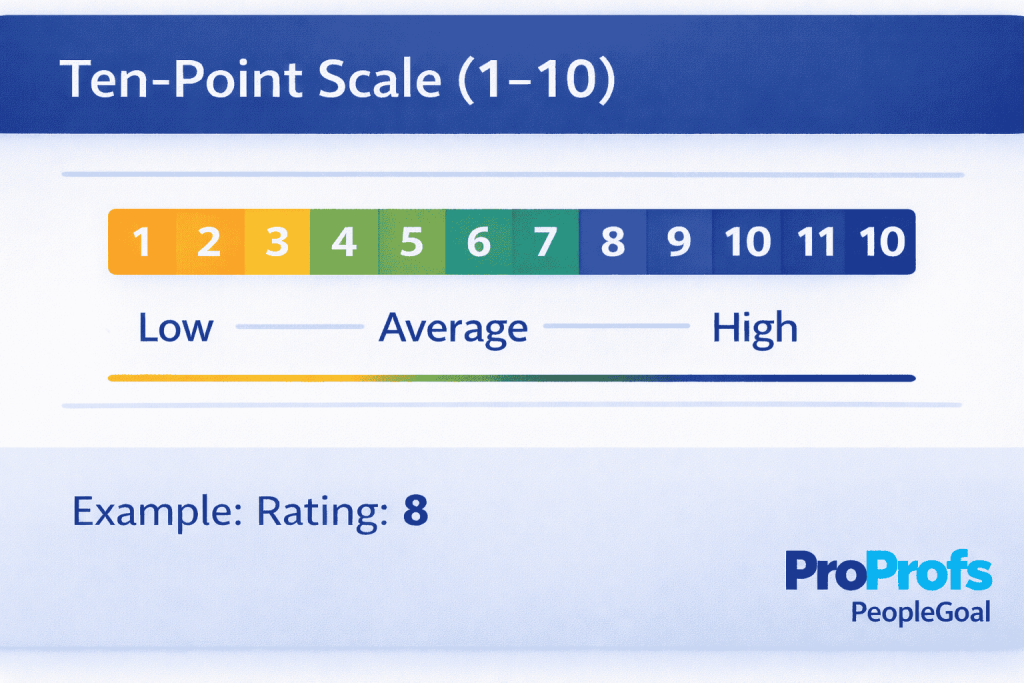
This gives more granularity, which can help in bigger teams. But it gets subjective fast if “7 vs 8” isn’t defined.
Example 1: Ten-point with anchor points
Scale (with anchors to reduce confusion)
- 1–2: Not meeting expectations
- 3–4: Inconsistent performance
- 5–6: Meets expectations (steady, reliable)
- 7–8: Strong performance (often exceeds)
- 9–10: Exceptional (rare, organization-level impact)
How it’s used (sample rating)
- Employee: Karan, Account Executive
- Evidence: “Hit quota 4 out of 5 months, improved deal notes, helped refine a pitch.”
- Rating: 8
Example 2: Score tied to measurable ranges (sales or ops)
Use case: When outcomes can be mapped to clear bands.
Scale based on goal attainment
- 1: <50% of target
- 3: 50–69%
- 5: 70–89%
- 7: 90–99%
- 8: 100–109%
- 9: 110–124%
- 10: 125%+
How it’s used (sample rating)
- Employee: Meera, SDR
- Result: 112% of qualified meetings target
- Rating: 9
4) Likert Scale (Agreement-Based)
This is great for rating specific statements, especially in self reviews or 360 feedback. It gives context, but you often still need a way to summarize results.
Example 1: 5-point agreement (quality and ownership)
Scale
- Strongly Disagree
- Disagree
- Neither Agree nor Disagree
- Agree
- Strongly Agree
Statements (rate each)
- “I take ownership of outcomes, not just tasks.”
- “I communicate risks early with options.”
- “I consistently deliver work that meets quality standards.”
How it’s used (sample rating)
- Employee: Aman, Designer
- Manager ratings:
- Ownership: Agree
- Communicates risks: Strongly Agree
- Quality: Agree
Example 2: Frequency-based Likert (behavior tracking)
Scale
- Never
- Rarely
- Sometimes
- Often
- Always
Statements (rate each)
- “Shares weekly progress updates without being asked.”
- “Documents decisions and next steps after meetings.”
- “Seeks feedback before finalizing important work.”
How it’s used (sample rating)
- Employee: Pooja, Marketing Ops
- Ratings: Progress updates Often, Documentation Always, Seeks feedback Sometimes
5) Behaviorally Anchored Rating Scale (BARS)
BARS is powerful because it replaces vague labels with concrete behaviors. It reduces bias and helps employees understand what to do next. It takes longer to create, but it’s worth it for important roles.
Example 1: Customer support (Ticket handling)
Scale with behavioral anchors
- 1: Frequently misses key details; escalations are common, and customers repeat issues.
- 2: Resolves some tickets, but misses steps and needs frequent correction.
- 3: Resolves most tickets correctly, follows SOP, average customer effort.
- 4: Resolves efficiently, anticipates follow-ups, reduces back-and-forth.
- 5: Handles complex cases, improves SOP, consistently earns excellent feedback.
How it’s used (sample rating)
- Employee: Ravi, Support Associate
- Evidence: “Handled complex billing cases, reduced escalations, improved SOP article.”
- Rating: 5
Example 2: Engineering (Code quality)
Scale with behavioral anchors
- 1: Code often breaks builds, lacks tests, needs heavy rework.
- 2: Code works but has gaps in tests and edge cases, review feedback repeats.
- 3: Good quality, tests core paths, responds well to reviews.
- 4: Strong design, good coverage, catches edge cases early, helps peers review.
- 5: Sets standards, improves architecture, raises quality across the team.
How it’s used (sample rating)
- Employee: Ishita, Backend Engineer
- Evidence: “Added meaningful tests, improved error handling, supported peers in reviews.”
- Rating: 4
6) Goal or Objective-Based Scales
These are outcome-driven and easy to defend. They work best when goals are well-defined. The gap is that they don’t explain how the results were achieved, so I often pair them with a behavior scale.
Example 1: Simple goal status (3 levels)
Scale
- Not Met: Missed the goal or delivered incomplete outcome.
- Met: Achieved the agreed goal and success criteria.
- Exceeded: Surpassed success criteria or delivered extra measurable value.
How it’s used (sample rating)
- Goal: “Publish 24 SEO articles this quarter with target readability and on-page checks.”
- Result: Published 26, met quality checks, two articles ranked in top 10
- Rating: Exceeded
Example 2: Progress-based goal scale (5 levels)
Scale
- 0% Not Started
- 1–49% Limited Progress
- 50–79% On Track
- 80–99% Nearly Complete
- 100% Completed
How it’s used (sample rating)
- Goal: “Launch onboarding email sequence v2 by Nov 30.”
- Result: Copy approved, design pending, QA not started (about 70%)
- Rating: 50–79% On Track
7) Custom Rating Scales (Values or Culture-Based)
Custom scales improve buy-in because they match how your company talks. Just keep them simple, define each level clearly, and avoid “cute names” that confuse people. You can still map them to numbers behind the scenes for reporting.
Example 1: Values-based scale (customer focus)
Scale
- Misaligned: Behaviors regularly conflict with our values.
- Growing: Understands the value, applies it inconsistently.
- Aligned: Consistently demonstrates the value in daily work.
- Role Model: Leads by example, influences others, improves team norms.
How it’s used (sample rating)
- Value: “Customer-first thinking”
- Employee: Sana, Product Analyst
- Evidence: “Used customer feedback to prioritize fixes and shared insights with stakeholders.”
- Rating: Role Model
Example 2: Impact language scale (hidden numeric mapping)
Scale (visible to employees)
- Foundation: Learning the role, needs guidance.
- Solid Contributor: Reliable delivery, consistent quality.
- High Impact: Drives outcomes, improves processes.
- Exceptional Impact: Company-level influence, sustained results.
Behind-the-scenes mapping (for HR analytics)
- Foundation = 2
- Solid Contributor = 3
- High Impact = 4
- Exceptional Impact = 5
How it’s used (sample rating)
- Employee: Vikram, Team Lead
- Evidence: “Improved sprint predictability and reduced defects, coached two new leads.”
- Rating: High Impact
5 Steps to Choose the Right Performance Rating Scale for Your Team
Choosing the right performance rating scale takes a bit of thought, but it pays off in fairer and more meaningful reviews. Here’s a simple, practical way to approach it:
- Start with your purpose
Before picking a scale, get clear on why you’re using ratings at all. Ask yourself what decisions they need to support. This could be promotions, compensation, development plans, or setting clearer expectations. When your purpose is clear, it becomes much easier to choose a scale that actually helps instead of adding confusion. - Choose the right level of detail
Not every team needs a complex scale. If ease of use matters most, a 3-point scale may be enough. If you need more differentiation, a 5-point scale often works well. The key is to use the simplest scale that still gives you the insight you need without overwhelming managers. - Define each rating clearly
A rating scale only works when everyone interprets it the same way. Take time to define what each number or label means in real, practical terms. Clear definitions help managers rate more consistently and help employees understand what strong performance looks like. - Keep the process transparent and fair
Ratings are easier to accept when the process feels open. Be clear about how ratings are used and encourage managers to discuss them during reviews. Calibrating ratings across teams also helps ensure the same standards are applied everywhere. - Review and refine over time
Treat your rating scale as a living system. Gather feedback from managers and employees, review how ratings are distributed, and make adjustments when needed. Small improvements over time can make a big difference in how fair and effective your reviews feel.
When your rating scale is purposeful, clear, and consistently applied, performance reviews become more helpful for both managers and employees.
Best Practices to Make Your Performance Ratings Successful
Choosing a rating scale is only half the work. How you use it day to day is what really determines whether it helps or hurts. Below are practical best practices that make performance ratings useful, fair, and employee-friendly, along with clear examples for each.
1. Always Pair Ratings With Clear Feedback
A number or label alone does not help anyone improve. Every rating should come with specific, behavior-based feedback that explains why the employee received that score and what they can do next.
Why this matters
Without context, ratings feel arbitrary. Clear feedback turns the score into guidance and helps employees focus on improvement instead of defensiveness.
Example
- Rating: Meets Expectations
- Poor feedback: “Doing fine overall.”
- Effective feedback:
“You consistently meet deadlines and collaborate well with the team. To move toward exceeding expectations, focus on proactively sharing updates with stakeholders instead of waiting for check-ins.”
The second version tells the employee exactly what is working and what to improve.
2. Use Ratings as a Starting Point, Not the End
Ratings should open a conversation, not shut it down. The most valuable part of a review is the discussion that follows, especially around growth, goals, and development.
Why this matters
When reviews focus only on defending a score, employees disengage. When the focus shifts to the future, ratings feel constructive instead of judgmental.
Example
- Rating: Needs Improvement
- Conversation shift:
Instead of debating the score, the manager says:
“This rating reflects where things stand today. Let’s talk about what support or changes would help you move to ‘Meets Expectations’ over the next quarter.”
The rating becomes a checkpoint, not a verdict.
3. Watch for Bias and Keep Training Managers
Bias does not disappear after one training session. Over time, managers may rate too generously, too harshly, or inconsistently across teams. These patterns need regular review and correction.
Why this matters
Unchecked bias erodes trust in the entire performance process. Employees notice when ratings feel uneven or unfair.
Example
- HR reviews ratings and notices one manager rates most employees as “Outstanding,” while another rarely rates above “Meets Expectations.”
- Action taken: HR schedules a calibration session where managers review sample performance scenarios together and align on what each rating level truly means.
This keeps standards consistent and reduces personal bias over time.
4. Connect Ratings to Ongoing Feedback
Performance reviews should never contain surprises. Ratings work best when they reflect feedback employees have already received throughout the year.
Why this matters
When feedback only shows up during reviews, ratings feel sudden and discouraging. Ongoing feedback builds trust and clarity.
Example
- During monthly check-ins, a manager regularly notes that an employee needs to improve prioritization.
- At review time, the employee receives a “Meets Expectations” rating with the same theme.
Because the feedback is consistent, the rating feels fair and expected, not shocking.
5. Review and Refine Your Approach Regularly
Your rating system should evolve as your organization grows. What worked for a small team may not work for a larger or more complex organization.
Why this matters
Outdated labels or unclear definitions can confuse managers and frustrate employees. Small refinements can greatly improve clarity and adoption.
Example
- A company finds that managers overuse the middle rating on a five-point scale.
- Update made: They clarify what “Exceeds Expectations” really looks like and add examples to the review form.
After the change, ratings spread more naturally, and discussions improved.
Create Clearer, Fairer Performance Reviews That Drive Growth
Choosing the right performance review rating scale is about being intentional. There’s no universal best option. What works for you is a scale that aligns with your goals, fits your culture, and helps you make fair decisions while supporting employee growth.
Ratings work best when they’re clearly defined, applied consistently, and supported by regular feedback. When managers are aligned and employees understand what each rating means, reviews feel more transparent and easier to trust.As your process evolves, having flexible tools like PeopleGoal can quietly support consistency and structure without adding complexity. The result is a performance review system that feels fair, useful, and focused on progress, not just scores.
Ready to 3x Your Teams' Performance?
Use the best performance management software to align goals, track progress, and boost employee engagement.