

Most companies still treat performance reviews like a once-a-year event. You sit down in December, try to remember what happened over the last 12 months, and hope the conversation feels fair. I’ve seen how easily that process turns into a formality, not something that actually helps people grow.
But the workplace has changed. Teams move faster, roles evolve quickly, and employees expect feedback that feels timely, supportive, and development-focused, not outdated and stressful.
That’s why employee appraisal methods are shifting toward continuous check-ins, goal alignment, and multi-rater feedback that gives a more complete picture of performance.
In this blog, I’ll walk through the major employee appraisal methods, along with real examples and when each one works best, so you can choose the right fit for your team.
The Complete List of Employee Appraisal Methods (+Examples)
Employee appraisals aren’t one-size-fits-all anymore. What works for a small startup doing quick monthly check-ins may look very different from how a large enterprise handles promotions and pay reviews.
That’s why it helps to understand the full range of employee performance appraisal methods, from traditional annual reviews to modern approaches like continuous feedback and 360-degree evaluations.
Below, you’ll find a complete list of the most common (and most effective) appraisal methods, along with real examples, ideal use cases, and a quick comparison table to help you choose the right fit for your team.
| Method | Best For | Strength | Limitation |
|---|---|---|---|
| 360-Degree Feedback Appraisal | Leadership growth and succession planning | Reduces blind spots with multi-rater input | Needs anonymity and strong trust culture |
| Management by Objectives (MBO) | Sales and goal-driven roles | Clear, measurable outcomes | Metrics can become box-checking exercises |
| OKR-Based Appraisal | Modern, scaling organizations | Strong alignment from company to individual goals | Needs regular tracking and well-written OKRs |
| Behaviorally Anchored Rating Scales (BARS) | Customer-facing and consistency-driven roles | Objective behavior-based ratings | Time-intensive to build benchmarks |
| Critical Incident Method | Coaching-focused cultures | Specific feedback based on real moments | Can feel unbalanced if only negatives are tracked |
| Self-Appraisal Method | Engagement-focused workplaces | Encourages ownership and employee voice | Employees may overrate or underrate themselves |
| Peer-to-Peer Feedback Appraisal | Collaborative, team-based environments | Highlights teamwork and day-to-day impact | Needs structure to avoid personal bias |
| Forced Distribution Method | Large competitive organizations | Identifies standout performers quickly | Can feel unfair and hurt trust |
| Skill-Based Appraisal | Technical, blue-collar, operational roles | Role-specific and competency-focused | Doesn’t capture soft skills well |
| 720-Degree Feedback | Senior, client-facing leadership roles | Captures external real-world impact | Harder to coordinate and manage |
Method 1: 360-Degree Feedback Appraisal
Think of this method as getting the full story, not just one viewpoint. Instead of feedback coming only from a manager, 360-degree appraisals gather input from peers, direct reports, leaders, and even self-reflections. For 360 reviews to work, employees need to feel safe sharing real feedback. Anonymous responses are essential to avoid fear, favoritism, or filtered answers.
Example: A company notices a manager hits targets, but wants to know how they actually lead day-to-day. So they ask teammates questions like: Do they communicate well? Do they support others? Do they handle pressure calmly? The feedback helps reveal strengths that don’t show up on a scorecard.
Here’s a quick video on how you can conduct a 360-degree feedback appraisal easily:
How to run it:
- Select 6–8 reviewers (peers, direct reports, manager, self)
- Use anonymous, role-specific feedback questions
- Share patterns and themes, not raw comments, in the discussion
Sample 360 feedback questions:
- How effectively does this person collaborate with others?
- What leadership strengths do they demonstrate day-to-day?
- What is one area where they could improve their communication?
Method 2: Management by Objectives (MBO)
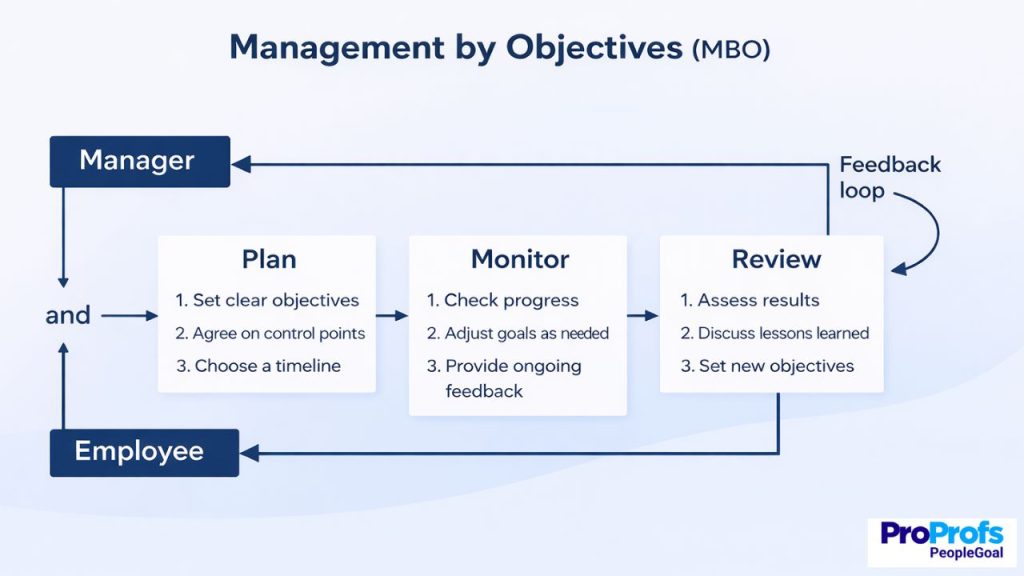
Management by Objectives is an appraisal method where performance is measured against clear, agreed-upon goals. Instead of vague ratings, employees and managers set specific targets upfront, and the review focuses on outcomes. The only catch is that if goals become just numbers to chase, people may start checking boxes instead of driving meaningful progress.
Example: Picture a sales manager starting the quarter with goals like improving client retention or closing a set number of deals. At review time, the conversation is simple: Did we hit the targets? What helped? What got in the way?
How to run it:
- Set 3–5 measurable objectives at the start of the cycle
- Track progress through mid-cycle goal reviews
- Evaluate outcomes and lessons learned at the end
Sample objective-setting questions:
- What specific results should be achieved this quarter?
- How will success be measured?
- What challenges might prevent goal completion?
Method 3: OKR-Based Appraisal (Goal Alignment Method)
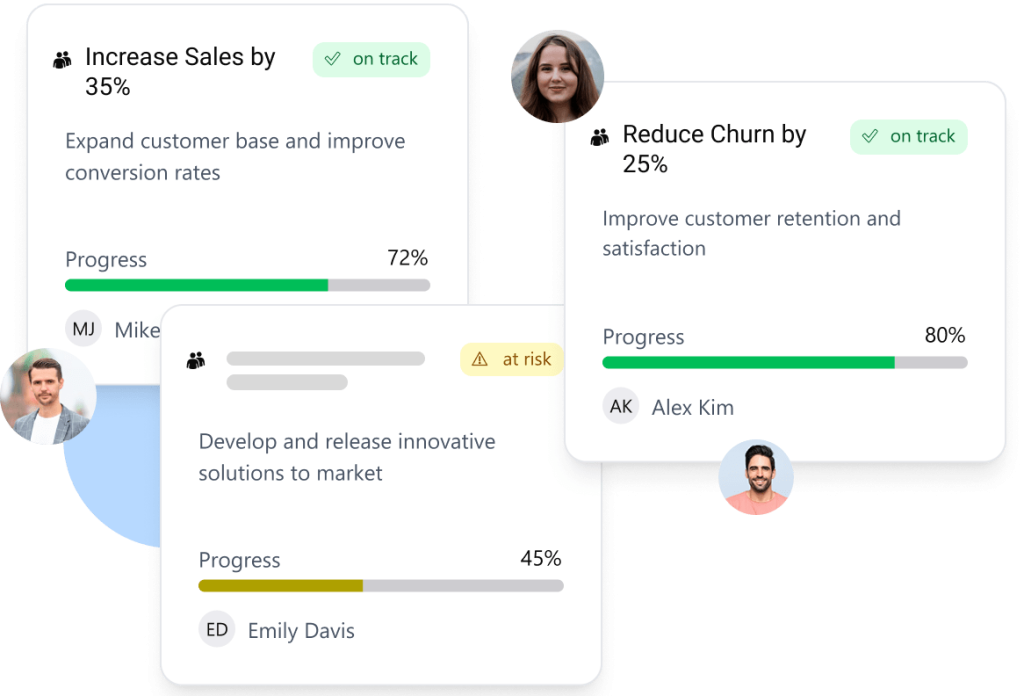
OKR-based appraisals evaluate employees based on how well their work aligns with the company’s broader goals. OKRs (Objectives and Key Results) create a clear chain from company priorities to team targets and individual contributions, so everyone knows what they’re working toward and why it matters.
Example: A product team might have an objective like improving user retention. An individual contributor’s OKR could focus on launching a feature that directly supports that outcome. At review time, performance is tied to impact, not just activity.
How to run it:
- Define company-level objectives first, then cascade to teams
- Set key results that are measurable and outcome-focused
- Review impact at the end, not just task completion
Sample OKR review questions:
- Which key results created the biggest business impact?
- What progress was made toward the objective overall?
- What should be adjusted in the next OKR cycle?
Here’s a quick video to help you understand OKRs better:
Method 4: Behaviorally Anchored Rating Scales (BARS)
BARS is an appraisal method that rates employees based on specific, observable behaviors rather than vague impressions. Instead of saying someone is “good” or “average,” managers evaluate how consistently an employee demonstrates real workplace actions tied to the role.
Example: In customer support, a benchmark might look like:
- Level 5: Resolves issues calmly, follows up proactively, and earns positive feedback
- Level 2: Responds late or misses key details
This makes reviews feel more objective and grounded.
How to run it:
- Identify 4–6 critical behaviors tied to role success
- Define performance levels with real observable actions
- Rate employees based on behavior frequency, not impressions
Sample behavior-based questions:
- How consistently does the employee demonstrate this skill?
- Can you point to recent examples of strong performance?
- What behaviors need improvement for the next level?
Method 5: Critical Incident Method
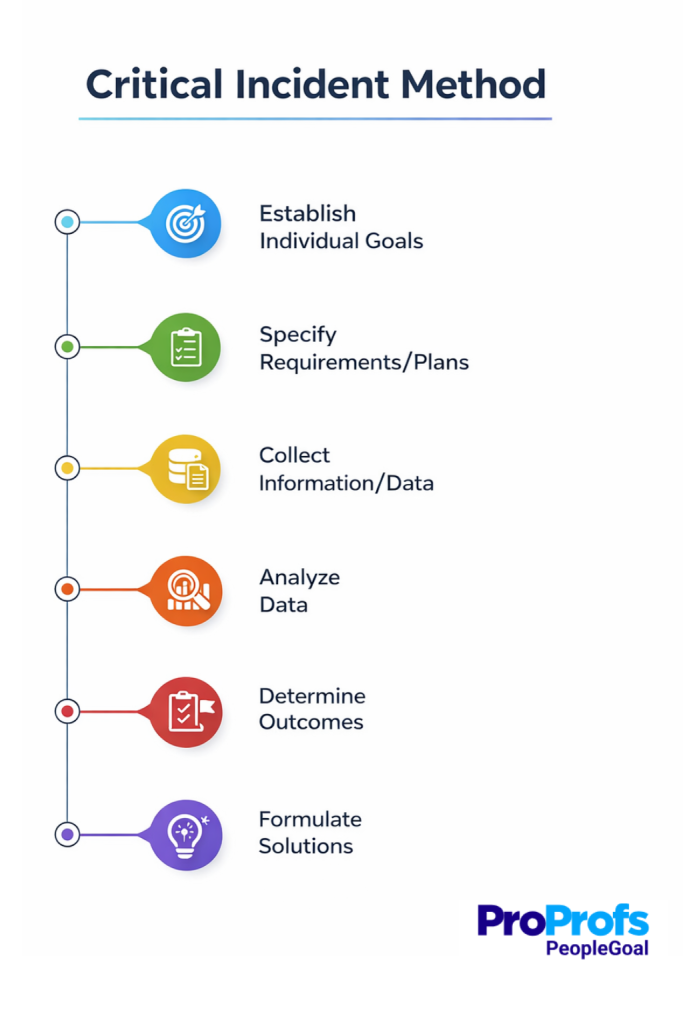
The Critical Incident Method is an appraisal approach in which managers track key moments that reflect an employee’s performance, both positive and negative. Instead of relying on memory during review season, employee feedback is based on real events that happened throughout the year.
Example: A manager might note when an employee handled an angry client exceptionally well or stepped in to prevent a major project delay. On the flip side, they may also document repeated missed deadlines or avoidable mistakes.
How to run it:
- Keep a running log of notable performance events year-round
- Document both positive wins and repeated issues
- Use incidents as discussion points during review conversations
Sample incident questions:
- What situations showed the employee at their best?
- What recurring problems affected performance?
- What patterns should be addressed moving forward?
Method 6: Self-Appraisal Method
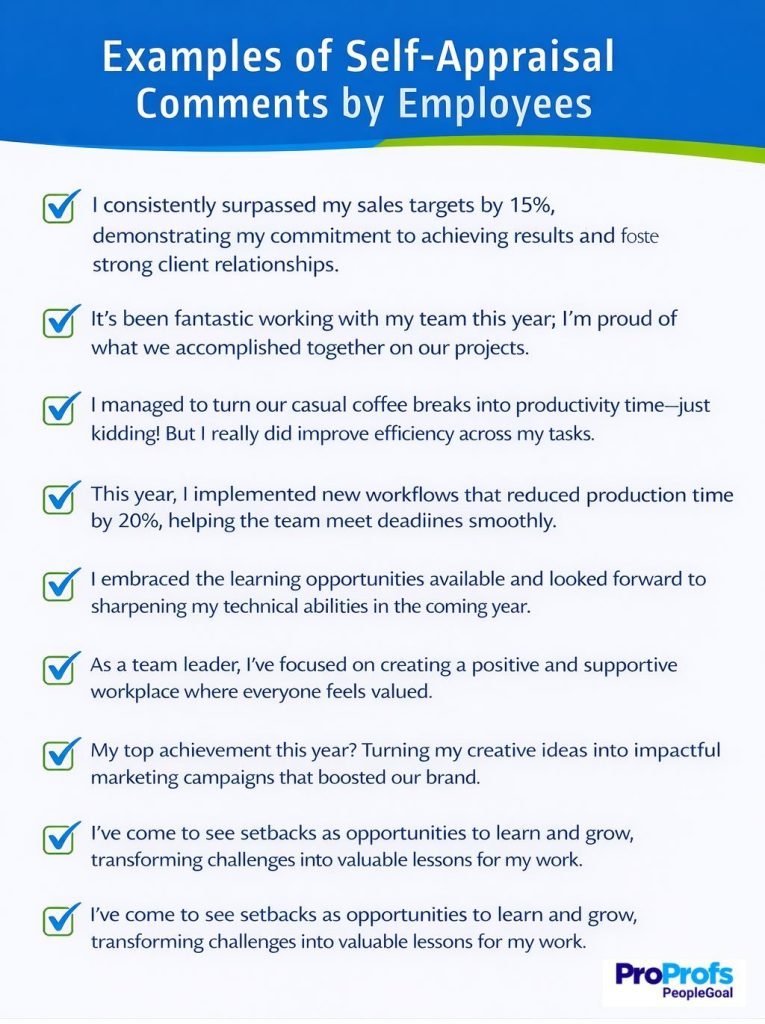
With self-appraisals, employees don’t just wait for feedback; they start the review by looking back on their own performance. It shifts the appraisal from a manager-led judgment to a more balanced conversation where employees share their wins, challenges, and growth goals upfront.
How to run it:
- Ask employees to complete a self-review before the meeting
- Compare self-feedback with manager observations
- Use it as a starting point for goal-setting and support
Example: Before a review meeting, an employee answers questions like:
- What achievements am I most proud of this quarter?
- Where did I struggle, and what support do I need?
- What skills do I want to build next?
It turns the conversation into a two-way dialogue, not a one-sided report card.
Method 7: Peer-to-Peer Feedback Appraisal
Here, colleagues play a role in evaluating performance. Since teammates often see day-to-day collaboration more closely than managers do, their input adds a more grounded, real-world perspective.
Example: In a cross-functional project, team members might share feedback on things like communication, reliability, and teamwork. Someone might be recognized not just for hitting deadlines, but for being the person who always unblocks others or keeps projects moving smoothly.
How to run it:
- Collect feedback from 3–5 close collaborators
- Use structured prompts focused on teamwork and reliability
- Share feedback constructively, not as criticism
Peer feedback questions:
- What does this person do that helps the team succeed?
- Where could they collaborate more effectively?
- What is one strength they consistently bring to projects?
Method 8: Forced Distribution Method (Ranking Method)
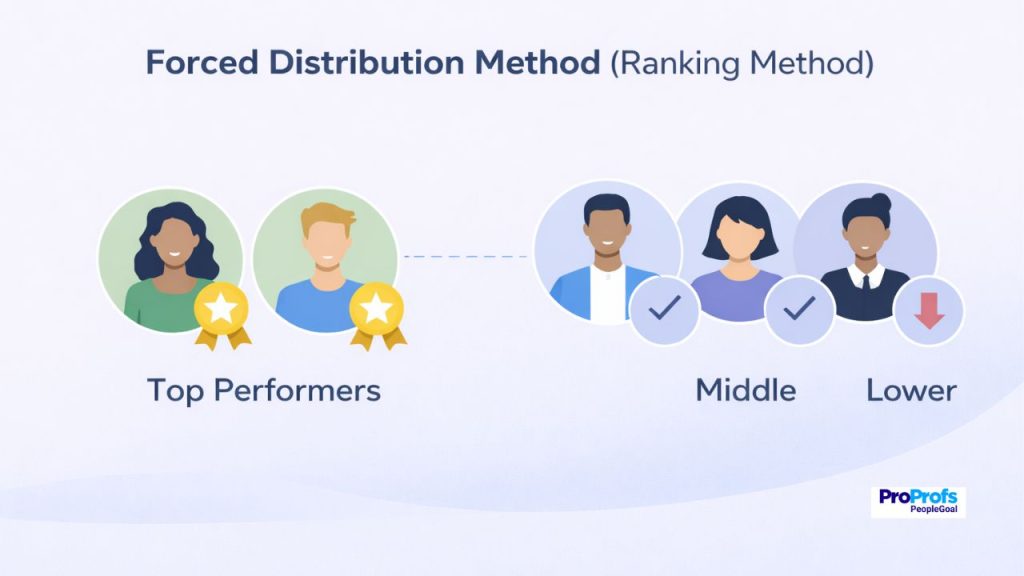
Forced distribution is an appraisal method in which managers rank employees against one another based on overall performance, results, and behaviors. Instead of everyone being rated independently, employees are compared within the same team and then placed into fixed tiers like top, average, or low performers.
Example: A manager reviews the entire team’s year, considering factors such as goal achievement, work quality, and impact. Then they may be required to label only a few employees as “top performers,” even if several people did well. The rest are placed in the middle or lower categories based on their relative contributions.
How to run it:
- Review performance across the team using shared criteria
- Group employees into defined tiers (top, middle, lower)
- Use rankings carefully alongside development conversations
Forced distribution questions:
- Who delivered the highest measurable impact this cycle?
- Who needs the most coaching support moving forward?
- Are rankings based on evidence, not perception?
Method 9: Skill-Based Appraisal (Technical & Blue-Collar Roles)
Skill-based appraisals focus less on broad performance ratings and more on how well an employee applies specific job skills. This method is especially useful in roles where technical ability, safety, and consistency matter more than subjective traits.
Example: In a manufacturing setting, an employee may be evaluated on machine handling, compliance with safety protocols, quality checks, and error reduction. The review becomes about real competence on the floor, not just general feedback.
How to run it:
- Identify core skills required for the role
- Evaluate employees against clear competency levels
- Combine skill results with safety and quality outcomes
Skill-Based appraisal questions:
- How consistently does the employee follow safety procedures?
- Can they operate equipment independently without errors?
- Which skills need certification or refresher training?
Method 10: 720-Degree Feedback (Future-Focused Advanced Method)
If 360-degree feedback gives you the internal view, 720-degree feedback goes a step further. It also brings in voices outside the organization, such as customers, clients, or external partners. The idea is simple: some roles have an impact beyond office walls, so the appraisal should reflect that.
Example: Consider a client-facing leader who manages key accounts. Along with feedback from managers and peers, the company also gathers client input on trust, communication, and service experience. It paints a much fuller picture of performance.
How to run it:
- Combine internal 360 feedback with external stakeholder input
- Use short surveys for customers, partners, or clients
- Focus on service experience, trust, and relationship impact
Sample external feedback questions:
- How reliable is this person in communication and follow-through?
- How well do they handle client needs or concerns?
- What could improve the overall experience of working with them?
How to Choose the Right Appraisal Method (Decision Framework)
With so many employee appraisal method types out there, the real question isn’t “Which one is best?”
It’s “Which one makes the most sense for your team right now?”
The best employee appraisal method depends on your company’s stage, your culture, and even the kind of roles you’re evaluating. What works in one environment can feel completely wrong in another.
Here’s a more detailed framework to help you match the method to your situation:
1. Company Stage
Your organization’s size and maturity shape what kind of appraisal system will actually stick.
- Startups often do better with continuous check-ins and (OKRs) objectives and key results, because priorities shift fast and teams need regular alignment.
- Mid-size companies usually benefit from 360 feedback and quarterly reviews, especially when leadership development becomes a focus.
- Enterprises tend to need structured cycles and calibration, so performance decisions stay consistent across large teams.
2. Role Type
Different roles require different evaluation styles.
- Technical or frontline roles work well with skill-based reviews and performance rating scales, since performance is tied to clear job behaviors.
- Leadership roles benefit from 360 feedback and MBO, where both people impact and results matter.
- Remote teams often need continuous feedback and peer input, so performance stays visible beyond just online presence.
3. Review Purpose
Not every appraisal is for the same purpose. Some are designed for compensation, while others are purely developmental.
- If you’re making pay or promotion decisions, structured methods like rating scales or MBO (management by objective) tend to work best.
- In case your goal is coaching and growth, continuous feedback or narrative-style reviews often feel more supportive.
4. Work Pace
In fast-moving environments, annual reviews can quickly become outdated.
- Teams working in quarterly cycles or agile projects often benefit from OKR-based or project-based reviews.
- More stable roles may do fine with annual or biannual appraisal structures.
5. Team Collaboration
The more cross-functional the work, the harder it is for one manager to see everything.
- Collaborative teams often benefit from peer reviews or 360-degree feedback, because performance depends heavily on teamwork and communication, not just output.
6. Manager Readiness
Even the best appraisal method fails if managers don’t have the bandwidth or training to use it well.
- Simple rating scales are easier to roll out quickly.
- More detailed methods like BARS or narrative reviews require more effort, consistency, and manager skill.
The best employee appraisal method is the one that feels fair, practical, and actually supports growth, not just paperwork.
Bias in Employee Appraisals (And How to Reduce It)
Even the best appraisal method can fall apart if bias creeps in. Most employee performance appraisal methods aren’t unfair on purpose; they’re just human. And humans naturally carry blind spots.
Here are a few common biases that show up in employee appraisals:
1. Halo/Horns Effect
This bias happens when one standout moment shapes the entire review, even if it doesn’t reflect the employee’s overall performance. A single strength can create an overly positive “halo,” while one mistake can create a negative “horns” effect.
Example: A team member is known for being extremely confident and articulate in meetings. They speak well, present ideas clearly, and often impress senior leadership. Over time, their manager starts rating them highly across the board, even in areas like execution or follow-through where they may actually struggle. On the other side, an employee who made one visible mistake, like mishandling a client call, may continue to be seen as “unreliable,” even if they perform consistently afterward.
2. Recency Bias
Recency bias shows up when managers focus too heavily on what happened in the last few weeks, instead of considering performance across the entire review period.
Example: An employee delivers strong results for most of the year, completes projects on time, and is regularly dependable. But in the last few weeks before reviews, they face a personal disruption, miss a couple of deadlines, or appear less engaged. The appraisal conversation becomes heavily centered on the recent dip, and their earlier contributions fade into the background simply because they’re less fresh in the manager’s mind.
3. Central Tendency Bias
This bias occurs when managers avoid giving high or low ratings, often because it feels safer or easier than differentiating performance. Over time, it flattens the entire review process.
Example: A manager has a team of ten people, with a few standout performers and a few who clearly need support. But when it’s time to submit ratings, the manager worries about difficult conversations, pushback, or having to justify extremes. So they give almost everyone the same middle score. The high performers feel unrecognized, and the struggling employees walk away thinking they’re doing fine, because the review doesn’t clearly differentiate performance.
4. Affinity Bias
Affinity bias happens when managers unintentionally rate employees higher if they communicate similarly, share common interests, or “feel familiar,” even when others contribute just as much.
Example: Two employees contribute equally, but one communicates in a style the manager personally relates to, maybe they’re outgoing, quick to speak up, and share similar interests. The other is quieter, works independently, and doesn’t self-promote, even though their output is just as strong. Over time, the manager naturally gravitates toward the more familiar personality, giving them higher ratings and more opportunities, while the quieter contributor is unintentionally overlooked.
The good news is, bias can be reduced with a few practical habits:
- Use the SBI model (Situation–Behavior–Impact) to keep feedback specific and objective
- Hold calibration meetings so managers align on what “good performance” really looks like
- Include multi-rater input (like peer or 360 feedback) to avoid one-person judgment
- Focus more on narrative feedback and real examples, not just numbers on a scale
Fair appraisals aren’t about perfection; they’re about building a process people can trust.
What Modern Employees Expect From Appraisals Today
Traditional performance appraisals often fall short, not because the idea is bad, but because the experience can feel a little outdated.
If you’ve ever tried managing reviews through spreadsheets, Google Forms, or a once-a-year meeting, you already know how quickly it becomes hard to track, harder to scale, and easy to lose the real story of someone’s work.
Many HR teams are now looking for ways to automate employee performance appraisal scheduling methods, so check-ins, review cycles, and feedback deadlines don’t fall through the cracks.
It blends smoothly, avoids sounding forced, and fits perfectly with the context of scaling beyond spreadsheets.
And when feedback only happens annually, it can start to feel one-sided, vague, or disconnected from what employees actually do day to day.
Common frustrations include:
- Manual review processes that get messy as teams grow
- Feedback that feels like a manager’s judgment instead of a real conversation
- Bias creeping into ratings and promotion decisions
- Employees feeling like their “invisible work” goes unnoticed
- Managers feeling overloaded with paperwork and difficult conversations
What most employees want today is something more modern, fair, and supportive.
Based on what many HR teams and managers are actively looking for today, it helps to build appraisal systems around a few modern expectations, like:
- Less manual chasing and more automation
- Clear goal tracking tied to skills and competencies
- Mid-year or continuous check-ins, not just annual reviews
- Simple workflows that managers can actually follow
- Strong employee performance reporting across teams, roles, and regions
- Anonymous feedback options that encourage honesty
- Integration with HR tools and calendars to keep everything connected
At the end of the day, appraisals work best when they feel fair, ongoing, and focused on growth, not just ratings on a form.
Future Trends in Employee Appraisal Methods
Employee appraisals are changing fast. What used to be a once-a-year formality is becoming a more continuous, tech-supported process focused on growth and clarity.
Here are a few trends shaping the future of performance reviews:
- AI-powered review summaries: Many teams are now using AI to extract insights from feedback, highlight patterns, and reduce manual effort.
- Feedforward over feedback: Instead of focusing only on what went wrong, appraisals are becoming more future-focused, centered on what employees can improve next.
- Continuous performance management: Annual reviews are slowly being replaced by regular check-ins, goal updates, and ongoing coaching.
- Real-time performance dashboards: Modern systems are moving toward live visibility, where goals, progress, and feedback don’t sit in a document, but stay accessible throughout the year.
The overall shift is clear: appraisals are becoming less about ratings and more about support, alignment, and long-term employee development.
Make Employee Appraisals More Effective With the Right Method
Employee appraisals have come a long way from the old once-a-year review. Today, the best organizations treat performance management as an ongoing conversation, not just a yearly formality.
Whether you’re using annual appraisals for structure, continuous check-ins for momentum, 360 feedback for leadership growth, or goal-based employee performance appraisal methods like OKRs and MBOs, the right approach is the one that feels fair, clear, and supportive for your team.
The real takeaway is simple: appraisals work best when they help employees grow, stay aligned, and feel recognized, not when they become paperwork.
If you want to make reviews easier to run, more consistent, and less manual, tools like PeopleGoal can help you manage goals, feedback, and appraisal cycles in one place.
Ready to build a modern appraisal process that your employees actually trust? Try PeopleGoal and start improving performance conversations today.
Frequently Asked Questions

Is 360-degree feedback better than annual reviews?
It can be, especially for leadership roles, because it gives a fuller picture beyond just a manager’s view. Annual reviews still work well for formal pay and promotion decisions.
How do you prevent bias in performance appraisal?
The easiest way is to use clear criteria, real examples, and input from more than one person. Structured questions and calibration meetings also help keep reviews more objective.
What appraisal method works best for startups?
Startups usually benefit from continuous feedback and OKR-based reviews since priorities change fast. Quick check-ins keep everyone aligned without heavy processes.
How often should appraisals happen?
Most teams shouldn’t wait a full year. Monthly or quarterly check-ins paired with an annual summary tend to create the best balance of growth and structure.
Ready to 3x Your Teams' Performance?
Use the best performance management software to align goals, track progress, and boost employee engagement.