
I still remember the first engagement survey I ran at a company I worked with. We sent it out, waited three weeks for responses, built a slide deck out of the results, and then never mentioned it again. Six months later, the same complaints came up in exit interviews. Nobody had closed the loop.
That is the moment I understood that collecting feedback and actually using it are two completely different problems. Most teams have solved the first one with a survey tool. Almost none have solved the second.
In this guide, I am walking you through the exact tools I would shortlist if I were building a feedback system from scratch today, how to tell which category of tool you actually need, and the questions that separate a tool people use from one that quietly dies after the first quarter.
What Is Employee Feedback Software?
Here is why this category matters more than it did five years ago:
- Retention risk shows up early: Teams that check in monthly, not annually, catch disengagement before someone hands in their notice.
- Managers stop guessing: Structured feedback data replaces gut feel with actual signals about who is struggling and who is ready for more.
- Reviews get fairer: Multi-rater input reduces the bias that creeps in when one manager’s opinion is the only data point.
- HR stops chasing spreadsheets: Automated reminders and centralized reporting replace the manual follow-up that eats up a Friday afternoon.
10 Best Employee Feedback Software To Compare
Here is the shortlist I would actually hand someone, with the details I would want in front of me before booking a single demo.
| Tool | Best For | Pricing | User Rating |
| PeopleGoal | Fully Customizable Performance Reviews, OKRs & Employee Development | Starts at $4/user/month (14-day free trial) | 4.5/5 (G2) |
| Culture Amp | Employee Engagement Surveys Backed By Validated Research | Contact sales | 4.5/5 (G2) |
| 15Five | Continuous Feedback Through Weekly Check-ins | From $4/user/month | 4.6/5 (G2) |
| Officevibe | Lightweight Pulse Surveys And Manager Coaching Prompts | From $5/user/month | 4.3/5 (G2) |
| TinyPulse | Anonymous Pulse Surveys And Honest Employee Voice | Contact sales | 4.4/5 (G2) |
| Engagedly | Engagement Tied Directly To Goals And Performance Reviews | From $5/user/month | 4.2/5 (G2) |
| Reflektive | Continuous Performance Feedback That Replaces Annual Reviews | Contact sales | 4.2/5 (G2) |
| Effy AI | AI-Assisted Reviews Built For Lean Teams | From $3/seat/month | 4.8/5 (G2) |
| CultureMonkey | Enterprise Pulse Surveys Across Shifts And Locations | Custom pricing | 4.7/5 (G2) |
| Zonka Feedback | Multi-Channel Surveys With Closed-Loop Action Workflows | Custom pricing, free trial available | 4.6/5 (G2) |
1. PeopleGoal – Best for Fully Customizable Performance Reviews, OKRs & Employee Development
I have used PeopleGoal to run 360 feedback across a team where one manager’s opinion was never going to be the full picture.
What stood out immediately is that it is the only tool I have tested that lets you pull structured input from multiple managers, peers, and even outside collaborators on a single employee, instead of forcing everyone into a one-rater format.
The anonymity settings are genuinely flexible too. I could adjust how anonymous a review was per cycle instead of committing to one blanket setting, which mattered a lot once we started collecting feedback on leadership, not just peer-to-peer input.
Everything ties back into goals and OKRs automatically, so feedback never sits in its own silo disconnected from performance.
Pros:
- Multi-rater 360 feedback that goes beyond the single manager to single employee format
- Adjustable anonymity settings per review cycle, not just one fixed toggle
- Feedback connects directly to OKRs, SMART goals, and performance reviews in one system
- Automated reminders and reusable review templates cut down manual chasing
- Real-time dashboards give centralized reporting instead of scattered files
- Integrates with Slack, BambooHR, Workday, and over 500 other platforms
Cons:
- No downloadable or on-premises version
- Dark UI mode is not available
User Rating: 4.5/5 (G2)
Pricing: 14-day free trial. Paid starts at $4/user/month
Collect 360 Feedback Without Endless Follow-Ups
2. Culture Amp – Best for Employee Engagement Surveys Backed By Validated Research
The first time I ran a Culture Amp survey, it was for a mid-sized organization that needed engagement data leadership would actually trust, not just glance at and forget. Nobody on that leadership team wanted to argue with a survey score once they could see how it stacked up against companies our size, and that benchmarking is what got the whole project taken seriously.

Survey design follows a research-backed framework rather than a blank template, so I was not sitting there guessing at question wording or worrying I was accidentally leading people toward a certain answer.
What earns Culture Amp its reputation, though, is what happens after the results come in. They do not just sit in a dashboard collecting dust until the next cycle rolls around. Each one turns into a tracked plan with an owner and checkpoints, which is the closing the loop step most tools skip entirely.
Pros:
- Engagement surveys benchmarked against industry and global data
- Advanced analytics that highlight engagement drivers and risk areas
- Action planning tools that track follow-through after results come in
- Performance and development feedback is built into the same platform
Cons:
- Pricing is not public, which slows down early-stage comparison shopping
- Heavier setup than lightweight pulse-only tools
User Rating: 4.5/5 (G2)
Pricing: Contact sales for pricing.
3. 15Five – Best for Continuous Feedback Through Weekly Check-ins
Weekly meetings were the thing everyone on my old team dreaded most, so when we tried 15Five, I fully expected the check-ins to get ignored within a month. Instead, they ended up replacing most of those meetings entirely, and nobody complained.
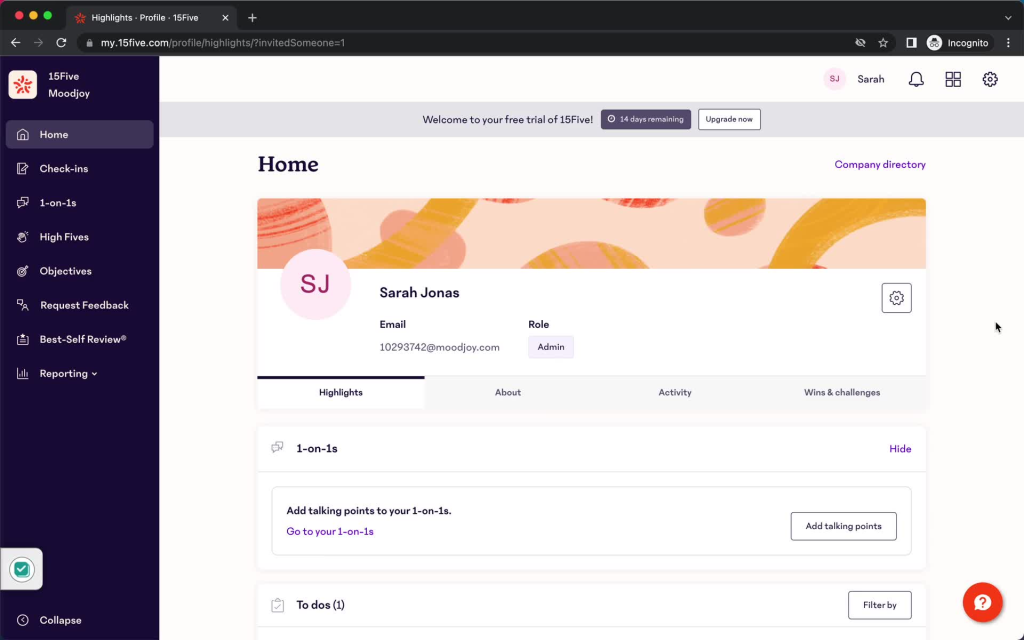
Employees log accomplishments, priorities, and blockers in a few minutes, and managers suddenly have a running record instead of trying to reconstruct what happened ten months ago, right before a review is due. I found myself actually looking forward to reading them on Monday mornings.
What surprised me more was the recognition feature sitting right next to the check-in flow, so positive feedback happens in the moment instead of getting saved up for a formal cycle that may or may not happen on schedule. A manager I know started using it just to say thanks more often, and it genuinely changed how her team talked to each other day to day.
Pros:
- Weekly check-ins create a running record instead of relying on memory at review time
- Continuous feedback and recognition built into the same weekly flow
- Goal tracking keeps individual work visibly tied to company priorities
- Performance review tools standardize what was previously an inconsistent process
Cons:
- Weekly cadence can feel like overhead for very small teams
- Reporting customization is more limited than enterprise-focused tools
User Rating: 4.6/5 (G2)
Pricing: Starts at $4 per user per month.
4. Officevibe – Best for Lightweight Pulse Surveys And Manager Coaching Prompts
A new manager on a team I once advised froze completely when a pulse score came back lower than expected, because he had no idea what to actually say to his team about it. That is the exact situation Officevibe is built for. It does not just hand you a score and leave you to figure out the rest.
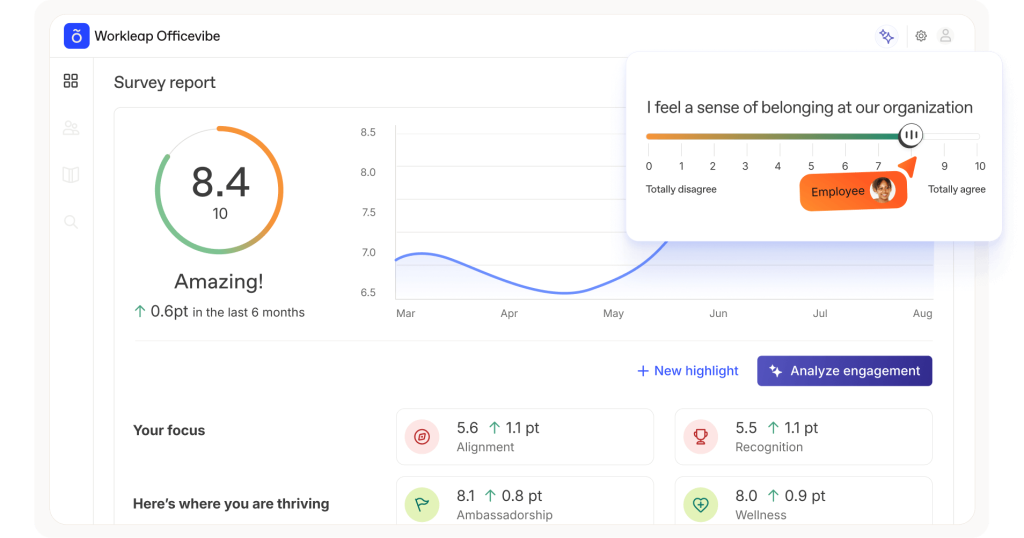
It hands you a coaching prompt tied directly to that result, which took the guesswork out of what to bring up in his next one-on-one without sounding defensive about it.
Anonymous feedback works well here without any extra setup on our end, and the team health dashboards give a quick read on where things stand without anyone needing to dig through raw survey data every week. It became the tool our managers checked before every one-on-one, not after.
Pros:
- Short recurring pulse surveys designed to avoid survey fatigue
- Manager coaching prompts tied directly to survey results
- Anonymous feedback options that protect honest responses
- Team health dashboards built for quick, regular scanning
Cons:
- Less depth for large-scale, cross-departmental benchmarking
- Fewer performance management features compared to review-focused tools
User Rating: 4.3/5 (G2)
Pricing: Starts at $5 per user per month.
5. TinyPulse – Best for Anonymous Pulse Surveys And Honest Employee Voice
Trust was already shaky on one team I worked with, and leadership genuinely needed a way to hear the truth without anyone worrying they would be identified afterward. TinyPulse ended up being the tool that made that possible.
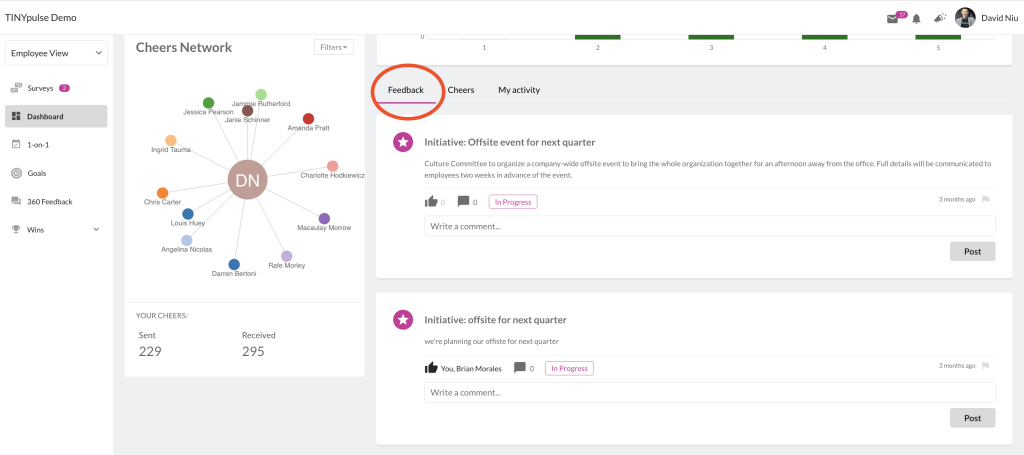
The anonymous messaging feature lets managers respond directly to feedback without ever knowing who sent it, which keeps the conversation open instead of shutting it down the moment something uncomfortable comes up. A friend of mine who runs HR at a small agency told me this was the first time her team actually believed the anonymous part was real.
The virtual suggestion box is a nice touch, too. It gives people a place to drop an idea or a concern outside of a scheduled survey window, so feedback is not limited to whenever HR decides to ask. She said it caught a scheduling issue two full months before it would have shown up in a quarterly survey.
Pros:
- Short, recurring pulse surveys built to maintain high participation
- Anonymous feedback and messaging that protects employee identity
- Virtual suggestion box for feedback outside scheduled survey cycles
- Peer recognition through its Cheers for Peers feature
Cons:
- Pricing is not published, so budgeting requires a sales conversation
- Less suited to companies wanting feedback tied to formal performance reviews
User Rating: 4.4/5 (G2)
Pricing: Contact sales for pricing.
6. Engagedly – Best for Engagement Tied Directly To Goals And Performance Reviews
One HR lead I worked with was tired of stitching engagement data and performance reviews together across two systems that never actually talked to each other, and Engagedly was what finally closed that gap.
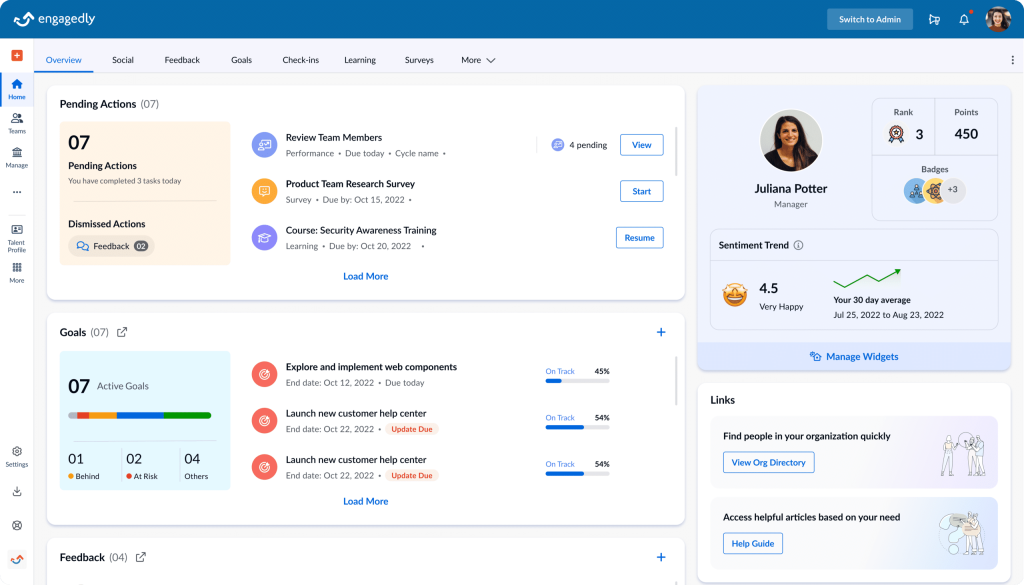
Pulse surveys feed directly into the same dashboard as goal tracking, so a dip in engagement is never disconnected from what is actually happening with someone’s OKRs that quarter. That connection was the thing she kept pointing to whenever someone asked why engagement scores mattered at all.
The recognition and learning features round it out, giving managers a way to reinforce good work in real time rather than saving every compliment for a scheduled review months later. She noticed people started calling out teammates publicly within the first couple of weeks of rollout, which was not something anyone told them to do.
Pros:
- Engagement and pulse surveys built alongside goal and OKR tracking
- Continuous feedback features that support more frequent check-ins
- Recognition tools that reinforce contributions in real time
- Learning and development features connected to feedback data
Cons:
- Reporting depth is lighter than dedicated engagement analytics platforms
- Full pricing details are not listed publicly
User Rating: 4.2/5 (G2)
Pricing: Starts at $5 per user per month.
7. Reflektive – Best for Continuous Performance Feedback That Replaces Annual Reviews
Killing an annual review sounds simple until you actually try it, and Reflektive is what made that transition possible for an organization I worked with, instead of just a nice idea in a slide deck.
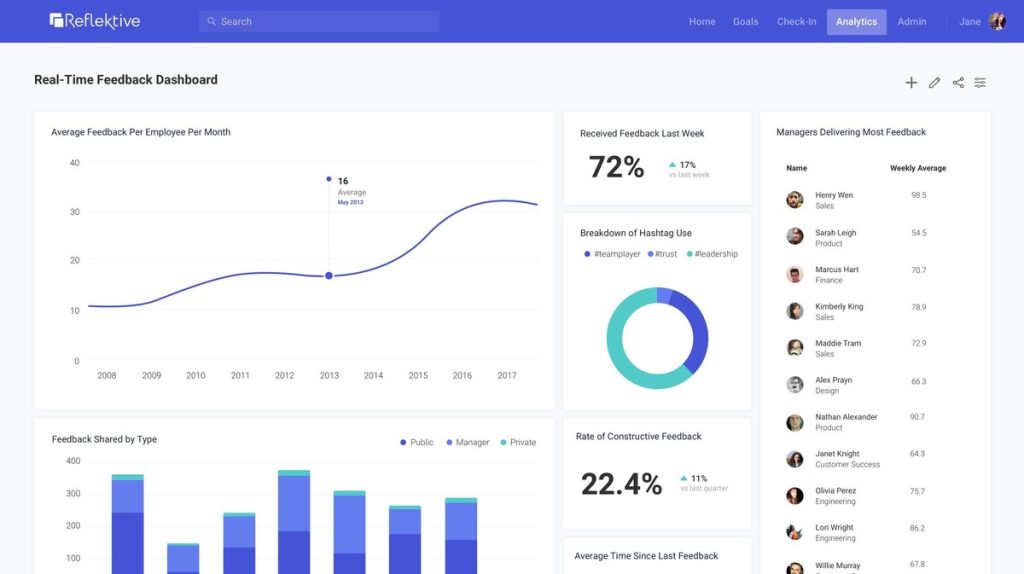
The real-time feedback requests meant employees and managers could exchange feedback whenever it was relevant, right after a project wrapped or a tough meeting happened, instead of saving every thought for a cycle that only came around once a year. It took a few weeks for people to trust that habit, but once they did, nobody wanted to go back.
Goal alignment tools sit alongside the feedback flow, so ongoing coaching conversations stay tied to what someone is actually supposed to be working toward that quarter. A manager on the team said it was the first time feedback felt connected to real work instead of a checklist.
Pros:
- Continuous feedback and check-ins that replace infrequent annual reviews
- Real-time recognition and peer-to-peer feedback requests
- Goal-setting tools that keep feedback tied to measurable outcomes
- Manager reporting that surfaces feedback activity and trends
Cons:
- Pricing information is not published on the website
- Interface feels less modern compared to newer entrants on this list
User Rating: 4.2/5 (G2)
Pricing: Contact sales for pricing.
8. Effy AI – Best for AI-Assisted Reviews Built For Lean Teams
A founder I know had zero patience for a heavy performance management rollout on his small, fast-growing team, so we tried Effy AI, and the AI summaries turned out to be the standout feature by a wide margin.
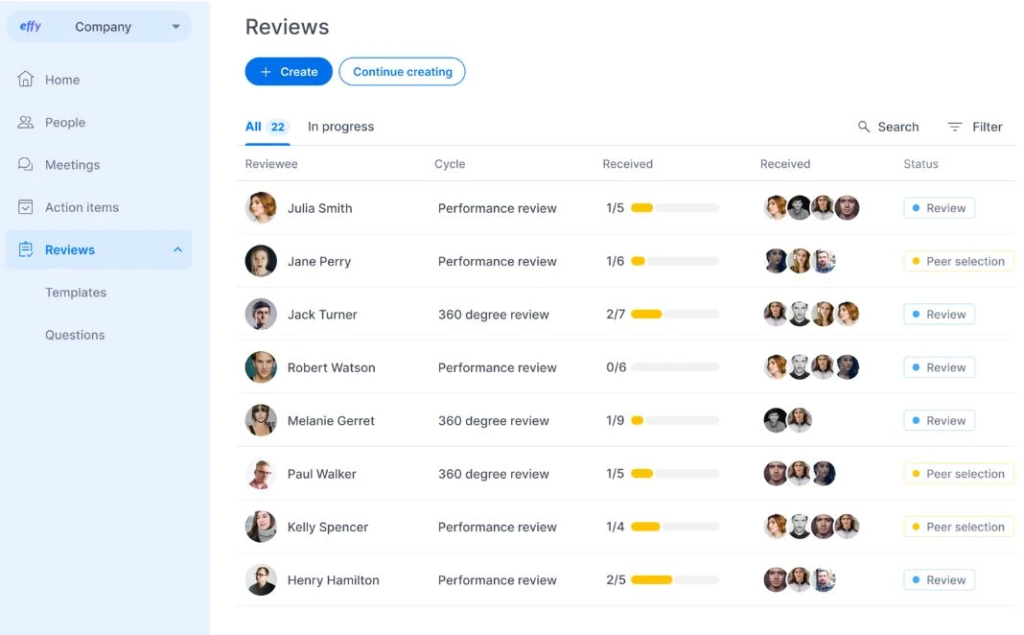
Instead of a manager sitting down to manually read through dozens of peer comments and try to spot patterns by memory, the tool surfaces recurring themes automatically and puts them right in front of you before the review conversation even starts.
Setup took less than an hour, which matters a lot if you are a lean HR team trying to run a review cycle without dedicating an entire week to configuration and training. He told me it was the only review tool his team did not need a manual for, and that alone was enough to keep everyone actually using it past the first cycle.
Pros:
- AI-assisted summaries that surface themes from peer and manager feedback
- Peer, self, and manager review formats in one lightweight platform
- Automated review cycles that reduce manual follow-up
- Fast, low-friction setup suited to smaller teams
Cons:
- Fewer enterprise-grade controls compared to larger platforms
- Not built for complex, multi-department performance frameworks
User Rating: 4.8/5 (G2)
Pricing: Starts at $3 per seat per month.
9. CultureMonkey – Best for Enterprise Pulse Surveys Across Shifts And Locations
Frontline and shift-based teams are where most feedback tools quietly fall apart, which is exactly why CultureMonkey is the one I reach for in those situations. Mobile-friendly pulse surveys and shift or location-based segmentation let leaders compare engagement across warehouses, depots, or departments instead of treating the whole company as one single block with one single score.
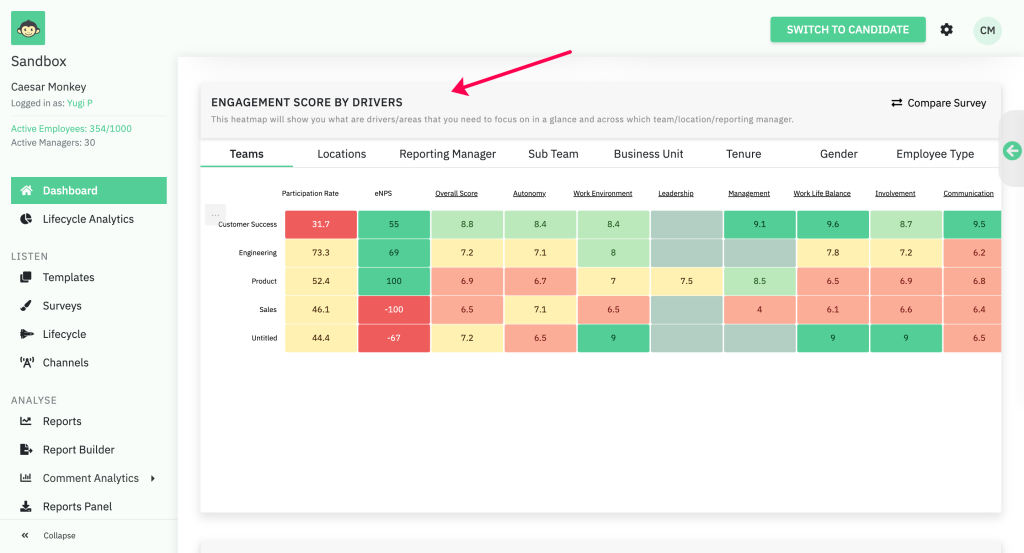
A friend who runs people operations at a logistics company said it was the first time she could actually see which depot was struggling, rather than guessing from turnover numbers alone.
The AI-powered theme detection pulls out issues like overtime fatigue or unsafe conditions directly from open text responses, which would otherwise take a person days to read through manually across hundreds of shift workers. She told me it flagged a scheduling complaint pattern before it ever reached her inbox as a formal grievance.
Pros:
- Mobile-friendly pulse surveys built for frontline and shift-based teams
- Segmentation by shift, location, and role to pinpoint where problems concentrate
- AI-powered theme detection across open text feedback
- Action tracking boards that assign ownership and monitor follow-through
Cons:
- Best suited to larger, multi-location organizations rather than small teams
- Pricing requires a custom conversation with sales
User Rating: 4.7/5 (G2)
Pricing: Custom pricing.
10. Zonka Feedback – Best for Multi-Channel Surveys With Closed-Loop Action Workflows
Juggling three separate tools just to collect feedback across email, SMS, and web got old fast for one HR manager I worked with, which is why Zonka Feedback ended up on her shortlist.
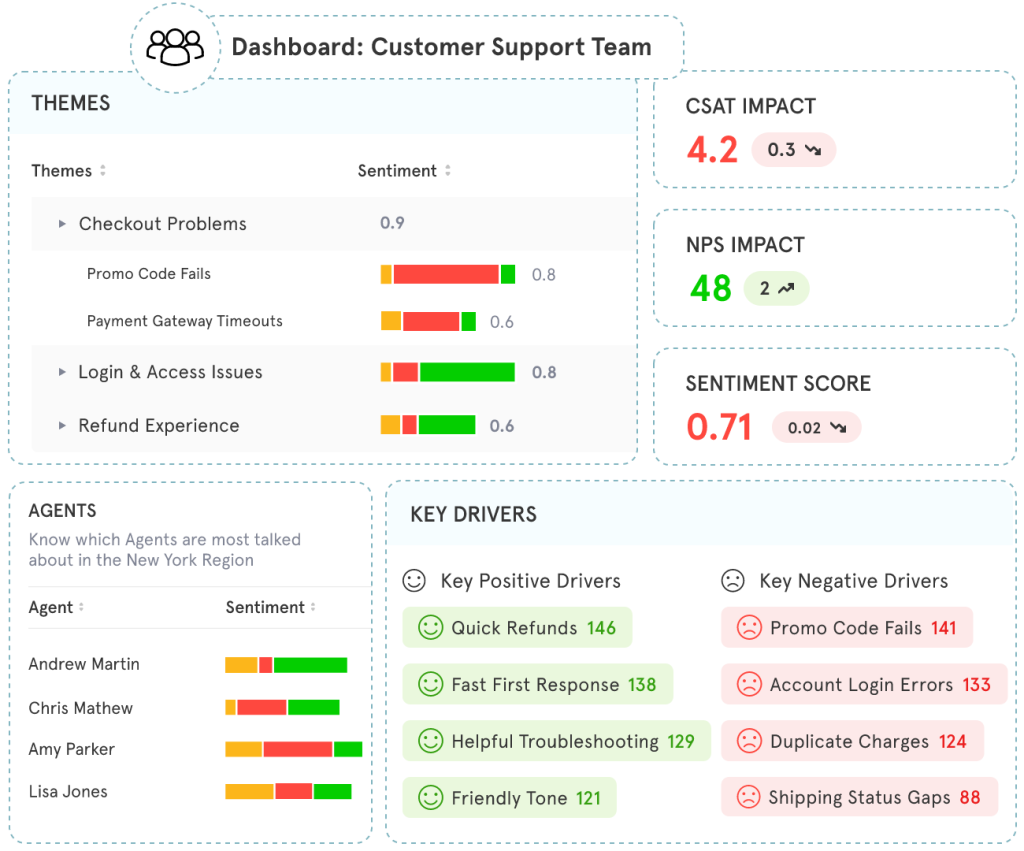
Conditional logic in the survey builder keeps questions relevant to each person instead of forcing every single employee through the exact same long form regardless of their role or department. The closed-loop workflows are what actually separate it from a simple survey tool though, and it is the reason I keep bringing it up in these conversations.
Follow-up actions get assigned to a specific owner and tracked automatically, so feedback does not just get collected and archived somewhere. It genuinely gets acted on, and she said that was the first tool where employees stopped asking her what happened to their last survey.
Pros:
- Multi-channel survey distribution across email, SMS, and web
- Customizable surveys with conditional logic for more relevant questions
- Anonymous feedback collection built in
- Closed-loop workflows that assign and track follow-up actions
Cons:
- Broader feature set than teams needing only simple pulse surveys
- Pricing is fully custom rather than published in tiers
User Rating: 4.6/5 (G2)
Pricing: Custom pricing, free trial available.
Evaluation Criteria
When I put together this list, I did not just rely on feature pages or marketing claims. I looked at how these tools actually hold up once real teams are using them every week. Here is the framework I used to make sure every recommendation earns its place:
- User Reviews and Ratings: I start with real user feedback from platforms like G2. This tells me how teams actually experience the tool day to day, what they love, and where it falls apart.
- Core Features and Functionality: I focus on what actually matters for employee feedback: survey building, anonymity controls, multi-rater support, reporting, and integrations. If a tool cannot handle these well, it does not make the cut.
- Ease of Use: A powerful tool that nobody wants to open is worthless. I look closely at onboarding time, interface clarity, and how quickly a manager can act on results without training.
- Customer Support: Implementation is where most feedback tools fail. I check how responsive support teams are during setup and during the messy first review cycle.
- Value for Money: I compare pricing against what you actually get. This is not about picking the cheapest tool; it is about whether the features justify the cost for your team size.
- Personal Experience and Expert Insight: Wherever I can, I pull from hands on experience and from conversations with HR leaders and people ops teams who run these systems in real organizations, not just demo environments.
Top 3 Employee Feedback Software Choices
Out of everything on this list, these are the three I would point a friend toward first if they only had time to look at a handful of options.
1. PeopleGoal
I keep coming back to PeopleGoal because it does not force you to choose between feedback and performance management. Multi-rater 360 reviews, adjustable anonymity, and OKRs all live in one system, so nothing gets lost translating results into an actual goal conversation, and HR never has to export a spreadsheet just to see the full picture.
2. Culture Amp
If your priority is engagement data leadership will actually trust, Culture Amp earns its spot through benchmarking and action planning tools that turn survey results into tracked follow through instead of a slide deck nobody revisits. It is the one I recommend when buy in from the top matters as much as the data itself.
3. Effy AI
For a lean team that wants reviews done without a heavy rollout, Effy AI deserves this spot because the AI summaries do the reading for you, cutting a task that normally takes days down to an afternoon. It is the fastest tool on this list to get running from a cold start.
Choose The Feedback Software That Actually Gets Used
The best employee feedback software will not fix a broken feedback culture on its own. What it can do is make it obvious when feedback is being ignored, and remove the excuses for why nothing changed after the last survey.
If I had to give you one filter for this decision, pick the tool that closes the loop, not just the one that collects the most data. For HR teams that want feedback, OKRs, and performance reviews running in one system instead of three, PeopleGoal is where I would start. You can run a 360 feedback cycle with multiple raters, adjust anonymity per review, and tie every response back to real goals without exporting a single spreadsheet.
Start with the 14-day free trial, run one review cycle with one team, and see whether the feedback actually leads to a conversation that would not have happened otherwise.
Frequently Asked Questions
What is the difference between employee engagement software and employee feedback software?
Engagement software tends to focus on measuring sentiment over time through recurring surveys, while feedback software often includes structured formats like 360 reviews, multi-rater input, and performance-linked check-ins. Many tools, including PeopleGoal, combine both, so you are not running two separate systems for what is really one job.
Is anonymous feedback in these tools actually anonymous?
It depends on the platform and the team size. Look for tools that let you adjust anonymity settings per review cycle rather than a single blanket toggle, since a fixed setting can accidentally reveal identity in very small teams where only one or two people could have given a specific response.
Can a small nonprofit or a 1,000 person company use the same feedback software?
Yes, but the configuration will look different. Smaller teams usually need simpler pulse surveys and basic anonymous review options, while larger organizations need calibration features, promotion flagging, and cascading review cycles across departments. Look for a tool built to scale rather than one designed only for a single company size.
How long does it take to see results after switching to feedback software?
Most teams see cleaner reporting and faster review cycles within the first month, but the real shift in employee trust takes two to three cycles, since people need to see that feedback actually leads to visible action before they respond honestly.
Do I still need separate performance management software if I have a feedback tool?
Not if you choose a platform that connects feedback directly to goals and reviews. Standalone feedback tools work fine for pure sentiment tracking, but if you want reviews, OKRs, and 360 feedback in one place, a combined platform like PeopleGoal removes the need to stitch two systems together manually.
Ready to 3x Your Teams' Performance?
Use the best performance management software to align goals, track progress, and boost employee engagement.