10 Best Self Evaluation Examples for Performance Reviews (+ Tips That Actually Work)

Key Takeaways

Quick Insights - by ProProfs AI.

  • Completing a rigorous self evaluation documents achievements and weaknesses—shaping perceptions, setting the tone with your manager, and unlocking clearer growth, feedback, and compensation conversations.
  • Use the STAR method, be specific, provide evidence, and reference your job description—clearly link actions to results and back claims with data and peer feedback.
  • Five focus areas guide a self review—objectives, accomplishments, improvements, core values, and development—culminating in a concrete upskilling plan and next steps aligned with your manager.

I’ve reviewed hundreds of self evaluations over the years, and the difference between a great one and a forgettable one almost always comes down to the same thing: specificity. Most people treat self evaluation examples as a box to check before their annual review. The ones who actually benefit from the process treat it as a strategic document that tells their professional story in their own words.

If you’ve ever stared at a blank review form and wondered where to even start, you’re not alone. Writing about your own performance is genuinely hard. It requires you to be honest about your gaps, confident about your strengths, and specific enough that your manager can actually picture what you did and why it mattered.

In this guide, I’ve put together 10 real-world self evaluation examples across different roles and review categories, a step-by-step breakdown of the STAR method, and a ready-to-use template you can fill in today. Whether you’re a first-time employee or a seasoned manager, these examples will give you a clear, concrete framework to write your best self evaluation yet.

What Is a Self Evaluation in a Performance Review?

A self evaluation is a written self-assessment completed by an employee before or during a performance review, where they reflect on their own goals, accomplishments, strengths, and areas for growth.

It’s not just a formality. Done well, it’s a strategic document that shapes how your manager, HR, and leadership perceive your contribution for the year. Most organizations use self evaluations as a core input into performance reviews, compensation decisions, and development planning.

According to a study by SHRM in 2023, organizations that include self evaluations in their review process report higher employee engagement and greater alignment between manager and employee expectations.

Why Does Your Self Evaluation Matter More Than You Think?

Most employees rush through their self evaluation or treat it like a formality. That’s a missed opportunity.

Here’s what a well-written self evaluation actually does for you:

  • Sets the tone for your review conversation. Your manager reads your self evaluation before meeting with you. A strong one anchors the conversation around your narrative.
  • Documents your wins before they’re forgotten. Managers juggle multiple direct reports. If you don’t document your achievements, someone else’s may take center stage.
  • Unlocks clearer feedback. When you’re specific about what you did and how, your manager can give you more targeted constructive feedback.
  • Supports compensation and promotion cases. HR teams use self evaluations to assess readiness for raises and role changes.
  • Forces you to plan ahead. Writing about your development goals forces you to think concretely about where you want to go next.

How Do You Write a Self Evaluation Using the STAR Method?

The STAR method is the most effective framework for writing self evaluation examples. It stands for Situation, Task, Action, and Result, and it forces you to be specific, evidence-backed, and outcome-focused.

A lot of self evaluations fail not because the person didn’t do good work, but because they wrote about it in a way that’s too vague or too general to land. “I supported my team throughout the year” could describe almost anyone. STAR fixes this by giving you a repeatable formula that makes your contributions concrete, credible, and easy for your manager to remember.

Here’s how each step works in practice:

  1. Situation – Set the context. What was happening? What was the challenge, gap, or opportunity your team or organization was facing? Keep this brief. One or two sentences is usually enough. The goal is to give your reader enough background to understand why your actions mattered.
  2. Task – What was your specific responsibility in that situation? Be clear about your individual role, especially if you were working as part of a team. “We worked on the problem” is less powerful than “I was responsible for X part of the solution.”
  3. Action – This is the most important part. What did you specifically do? What decisions did you make? What methods did you use? Focus on your own actions, not the team’s. If you led a project, explain what your leadership actually looked like in practice. If you solved a problem, walk through how you approached it.
  4. Result – What was the measurable outcome? This is where most people undersell themselves. If you have numbers, use them: percentages, dollar figures, time saved, error rates reduced, satisfaction scores improved. If you don’t have hard numbers, use qualitative outcomes like stakeholder feedback, process changes, or team impact.

How Do You Put STAR Into Practice?

The best way to understand STAR is to see it applied. Here is a worked example before and after using the framework.

Without STAR (weak):

“I helped improve our customer retention this year by working closely with the account management team.”

With STAR (strong):

“In Q2, our customer churn rate was climbing above 8%, and the account team was stretched too thin to follow up with at-risk accounts proactively (Situation). I was responsible for identifying early warning signals in our account data (Task). I built a churn risk dashboard in our CRM and personally reached out to 15 flagged accounts over six weeks (Action). As a result, we reduced churn to 5.3% by Q3, a 34% improvement over the previous quarter (Result).”

The second version tells a complete story. It gives your manager something specific to discuss, recognize, and reference in their own review of your performance.

What About SMART Goals?

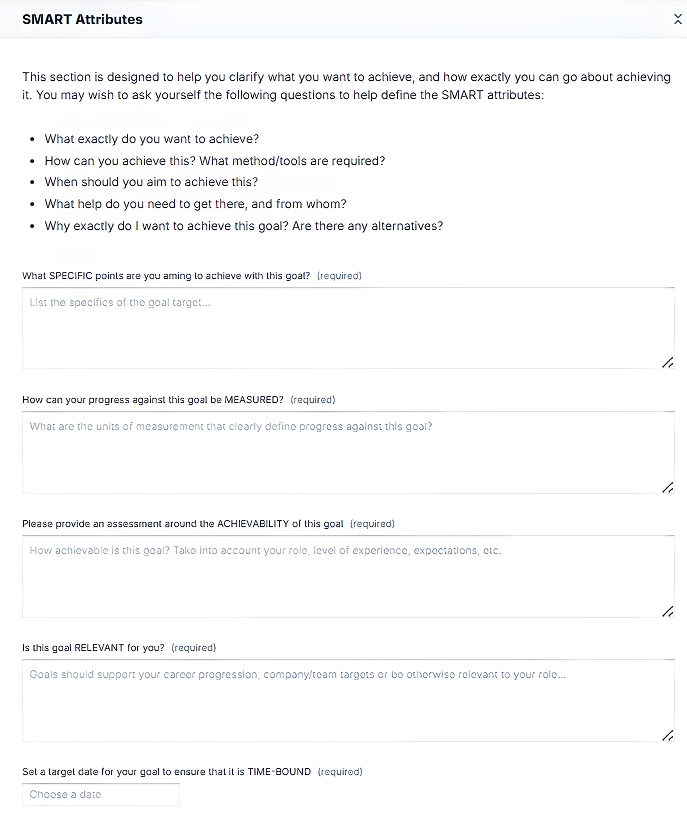
STAR works best when you pair it with SMART goals (Specific, Measurable, Achievable, Relevant, Time-bound). 

If your company asks you to evaluate yourself against the goals you set at the start of the year, use SMART formatting for those goals and STAR formatting for the examples that show how you pursued them. Together, they give your self evaluation both structure and narrative depth.

Pro tip: Keep a running document throughout the year where you log wins, challenges, and feedback as they happen. When review season arrives, you’ll have a full bank of STAR examples to draw from instead of trying to remember everything from memory.

What Are the Five Areas Every Self Evaluation Should Cover?

Most performance appraisals assess employees across these five core areas. Even if your company’s review form uses different language, structuring your self evaluation around these will cover all the bases. Think of these as the five chapters of your professional story for the year.

1. Achievement of Objectives

This is the most straightforward section, but also the one where people either undersell or oversell themselves most often. Your job here is to be objective about what you set out to do and what actually happened.

If you hit your goals, say so clearly and show the evidence. If you missed a target, don’t bury it. State the original goal, what you achieved, and the gap. Then explain why. Was it a market shift outside your control? A resource constraint? A miscalculation on your part? Managers respect honesty here far more than they respect a sanitized version of events. What they really want to see is whether you understood what happened and what you’d do differently.

Go back to your goal-setting document from the start of the year (or last review cycle) before writing this section. It’s easy to forget what you originally committed to, and your manager will likely have those goals in front of them. If you want a refresher on what strong performance objectives look like, it helps to revisit them before you start writing.

2. Accomplishments Beyond Goals

This section is your chance to show the full picture of your contribution, not just what was measured. Some of your best work this year probably wasn’t captured in a KPI or OKR. Maybe you mentored a colleague who went on to close a major deal. Maybe you spotted a process inefficiency and fixed it before it became a problem. Maybe you stepped up during a team restructure and absorbed responsibilities outside your job description.

Write these up using STAR just like your formal objectives. The fact that they weren’t tracked doesn’t make them less valuable. In fact, they often say more about who you are as an employee than the metrics you were hired to hit.

3. Areas for Improvement

This is the section most people dread, and the one managers pay closest attention to. Skipping it or filling it with fake humility (“I sometimes care too much about quality”) signals a lack of self-awareness that actually hurts your credibility everywhere else in the review.

Pick a genuine area where your performance fell short or where you lack a skill you need to grow. Be specific about where it showed up and what you’re doing to fix it. A candid improvement section paired with a concrete action plan is one of the strongest trust signals you can send in a self evaluation.

4. Company Core Values

Most companies have three to five stated values (things like integrity, collaboration, customer focus, or innovation). This section asks you to show how those values showed up in your actual work, not just in your attitude.

The key mistake here is treating values as personality traits. Don’t write “I am a collaborative person.” Instead, show a specific instance where you demonstrated collaboration, what you did, and what the result was. Treat this section exactly like an objectives section, but framed around behavior rather than metrics.

5. Professional Development

This section is forward-looking, and it’s where you plant the seeds for next year’s conversations about growth, promotion, and compensation. Be specific about what skills you want to build and why. Reference concrete resources: courses you’ve researched, mentors you want to work with, projects you want to take on.

Vague goals like “I want to develop my leadership skills” are easy to ignore. Specific goals like “I want to complete a coaching certification in Q1 and run structured monthly 1:1s with two junior team members by Q2” are hard to ignore. They also give your manager something to support you on, which is exactly what you want going into the review conversation. If you’re not sure where to begin, looking at personal development goals examples can help you get clear on direction before you put pen to paper.

10 Real Self Evaluation Examples by Role and Category

Below are 10 self evaluation examples organized by category and role type. Use these as starting templates, replacing the specifics with your own data, outcomes, and context.

1. Sales (Individual Contributor)

“In Q1, I exceeded my sales target by 10% through a creative outbound campaign I co-developed with the marketing team. This resulted in signing our largest client to date and generating three direct referrals from that relationship alone, contributing an additional $85K in pipeline.”

What makes this strong: Specific percentage, named collaboration, concrete outcomes with a dollar figure.

2. Marketing (Individual Contributor)

“I didn’t hit my Q4 target of 15% increased organic traffic—we ended at 12%. I’ve done a content audit to understand what drove that gap and identified three high-performing content formats to prioritize next quarter. Going into Q1, I have a more focused content calendar built around those insights.”

What makes this strong: Honest about missing the target, explains root cause analysis, shows a forward plan.

3. Software Developer (Technical Role)

“This year I focused on improving my knowledge of on-page technical SEO to help reduce site errors. I built an on-page SEO checklist that cut page errors by 40%, improved load times by 1.2 seconds, and helped the marketing team restructure content that drove a 25% lift in organic traffic in Q4.”

What makes this strong: Quantified across three dimensions (errors, speed, traffic), shows cross-functional impact.

4. HR Manager (Manager Role)

“I led our first company-wide employee engagement survey, coordinating input from six departments and designing a survey that achieved a 98% participation rate, well above the industry average of 70-75% (a study by Gallup in 2023). The survey surfaced three actionable themes that I translated into a leadership-ready action plan within two weeks of data collection.”

What makes this strong: Uses benchmark data for credibility, shows both the process and the output.

5. Operations / Administration

“At the start of the year, technical issues with our conferencing tools caused several meetings to run over or restart, which affected team productivity. I proactively scheduled time with IT to close that knowledge gap and can now troubleshoot the most common issues independently. I also created a quick-reference guide that’s been shared across three other teams.”

What makes this strong: Takes ownership without being overly self-critical, shows the corrective action, and adds a positive outcome.

6. Sales (Customer-Facing Role)

“With the volume of new clients I onboarded in Q3, I let some warm lead follow-ups slip. I’ve now restructured my daily schedule to include a dedicated 30-minute follow-up block and set reminders in our CRM for leads that hit the 5-day mark without contact. Since implementing this in October, I haven’t missed a follow-up.”

What makes this strong: Admits the gap, explains the structural fix, shows it’s already working.

7. Marketing (Collaboration Value)

“I consistently look for ways to bring cross-functional perspectives into our marketing work. This year, I partnered with Sales and Customer Success to develop six customer case studies, coordinating interviews, content approval, and distribution across three teams. The case studies increased inbound inquiry rate by 18% in the quarter they launched.”

What makes this strong: Shows the value in action, not as a personality trait, with a measurable business outcome.

8. HR (Quality / Accountability Value)

“I hold myself to a high standard for accuracy and turnaround time. The three new HR policies I developed this year were delivered on schedule and received positive feedback from our legal and business partner teams—specifically for their clarity and practical examples. Zero revision requests from leadership after final review.”

What makes this strong: Uses peer/stakeholder feedback as social proof, not just self-assertion.

9. Developer (Skill-Building Goal)

“Next year, I want to build stronger UI/UX design skills to reduce dependency on external design support for front-end work. I’ve identified two online courses (Interaction Design Foundation) and one industry conference (UX Copenhagen) that would give me both foundational skills and practical exposure. I estimate this would reduce our design request backlog by 30%.”

What makes this strong: Specific courses named, connects to a business outcome, quantifies the expected impact.

10. Team Lead (Leadership Development)

“As our team grows, I want to develop as a mentor and help newer team members accelerate their learning curves. I plan to complete a coaching skills workshop in Q1 and apply those skills through structured monthly 1:1s with two junior team members. My goal is for both to be independently leading projects by Q3.”

What makes this strong: Sets a concrete outcome metric (independent project ownership), not just a vague goal.

What Are Role-Specific Tips for Writing a Strong Self Evaluation?

Different roles have different expectations in a performance review. Here’s what to focus on depending on your situation:

For Managers

Focus on team-level outcomes, not just personal actions. Show how your leadership decisions improved team performance, engagement, or delivery. Include examples of how you coached, removed blockers, or developed team members. Knowing how to clearly articulate employee strengths is particularly useful in this section, both for your own review and for the language you use when developing your team.

For Individual Contributors

Lead with your direct outputs—what you specifically produced, shipped, or closed. Be precise about your percentage contribution to team results rather than saying “we did X.”

For Customer-Facing Roles

Use customer feedback, satisfaction scores, and retention data as your primary evidence. Reference specific customers or deal sizes where appropriate (without violating confidentiality).

For Technical Roles

Quantify the technical impact: performance improvements, error reduction, time saved, or features shipped. Connect technical work to business outcomes (e.g., “reduced load time by 1.2 seconds, which contributed to a 7% improvement in conversion rate”).

What Should You Avoid When Writing Your Self Evaluation?

Knowing what not to do is just as important as knowing what to include. In my experience reviewing self evaluations, the same mistakes come up again and again. Here’s what to watch out for.

1. Being Too Vague

This is the most common mistake and the easiest one to fix. Phrases like “I contributed to the team’s success” or “I worked hard this year” are genuinely meaningless in a review context. 

Every sentence in your self evaluation should answer the question: what specifically did I do, and what specifically changed because of it? If you can’t answer both parts, the sentence probably shouldn’t be there.

2. Listing Actions Without Outcomes

A lot of self evaluations read like a job description rather than a performance record. They tell you what the person did but not what happened as a result. Every example you write should end with a result. It doesn’t have to be a number, but it needs to show that your actions had an effect. 

“I redesigned the onboarding process” is a task. “I redesigned the onboarding process, which reduced new hire ramp time from 8 weeks to 5 weeks” is an accomplishment.

3. False Modesty

Some people underclaim their contributions because they feel uncomfortable talking about themselves positively. This is particularly common among high performers and introverts. Your self evaluation is not the place for humility. 

Your manager has dozens of conversations to prepare for. If you don’t advocate for your own work, there’s a real chance it goes unnoticed. State your achievements clearly, confidently, and with evidence.

4. Glossing Over What Went Wrong

Managers notice when a self evaluation is 100% positive. It reads as either dishonest or unaware, neither of which is a good signal. Including one or two genuine areas for improvement, paired with a specific plan to address them, actually makes the rest of your self evaluation more credible. 

It shows your manager that you have perspective and that you’re in control of your own growth.

5. Writing It At The Last Minute

The best self evaluations are built throughout the year, not assembled in a panic the night before they’re due. The further back you try to recall, the more your memory will default to recent events (this is called recency bias, and it’s one of the most well-documented forms of bias in performance appraisals). 

A simple habit fix: keep a shared document or note where you log wins, milestones, feedback, and challenges as they happen. When review season comes around, you’ll have a full year’s worth of material to work with instead of trying to reconstruct it from memory.

Using “we” when you mean “I.” Team accomplishments are great, but your self evaluation is about your contribution specifically. If your team hit a major milestone, that’s worth mentioning. But make sure you’re also explaining what your specific role was in making it happen. “We launched the product on time” is weaker than “I managed the cross-functional timeline and coordinated four teams to deliver the product on schedule.”

How Do Employee Engagement Surveys Connect to Self Evaluations?

An employee engagement survey measures how connected, motivated, and committed employees feel to their work and organization. Self evaluations and engagement surveys together give HR teams a more complete picture of performance and culture.

A work engagement survey typically covers:

  • Sense of purpose and meaning in the role
  • Manager relationship and feedback quality
  • Growth and development opportunities
  • Team collaboration and psychological safety
  • Workload and wellbeing

Why Does the Employee Engagement Survey Purpose Matter?

The purpose of an employee engagement survey is to surface systemic issues that individual performance reviews can’t capture, like whether people feel heard, whether they have the tools to do their jobs, and whether they see a future at the organization.

According to a study by Gallup in 2023, only 23% of employees globally are actively engaged at work, meaning the vast majority are either just getting by or actively disengaged.

When your self evaluation demonstrates high engagement, including initiative, cross-functional collaboration, and continuous learning, it stands out. It signals that you’re part of the solution to low engagement, not a passive participant. If you want to understand what that looks like at an organizational level, our guide on employee engagement covers the full picture.

Benefits of Employee Engagement Surveys for Review Cycles

When organizations run regular engagement assessments alongside performance reviews, they typically see:

  • Better review conversations, because managers have richer context about team sentiment before sitting down with individuals
  • More honest self evaluations, because employees feel psychologically safer in cultures that actively listen
  • Clearer development priorities, because engagement data surfaces systemic skill gaps across teams, not just individual ones

What Is a Simple Self Evaluation Template You Can Use Right Now?

Here’s a fill-in-the-blank self evaluation structure you can adapt for your next review:

Self Evaluation Template

Name: ___________________ Role: ___________________ Review Period: ___________________

1. Goal Achievement

“This [period], my key objectives were [list goals]. I [met / exceeded / did not meet] [goal] because [brief explanation]. The outcome was [result with data if possible].”

2. Key Accomplishment

“One achievement I’m proud of this [period] is [accomplishment]. I approached it by [actions]. The result was [outcome], which contributed to [team/company impact].”

3. Area for Improvement

“An area where I can grow is [skill or behavior]. This showed up when [specific example]. My plan to address this is [specific steps] by [timeframe].”

4. Core Values in Action

“I demonstrated [company value] by [specific example]. The outcome was [result or feedback received].”

5. Development Goals

“In the next [period], I want to develop [skill]. I plan to do this by [specific courses, projects, or mentoring]. My success metric will be [measurable goal].”

Start Writing Self Evaluations That Get You Noticed, Promoted, and Paid Better

A great self evaluation isn’t just about looking good. It’s about being honest, specific, and forward-thinking. The examples and frameworks in this guide give you a repeatable structure for writing self evaluations that actually move the conversation forward.

Start with STAR. Back every claim with evidence. Acknowledge what didn’t go perfectly. And end with a concrete development plan that shows your manager you’re already thinking about what comes next.

Want to make your performance review process more structured and data-driven across your entire team? Tools like PeopleGoal can help HR teams run employee engagement surveys and self evaluation processes at scale, giving you the data you need to have better development conversations year-round.

Frequently Asked Questions

Most self evaluations are 300–600 words. They should be long enough to give specific, evidence-backed examples for each key area, but short enough that a manager can read them comfortably before a review meeting. Quality matters more than length, one strong STAR example beats three vague bullet points.

The STAR method structures your examples around four elements: Situation (the context), Task (your responsibility), Action (what you specifically did), and Result (the measurable outcome). It's the most widely recommended framework for writing performance review self evaluations because it forces specificity and outcome-focus.

Most organizations run annual self evaluations, though high-performing teams often do them quarterly or at mid-year too. HR best practice recommends at least two self evaluation touchpoints per year: one aligned with goal-setting (typically Q1) and one tied to the formal annual review. More frequent check-ins lead to more accurate, less recency-biased assessments.

Be honest but constructive. Pick a real area where your performance fell short or where you lack a skill you need. Explain what happened, what you learned, and specifically what you're doing to improve. Avoid generic answers like "I work too hard" or "I need to delegate more," as managers can tell when improvement areas aren't genuine.

Own the miss directly. Don't bury it. State the original goal, what you actually achieved, and the gap. Then explain the root cause (was it a market shift, a resourcing constraint, or a personal execution gap?) and outline what you're doing differently going forward. Honest accountability with a forward plan is more credible than hitting every goal but never being self-aware.

A self evaluation is written by the employee and reflects their own perspective on their performance. A performance appraisal is the formal review process conducted by a manager, which often incorporates the self evaluation as one input alongside manager observations, peer feedback, and goal attainment data. Think of the self evaluation as your submission to the performance appraisal process.

An employee engagement survey measures broader sentiment: whether people feel motivated, supported, and connected to their work. Performance reviews assess individual output and growth. The two are complementary. High engagement scores alongside strong self evaluations typically indicate both individual performance and a healthy team culture. HR teams that run engagement assessments alongside review cycles get a fuller picture of both individual and organizational health.

Ready to 3x Your Teams' Performance?

Use the best performance management software to align goals, track progress, and boost employee engagement.


Kylie Strickland

About the author

Kylie Strickland