
Company A hit 90% of its KPIs. Company B “crushed” 5 OKRs on paper. Both still missed the real target because OKR vs KPI confusion had them measuring the old game and chasing the wrong targets.
This is not a one-off cautionary tale. From a distance, OKRs and KPIs look like the same tool wearing different labels, but they drive very different outcomes.
In fact, over nearly a decade of studying how organizations set goals and track performance across product, marketing, support, and HR, I have watched the same patterns repeat.
So, in this blog, I will show you:
- What OKRs and KPIs are, and why they exist.
- The real differences between them, with clear examples.
- How to use both together so KPIs monitor performance and OKRs drive improvement.
By the end, you will know which metrics deserve long-term tracking, which goals need a focused OKR push, and how to run goal cycles that move the business instead of just reporting on it.
Let’s start with the fundamentals.
What Is a KPI?
A Key Performance Indicator (KPI) is a quantifiable measure that tracks how effectively a business, team, or process performs against a target. They serve as business performance metrics for continuous performance tracking of business-as-usual metrics such as revenue, churn, uptime, or defect rates.
Each KPI has a defined formula, baseline, cadence, and threshold, supporting reliable performance measurement over time. Good KPIs report measurable results and preserve the metric vs. objective distinction by describing current health, not future intent.

As Performance metrics, they reveal trends, compare performance, and signal when stability needs an OKR-driven push. This baseline also supports examples of OKRs and KPIs in practice. Used well, KPIs focus attention on what matters most in daily operations.
Now that we have defined what a KPI is and why it matters, the next step is to see KPIs in action.
Let’s look at a few sharp KPI examples that make the difference obvious.
Real-World KPI Examples in Practice
KPIs matter when they turn daily work into clear signals. Here are a few KPI examples that demonstrate how performance metrics help teams track business performance and identify areas where improvement is needed.
- E-commerce: Shopping Cart Abandonment Rate
An online store tracks abandonment weekly as a key performance indicator with a target below 20%. If it rises to 26% for two straight weeks, the measurable results point to a checkout problem. The team reviews shipping costs, payment failures, or page speed, fixes the most likely cause, then keeps the KPI in place for continuous performance tracking.
- Sales: Qualified Pipeline Coverage
A sales team monitors pipeline value against quarterly quota, aiming for 3x coverage. When coverage drops to 2x mid-quarter, performance measurement shows risk early. Leaders respond by tightening lead quality, increasing outreach, or removing bottlenecks. The KPI remains a business-as-usual metric even after recovery.
- Project management: On-time Sprint Delivery Rate
In KPI for project management, on-time delivery is a core KPI. A product team targets 90% story completion per sprint. If delivery falls to 75%, the metric vs objective gap is clear. The KPI highlights strain, while an OKR may be set to fix estimation or dependency planning.
- Customer support: First Response Time and CSAT
Support teams track response time daily and CSAT monthly. If response time averages 50 minutes against a 30-minute target and CSAT slips, the KPI trend signals a service gap. In OKR vs KPI in performance management (HR perspective), similar KPIs track internal support quality. After an OKR improves speed or staffing, these KPIs keep monitoring the new standard.
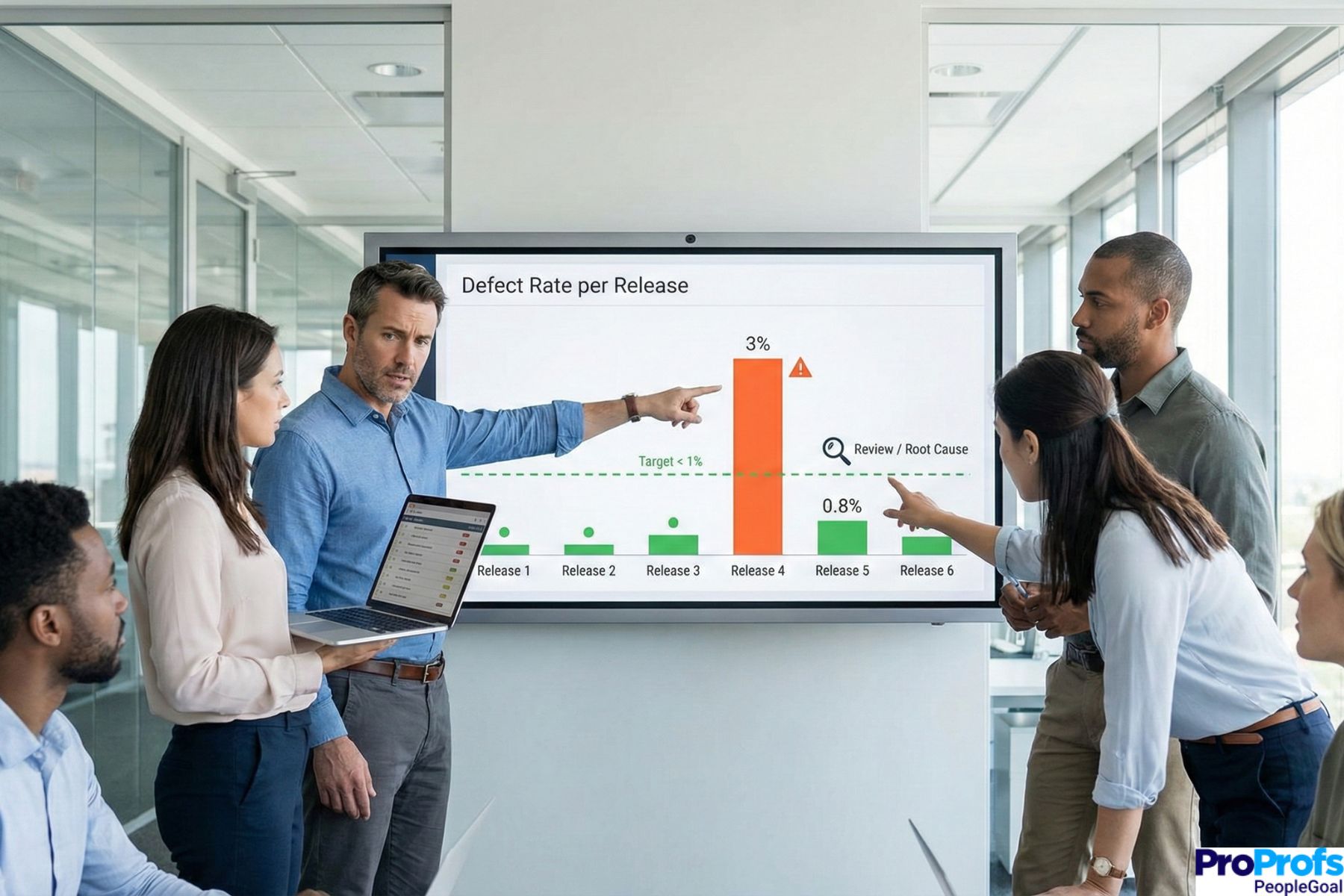
- Product quality: Defect Rate per Release
A SaaS team tracks production defects per release with a target under 1%. A spike to 3% flags quality risk and triggers a deeper review. Once fixed, the KPI stays as steady tracking for future releases.
We have seen how KPIs keep the engine running and warn you when something slips.
Now it is time to talk about the steering wheel, the framework that decides where the business should go next.
What Is an OKR?
An OKR, or Objectives and Key Results, is a goal-setting framework used to drive meaningful progress within a fixed period, most often a quarter. It starts with an Objective, a concise statement of what a team wants to achieve and why it matters.
The Objective is supported by two to five Key Results, each a measurable target that proves movement toward the goal. OKRs are not for routine reporting. They are for focused improvement, new initiatives, or strategic shifts.
Teams check progress regularly, learn from what is or is not working, and adjust effort during the cycle. This keeps everyone aligned on outcomes, not just activity. At the end, they score results, share insights, and set the next OKRs.

“If you set a crazy, ambitious goal and miss it, you’ll still achieve something remarkable.”
— John E. Doerr
American Investor & Venture Capitalist
In many organizations, OKRs are managed through simple spreadsheets at first, but as they scale, teams often adopt OKR software to track progress, align goals across levels, and keep updates consistent.
We have OKRs on the table, but they only click when you see them in the wild.
So let’s walk through three everyday OKR examples and call out what makes them real OKRs.
Real-World OKR Examples
Example 1: Customer Support
Objective: Make support feel effortless for customers this quarter.
Key Results (Key result metrics):
- Increase CSAT from 85% to 95%.
- Reduce the average first response time from 60 minutes to 30 minutes.
- Raise first-contact resolution from 70% to 90%.
Why this works:
The Objective is the story and direction. The Key Results are the measurable results that prove the story is coming true. CSAT and response time might already be KPIs in the OKR and KPI framework, but here they are being pushed hard inside a time box. That is a clean metric vs objective separation, and a classic difference between OKRs and KPIs in practice.
Example 2: Marketing and Growth
Objective: Turn more trial users into confident, active customers in Q2.
Key Results:
- Increase free-to-paid conversion from 3% to 5%.
- Grow weekly active users from 50,000 to 70,000.
- Lift trial-to-activation rate from 40% to 55%.
Why this works:
Nothing here is “keep doing what we do.” These are outcome-driven goals aimed at changing behavior and results fast. The Key Results are specific and unarguable. If they move, the Objective is happening. If not, it is not. After Q2, conversion and activation rates may settle back into KPIs for steady tracking. That handoff shows up in many examples of OKRs and KPIs in practice.
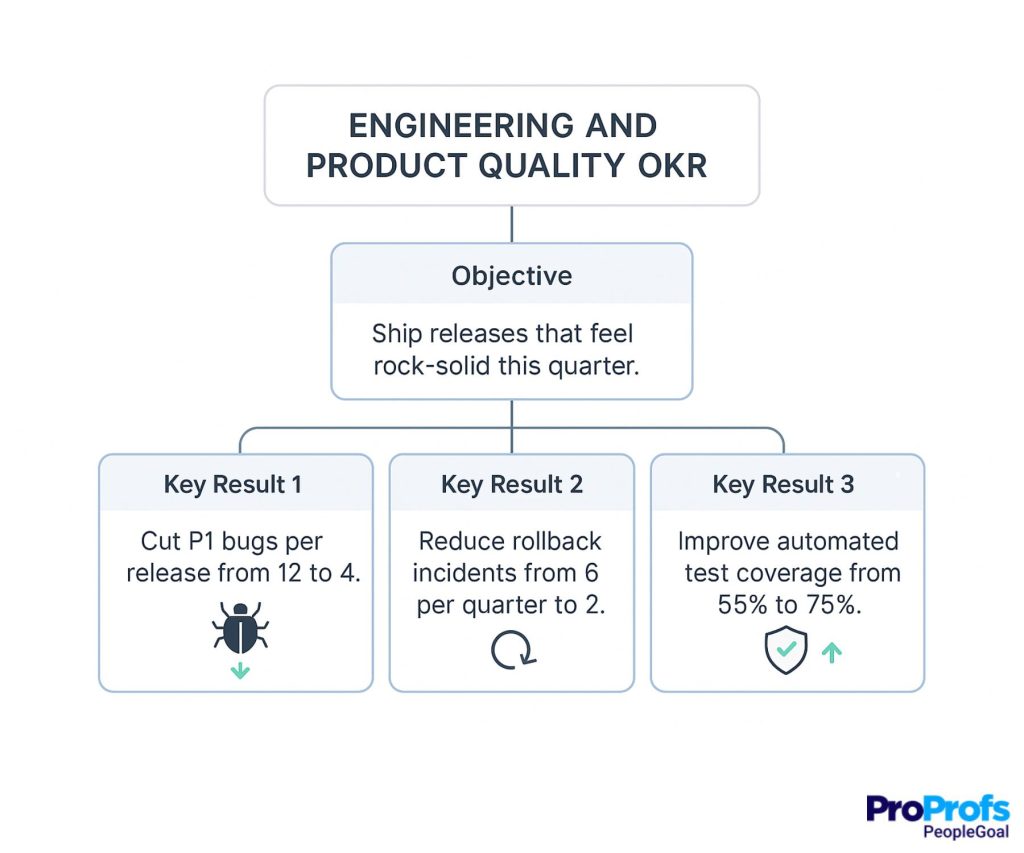
Example 3: Engineering and Product Quality
Objective: Ship releases that feel rock-solid this quarter.
Key Results:
- Cut P1 bugs per release from 12 to 4.
- Reduce rollback incidents from 6 per quarter to 2.
- Improve automated test coverage from 55% to 75%.
Why this works:
“Bug rate” and “rollback incidents” are usually business-as-usual KPIs. But when they start hurting trust, they stop being just a dashboard check and become fuel for an OKR. This Objective makes the change clear, and the Key result metrics tell engineers exactly what “rock-solid” means in numbers. Again, that is the OKR vs KPI difference showing up in real work.
We have seen KPIs doing steady monitoring, and OKRs pushing for change with clear targets.
Now comes the part everyone cares about, the clean side-by-side difference that tells you when each tool earns its place.
OKR vs KPI: Key Differences
OKRs and KPIs both rely on numbers, so they can look similar at first glance. But they are built for different jobs, which is why teams often confuse them.
To make the contrast easy to scan, here is a clear tabular comparison showing where OKRs lead and where KPIs take over.
| Basis of Difference | OKRs (Objectives and Key Results) | KPIs (Key Performance Indicators) |
|---|---|---|
| Core purpose | Built to drive change, improvement, or a new outcome. | Built to monitor and maintain ongoing performance. |
| Primary question answered | “Where do we want to go next?” | “How are we doing right now?” |
| Nature of goals | Aspirational and outcome-driven, often involving stretch. | Operational and health-focused, often involving stability. |
| Time frame | Time-bound, usually quarterly or for a defined cycle. | Continuous and long-term, tracked without a set end date. |
| What success looks like | Achieving the objective through hitting key results within the cycle. | Staying within the target range and improving trends over time. |
| Structure | One qualitative Objective plus 2 to 5 measurable Key Results. | A single metric with a target, benchmark, or threshold. |
| Relationship to strategy | Translates strategy into focused, short-term execution priorities. | Reflects strategic health areas that must stay strong. |
| How often they change | Reset each cycle based on priority shifts and learning. | Usually stable for long periods, targets may adjust. |
| Role in team behavior | Pulls attention toward new initiatives and breakthrough work. | Keeps attention on business-as-usual performance quality. |
| Typical use case | Launching products, entering markets, fixing major gaps, and achieving step-change. | Tracking revenue, churn, uptime, quality, productivity, and satisfaction. |
| How they work together | Often created to improve a KPI that is off-track or needs a lift. | Often supply baselines and trend signals that inspire OKRs. |
Now that the difference is laid out in black and white, the real question gets practical.
When you are staring at a dashboard full of numbers, which ones should keep running as KPIs, and which ones deserve an OKR spotlight?
OKRs vs KPIs: When to Use the One
Sounds confusing?
Most teams do not get stuck because they chose OKRs or KPIs. They get stuck because they used the right tool in the wrong place. The trick is to match the tool to the intent.
Use KPIs for Always-On Performance Health
KPIs are your business’s vital signs. You use them when you want continuous visibility into how something performs week after week. If the aim is to keep an operation healthy and predictable, it belongs as a KPI. These are the numbers you want on a rainy Tuesday, not just during quarterly planning.
Where KPIs Fit Best
KPIs work best for core processes that should never fall off your radar. Think monthly recurring revenue, churn rate, support backlog, website uptime, sales cycle length, or employee turnover. These are business-as-usual metrics. A KPI helps you spot drift early, ask why it is happening, and fix it before it snowballs.
Use OKRs for Focused Change and New Outcomes
OKRs are for moments when “keep it stable” is not enough. If you want a step-change, a focused breakthrough, or a new strategic move, OKRs are the better fit. They give the team a clear target, a timeline, and a reason to rally around outcomes, not just activity.
Where OKRs Fit Best
Launch a new product. Fix onboarding drop-offs. Improve retention beyond the usual slow climb. Cut defects sharply before a major release. Enter a new market. These are not “watch and wait” goals. They need an objective plus a few measurable results that define what success looks like by the end of the cycle.
A Simple Test to Decide
Ask one question: Are we trying to monitor performance, or move performance?
- If you are monitoring, track it as a KPI.
- If you are moving it fast within a time box, frame it as an OKR.
Before we move forward, here is a quick video on how to solve the key performance management challenges better:
Sounds good?
Now, picture this: your dashboard is calm, but your strategy feels stuck.
That is the moment to stop asking “OKRs or KPIs?” and start asking “How do I make them work together?” The next section gives you the exact idea.
How to Use OKRs and KPIs Together
“KPIs keep you honest. OKRs keep you hungry.”
That line sums up the OKR and KPI framework better than most textbooks. The point is not to pick a winner. The point is to build a system where each tool does what it was born to do.
KPIs As Your Reality Check
Ask yourself a blunt question: “If we stopped tracking this metric tomorrow, would we still notice if the business was sick?”
If the answer is yes, it is a KPI. These are your business vital signs, and many teams pick one North Star metric to sit at the top. That North Star metric is not a motivational poster. It is a hard number that says, “This is what success looks like for us over time.”
OKRs As Your Change Engine
Now another question: “Which KPI trend makes you uneasy right now?”
Flat growth. Rising churn. Slow onboarding. Whatever it is, that KPI is telling a story. OKRs help you rewrite that story inside a time box. This is the practical link between monitoring and innovation. KPIs monitor what is true today. OKRs innovate what must become true tomorrow.
How to Align OKRs With KPIs Without Overthinking It
If you are wondering how to align OKRs with KPIs, use a simple three-step flow:
- Name the few KPIs that define business health. Keep it tight.
- Pick the one KPI that needs a real lift this cycle. Not five. One.
- Write an OKR that moves that KPI in a measurable way.
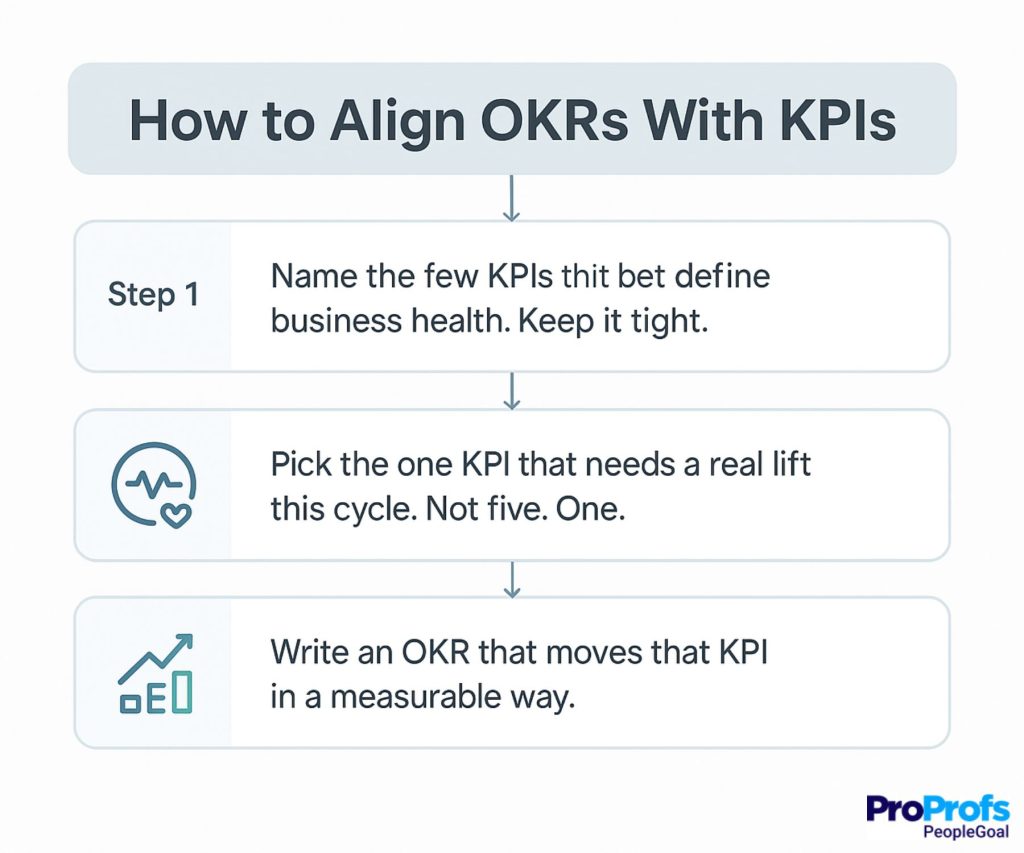
That is how to align OKRs with KPIs so strategy does not float away from execution. It also drives organizational alignment because teams chase the same business signals, not random pet projects.
“Can You Use OKR and KPI Together?”
Yes, and you probably should. Here is why.
- KPIs without OKRs can turn into “maintenance mode,” where teams protect the baseline but never break through it.
- OKRs without KPIs can turn into “goal fireworks,” lots of excitement, but no steady proof that the business is healthy.
So when someone asks, “Can you use OKR and KPI together?”, the answer is that using only one is where most systems wobble.
For example, let’s say your KPI is customer churn. It is stable but not great. You do not throw away the KPI. You use it as the baseline. Then you set an OKR like “Improve retention this quarter,” with key results tied to reducing churn and improving adoption. After the quarter, churn stays on the dashboard as a KPI, and the OKR retires. That loop is one of the simplest strategic planning tools you can run.
That churn example shows the pattern clearly: one metric stays on watch, while the other steps in to move it.
Once you see that loop, the idea of replacement stops making sense, and the real role of each tool becomes obvious. But…
Can OKRs Replace KPIs or Vice Versa?
Short answer: No, and trying to force that swap usually creates a mess. OKRs and KPIs look similar because both use metrics, but they solve different problems within the OKR and KPI framework.
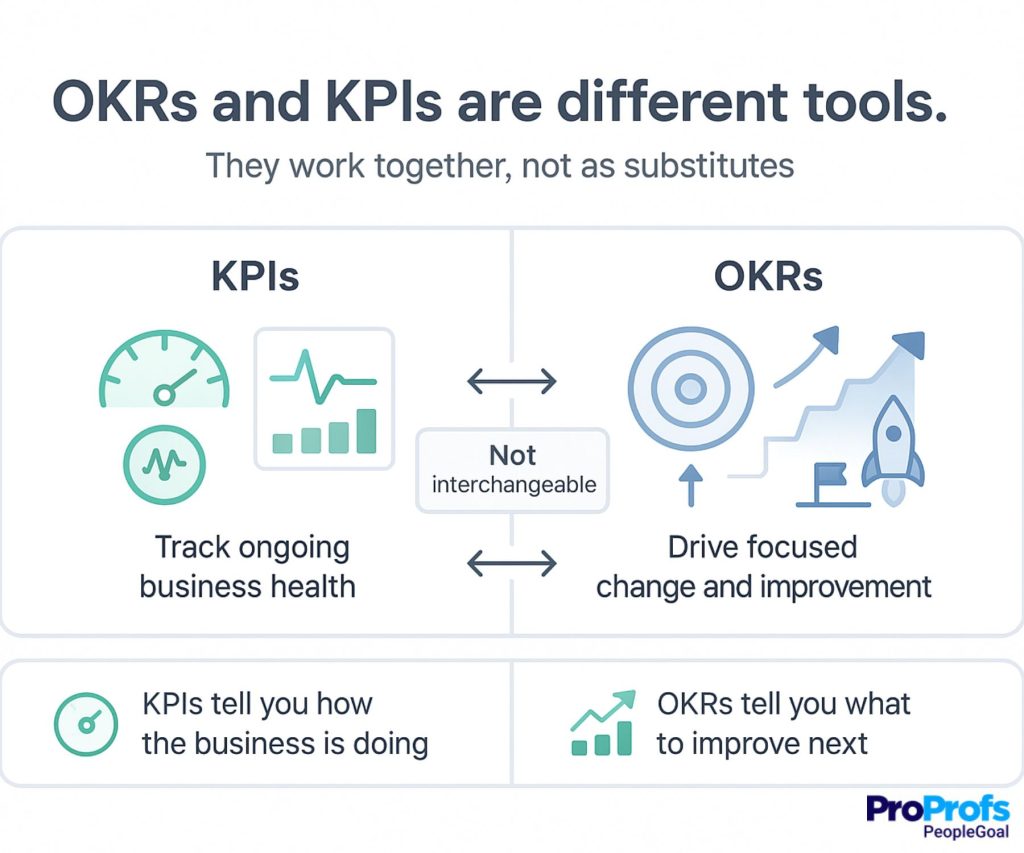
Why OKRs Cannot Replace KPIs
OKRs are meant to drive change. They are time-bound and designed to push a team toward a new outcome. Once the cycle ends, the OKR retires, even if the work continues in some form.
If you try to use OKRs for continuous performance tracking, you end up rewriting the same goals every quarter just to monitor business-as-usual metrics. That turns a goal-setting framework (OKR) into routine reporting, and teams start treating OKRs like paperwork.
A simple clue: if the metric matters even when you are not running a special push, it wants to be a KPI.
Why KPIs Cannot Replace OKRs
KPIs are performance metrics that tell you how a system is doing right now. They are excellent at employee performance measurement and showing measurable results over time. But they do not tell a team what to change next.
If you rely only on key performance indicators, you often get a “steady but stuck” business. The dashboard looks fine, yet growth and innovation slow down because nothing is rallying people toward the next strategic objectives.
A simple clue: if you want a meaningful shift in a quarter, the KPI needs an OKR to move it.
Let’s understand this with an example:
Let’s say customer churn is a KPI. You track it every month because it is a core business performance metric. If churn rises above the target, you do not rename churn as an OKR. Instead, you create an OKR like “Improve retention this quarter,” with key result metrics tied to reducing churn and increasing product adoption.
After the quarter, the OKR ends, while churn stays as a KPI to confirm the new baseline holds. That loop is how implementing OKRs and KPIs effectively actually works in the real world.
OKR vs KPI: What to Pick for Best Results?
If you are hoping for a single winner, sorry to disappoint, but that is not how this story ends. KPIs are like the steady pulse check. They tell you whether the business is healthy today. Are customers sticking around, are sales holding up, and are teams delivering on time?
You need those signals even when nothing dramatic is happening. OKRs, on the other hand, are your chosen quests. They show where you want to go next and what “better” looks like by the end of the quarter.
Here is the fun part. Use only KPIs, and you may run a very stable business that never really grows. Use only OKRs, and you may chase bold goals while the basics quietly fall apart. The smart move is to pair them.
And to make that pairing easier in real teams, you can use software like PeopleGoal. It lets you track KPIs as steady scorecards, set OKRs as focused cycle goals, and connect both in one view so everyone sees what is being monitored and what is being improved.
That kind of shared system is often the difference between “we set goals” and “we actually hit them.”
Frequently Asked Questions

2. OKR vs KPI: Which Is Better for Business?
Neither is “better” on its own. KPIs keep operations stable by showing whether core processes are healthy. OKRs push growth by focusing teams on specific improvements in a set period. Businesses win when they use KPIs as guardrails and OKRs as the engine for meaningful progress.
3. Should I Use OKRs or KPIs (or Both)?
Use both, but for different jobs. Track KPIs for critical metrics you need to watch all the time. Set OKRs when you want to move those metrics or achieve something new within a quarter. If a KPI is stable, leave it. If it needs a lift, build an OKR around it.
4. Can I Use OKR and KPI Together?
Yes, and most strong teams do. KPIs provide the baseline and reveal where performance is slipping or flat. OKRs turn that insight into a focused improvement plan. After the OKR cycle ends, the improved metric continues as a KPI. This creates a clean loop of monitor, improve, and maintain.
5. OKR vs KPI vs Metrics: Are They the Same Thing?
No. A metric is any measurable number. A KPI is a metric chosen because it reflects the health of the business and must be tracked continuously. An OKR is a goal framework that uses metrics as key results to drive change in a fixed period: same ingredients, different roles.
Ready to 3x Your Teams' Performance?
Use the best performance management software to align goals, track progress, and boost employee engagement.