What if I told you your team might be blaming “stress” and “deadlines” when the real culprit is… the performance tool they open every morning?
I have seen entire teams breathe a sigh of relief the moment they switched from Lattice to something that actually works the way humans think. That is why so many companies are hunting for Lattice Alternatives before another review cycle melts their sanity.
After 9 years of testing HR platforms and helping over 200 teams escape clunky systems, I know exactly which tools deserve your time.
In this guide, I’ll help you understand:
- The best Lattice alternatives to consider
- What each one improves instantly
- My personal top 3 recommendations
By the end, you’ll know which platform will actually make work feel lighter.
Sounds good?
Here’s a sneak peek into these tools, before we move into the details:
| Tool Name | Best For | Pricing |
|---|---|---|
| PeopleGoal | Boosting Employee Performance & Improving Engagement | FREE 14-day trial. Paid starts at $4/user/month |
| 15Five | Enterprise Performance Reviews System | Starts at $4 per user/month |
| Betterworks | Structured Check-ins | Custom price |
| Leapsome | Personalized Learning Paths | Custom price |
| Culture Amp | Building Organizational Culture | Custom price |
| BambooHR | Comprehensive HRIS With Payroll Solutions | Custom price |
| Small Improvements | Lightweight performance management and 360-degree feedback | Starts at $3/user/month. |
| Officevibe | Improving Employee Engagement With Continuous Feedback | Starts at $5/user/month |
| Profit.co | Managing OKRs With Structured Goal Alignment | Custom pricing |
| Motivosity | Boosting Employee Recognition & Workplace Motivation | Custom pricing |
| Workday | Unified Finance Solutions | Custom pricing |
11 Best Lattice Alternatives and Competitors in 2026
Here is a detailed view of the top Lattice alternatives that stood out for their practicality, consistency, and real impact in everyday workflows. I evaluated each one based on how well it supports performance, engagement, and team alignment without adding extra complexity.
1. PeopleGoal – Best for Boosting Employee Performance & Improving Engagement
I’ve used PeopleGoal personally, and what impressed me most was how it made performance management feel less like a chore and more like a shared mission. I remember setting quarterly OKRs for my team and watching how the platform kept everyone aligned without any micromanagement.
The 1:1 meeting templates were a quiet revelation. Instead of generic agendas, each conversation became purposeful, grounded in the actual goals and feedback shared on the platform. The recognition feature also changed the tone of our workspace. Simple “shoutouts” started appearing for achievements big and small, and suddenly, employee engagement metrics began to rise without any forced effort.
It was clear that PeopleGoal was designed by people who understand what drives motivation at work. If you’ve ever wished your performance reviews felt more human and your feedback loop more natural, this is that bridge between structure and empathy.
Why PeopleGoal Is One of the Best Lattice Alternatives
- Flexible HR Workflow Builder: With PeopleGoal’s no-code workflow builder, HR teams can design custom processes for reviews, onboarding, or any HR function. Lattice, on the other hand, restricts users to predefined processes and doesn’t allow the creation of entirely new workflows.
- Succession Planning Module: PeopleGoal lets organizations identify and develop future leaders through built-in succession planning tools. Lattice focuses only on current performance and offers no succession or future role planning capabilities.
- Automated Onboarding & Offboarding: The platform automates both onboarding and offboarding tasks, ensuring smooth transitions for new hires and departing employees. Lattice lacks such lifecycle automation, as it isn’t designed to manage employee entry or exit processes.
- Time-Off Management: Managers using PeopleGoal can easily track vacation requests and see team availability through a self-service calendar. Lattice provides no time-off or attendance tracking, requiring a separate tool for basic PTO functions.
- Anonymous Feedback Channel: Employees can share honest opinions safely using PeopleGoal’s anonymous feedback feature. Lattice lacks a dedicated anonymous suggestion system, tying most feedback to identifiable surveys that may reduce openness.
Pricing: FREE 14-day trial. Paid starts at $4/user/month.
2. 15Five – Best for Enterprise Performance Reviews System
I first tried 15Five when consulting for a large enterprise that was struggling with consistency in its review process. Within two cycles, the difference was clear. Managers who once dreaded quarterly reviews started looking forward to the “Weekly Check-ins” and “High Fives” features.
The platform made it easy to blend structure with personality. One HR manager said, “For the first time, I actually know how my team feels before the review meeting.” What stood out to me was the balance between analytics and warmth. The performance insights were sharp, but the language was encouraging, not clinical.
When rolled out across departments, it transformed reviews from a backward-looking exercise to a continuous growth dialogue. If you manage large teams across time zones, 15Five ensures that every voice is heard and every success is recorded in real time.
Why 15Five Is One of the Best Lattice Alternatives
- Built-In Manager Coaching: 15Five offers built-in manager coaching programs and leadership development content that helps managers improve their communication and team-building skills. Lattice doesn’t provide any kind of coaching or manager training resources, leaving leadership growth entirely to external solutions.
- AI-Powered Manager Copilot: With its AI-powered Copilot, 15Five supports managers during one-on-ones and feedback discussions by suggesting insights, questions, and coaching points in real time. Lattice does not use AI to enhance managerial performance, which makes it less helpful for first-time or inexperienced managers.
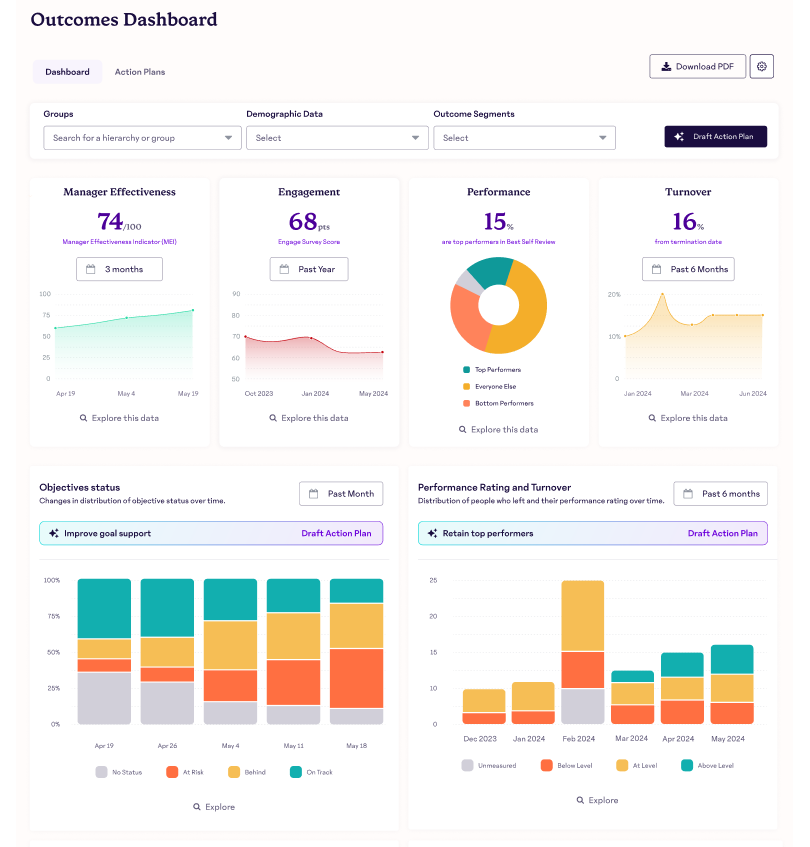
- Manager Effectiveness Index: 15Five measures leadership success through a dedicated Manager Effectiveness Index that tracks how well managers support their teams. Lattice lacks a built-in system to evaluate or quantify managerial impact, making it harder to identify coaching needs.
- Private Assessments for Managers: The platform enables self and upward assessments that remain confidential, allowing managers to reflect on their performance without fear of exposure. In Lattice, feedback to managers typically happens through regular review cycles and isn’t private, which can discourage honest commentary.
- Best-Self Review Framework: 15Five’s Best-Self Review® process encourages reflection, goal alignment, and personal growth during performance reviews. Lattice’s review process is more traditional, focusing heavily on metrics and outcomes without fostering the same personal development mindset.
Pricing: Starts at $4 per user/month (billed annually).
3. Betterworks – Best for Structured Check-ins

A colleague of mine, a senior HR director at a multinational firm, used Betterworks. She once told me how chaotic their performance check-ins used to be, with random, scattered, and poorly documented. After adopting Betterworks, her team gained rhythm. She shared how the “Progress Insights” feature became her north star during quarterly reviews.
Managers stopped chasing updates through emails and started having more meaningful goal conversations. She laughed once, saying, “I finally have weekends again.” The automation didn’t just save time; it restored sanity. The tool gives visibility into every employee’s progress without the need for constant follow-ups. I
t works best in organizations where goal accountability needs both transparency and trust. From what I’ve observed, Betterworks turns check-ins from interruptions into valuable checkpoints that actually move performance forward.
Why Betterworks Is One of the Best Lattice Alternatives
- Guided OKR Templates: Betterworks helps teams set better goals with prebuilt OKR templates and best-practice guidance, ensuring alignment and clarity from the start. Lattice’s OKR setup is more manual and lacks structured guidance, making goal creation less consistent across teams.
- Deep Productivity Tool Integrations: Integrations with systems like Salesforce, Jira, Slack, and Workday enable automatic goal updates in Betterworks. Lattice supports limited integrations, so progress must often be updated manually instead of being synced automatically.
- Diversity & Inclusion Analytics: HR teams using Betterworks can analyze engagement and performance data through diversity filters to detect potential bias. Lattice does not offer diversity-based segmentation in analytics, leaving DEI insights underexplored.
- Performance Calibration Toolkit: Betterworks includes a calibration module that helps managers align and compare performance ratings across teams. Lattice doesn’t have a calibration feature, which makes ensuring consistency across evaluations more difficult.
- Continuous Listening Integration: By combining engagement data with goal tracking, Betterworks links employee sentiment to business performance. Lattice separates engagement and performance functions, preventing this kind of direct connection between morale and outcomes.
Pricing: Custom price.
4. Leapsome – Best for Personalized Learning Paths
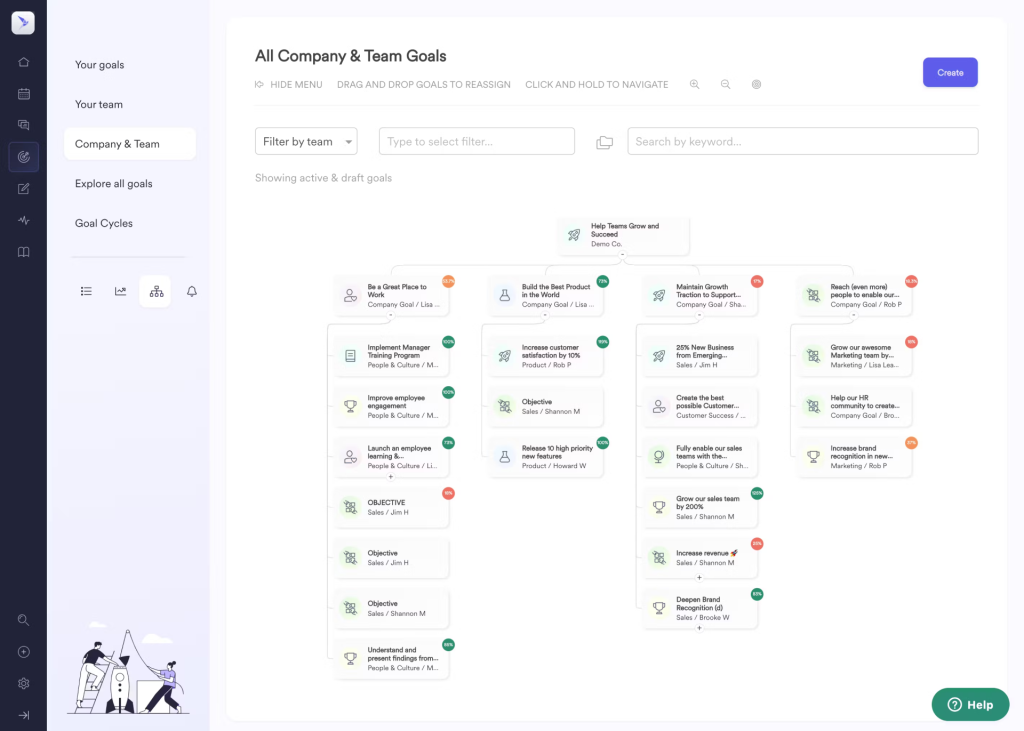
Leapsome feels like a personal trainer for your professional growth. When I used it, the learning paths felt intuitive, almost as if the system understood where I wanted to go next. I once created a tailored development plan for a marketing associate, linking her skill gaps directly to curated learning content.
The result was remarkable within three months; her engagement score spiked, and her project ownership improved dramatically. What I admire most is how seamlessly Leapsome ties performance feedback to learning opportunities. It’s not about ticking boxes; it’s about guiding real growth.
The platform’s balance between structure and personalization makes it ideal for leaders who want employees to progress with purpose. It’s like having a private coach that never forgets your goals.
Why Leapsome Is One of the Best Lattice Alternatives
- Learning Path Integration: Leapsome stands out by directly connecting performance feedback to employee learning through personalized learning paths. Lattice lacks an internal LMS or development feature, so feedback doesn’t automatically translate into training opportunities.
- AI-Assisted Feedback Writing: The AI assistant in Leapsome helps employees and managers craft constructive, clear feedback with tone suggestions and phrasing support. Lattice users must write all feedback manually without AI-generated assistance to improve quality or tone.
- Cross-Cycle Performance Analytics: Leapsome tracks performance changes over multiple review periods to reveal long-term improvement or decline trends. Lattice’s analytics reset with each review cycle, losing visibility into longitudinal progress.
- Multi-Language Platform: Available in 13 languages, Leapsome supports international teams that work across regions and languages. Lattice’s limited language support makes it less inclusive for global organizations.
- Advanced 360° Reviews: Leapsome’s 360° review feature uses customizable competency frameworks for well-rounded evaluation. While Lattice offers 360 reviews, it doesn’t allow the same depth of competency mapping or role-specific customization.
Pricing: Custom price.
5. Culture Amp – Best for Building Organizational Culture
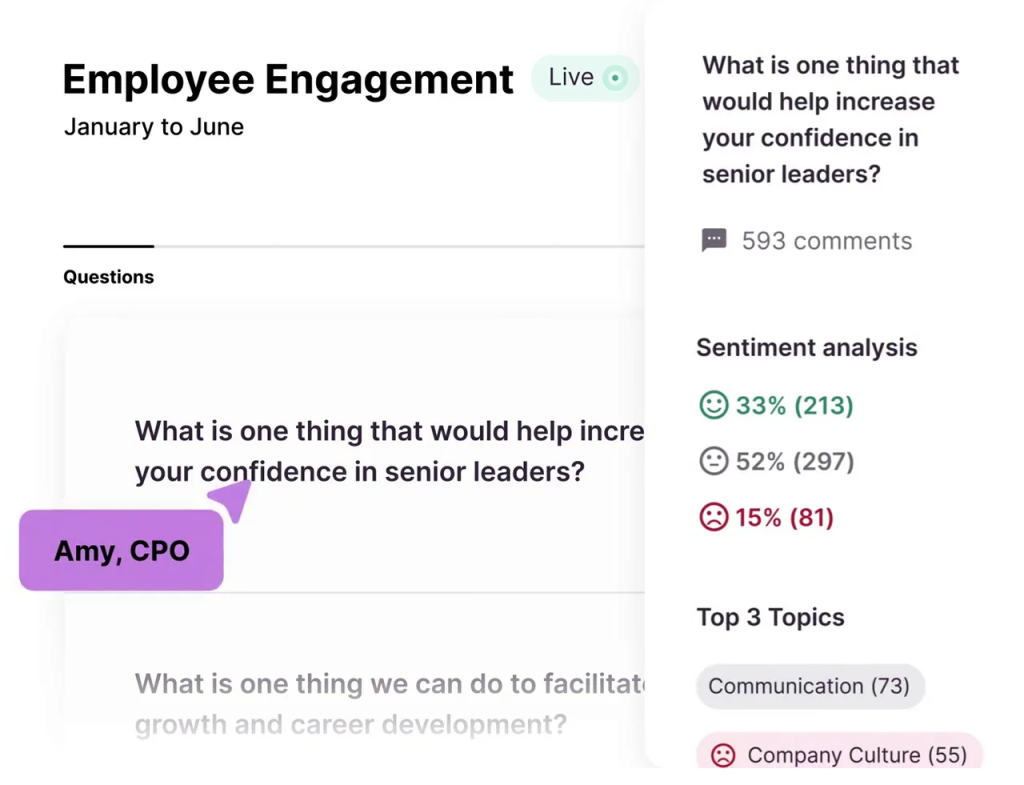
A friend of mine, an HR consultant for mid-sized tech firms, often calls Culture Amp her “secret weapon.” She once ran an engagement survey for a startup that had lost its spark after rapid expansion. Using Culture Amp’s analytics, she pinpointed the exact areas causing friction, like a lack of recognition and poor communication between teams.
She told me how the leadership team was impressed by the precision of the insights. Within weeks, they rolled out targeted initiatives using the platform’s recommended actions, and within a quarter, employee sentiment scores had risen significantly.
She said, “It’s like having an X-ray for your company’s culture.” I’ve seen many survey tools, but Culture Amp’s depth and empathy make it more than just a data collector; it’s a mirror that reflects how your people truly feel.
Why Culture Amp Is One of the Best Lattice Alternatives
- Extensive Benchmark Database: Culture Amp’s engagement surveys draw on one of the largest benchmark databases in HR, offering contextual comparisons by industry and geography. Lattice’s smaller data set provides less context for interpreting engagement results.
- DEI Survey Tools: With science-backed DEI survey templates and inclusion metrics, Culture Amp helps leaders measure belonging and fairness. Lattice lacks ready-made DEI survey tools and inclusion-specific reporting.
- Skills Coach Micro-Learning: Managers receive two-minute daily micro-lessons through Slack or email to strengthen leadership skills. Lattice does not include learning or habit-building tools for managers within its platform.
- Storyboards Analytics: Culture Amp’s Storyboards turn data into compelling visual stories, linking engagement to outcomes such as turnover or productivity. Lattice’s analytics remain static and less narrative-driven.
- Lifecycle Surveys: Onboarding and exit survey templates in Culture Amp let HR capture key employee experiences across the entire journey. Lattice doesn’t offer dedicated lifecycle survey options, focusing mainly on engagement pulses.
Pricing: Custom price.
6. BambooHR – Best for Comprehensive HRIS With Payroll Solutions
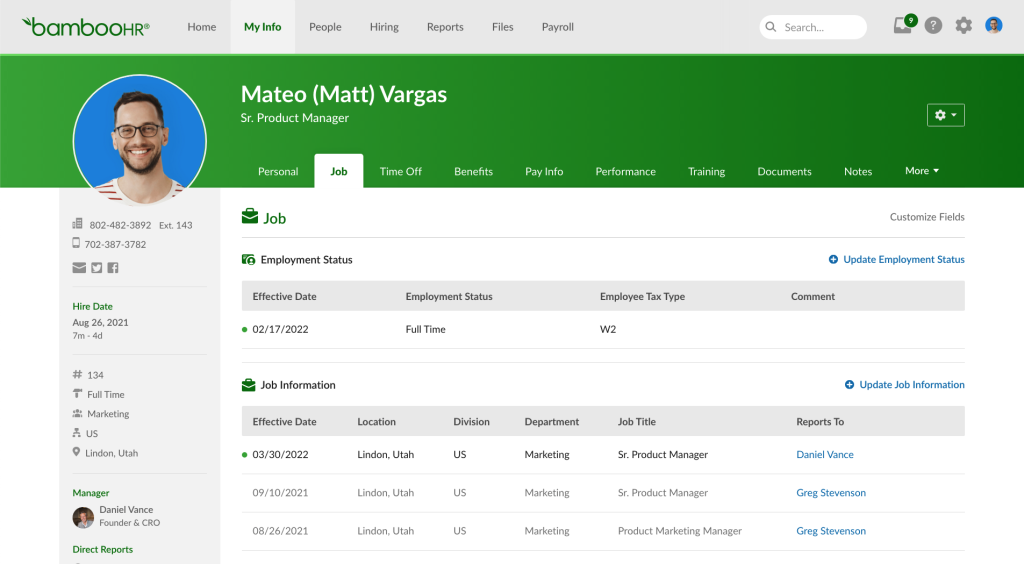
When I first explored BambooHR, I was surprised by how much calmer HR operations felt after the first week. The platform simplifies everything from onboarding to payroll without stripping away detail. I used it in a mid-sized company where HR tasks were scattered across spreadsheets and emails.
With BambooHR, the chaos melted away. One of my favorite moments was when our new hire completed all paperwork digitally within 30 minutes; something that used to take an entire afternoon. Payroll integration was equally smooth, ensuring no one ever had to chase down missing numbers again.
BambooHR turns what’s often a tedious back-office function into a professional, seamless experience. It’s one of those rare systems that both HR teams and employees genuinely enjoy using.
Why BambooHR Is One of the Best Lattice Alternatives
- Central HR Database: BambooHR functions as a full HRIS where employee data, personal info, and employment history are stored and updated. Lattice lacks this capability, depending on external integrations for personnel data.
- Integrated Payroll: Payroll management and tax processing are built directly into BambooHR for U.S. users. Lattice doesn’t include payroll at all, forcing companies to rely on other platforms for compensation management.
- Time and PTO Tracking: With automated time-off requests and tracking, BambooHR simplifies attendance management for teams. Lattice offers no attendance or leave management functionality.
- Applicant Tracking System: The built-in ATS helps recruiters post jobs, track candidates, and collaborate on hiring decisions. Lattice does not provide recruitment tools, which limits its use in the full employee lifecycle.
- Benefits Administration: BambooHR’s benefits administration allows HR to manage insurance and retirement plans while syncing deductions with payroll. Lattice lacks any benefits tracking or administration features.
Pricing: Custom price.
7. Officevibe – Best for Improving Employee Engagement With Continuous Feedback
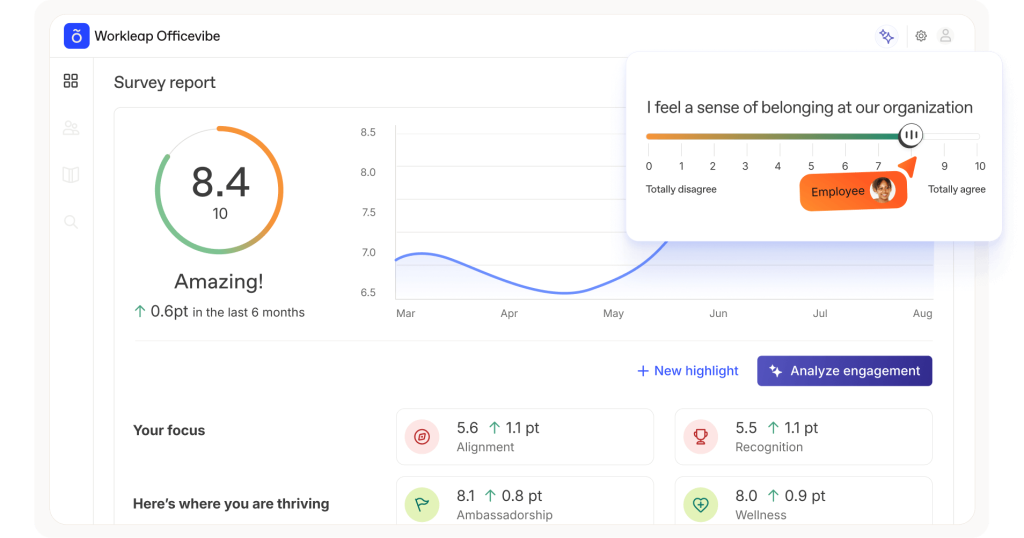
Officevibe taught me that small questions can spark big cultural shifts. I used it to gather weekly pulse surveys, and the anonymous feedback turned out to be gold. Once, a quiet designer mentioned through Officevibe that the team’s stand-up meetings felt rushed. Within days, we adjusted the format, and engagement jumped.
The system thrives on simplicity, such as short surveys, honest answers, and immediate insights. Over time, it built a safe feedback rhythm where employees felt heard without pressure. The real magic lies in the follow-up recommendations that turn data into action.
It’s an excellent tool for managers who want to keep engagement consistent, not just measured. Think of it as your early warning system for morale before small issues become resignations.
Why Officevibe Is One of the Best Lattice Alternatives
- Anonymous Pulse Surveys: Officevibe’s short, anonymous surveys encourage open and honest employee feedback on engagement and morale. Lattice’s surveys are identifiable, which can discourage candid responses.
- Peer Recognition via Good Vibes: The Good Vibes feature allows colleagues to share positive feedback and appreciation across teams. Lattice’s praise tool is less interactive and doesn’t include a dedicated recognition feed.
- Actionable Manager Insights: Officevibe goes beyond data reporting by suggesting practical next steps to improve team morale. Lattice reports engagement scores but offers no direct recommendations for improvement.
- Slack and Teams Integration: Employees can complete surveys and share feedback directly from Slack or Teams in Officevibe. Lattice’s Slack integration is limited to notifications and reminders, not full engagement participation.
- Built-In One-on-One Tool: Officevibe turns survey feedback into meaningful discussions through its one-on-one meeting planner. Lattice does include 1:1 agendas, but its connection to feedback and engagement insights is far weaker.
Pricing: Starts at $5/user/month for a minimum of 10 users. Billed annually.
8. Small Improvements – Best for Lightweight Performance Management & 360-degree Feedback
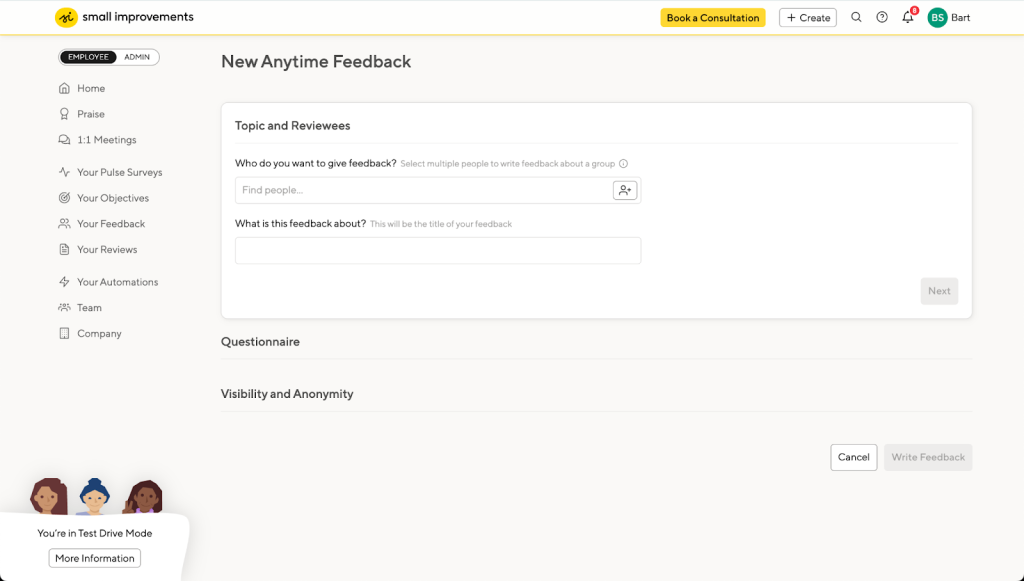
Small Improvements is often chosen by teams that want a lightweight performance management solution without the complexity of enterprise tools. It works well for organizations where reviews, feedback, and one-on-ones are spread across tools. By bringing everything together in one clear place, performance conversations become easier to run and easier to maintain.
The platform feels simple and human-friendly. Reviews and 360-degree feedback are easy to set up, one-on-ones come with shared agendas and practical templates, and cascading goals and objectives are very intuitive. AI-powered insights support managers and HR with clear signals.
Small Improvements is especially suited for scaling teams and modern startups that want to keep performance management lean and approachable.
Why Small Improvements Is One of the Best Lattice Alternatives
- Lightweight Reviews and 360s: Flexible review and 360-degree feedback templates make it easy to run cycles without overengineering the process. Lattice often feels more rigid and process-driven by comparison.
- Continuous Feedback and 1-on-1 Agendas: Shared one-on-one agendas and continuous feedback tools encourage ongoing dialogue instead of isolated review moments. Lattice supports similar features, but with more friction in day-to-day use.
- Simple Objectives Tracking: Teams can track goals without committing to full OKR hierarchies. Lattice is more opinionated around structured goal frameworks, which can feel heavy for smaller or fast-moving teams.
- Human-Friendly Experience: The interface is intuitive and manager-first, making adoption easier across the organization. Lattice has a steeper learning curve, according to many users.
Pricing: Starts at $3 per user per month. Billed annually. 30-day free trial available.
9. Profit.co – Best for Managing OKRs With Structured Goal Alignment
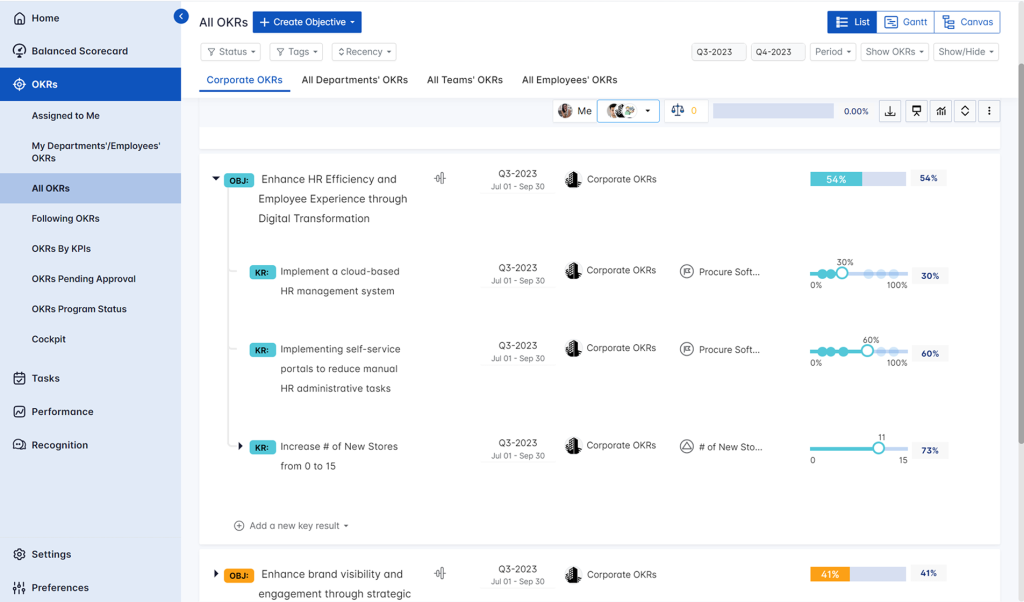
One of my clients, a COO at a logistics firm, introduced me to Profit.co after using it for a year. He said, “It finally made OKRs feel achievable instead of intimidating.” I saw how his team used it to align company goals with individual targets. They had weekly reviews where each metric lit up in real time, showing exactly where performance stood.
He explained how the visual dashboards cut through confusion and made cross-department collaboration smoother. What impressed him most was the clarity—no one could hide behind vague objectives anymore.
The structure was liberating, not restrictive. After a few months, the company’s project delivery rate improved by nearly 20 percent. Profit.co isn’t just about tracking goals; it creates the discipline that every growing business quietly craves.
Why Profit.co Is One of the Best Lattice Alternatives
- Reflect and Reset Cycle: Profit.co’s quarterly review framework ensures teams analyze past results and reset OKRs systematically. Lattice lacks a built-in structure for goal retrospectives or continuous OKR cycles.
- Flexible Key Result Formats: Users can set binary, milestone, and quantitative goals with nested sub-goals for precision. Lattice’s goal framework supports only basic key result types without hierarchical depth.
- Extensive KPI Library: Over 300 KPIs and prebuilt OKR templates help teams adopt proven goal structures faster. Lattice provides no KPI library, leaving teams to build metrics manually.
- OKR Cockpit Dashboard: Profit.co’s visual cockpit offers a live overview of all organizational OKRs for tracking and alignment. Lattice’s goal dashboards are simpler and lack this strategic overview.
- AI Assistant for Goals: The AI assistant monitors OKR progress and sends alerts about misaligned or lagging objectives. Lattice doesn’t utilize AI for goal management, so users must track and interpret progress manually.
Pricing: Custom pricing.
10. Motivosity – Best for Boosting Employee Recognition & Workplace Motivation
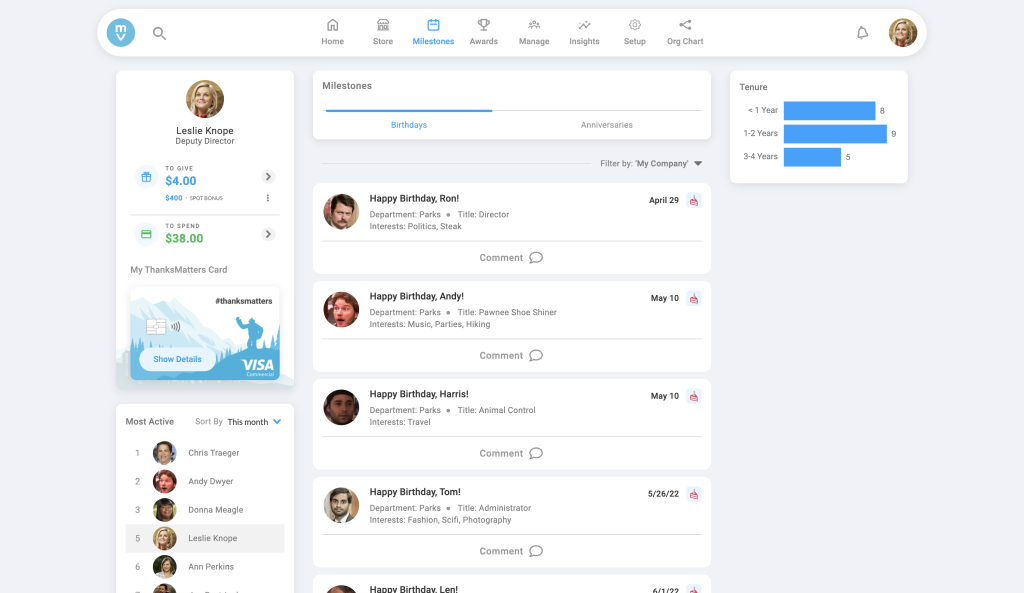
Motivosity felt like an instant mood booster for the workplace, right from the first usage. We introduced it to a team that had grown distant after going hybrid. Within days, the “Thanks” feed lit up with peer recognition posts. What stood out was how authentic the appreciation felt—it wasn’t corporate fluff.
One engineer wrote, “Thanks for saving the day during that server crash,” and suddenly others followed suit. The peer-to-peer recognition system turned acknowledgment into a daily habit.
I also liked the reward options; they gave recognition tangible weight without making it transactional. The energy shift was visible, and productivity followed naturally. Motivosity proves that when you make gratitude visible, performance quietly catches up.
Why Motivosity Is One of the Best Lattice Alternatives
- Social Connectivity Platform: Motivosity’s Connect module creates a social space where employees share interests, photos, and direct messages. Lattice offers no such community-oriented environment for employees to bond.
- Monetary Peer Recognition: Employees can publicly recognize peers and attach small monetary rewards or gift cards. Lattice’s praise system does not include financial incentives, limiting the motivational impact of recognition.
- Leadership and 1:1 Tools: The Lead module combines one-on-one meeting scheduling, goal setting, and shared to-do tracking in one place. Lattice supports 1:1 agendas but lacks shared progress tracking within meetings.
- Employee Listening Surveys: Motivosity’s Listen module links engagement surveys with recognition insights for a full cultural view. Lattice’s engagement and feedback systems work separately, missing this synergy.
- Global Support: With over 70 languages and 140 currencies supported, Motivosity ensures recognition programs are inclusive and localized. Lattice is not optimized for international rewards or multilingual participation.
Pricing: Custom pricing.
11. Workday – Best for Unified Finance Solutions
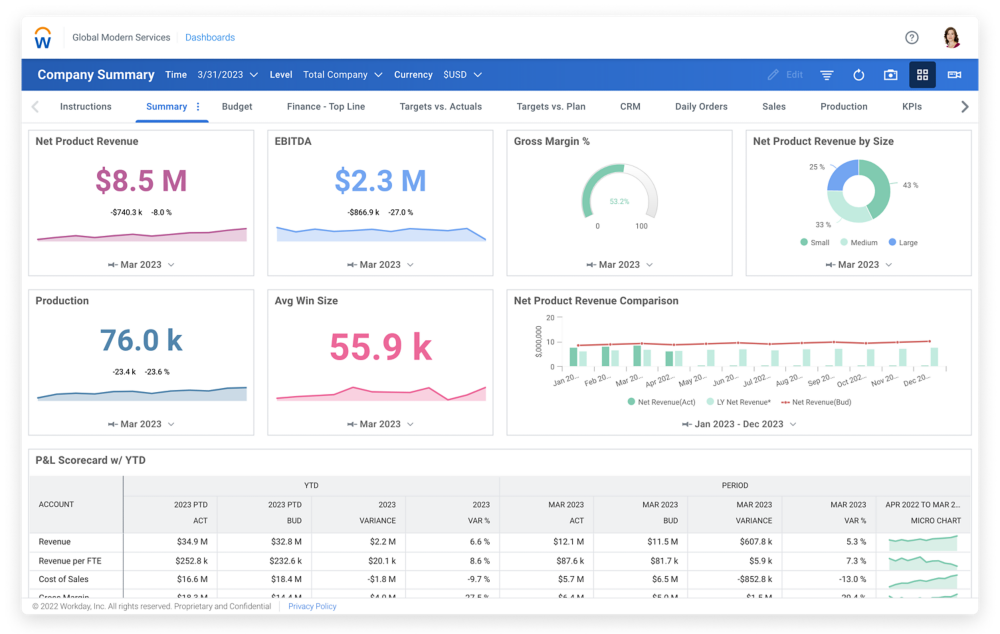
A former colleague of mine, now a finance lead at a global firm, often speaks about Workday with admiration. He once described how managing HR and finance under one roof finally made reporting “feel logical again.”
Before Workday, their finance and HR teams operated in silos, leading to endless reconciliation errors. After implementation, he could pull consolidated reports that combined payroll, budgeting, and headcount planning in a single view. He told me about a time when a board meeting was saved because Workday produced a real-time labor cost forecast within minutes.
His team now trusts their data, which is rare in large enterprises. From his stories, it’s clear that Workday’s strength lies in its ability to bring order and unity to complex systems, turning scattered information into strategy.
Why Workday Is One of the Best Lattice Alternatives
- Unified HCM Platform: Workday manages every HR function from hiring to retirement under one integrated system. Lattice focuses only on performance and engagement, not full HR lifecycle management.
- Time and Attendance Management: Employees can clock in, track shifts, and manage absences directly within Workday. Lattice provides no such workforce scheduling or compliance tools.
- Advanced People Analytics: Workday’s analytics uncover trends, predict turnover risks, and merge HR with financial insights. Lattice’s analytics are limited to performance data and lack predictive depth.
- Global Payroll and Benefits: With built-in global payroll and benefits administration, Workday simplifies multi-country workforce management. Lattice doesn’t manage compensation, taxes, or benefits in any capacity.
- AI-Driven Talent Intelligence: Workday’s Skills Cloud identifies employee skills and suggests learning or role opportunities using AI. Lattice doesn’t offer AI-based skill mapping or internal mobility insights.
Pricing: Custom pricing.
How I Selected these Lattice Alternatives/Evaluation Criteria
When I put this list together, I wanted every recommendation to feel grounded in real experience rather than theory. My goal was to judge each platform with the same care I use when choosing tools for my own teams.
I relied on a mix of firsthand use, expert conversations, and clear standards that helped me compare these systems fairly.
User Reviews and Ratings
I started by studying feedback from people who have actually used these platforms. Real experiences often reveal patterns that polished marketing pages overlook. These user reviews helped me understand how each tool performs once it becomes part of someone’s daily workflow.
Essential Features and Functionality
I examined the core features of every platform and how well they support performance management, reviews, engagement, or OKRs. My focus was on practical usefulness and whether each system delivers consistent value in real work settings.
Ease of Use
I paid close attention to the overall experience of navigating these tools. A clean layout, intuitive menus, and thoughtful design matter, especially for managers who do not have time to climb a steep learning curve.
Customer Support
I looked at how each company supports its users when they need guidance. Quick responses, clear explanations, and dependable help during setup or troubleshooting played a major part in my evaluation.
Value for Money
I compared the capabilities of these tools with their pricing. My goal was to judge whether a company receives enough substance, stability, and impact for the cost.
Personal Experience and Expert Insight
I leaned on my own hands-on use of many of these platforms, along with conversations with HR experts and leaders who rely on them every day. Their stories and observations helped me understand how these tools influence team performance and workplace culture in practice.
My Top 3 Choices as Workday Alternatives
Now, after checking the top workday alternatives and seeing how I selected these tools, let me make it easier for you by narrowing down the list. Here are my top 3 favorite tools from the list above.
1. PeopleGoal
The first among my top three is PeopleGoal because it consistently brings humanity back into performance management. I have seen how its OKRs, 1:1 templates, and recognition features lift engagement without creating noise or complexity. It earned this spot because it makes performance feel purposeful, personal, and far more agile than what most teams experience with Workday.
2. BambooHR
Next on my list is BambooHR, a platform that smooths out HR operations in a way that feels almost restorative. I have watched scattered onboarding, payroll, and attendance tasks fall into order within days of switching to it. It deserves its place here because it delivers the calm and clarity growing companies crave when Workday begins to feel too dense for everyday use.
3. Five
Rounding out the top three is 15Five, a tool that transforms reviews and check-ins into steady, meaningful conversations. I have seen managers rediscover confidence through its coaching tools, weekly check-ins, and Best-Self Review approach. It made the cut because it gives teams what Workday often overlooks, which is a system that strengthens leadership while keeping people genuinely connected.
Ready to Pick the Best Lattice Alternative?
Choosing the right platform depends on how your teams work, what they value, and the kind of growth you want to encourage. Each tool in this list offers its own way of strengthening performance, improving communication, and bringing structure to everyday management. When you look closely at how your people set goals, share feedback, and stay engaged, the right choice becomes much clearer.
Out of every platform I tested, PeopleGoal remains my personal favorite. It blends steady performance management systems with a tone that feels human rather than mechanical, and it keeps teams aligned without creating pressure or noise. It is the rare tool that supports both structure and genuine connection, which is why it stands out for me.
Ready to 3x Your Teams' Performance?
Use the best performance management software to align goals, track progress, and boost employee engagement.