
I’ve worked with many performance management tools over the years, and I’ve seen a common pattern: teams start strong with Clear Review, but eventually outgrow its limited flexibility and light analytics. If you’ve felt the same frustration: rigid workflows, basic reporting, or a process that doesn’t quite fit your culture, you’re not alone.
These pain points are exactly why so many companies begin searching for Clear Review alternatives.
Performance management should feel natural, not forced. Your tool should support better conversations, clearer goals, and more meaningful feedback without slowing everyone down.
That’s why I put together this list of 10 alternatives I’ve seen teams genuinely succeed with. Each option brings something that the tool is missing, and my goal is to help you find the one that matches how your people actually work. Let’s dive in.
Top Clear Review Alternatives
If you’re exploring alternatives to Clear Review, read on for an in-depth look at each of these tools, including firsthand insights on their features, pros and cons, G2 ratings, and pricing.
| Tool Name | Best For | Pricing | User Rating (G2) |
|---|---|---|---|
| PeopleGoal | Boosting Employee Performance & Improving Engagement | FREE 7-day trial. Paid starts at $4/user/month. | 4.6/5 |
| Lattice | Performance Management | Starts at $11/user/month | 4.7/5 |
| 15Five | Continuous feedback | Starts at $4/user/month | 4.6/5 |
| Leapsome | Personalized Learning Paths | Custom pricing | 4.8/5 |
| Engagedly | AI-driven talent management suite | Starts at $5/user/month | 4.3/5 |
| Culture Amp | Employee engagement | Custom pricing | 4.5/5 |
| Betterworks | Structured Check-Ins | Starts at $7/user/month | 4.4/5 |
| BambooHR | Comprehensive HRIS With Payroll Solutions | Starts at $10/user/month | 4.4/5 |
| PerformYard | Flexible Review Cycles | Starts at $5/user/month | 4.8/5 |
| Trakstar Perform | Traditional performance reviews | Custom pricing | 4.2/5 |
1. PeopleGoal – Best for Boosting Employee Performance & Improving Engagement
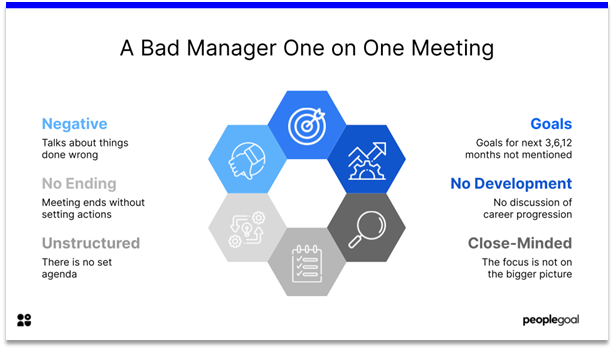
I used PeopleGoal to overhaul our performance review process, and it quickly made everything easier. We had struggled with rigid templates and slow adoption in the past, but PeopleGoal let me customize review cycles, build 360 feedback flows, and set up continuous check-ins without any limitations.
The interface was simple, so the team picked it up fast. I especially liked the real-time feedback and recognition badges. It made everyday wins more visible and helped boost engagement across teams. Goal alignment was another area where it stood out. I could link individual goals to company objectives and use the analytics dashboard to spot alignment gaps early.
Even with all the features packed in, setup was smooth, and support was always available when I needed guidance. I was able to launch a full 360 review cycle in minutes, which was a huge improvement compared to other tools I’ve used.
Pros:
- Customizable performance and feedback workflows that adapt to your needs
- All-in-one features for goals, 360 reviews, surveys, and check-ins
- Strong reporting and analytics for clear insights on performance
- Integrates with HR tools and platforms like Slack for smoother data flow
- Highly user-friendly and easy for employees and managers to navigate
How PeopleGoal Compares to Clear Review
Clear Review offers simple tools for structured conversations and goal tracking, but PeopleGoal gives you a lot more flexibility. I could design my own review workflows, automate new-hire check-ins, build department-specific 360 reviews, and even link survey results to development plans. With Clear Review, the focus stays mainly on performance conversations. PeopleGoal goes wider by combining performance, engagement, development, and recognition in one platform. If you want more control over how your HR processes work, PeopleGoal gives you that customization.
User Rating: 4.5/5
Pricing: FREE 7-day trial. Paid starts at $4/user/month.
2. Lattice – Best for Performance Management
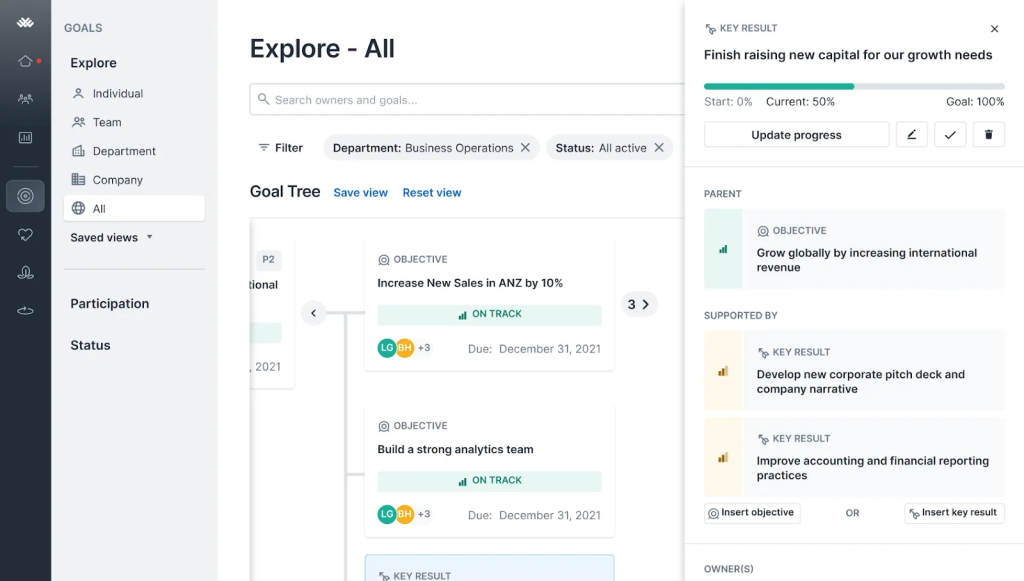
Image source: Lattice
A colleague recently told me about their experience with Lattice, and they said it quickly became their all-in-one hub for performance and engagement. They could run reviews, set OKRs, launch surveys, and manage one-on-ones without switching tools. The weekly updates were a big win for their managers since they could track progress and morale without extra meetings.
They also mentioned that setting up goals and OKRs was simple, and the visual alignment chart helped everyone see how their work supported company objectives. The clean interface made adoption easy, and they liked how customizable everything was.
What impressed them most was the analytics. Heatmaps and trend reports helped them spot patterns across teams and identify where more support or training was needed. They even said the support team and webinars were genuinely helpful as they explored new features.
Pros:
- Lattice brings all performance, goals, surveys, and one-on-ones together in a single platform that’s easy to manage.
- The clean and intuitive interface makes it simple for employees and managers to adopt the system quickly.
- The analytics tools provide clear, actionable insights that help identify performance trends and development needs.
- It offers flexible review cycles and customizable questionnaires that adapt to different team structures.
How Lattice Compares to Clear Review
Clear Review focuses on simple performance conversations and goal tracking, while Lattice offers a much wider set of tools. With Lattice, I could run surveys, manage OKRs, track one-on-ones, and even streamline parts of compensation planning. Clear Review keeps things straightforward, but Lattice connects performance, engagement, and development in one workflow. If a team needs deeper analytics and wants everything in one ecosystem, Lattice offers a more complete solution.
User Rating: 4.7/5 (G2)
Pricing: Starts at $11/user/month
3. 15Five – Best for Continuous Feedback
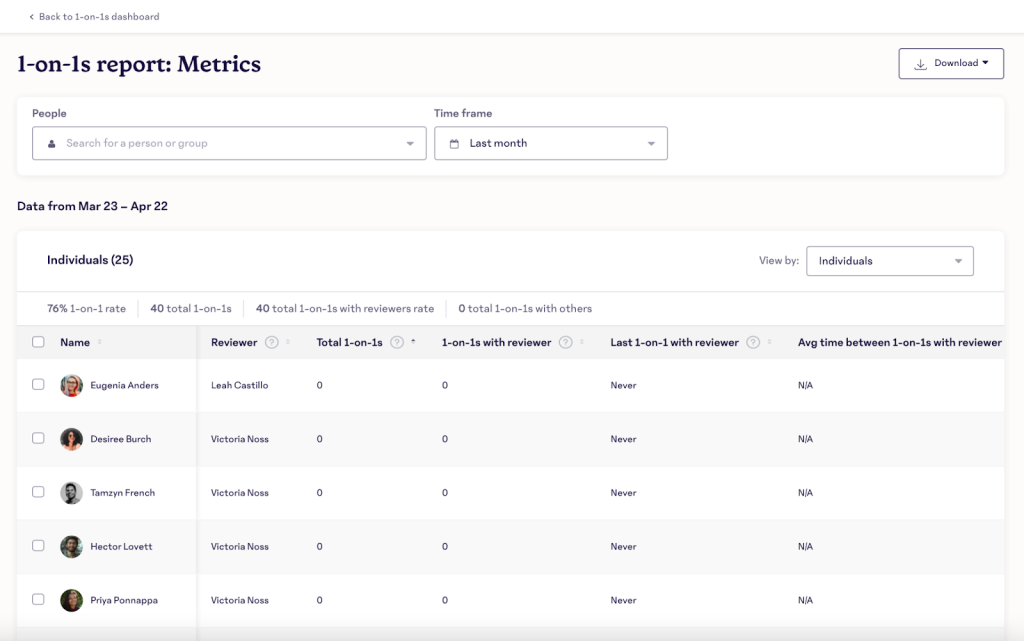
Image source: 15Five
I used 15Five to strengthen our feedback culture, and it quickly became a central part of how our team communicated. The weekly check-ins were the core feature. Employees shared their wins, challenges, and moods each week, which helped me stay updated without needing extra meetings.
The platform also worked well for performance reviews and goal tracking. Our semiannual reviews felt more thoughtful because the question templates focused on growth rather than formality. I liked how easy it was to fold 360 feedback into the review conversation, giving managers and employees a more complete picture.
Beyond that, 15Five included engagement surveys and a simple peer recognition tool called High Fives. I noticed our team using High Fives regularly, which helped improve morale in a natural way.
Pros:
- 15Five keeps teams aligned through continuous feedback by using weekly check-ins and quick pulse questions.
- The review experience feels meaningful because the templates focus on growth and coaching instead of administrative tasks.
- Goal tracking is easy to maintain through integrated OKRs and weekly progress updates.
- The platform includes engagement tools such as pulse surveys, eNPS, and peer recognition through High Fives.
How 15Five Compares to Clear Review
Clear Review focuses on structured conversations and straightforward performance check-ins, while 15Five leans heavily into continuous feedback. With 15Five, I could run weekly updates, pulse surveys, peer recognition, and coaching-based reviews all in one flow. Clear Review keeps things simple, but 15Five creates a more interactive rhythm between managers and employees. If your team values ongoing communication and development, 15Five offers a more dynamic approach.
User Rating: 4.6/5
Pricing: Starts at $4/user/month.
4. Leapsome – Best for Personalized Learning Paths
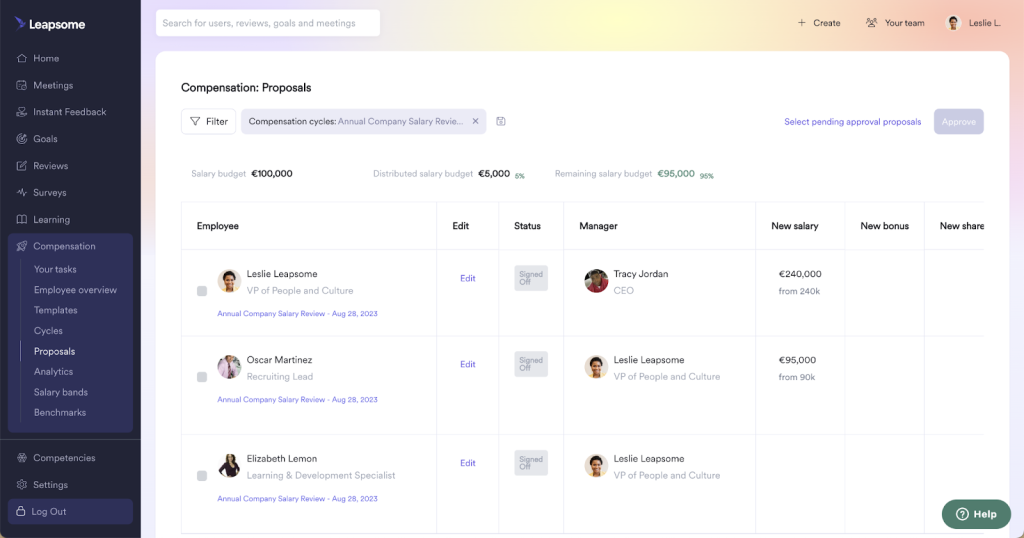
Image source: Leapsome
An HR friend of mine told me how Leapsome helped them connect performance, engagement, and learning in one smooth workflow. They set up a 360-degree review cycle and said the whole process felt simple and flexible. What impressed them most was how the tool linked reviews to personalized learning paths so development continued naturally.
They also liked the OKR tools. Their team tracked quarterly goals, updated progress in real time, and used the visual dashboards to stay aligned. Instant feedback became a normal habit too since employees could share recognition or quick suggestions that later fed into review conversations.
On the engagement side, the survey question library saved them a lot of time, and the Q&A board turned into a great way for leadership to address common concerns during all-hands meetings.
Pros:
- Leapsome brings performance, goals, engagement, and learning together in one platform that helps teams grow continuously.
- The system is modular and customizable, allowing you to tailor competencies, questions, and rating scales to match your culture.
- The real-time feedback and praise tools make it easy to build a strong everyday feedback habit.
- The engagement tools provide science-backed survey questions and detailed analytics across different employee groups.
How Leapsome Compares to Clear Review
Clear Review keeps performance management simple with structured conversations, but Leapsome goes broader by combining performance, engagement, and learning in a tightly connected system. With Leapsome, I could create learning paths tied directly to review outcomes, track OKRs alongside development goals, and run engagement surveys with built-in research-backed questions. Clear Review is easier if you only need reviews and goals, while Leapsome is better for teams that want a full talent development cycle in one place.
User Rating: 4.8/5
Pricing:
Custom pricing.
5. Engagedly – Best for AI-Driven Talent Management Suite
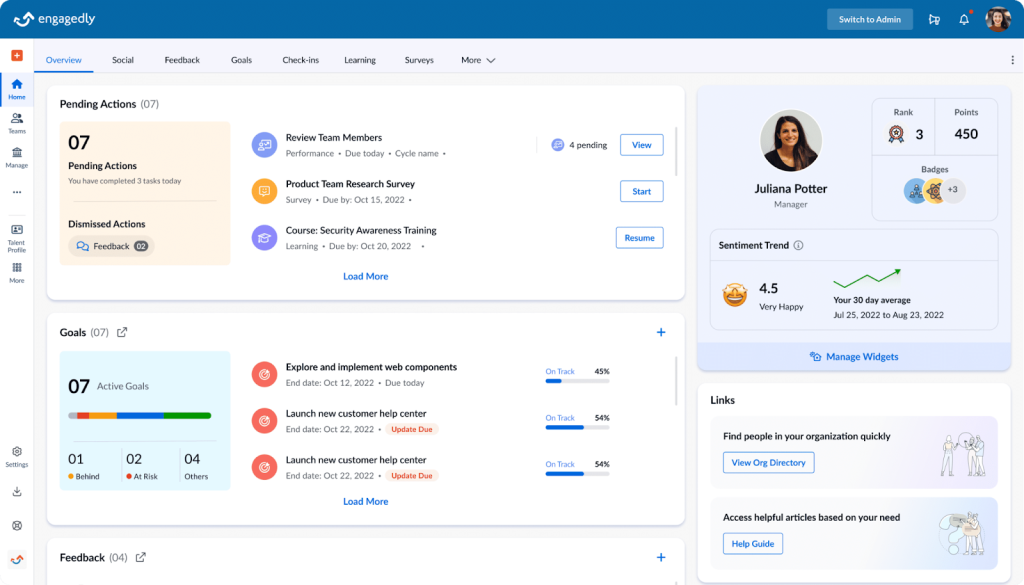
Image source: Engagedly
I used Engagedly as an all-in-one platform to manage performance, engagement, and learning, and its AI assistant “Marissa” immediately caught my attention. The AI offered helpful suggestions, like recommending goals or learning content based on an employee’s role or past feedback. We ran annual reviews, quarterly check-ins, and project-based assessments, all with the option to collect 360 feedback seamlessly.
The engagement features were surprisingly effective. Beyond surveys and eNPS, the social recognition feed and gamification tools made participation fun. We also used the built-in LMS to host training content.
Goal alignment was another strong point. We cascaded company objectives down to individual goals and used the dashboards to track progress across teams. Engagedly also reminded employees to update goals, which kept things moving during busy weeks.
Pros:
- Engagedly provides a unified suite for performance reviews, 360 feedback, goals, engagement surveys, learning, and recognition in one platform.
- The AI assistant offers smart suggestions that help employees and managers improve goals and learning choices.
- Its gamified recognition system encourages participation through points, badges, and leaderboards.
- The performance workflows are flexible, supporting everything from annual reviews to continuous check-ins.
How Engagedly Compares to Clear Review
Clear Review focuses heavily on structured conversations and simple performance workflows, while Engagedly offers a broader talent management ecosystem. With Engagedly, I could manage reviews, run engagement surveys, assign training, and use AI-driven suggestions all in one place. The platform also adds gamified recognition and a built-in LMS, which Clear Review doesn’t offer. If you want more than performance management and prefer a comprehensive, AI-supported tool, Engagedly delivers a much wider range of capabilities.
User Rating: 4.3/5
Pricing:
Starts at $5–8/user/month.
6. Culture Amp – Best for Employee Engagement
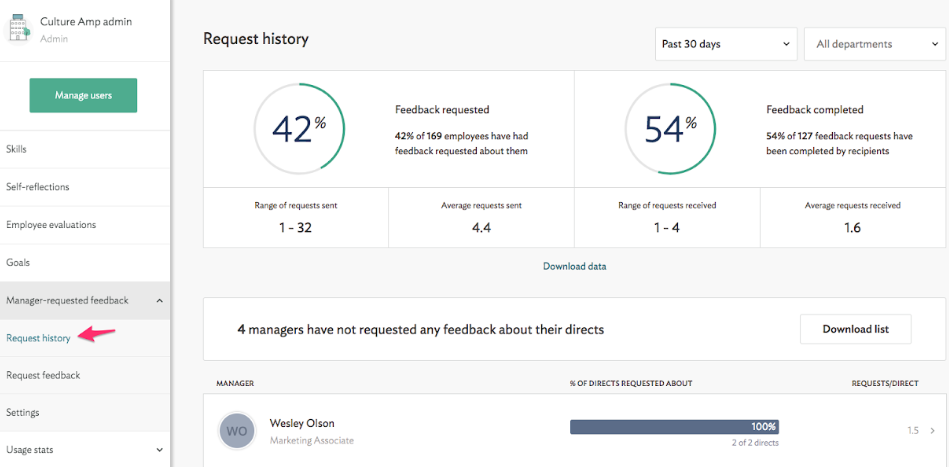
Image source: Culture Amp
I once chatted with an HR professional who shared their experience using Culture Amp. They started with it mainly for engagement surveys and were impressed by how much of the platform was built on solid people science. When Culture Amp introduced performance reviews and goals, they gave the full platform a try. They said the performance module handled their 360 cycles and annual reviews well, even if it wasn’t the most flexible option.
What really stood out to them was the analytics. The heatmaps made it easy to spot trends they might have missed. One engagement survey revealed low recognition scores in a specific department, which pushed them to roll out a targeted recognition effort that actually boosted morale.
They also appreciated Culture Amp’s focus on continuous development. Features like the Skills Coach gave managers simple, practical tips to improve one-on-one conversations and coaching habits.
Pros:
- Culture Amp provides some of the strongest engagement analytics available, with clear visuals and robust benchmark data.
- The focus on continuous development helps managers build better feedback habits through prompts and coaching tips.
- It integrates performance and engagement data so you can understand how both areas influence each other.
- The survey and review templates are backed by organizational psychology, which adds credibility and depth.
How Culture Amp Compares to Clear Review
Clear Review focuses on simple, structured performance conversations, while Culture Amp excels at engagement insights and people analytics. Culture Amp gives you deeper survey data, science-backed templates, and strong connections between engagement and performance results. If you want clarity on what drives morale, retention, and performance trends across your company, Culture Amp offers far more analytics. Clear Review is easier to use for pure performance reviews, but Culture Amp is the stronger choice when engagement is a top priority.
User Rating: 4.5/5
Pricing:
Custom pricing.
7. Betterworks – Best for Structured Check-Ins
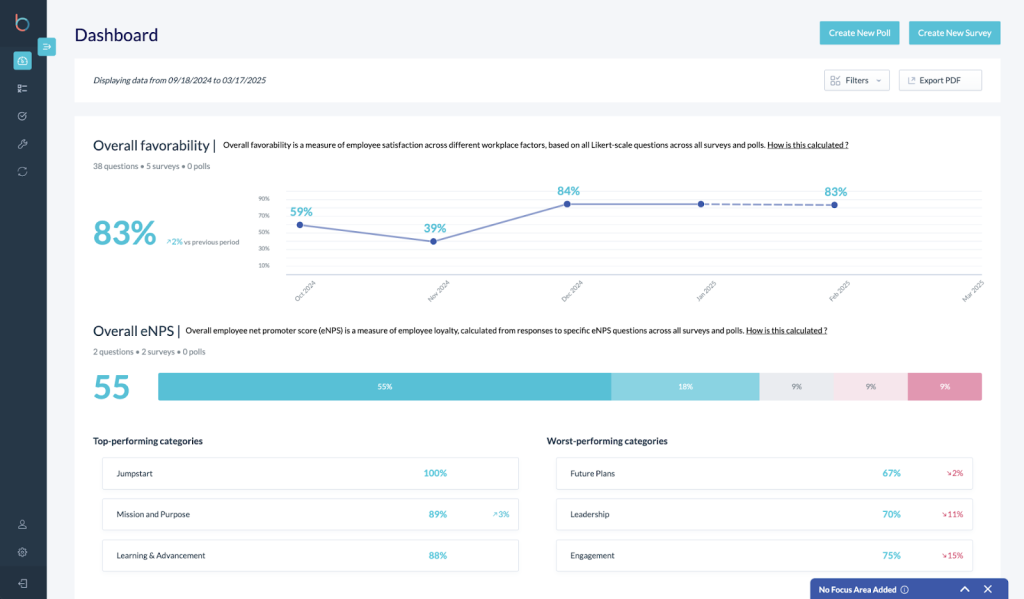
Image source: Betterworks
I used Betterworks in a large organization, and it was clear that the platform was built for scale. Its OKR tools were the first thing we relied on. Setting company, team, and individual goals was quick, and the system encouraged regular progress updates.
Betterworks also helped us move away from annual reviews toward continuous performance. We set up quarterly check-ins with guided templates, and managers could log feedback directly from Slack or Outlook.
One moment that stood out was using the insights dashboard during an executive meeting. We pulled up company-wide goal progress and immediately saw which teams needed support. The interface wasn’t flashy, but it was practical and business-focused. They also introduced AI features for writing better OKRs, which helped streamline goal setting.
Pros:
- Betterworks offers strong OKR management with cascading goals and automated reminders to keep updates consistent.
- It supports continuous performance conversations through structured check-ins and real-time feedback tools.
- The platform integrates well with tools like Slack, Outlook, Teams, and HRIS systems to improve adoption.
- It includes enterprise-ready features such as calibration tools, alignment dashboards, and strong security.
How Betterworks Compares to Clear Review
Clear Review focuses on simple, structured performance conversations, while Betterworks emphasizes deep goal alignment and OKR discipline across the entire company. With Betterworks, I could align goals across levels, track progress visually, and use integrations to capture feedback in real time. Clear Review is easier for straightforward performance needs, but Betterworks is the better match when enterprises want full visibility into goals and continuous performance rhythms at scale.
User Rating: 4.4/5
Pricing:
Starts around $7/user/month.
8. BambooHR – Best for Comprehensive HRIS With Payroll Solutions
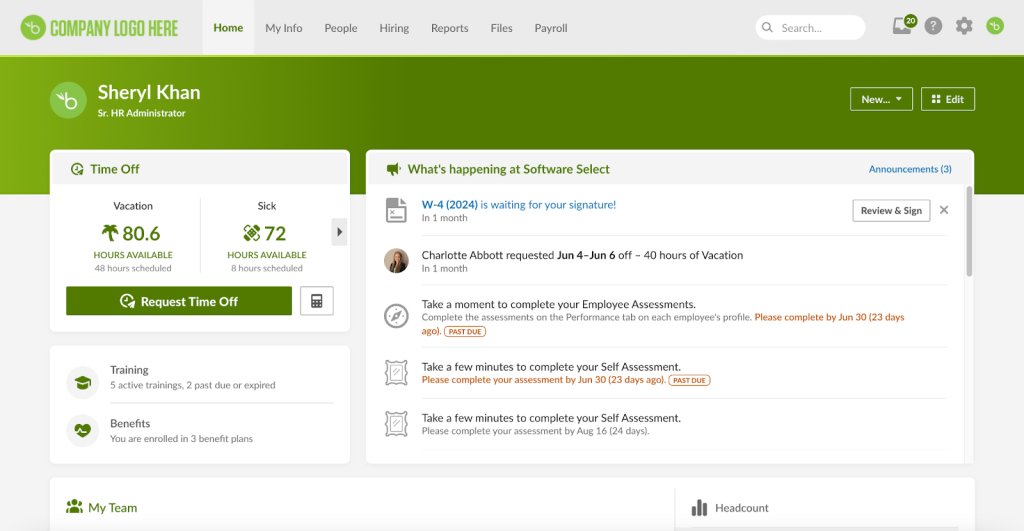
During an HR webinar Q&A, one of the participants shared how their team used BambooHR as their main HR system and added the Performance Management module to keep everything in one place. They said the setup was straightforward. Besides, they ran annual reviews, set a few quarterly goals, and let BambooHR handle reminders and deadlines, which cut down a lot of manual follow-up.
They also turned on basic 360 feedback, and peer reviews flowed through simple email prompts. It wasn’t as flexible as dedicated performance platforms, but it covered what their team needed at the time.
From what they described, the performance analytics were fairly basic but usable. Their team mainly used BambooHR to store reviews, goals, and feedback, then exported the data when they needed deeper analysis. What they seemed to appreciate most was the clean, intuitive interface.
Pros:
- BambooHR brings performance and core HR data together so employees see everything in one place.
- The interface is very easy to use, making adoption smooth for both managers and employees.
- It handles the essentials such as reviews, self-assessments, goal-setting, and basic 360 feedback with automated reminders.
- Existing BambooHR customers benefit from using the same login and environment without adopting new software.
How BambooHR Compares to Clear Review
Clear Review offers more structure and depth for performance management, while BambooHR focuses on keeping things simple and integrated within its HRIS. BambooHR is easier to use and ideal if you want lightweight reviews and basic goal tracking without managing a separate tool. Clear Review is more powerful for teams that need richer feedback workflows and stronger performance-focused features, whereas BambooHR works best when convenience and simplicity are the priority.
User Rating: 4.4/5
Pricing:
Starts at $10/user/month.
9. PerformYard – Best for Flexible Review Cycles
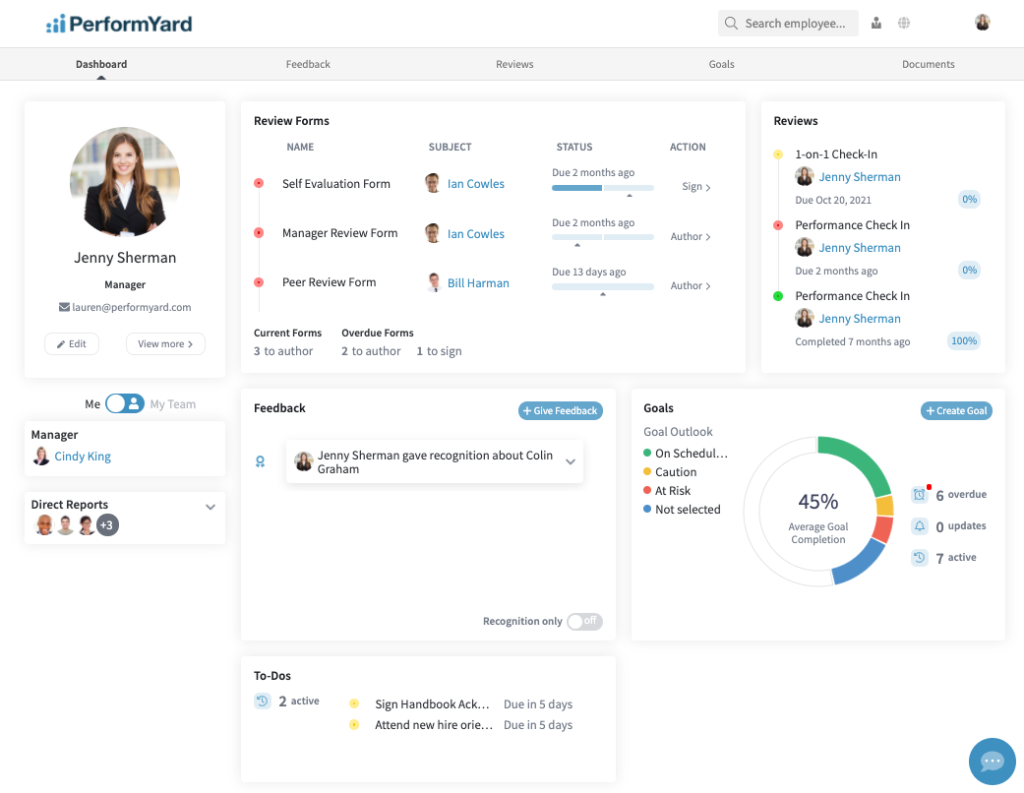
I used PerformYard to run our performance reviews, and I liked that it focused solely on performance management without extra features getting in the way. Setting up review cycles was simple. The platform kept everything organized with clear timelines and status tracking, which saved me from following up manually.
The continuous feedback log was one of the most helpful features. Managers recorded quick notes and wins throughout the year, so by the time reviews came around, we already had a full record of accomplishments and coaching moments.
The goal module was basic but effective for setting individual goals and sending reminders to update progress. PerformYard’s interface was clean and easy to use, even for managers who weren’t very tech-savvy.
Pros:
- PerformYard stays focused on reviews, feedback, and goals, offering a clean and uncluttered experience.
- It supports highly customizable review processes with multiple steps and transparent status tracking.
- Continuous feedback and note-taking make annual reviews easier and more accurate.
- Customer support is responsive and helpful, offering strong onboarding and template assistance.
How PerformYard Compares to Clear Review
Clear Review is built around simple, structured performance conversations, while PerformYard gives you more customization for building detailed review workflows. PerformYard works well if you want precise control over review steps, feedback logs, and documentation throughout the year. Clear Review is easier if you want something lightweight, but PerformYard is the better option for teams that want a fully managed and structured performance review process without extra HR features.
User Rating: 4.8/5
Pricing:
Starts at $5/user/month.
10. Trakstar Perform – Best for Traditional Performance Reviews
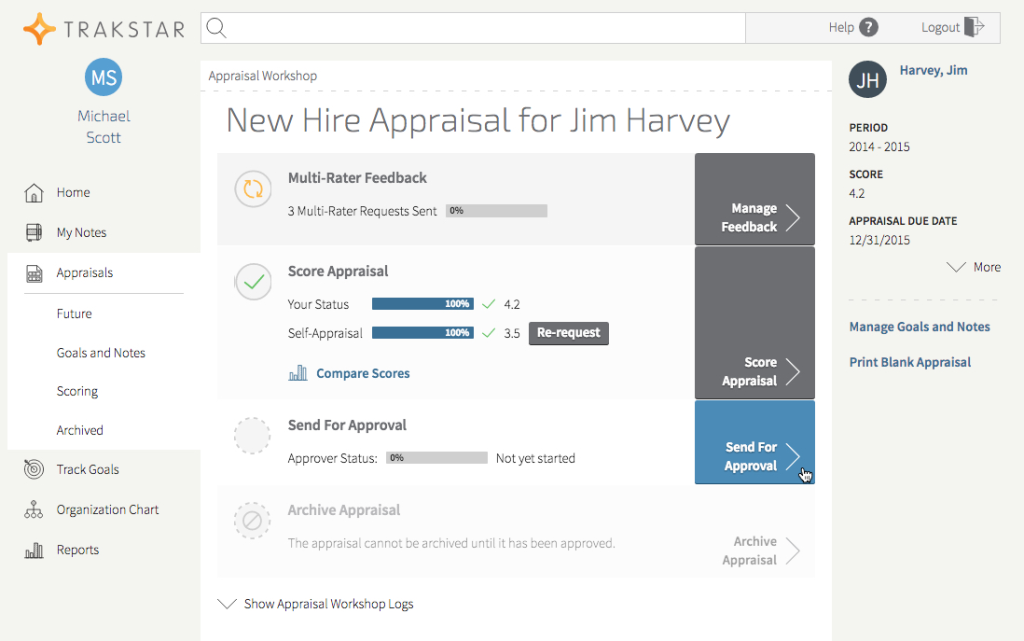
Image source: Trakstar
At an HR meet-up, I heard someone share how their company used Trakstar Perform when they moved from paper reviews to a digital system. They ran annual reviews for about 300 employees, and Trakstar handled form distribution, reminders, and collection reliably.
Besides, they mentioned that the review forms were customizable, with competency ratings, development plans, and weighted scoring. They also rolled out 360 reviews for leaders with selected raters and anonymous peer feedback to keep responses honest.
Reporting was fairly simple, mostly tables and basic charts, but it was still useful. They mainly used it to spot top performers and support talent review conversations.
Pros:
- Trakstar Perform is a mature and reliable system that handles structured performance reviews consistently well.
- Its 360-degree feedback tools are strong, with anonymity and consolidated reporting for clear insights.
- It supports competency libraries and weighted scoring, which is useful for organizations using detailed scoring models.
- The goal-tracking features are simple but effective for linking goals to review conversations.
How Trakstar Perform Compares to Clear Review
Clear Review focuses on simple, conversation-driven performance processes, while Trakstar Perform offers a more traditional, structured appraisal system. Trakstar is ideal if your organization relies on formal reviews, competency ratings, or weighted scoring. Clear Review is better for teams seeking modern continuous feedback, whereas Trakstar works well for companies that want a dependable, step-by-step review process without extra complexity.
User Rating: 4.2/5
Pricing:
Custom pricing.
My Top 3 Picks for Clear Review Alternatives
If you’re short on time and want to zero in on the best of the best, here are my top 3 picks from the list above:
1. PeopleGoal
The most flexible and customizable platform I’ve used. It brings goals, feedback, 360 reviews, and engagement into one system you can shape to fit your culture. Now part of ProProfs, it offers strong support and an all-in-one experience.
2. Lattice
A polished, all-around people success platform with performance reviews, OKRs, surveys, and even compensation tools. Great for growing teams that want modern UI, powerful analytics, and a system that scales.
3. 15Five
Best for continuous feedback and culture-building. Weekly check-ins, recognition, and coaching tools helped our team stay aligned and communicate more openly, with solid review and goal features built in.
How I Evaluated the Best Clear Review Alternatives
To shortlist the best Clear Review alternatives and competitors, I focused on the factors that matter most to HR teams. Here’s the simple framework I used to compare each tool fairly and effectively.
- Performance Review Flexibility
I checked the third-party reviews on platforms like G2 to know whether each tool supports different review styles like annual reviews, quarterly cycles, 360 feedback, and quick check-ins. Tools that let me customize workflows easily — without forcing a rigid structure — scored higher. - Goal-Setting & Alignment
Since goal alignment is a big reason teams explore Clear Review alternatives, I looked for tools with clear OKR tracking, progress updates, and cascading goals. The best platforms made goal-setting feel effortless and transparent for everyone. - Continuous Feedback & Conversations
I prioritized tools that encouraged ongoing feedback. This includes real-time comments, peer feedback, private notes, and structured one-on-one conversations. Platforms that made feedback part of the daily workflow ranked higher. - Ease of Use & Adoption
Adoption makes or breaks a performance tool. I focused on clean interfaces, simple navigation, and short learning curves. If managers and employees could use it without training, it instantly scored better. - Analytics & Reporting
Insightful analytics help teams make smarter decisions. I evaluated how well each tool surfaces trends, highlights top performers, and tracks goals. Tools with clear, visual dashboards and actionable insights performed better. - Integration Options
Most teams already use tools like Workday, BambooHR, Slack, or Teams. I checked how easily each platform connects to popular HRIS and communication tools. Smooth integrations reduce admin work and keep everything in sync. - Customization & Scalability
Every company has its own process, so flexibility was key. I reviewed whether each tool allows custom review forms, rating scales, competencies, and workflows — and whether it can scale with growing teams. - Pricing & Value
I compared starting prices, feature availability, and overall value. Some tools charge per module, while others bundle everything together. The goal was to highlight options that offer strong performance features without stretching budgets.
Achieve Better Performance Outcomes With the Right Clear Review Alternative
Choosing the right alternative to Clear Review can completely reshape how your teams set goals, share feedback, and stay aligned. When you pick a tool that fits your culture and workflows, performance conversations become easier, more consistent, and far more meaningful.
Each platform in this list brings its own strengths, so the best choice depends on what your team values most — flexibility, simplicity, or deeper insights. The real win comes from adopting a system that supports continuous growth instead of forcing a rigid process.
If you’re unsure where to start, it helps to explore tools that adapt well to different review styles and team structures. Many teams I’ve worked with naturally gravitate toward options like PeopleGoal for that reason — it blends into existing workflows without adding friction, making performance management feel more intuitive for everyone.
Frequently Asked Questions

Why might a company look for Clear Review alternatives?
Companies consider alternatives when they need features Clear Review lacks, such as advanced analytics, engagement surveys, or deep customization. Some prefer more flexibility, faster innovation, or different pricing. Others feel Clear Review’s process is too prescriptive. Alternatives help teams find a system that fits their culture, tools, and performance approach better.
What key features should I consider in a performance management tool?
Look for continuous feedback, easy goal tracking or OKRs, and solid 360-feedback options. A user-friendly interface, helpful analytics, and strong integrations also matter. Customizable forms and competencies allow you to tailor the process. Finally, good support and onboarding make adoption smoother for managers and employees.
Can performance management software improve employee engagement?
Yes. Performance tools encourage regular feedback, recognition, and meaningful conversations, which boost engagement. Many platforms include pulse surveys, analytics, and goal alignment that help employees feel supported and connected to company priorities. While the software assists the process, engagement improves most when managers consistently use it to guide growth-focused discussions.
Ready to 3x Your Teams' Performance?
Use the best performance management software to align goals, track progress, and boost employee engagement.